The Morocco airport fast track answers one very specific problem, and only one: the tens of minutes spent standing between the aircraft door and the stamp in your passport, in a corridor where nobody tells you how much longer you have to wait. Fast track is the term people type into search engines, but the plainer phrase, skipping the line, describes better what is actually being sold: not going faster, but not waiting behind the other passengers on your own flight.
This article describes the mechanism, step by step: what each formality really takes, what slows it down, what an escort changes and what it does not. Every figure quoted carries its source in the sentence, and when sources contradict each other, that is written down. The full picture of premium services in the country is covered separately, in our guide to fast-track and VIP welcome at Morocco’s airports; here, the subject is the wait itself.
In brief
- Morocco’s airports handled 36.3 million passengers in 2025 against 32.7 million in 2024, an increase of roughly 11%, according to the traffic report from the Office National des Aéroports picked up by Médias24 and Air-Journal.
- Marrakech-Menara passed 10 million passengers for the first time in 2025, with 10,197,736 travellers against 9,263,261 in 2024, for a terminal capacity officially put at 7.4 million by ONDA: the queue is first of all a sizing problem.
- The average waiting time on arrival in Marrakech has been brought down to “less than an hour on average”, with a stated target of half an hour, according to an ONDA progress update reported by Finances News Hebdo in March 2025.
- Fast track, skipping the line, meet and greet, VIP welcome and lounge do not mean the same thing: three of those five services save you nothing at passport control.
- There is no longer a landing card to fill in: the Direction Générale de la Sûreté Nationale abolished it on 16 September 2019, after bringing its computerised border-post management system into service.
- The entry stamp in your passport, on the other hand, remains compulsory: no service, official or private, lets you skip that step.
- On departure, the bottleneck is not the police but bag drop: easyJet closes its bag drop 60 minutes before departure in Morocco, against 40 minutes at most of its other airports.
- Fast track is useful on a night arrival, with young children, with reduced mobility or on a short connection. On a domestic flight with hand luggage only, it is pointless.
Fast track, skipping the line, meet and greet, VIP welcome, lounge: what exactly is on sale
These five expressions are used as synonyms by almost every commercial page, and they do not cover the same service. The confusion is expensive: a lounge booked in order to “avoid the queue” saves nothing at passport control, and a meet and greet without access to a dedicated lane simply walks you through the same line as everyone else. The table below settles the matter, separating what touches a regulated queue from what is a matter of comfort.
| Term | What it actually is | Does it save time at passport control? | When it makes sense |
|---|---|---|---|
| Fast track | Access to a dedicated or priority lane at passport control, or an escorted walk-through by an agent authorised to use that lane | Yes, that is precisely its purpose | Arrival in the middle of a wave, short connection |
| Skip the line (coupe-file) | The French wording for the above, used as such by ONDA in its Convive de Marque documentation | Yes | Same use |
| Meet and greet | An agent waits for you, holds a name board, guides you, speaks the language, handles the trolley and the handover to the driver | Not in itself: only if the service also includes the dedicated lane | First arrival, children, lots of luggage, language barrier |
| VIP welcome | Full handling, often through an official lounge, sometimes with a vehicle on the apron | Yes in its official version, which includes the fast lane at passport control | Business travel, protocol |
| Lounge | A seated space with food and drink, in the restricted area, before boarding | No, never | A long wait after the checks, on departure |
Remember the dividing line: the lounge sits after the checks, the fast track sits during them. Buying one while hoping for the effect of the other is the most common mistake, and it cannot be undone once you are there.
What actually happens between the aircraft door and the kerb
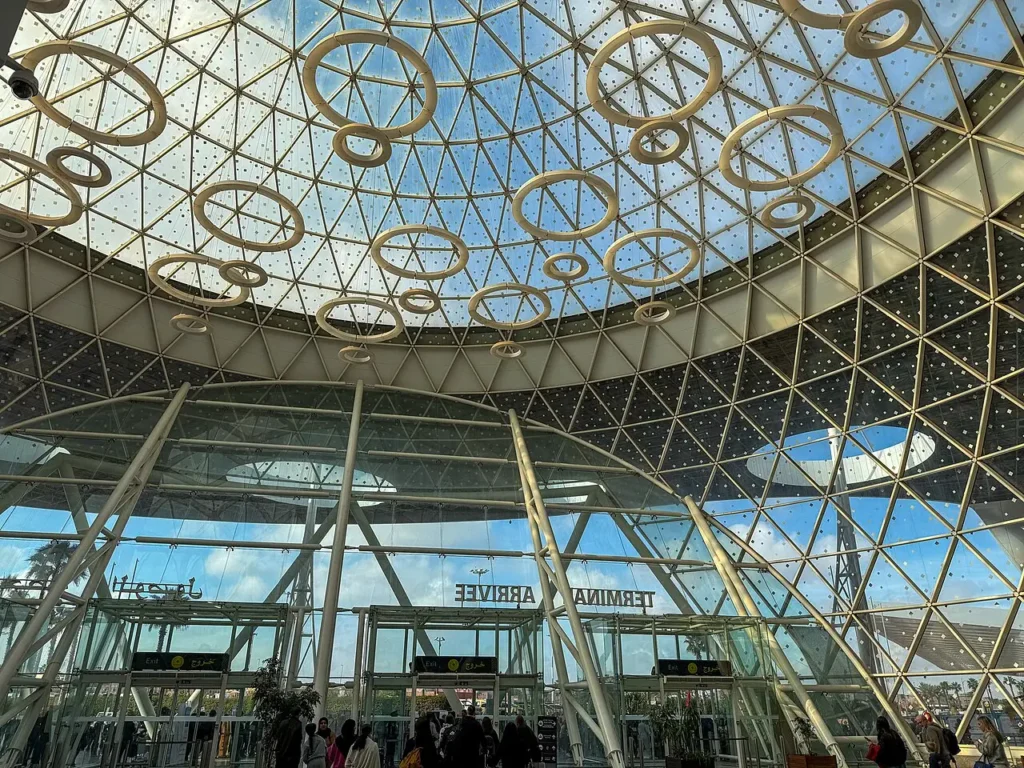
On arrival at a Moroccan airport, six steps separate the aircraft door from the pavement, and one of them concentrates almost all of the waiting. The other five are quick, but each can seize up for an identifiable reason. Here is the sequence in order, with what is at stake at each point.
1. Leaving the aircraft and the corridor. On low-cost flights, which dominate at Marrakech and Agadir, the aircraft is often parked on a remote stand and you disembark by stairs and bus. Two concrete consequences: passengers reach the police in batches of fifty rather than in a steady flow, and the order inside the aircraft does not determine the order in the queue, because the bus reshuffles it. Being first off an Airbus A320 therefore guarantees nothing; getting on the first bus does.
2. Border police control. This is the step that creates the queue, and the only one that is a genuine obligation. There is no longer a form to fill in: the embarkation and landing card was abolished on 16 September 2019 by the Direction Générale de la Sûreté Nationale, after the upgrade of its computerised border-post management system, as Aujourd’hui le Maroc and LesEco reported at the time. The check now rests on reading the biometric passport. The entry stamp, however, remains essential: the travel advice from the British Foreign Office states that officers must stamp the passport on entry and notes that travellers have had difficulty leaving the country without it. No fast track removes this step; it only changes the queue you wait in for it.
3. The wait itself. Its length barely depends on you: it depends on how many international flights land within the same half hour and how many desks are open. ONDA reorganised the route through Marrakech-Menara by moving the screening equipment towards the terminal entrances and increasing the waiting capacity on arrival; Finances News Hebdo reported in March 2025 that the average waiting time had been brought below one hour, with the aim of getting down to half an hour. Those are averages: they say nothing about your 11.40 pm flight on a Saturday in February.
4. Baggage delivery. It runs in parallel with the police, not afterwards. This is the point commercial pages forget: if you have a checked bag, the time saved at the control is capped by the belt. Clearing the police twenty minutes earlier only to wait twenty minutes longer at a carousel produces no net gain. Fast track has its full mechanical effect only for a traveller with no checked bag, or when the provider collects the suitcase for you while you go through.
5. Customs. This is usually smooth, with spot checks and a baggage scanner on the way out. Two concrete declaration duties do exist, though: the Foreign Office points out that you must declare currency from the equivalent of 100,000 dirhams upwards, as well as any taxable or prohibited goods. The detail of the allowances is covered in our guide to Morocco customs and what you can bring back.
6. The exit and the handover. This is the second genuine friction point, and it is human rather than administrative: a crowded arrivals hall, people approaching you, and the need to find one driver among dozens of name boards. An escort has an immediate effect here, because it replaces a search with a hand-to-hand handover. The options for getting into town are compared in our comparison of airport transfers in Morocco.
| Step | What slows it down | What an escort changes | What it does not change |
|---|---|---|---|
| Leaving the aircraft, bus | Remote stand, a single bus | Nothing, except pick-up at the aircraft door when that is included | The number of buses available |
| Passport control | Several flights at once, limited number of desks open | The lane you use | The obligation to be checked and stamped on entry |
| Baggage delivery | Number of carousels, number of flights unloaded at the same time | Someone waits for the suitcase in your place | The time the belt starts |
| Customs | Spot checks, exit scanner | The agent explains and directs you | The declaration duties |
| Arrivals hall | Crowds, people approaching you, finding the driver | Direct handover to the driver | The traffic on the way out of the airport |
When the queue is long at Moroccan airports
The queue is long when several international flights land within the same half hour, and that happens at predictable moments. Moroccan traffic reached 36.3 million passengers in 2025 against 32.7 million in 2024, an increase of roughly 11%, according to the ONDA report relayed by Médias24, Air-Journal and Le360. Marrakech-Menara absorbed 10,197,736 of them against 9,263,261 the previous year, 10.09% more and 28% of national traffic, with Casablanca Mohammed V accounting for 32% and more than 11 million passengers. One divergence is worth flagging: the English Wikipedia page on Mohammed V gives 15 million passengers for 2025, a figure that does not match the statements picked up by the Moroccan business press and that is closer to the terminal’s capacity; the report published by Airports of Morocco is the one to go by.
The structural fact lies elsewhere. ONDA puts the current capacity of the Marrakech-Menara terminals at 7.4 million passengers a year, which building works are meant to raise to 16 million over a floor area of around 142,000 square metres: the 2026-2028 plan approved by the authority’s board on 25 May was awarded to Jet Contractors for nearly 1.8 billion dirhams before tax, according to La Tribune de Marrakech in June 2026. In other words, the airport handled around 38% more passengers in 2025 than its declared capacity. Until the works are delivered, the peak-hour queue is not an occasional malfunction: it is an arithmetical consequence.
The airline season matters too. The IATA winter season runs from 25 October 2026 to 28 March 2027, and it is at that switchover that European schedules to Marrakech, Agadir and Fes are redrawn, with rotations concentrated at weekends. French school holidays add a step effect: Christmas from 19 December 2026 to 4 January 2027 for all three zones, then staggered winter breaks, zone C from 6 to 22 February, zone A from 13 February to 1 March and zone B from 20 February to 8 March 2027. Four consecutive weekends therefore concentrate departures, which explains why a Saturday in mid-February feels like a Saturday in August.
One timekeeping marker, finally, useful and rarely written down: since 20 September 2026 Morocco has been on GMT, that is UTC+0, permanently, under decree no. 2.26.530 published in the Bulletin Officiel no. 7521 of 29 June 2026. In winter, a flight leaving Paris at 7 am therefore lands at 8.40 am local time and not at 9.40 am: travellers who plan their day around a one-hour time difference turn up early, and the first morning waves are denser than they expect.
| Moment | What happens | Expected level of waiting | What to do |
|---|---|---|---|
| Late afternoon and evening, all year round | The day’s European rotations come back, several flights close together | High | Plan the transfer without a tight schedule |
| Friday evening, Saturday, Sunday | Weekly peak of leisure low-cost traffic | High | Fast track worth it with a connection or children |
| Christmas holidays, 19 December 2026 to 4 January 2027 | All three French zones on holiday at once | Very high | Book the escort well in advance |
| Winter breaks, 6 February to 8 March 2027 | Zones C, A then B staggered over four weekends | Very high | Avoid late-afternoon Saturday arrivals |
| Night arrivals, after 10 pm | Fewer desks, fewer taxis, fewer staff | Variable but unpleasant | Pre-booked transfer, escort on a first visit |
| Mid-morning on a weekday, outside the holidays | Lull between two waves | Low | Fast track is superfluous |
The official ONDA service, now Airports of Morocco
There is indeed an official fast lane, run by the airport operator itself, and it is called Convive de Marque. The Office National des Aéroports unveiled a new identity on 28 July 2025 under the name Airports of Morocco, rolled out from August 2025 as part of the Aéroports 2030 strategy; the old ONDA acronym remains in common use, including in press releases. Its Convive de Marque documentation describes a personalised welcome, assistance during the formalities, fast-lane access at passport control and access to its lounges. It is the only offer backed by the terminal operator, and that is what structurally sets it apart from private providers.
Let us be honest about what is not published. The number of airports covered differs from one source to another: six according to the Wikipedia pages on Marrakech-Menara and Agadir-Al Massira, nine according to the VIP lounges page on the Casablanca airport website, which lists Casablanca Mohammed V, Marrakech-Menara, Rabat-Salé, Tangier Ibn Battouta, Agadir-Al Massira, Fes-Saïss, Oujda-Angads, Laayoune and Dakhla. No price list and no online booking procedure is publicly accessible, and the onda.ma site remains the reference to ask directly. On top of that, something is moving on the lounge side: La Vie éco reported in November 2024 that Aspire Executive Lounges, a Swissport brand, had been awarded a ten-year licence covering eleven lounges in nine airports, with openings announced from April 2025. Lounge directories were until recently still listing the Convive de Marque facilities in Marrakech and Casablanca as closed, which probably reflects the works period rather than the current state: check case by case, for your flight date.
One development deserves following, because it affects the queues directly. Airports of Morocco launched Pax Check in July 2026, a fully digital boarding pass in the form of a QR code shown at the security check, at the police post and at the boarding gate, with a gradual rollout airline by airline; Médias24, TelQuel and Air-Journal report that Ryanair passengers departing from several cities including Marrakech were already using it before the national announcement. Along the same lines, the Marrakech-Menara projects mention the installation of automated gates. The state of the equipment is covered in our tracking of biometric e-gates at Morocco’s airports.
Private Morocco airport fast track providers: what they do and what they cannot do
A private provider holds no power over passport control: it cannot open a desk, waive the entry stamp or speed up the reading of a passport. What it sells is something else, and that is perfectly legitimate as long as it is named correctly: the presence of an agent authorised to move around the restricted area, who waits for the traveller at the aircraft door, takes them by the shortest route, points them to the right lane, handles the trolley and the suitcase, and then hands them over to their driver. On a night arrival or with two tired children, that is not luxury, it is logistics.
The models differ on one decisive point, geographical coverage. Some operators cover a single airport, others several. TMC Conciergerie, for example, offers an escort from the aircraft door to the vehicle at six airports, Marrakech-Menara, Casablanca Mohammed V, Rabat-Salé, Tangier Ibn Battouta, Fes-Saïss and Agadir-Al Massira, on arrival as well as on departure, with a dedicated page for each airport. The practical value of multi-site coverage is simple: an itinerary that comes in through Casablanca and leaves through Marrakech is handled with one point of contact and one procedure.
Three limits need to be stated plainly, because sales pages pass over them in silence. First, no provider can guarantee a duration: it can guarantee a presence. Second, an escort is no substitute for travelling with hand luggage only when the goal is pure speed: nothing will ever beat a traveller with no checked bag on a domestic flight. Third, most of the gain disappears if the provider does not collect the luggage, since the belt becomes the limiting factor again. A supplier who explains that unprompted is a good sign; a supplier who promises “twenty minutes guaranteed” is a bad one.
Morocco airport fast track airport by airport, from Marrakech to Tangier
The need is not the same from one airport to the next, because traffic pressure and the mix of flights differ sharply. The top five hubs concentrate close to 90% of national traffic according to ONDA’s 2025 report relayed by Air-Journal, which is enough to rank how useful the service is.
Marrakech-Menara (RAK). This is the airport where skipping the line makes the most sense, for a measurable reason: 10,197,736 passengers in 2025 for a terminal capacity put at 7.4 million by ONDA, and growth that is not easing, with 6,407,303 passengers from January to July 2026 against 5,811,270 over the same period in 2025, including 770,339 in July alone, according to figures from the Maghreb Arabe Presse agency picked up by Barlaman Today. The layout adds a difficulty: two terminals in a single complex, with low-cost flights often parked on remote stands. Sources even diverge on the distance to the city centre, 5 to 6 kilometres depending on the guide, for a journey usually given as 15 to 20 minutes to the Medina, Gueliz or Hivernage. If you are specifically after fast track at Marrakech-Menara airport, check that the service really covers pick-up at the aircraft door and not just the wait in the hall. The terminal is described in detail in our guide to Marrakech Menara airport.
Casablanca Mohammed V (CMN). The country’s leading airport with 32% of traffic and more than 11 million passengers in 2025, it is also the only connecting hub: fast track changes purpose here, since it serves to hold a connection time rather than to get out faster. The terminal is caught up in a major extension project, an H-shaped terminal put out to international tender in May 2025 for around 1.6 billion dollars, intended to raise capacity from around 15 to 35 million passengers, with a 3,700-metre parallel runway, a 42-metre control tower and a high-speed rail station, with a target opening in 2029. In the meantime, the existing rail link remains an underrated asset: the Al Bidaoui train run by ONCF connects the airport to Casa-Port and Casa-Voyageurs every hour from 4 am to 11 pm, bearing in mind that a new transport plan has applied since 14 September 2026 in connection with the Kenitra-Marrakech high-speed line works and that some journey times have been lengthened. Connections are covered on our page about Casablanca Mohammed V airport.
Agadir-Al Massira (AGA), Fes-Saïss (FEZ), Rabat-Salé (RBA), Tangier Ibn Battouta (TNG). Agadir accounts for around 10% of national traffic, Rabat-Salé grew by 26% in 2025 as it passed 2 million passengers and Tangier by 17%, still according to the same report. The profile is different: smaller terminals, where the wait is short during the day but can build up abruptly when two charters land one after the other. In Rabat and Fes, an escort is justified more by language, protocol or reduced mobility than by the length of the queue.
| Airport | Weight and trend in 2025 | Why the queue builds up | How useful fast track is |
|---|---|---|---|
| Marrakech-Menara (RAK) | 10,197,736 passengers, 28% of national traffic | Traffic far above the declared capacity of 7.4 million, low-cost flights in waves | High, especially in the evening and during the school holidays |
| Casablanca Mohammed V (CMN) | More than 11 million passengers, 32% of traffic | Connecting hub, long-haul and domestic flows mixed together | High on a short connection, moderate otherwise |
| Agadir-Al Massira (AGA) | Around 10% of national traffic | Seasonal charters arriving in groups | Moderate, depending on the arrival time |
| Fes-Saïss (FEZ) | Not published in the report relayed by the press | Compact terminal, European flights bunched together | Moderate to low |
| Rabat-Salé (RBA) | More than 2 million passengers, up 26% | Rapid growth at a small terminal | Low, unless assistance is needed |
| Tangier Ibn Battouta (TNG) | Up 17% | Weekend peaks | Low to moderate |
On departure, the problem is not the same as on arrival
On departure, the sticking point is almost never the police: it is bag drop, then the security check. The order of operations matters, because only one of those four steps has a hard cut-off time. Check-in and bag drop first, with a firm closing time; then the security check, which depends on how many lanes are open; then border police, generally quicker than on arrival because departure schedules spread the flow out; and finally boarding, with its own closing time.
Royal Air Maroc publishes explicit deadlines that are useful as a benchmark: the airline recommends turning up 3 hours before a short- or medium-haul international flight, 4 hours for a long-haul flight, and 4 and 5 hours respectively during busy periods, against 2 hours for a domestic flight; its desks close 60 minutes before departure, online check-in 2 hours before, and the boarding gates 15 minutes before, as set out in its check-in conditions. A fast track on departure is therefore bought for one specific reason: to get through check-in and security within the time available, when you arrive late or with a group. It will not rescue a desk that has already closed.
What changes depending on the airline: easyJet, Ryanair, Transavia
The airline changes the calculation, and not marginally. Low-cost carriers arrive in waves on very full aircraft, which packs out the police queue: a single full Boeing 737 or Airbus A320 pours close to 190 passengers towards the same desks. Marrakech-Menara is an operating base for easyJet as well as Ryanair and a support city for Transavia France, according to the Wikipedia pages on the airport, which explains why European rotations bunch into the same slots.
Leaving Morocco, one detail changes everything and is very little known: easyJet applies a specific regime. Its help page states that for flights departing from Egypt, Israel, Jordan, Morocco and Serbia, bag drop opens 3 hours before departure and closes 60 minutes before, against 40 minutes at most of its airports, with the boarding gate closing 30 minutes before. At Ryanair, the official help page gives a bag drop closing 40 minutes before departure and gates 30 minutes before; be careful, though, sources diverge, with a specialist site announcing a move to 60 minutes from 10 November 2026 that we were unable to confirm on the airline’s own site. At Transavia, the help centre gives desks opening 2 hours before departure and closing 40 minutes before, with exceptions by airport, Amsterdam Schiphol moving to 3 hours and 50 minutes and Eindhoven to 2 hours 30 minutes, while Eindhoven airport itself states 45 minutes. In every case, the time shown on your booking takes precedence.
| Airline | Bag drop closing time | Gate closing time | Practical consequence in Morocco |
|---|---|---|---|
| easyJet, departing from Morocco | 60 minutes before departure, opening 3 hours before | 30 minutes before | The regime is stricter than elsewhere on the network: arrive early |
| Ryanair | 40 minutes before, according to its official help page | 30 minutes before | Sources diverge on a possible move to 60 minutes in late 2026 |
| Transavia | 40 minutes before as a general rule, exceptions by airport | Not published in the help centre | Check the departure airport, not just the airline |
| Royal Air Maroc | 60 minutes before, online check-in closing 2 hours before | 15 minutes before | Arrival recommended 3 hours before on international flights |
Two consequences follow from this table. First, online check-in and hand luggage remove the first step, and therefore the main cause of a missed departure; that is the real fast track, and it is free. Second, Pax Check reinforces that effect since the QR code replaces paper at the security check, at the police post and at boarding, but the system is being rolled out airline by airline: keep a screenshot and, if in doubt, a printed copy.
Who the Morocco airport fast track really helps, and who it does not
It is useful in four identifiable situations, and pointless in four others, just as identifiable. Saying both is the only honest way to treat the subject, because a service sold to the wrong traveller creates a disappointment that has nothing to do with its quality.
It is useful, first, for a family with young children: what counts is not the time saved but not having to hold a pushchair, two passports and a three-year-old while standing for forty minutes. Second, on a short connection in Casablanca, where the gain is measured in a flight caught or missed. Third, for a traveller with reduced mobility: official assistance has to be requested from the airline, generally at least 48 hours before the flight, and a private escort complements it without replacing it. Fourth, on a night arrival, because everything is slower after 10 pm and walking out into a crowded hall looking for a driver is the moment when travellers give up on negotiating.
It is pointless, on the other hand, on a domestic flight with no checked bag, where the formalities take a few minutes. It is pointless mid-morning on a Tuesday outside the holidays, when there is no queue. It is pointless if you have checked bags and the provider does not deal with them, since the belt cancels out the gain. And it is pointless if your real goal is to sit down quietly before a flight: what you need to buy then is a lounge, not a fast lane.
| Profile | Verdict | Reason |
|---|---|---|
| Family with a young child, evening arrival | Useful | Comfort and being taken care of count more than the minutes |
| Short connection in Casablanca | Useful | The gain is measured in a flight caught |
| Traveller with reduced mobility | Useful, alongside the airline’s own assistance | To be requested from the carrier ahead of the flight |
| Arrival after 10 pm, first visit | Useful | Fewer desks, crowded hall, finding the driver |
| Domestic flight, hand luggage only | Pointless | The formalities are already minimal |
| Weekday arrival outside the holidays, mid-morning | Pointless | Low-traffic slot |
| Checked bags, service without luggage handling | Pointless | The carousel becomes the limiting factor again |
| Goal: to sit and wait before the flight | Pointless | That is a lounge, not a fast lane |
How to book a Morocco airport fast track and what to check before paying
Booking goes either through the airport operator for the official service or through a private provider, and in both cases it calls for the same information: flight number, date, arrival or departure time, number of travellers, number of bags, and the direction of the service, arrival or departure. Allow a few days’ notice in quiet periods, and more during the European school holidays, because the number of agents authorised to move around the restricted area is limited. TMC Conciergerie, for example, advertises the same service at all six of its airports and a price shown before booking, a firm-quote model that avoids extras discovered on the spot.
- Where exactly the service begins: at the aircraft door, at the start of the corridor, or only after the police? This is the most decisive question, and the one most often dodged.
- Are checked bags collected by the agent, or do you have to wait at the belt yourself?
- Does the service really include a dedicated lane at passport control, or only an escort through the common queue?
- What happens if the flight is two hours late, and how long does the agent wait at no extra charge?
- How do you reach the agent on landing: phone, WhatsApp, name board? Make sure you have a connection as soon as you leave the aircraft.
- Is the price per person or per group, and what exactly does it cover in the event of cancellation?
Six mistakes to avoid with a fast track
The following mistakes come up again and again, and none of them has anything to do with the quality of the provider chosen: they all come down to a badly calibrated expectation.
- Buying a lounge in the belief that it avoids the police. The lounge sits after the checks, on departure; it does not touch the passport control queue.
- Paying for a fast lane on arrival while keeping two bags in the hold, with no luggage service: the belt takes back all the time saved.
- Believing that a service waives the entry stamp. The British Foreign Office in fact reports difficulties leaving the country when that stamp is missing.
- Booking a transfer at a fixed time pegged to the landing time, with no margin for the formalities: a thirty-minute delay in the queue is enough to push everything back.
- Forgetting the change of reference time. Morocco has been permanently on GMT since 20 September 2026, which changes the difference with continental Europe in winter and throws off calculations made from memory.
- Counting on last-minute bag drop on departure, particularly with easyJet, whose cut-off is 60 minutes when leaving Morocco and not 40.
FAQ about the Morocco airport fast track
Is the Marrakech fast track official?
There is an official service, run by the airport operator under the name Convive de Marque, whose documentation mentions fast-lane access at passport control. The many commercial offers found online are private assistance services: they can be perfectly serious, but the word “official” used on some of those sites is their own description. For the operator’s service, the reference to ask is onda.ma.
How long does passport control take at Marrakech airport?
No official waiting-time statistics are published on a continuous basis. The only verifiable marker is an ONDA progress update reported by Finances News Hebdo in March 2025, which mentions an average time brought below one hour and a target of half an hour, after the screening equipment was moved towards the terminal entrances and the waiting capacity on arrival increased. The estimates of 30 to 60 minutes you read on commercial sites are not sourced.
Does fast track work on arrival and on departure?
Yes, but not over the same steps. On arrival, the service covers the corridor, the police, the luggage and the exit. On departure, it covers check-in, the security check and the escort to the gate. The two directions are booked separately with most providers, even when the offer carries the same name.
Is there a fast track for easyJet, Ryanair or Transavia flights in Marrakech?
Airport assistance services do not depend on the airline: they are bought separately and work with any carrier. What changes with a low-cost airline is the context: very full aircraft, frequent remote stands with a bus, and schedules concentrated at weekends. On departure, check the bag drop closing time, which is 60 minutes before departure for easyJet leaving Morocco.
Do you still have to fill in a landing card on arrival in Morocco?
No. The embarkation and landing card was abolished on 16 September 2019 by the Direction Générale de la Sûreté Nationale, after the upgrade of its computerised border-post management system, according to the reports published at the time by Aujourd’hui le Maroc and LesEco. The check is carried out by reading the biometric passport, and the entry stamp is applied at that point.
Does fast track let you skip the security check?
No. The security check is a regulatory obligation applied to every departing passenger, and no commercial service cancels it. What can exist, depending on the airport and the service, is access to a dedicated screening lane that is less busy. The difference matters: you change queue, you do not skip the check.
Is skipping the line worth it in low season?
Rarely, if it is bought for the time alone. A night arrival, however, remains unpleasant all year round, and the need for assistance with reduced mobility, a first visit or a group does not depend on the season. The right question is therefore not the period but the time slot and the traveller’s profile.
In summary
The queue at Moroccan airports has a measurable cause: traffic of 36.3 million passengers in 2025, up by around 11%, absorbed by terminals of which some, like Marrakech-Menara with 10.2 million passengers against a declared capacity of 7.4 million, are running beyond their design size while they wait for extension works. Skipping the line does not fix that cause: it changes the queue you wait in, and it replaces the search for a driver with a hand-to-hand handover.
The decision therefore rests on three things, and not on a promise of minutes: your arrival slot, whether or not you have checked bags, and your tolerance for standing in line. A mid-morning weekday flight with hand luggage justifies nothing. A Saturday evening flight in February, with two children and two suitcases, justifies a great deal. And on departure, the most effective measure remains free: online check-in, hand luggage where possible, and the bag drop closing time written down before you leave the hotel.
Sources
- Office National des Aéroports, now Airports of Morocco: 2025 traffic report, Convive de Marque documentation, extension projects and the Pax Check system, on onda.ma.
- Médias24, Air-Journal, Le360 and Finances News Hebdo: coverage of ONDA’s 2025 report, 36.3 million passengers, and of the March 2025 progress update on the queues at Marrakech-Menara.
- Barlaman Today, citing the Maghreb Arabe Presse agency: Marrakech-Menara traffic from January to July 2026.
- La Tribune de Marrakech, June 2026: the 2026-2028 plan, extension of terminals 1 and 2, capacity raised from 7.4 to 16 million passengers.
- Aujourd’hui le Maroc and LesEco, September 2019: abolition of the embarkation and landing card by the Direction Générale de la Sûreté Nationale.
- British Foreign, Commonwealth and Development Office: travel advice for Morocco, entry stamp and customs declarations.
- Royal Air Maroc, check-in conditions; easyJet, Ryanair and Transavia help pages for the closing times.
- IATA for the dates of the 2026-2027 winter season; ONCF for the rail link to Casablanca Mohammed V; La Vie éco, November 2024, for the lounge licence awarded to Aspire Executive Lounges.
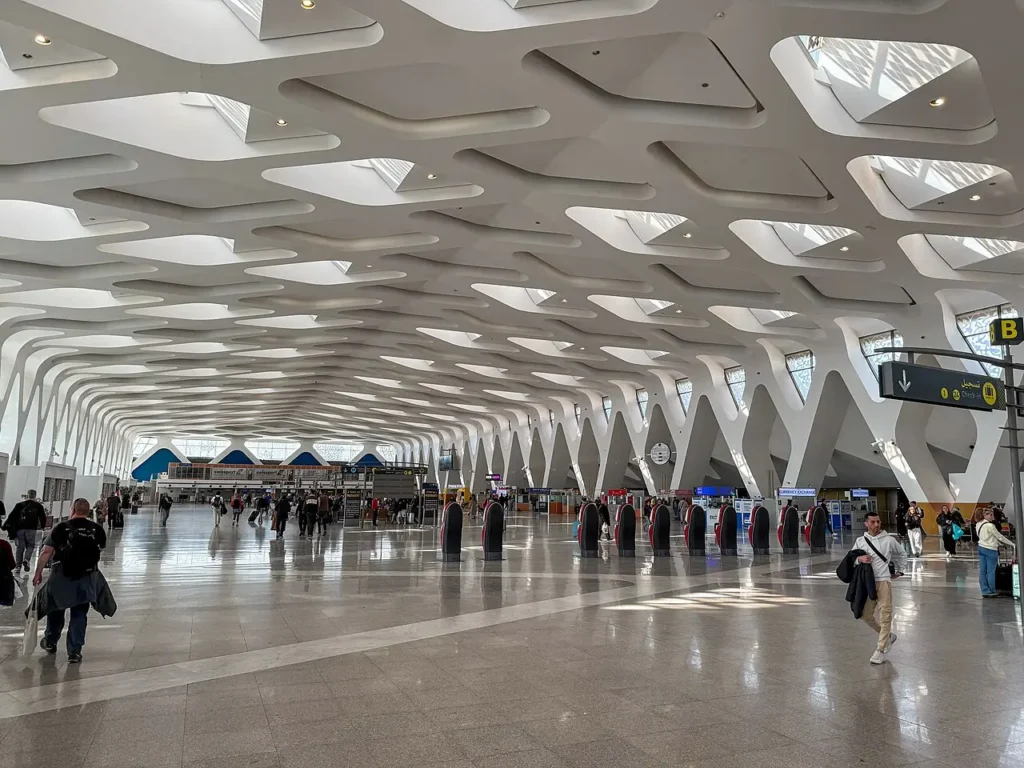
- Photographs: “Marrakech Airport terminal 1 – interior” and “Marrakech Airport terminal 2 – interior” by 瑞丽江的河水 (CC BY-SA 4.0), via Wikimedia Commons.
Information checked in October 2026. Services, times and access conditions change: check with the airport or the provider before you travel.