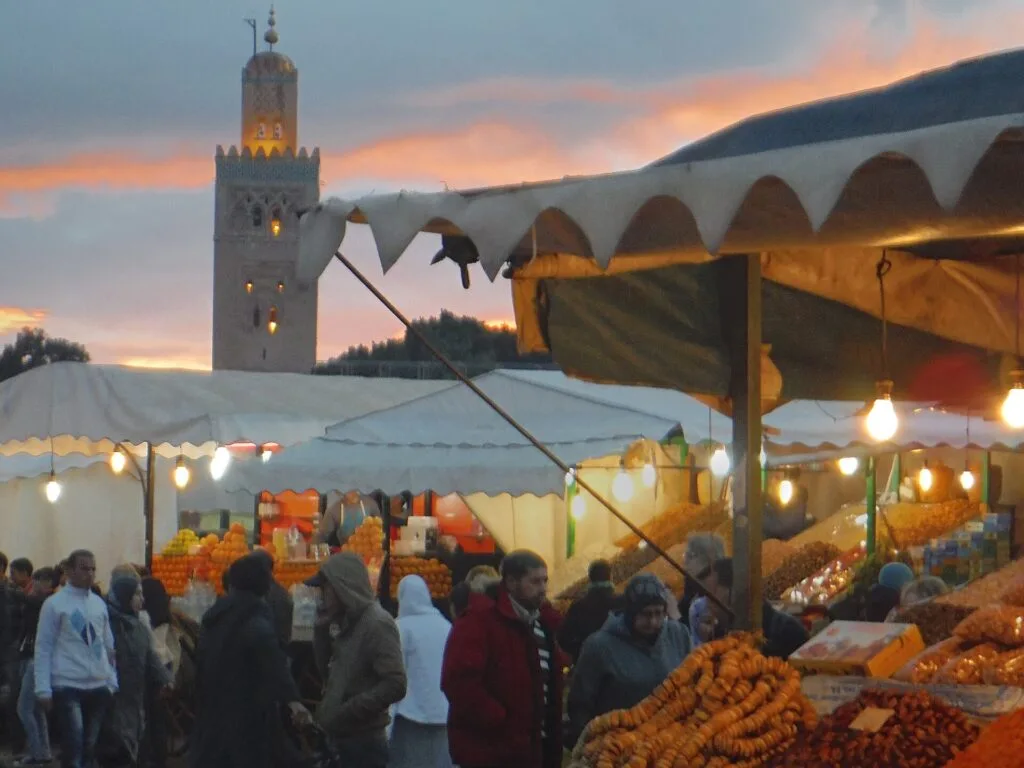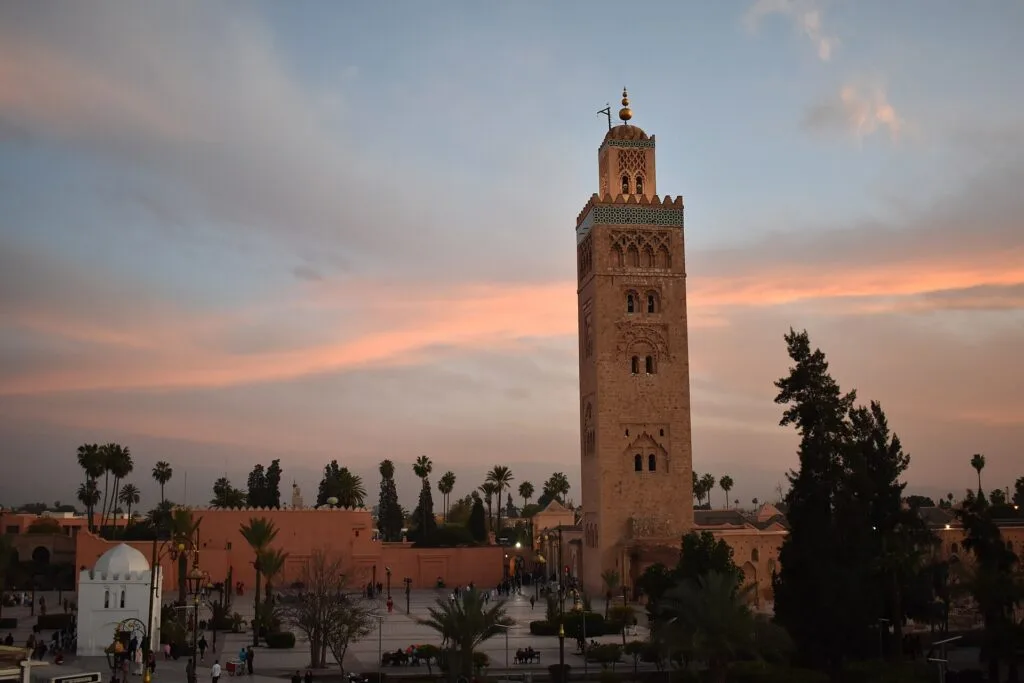
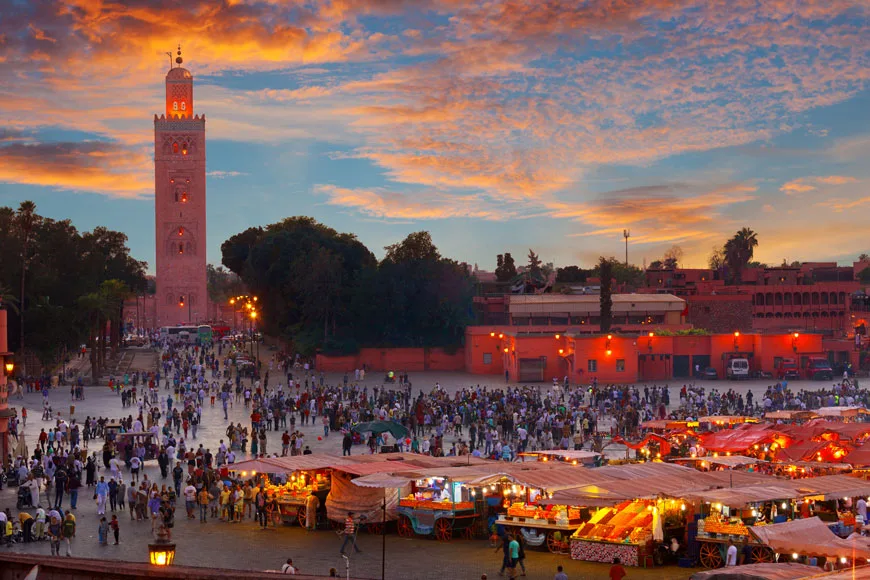
Arrive in Marrakech and your first walk will lead, almost inevitably, to a vast open space at the foot of the Koutoubia minaret. Jemaa el-Fna is not simply a public square: it is the living centre of the medina, a permanent open-air theatre, and a piece of recognised world heritage. This guide covers what actually happens there, by day and by night, what to eat, which approaches to decline, and how to reach it from the airport.
In short: visiting Jemaa el-Fna
- Entry is free and the square is open at all hours. There is no ticket and no gate.
- Go twice. By day it is a market with performers; after sunset it becomes a field of numbered food stalls. They are two different places.
- The best time is from about an hour before sunset, so you see both versions in one visit.
- Carry small notes. Stalls and performers deal in cash, and nobody will have change for a large note.
- Always ask before photographing a performer, and expect to tip a few dirhams. Photographing without asking is the single most common cause of friction.
- Refuse black henna. Natural henna is dark brown and takes hours to develop; the instant black version can contain a dye that causes skin reactions.
- From the airport: about fifteen to twenty minutes by taxi. The square itself is pedestrian, so you are dropped at the edge.
- Spelling: you will also see Jemaa el-Fnaa, Djemaa el-Fna and Jamaa el Fna. They are the same square.
Why this square is protected heritage
Jemaa el-Fna was proclaimed a Masterpiece of the Oral and Intangible Heritage of Humanity by UNESCO in 2001, and inscribed on the Representative List of the Intangible Cultural Heritage of Humanity in 2008. The distinction matters, and it explains what you are looking at.
What is protected is not the ground, the buildings or the view. It is the practices: the storytellers, the musicians, the healers and herbalists, and the way a crowd assembles around a performer. That is why the square can look chaotic and still be a heritage site: the chaos is the heritage. It also explains why the same trades keep reappearing in the same spots, generation after generation, and why there is a museum in Marrakech dedicated to a square rather than to a building.
Where the name comes from
The name puzzles most visitors, and the explanation is genuinely interesting. In Arabic, jamaa can mean either “mosque” or “assembly”, while fna carries the sense of annihilation, ruin, or simply an open space. A literal reading gives something like “the mosque of the ruin”.
The usual historical account points to the Saadian sultan Ahmad al-Mansur, who reigned from 1578 to 1603. He began building a great mosque in the middle of the square, to be called Jamaa al-Hanaa, the Mosque of Serenity. Plague outbreaks and a reversal of fortunes stopped the work, the unfinished site stood visible for years, and the people of Marrakech renamed it with some irony. The name stuck. The Souk Jdid, the “new souk” at the north of the square, is generally held to stand on the site of that abandoned mosque.
The open space is older than the name and older than the Saadians. From the founding of Marrakech by the Almoravids in the eleventh century, there was a great esplanade here facing the fortress and the rulers’ palace, used for military parades, public justice and executions. That function gave it another grim nickname in the seventeenth century. Through every decline and every attempt to build on it, its role as a market and a meeting place kept it open.
Who you will actually meet on the square
The performers are not a show put on for tourists in the usual sense. Most of these trades predate mass tourism by centuries, and several are now down to a handful of practitioners.
The storytellers and the halqa
The halqa is the circle of listeners that forms around a storyteller. These are the keepers of an oral repertoire that includes long epics such as Al Antar and Al Hilaliyya, carried entirely by voice and gesture. In the 1970s there were about twenty of them on the square. Today only a few remain, and they perform in Moroccan Arabic, so you will follow the crowd’s reaction rather than the plot. It is still the single most authentic thing on the square.
Musicians, acrobats and animal handlers
The Gnaoua musicians bring hypnotic rhythms from the spiritual brotherhoods of sub-Saharan origin, playing the guembri lute and the metal qraqeb castanets. The acrobat troupes, many from the Souss plain around Agadir, build human pyramids that are more impressive than they look in photographs.
You will also encounter snake charmers and monkey handlers, and it is worth being clear about them. These species are protected under Moroccan law, and the conditions in which the animals are kept on the square raise genuine welfare questions. Many visitors choose not to engage, and declining is perfectly acceptable. If a handler places an animal on you unasked, that is the start of a payment request, not a gift.
The water sellers and the practitioners
The gherrab, the water sellers in red costume with tasselled hats and bells, once genuinely sold water to passers-by. The trade has disappeared and they now make their living from photographs, which is worth knowing before you point a camera. Around them work herbalists, traditional healers, tooth-pullers and naqachat, the women who read palms and apply henna. These are survivals of a popular knowledge system, and they are part of what UNESCO listed.
Day and night: two different squares
The thing nobody tells you clearly enough is that visiting once means seeing half of it. The transformation at sunset is total: the daytime stalls are dismantled and dozens of numbered food stalls are assembled in their place, in under an hour.
| By day | After sunset | |
|---|---|---|
| What is there | Orange juice carts, performers, herbalists, henna artists | Dozens of numbered food stalls, drummers, dense crowds |
| Atmosphere | Busy but manageable, good light for photographs | Smoke, noise, music, far more intense |
| Best for | A first look, understanding the layout, photographs | Eating, and the experience people come for |
| What to watch | Photo fees, insistent approaches | Your pockets and bag in the crush |
| How long | Thirty to sixty minutes is enough | Two hours, including dinner and a terrace |
What to eat at the night stalls
The food stalls are the core of the evening. Waiters in white coats will pitch at you in several languages to pull you to their tables; that is normal and not aggressive. The useful trick for choosing is simple: look for the stall where Moroccans are eating. Local custom is the best proxy for freshness, fair prices and genuine cooking. Prices are usually displayed, and it is entirely normal to check them before you sit down.
| Dish | What it is | Worth knowing |
|---|---|---|
| Harira | Lentil and tomato soup, the everyday Moroccan soup | The safest first order, and served everywhere |
| Brochettes and merguez | Charcoal-grilled lamb skewers and spiced sausage | Ordered by the skewer, so you can try a little |
| Tagine and couscous | The national dishes, often in large shared platters | Couscous is traditionally a Friday dish |
| Snails | Simmered in a spiced broth, served in small bowls | The surprise of the square, and genuinely good |
| Bissara | Creamy broad bean soup with olive oil and cumin | A working breakfast dish, also sold in the evening |
| Fresh orange juice | Pressed in front of you at the carts | Ask for it without added sugar or syrup if you prefer |
If you prefer to eat sitting above the crowd rather than in it, the café terraces around the square are the answer. The Café de France is the famous one, but the Café Glacier and several others give an equally good panorama with less waiting. A mint tea on a terrace is the moment the square stops looking chaotic and starts looking organised.
The approaches to decline, and how to do it well
Jemaa el-Fna is a commercial space and you will be approached. Almost none of it is hostile, and a firm, friendly refusal ends it. The Moroccan Arabic for “no, thank you” is la, shukran, and it works better than English. Keeping your sense of humour is genuinely the most effective tool you have.
- Photographs without asking. Performers earn from images. Ask first, agree that you will tip, and hand over a few dirhams afterwards. A photo taken from a distance with a zoom is still a photo, and they will notice.
- Black henna. Natural henna is a dark brown paste that develops slowly over hours. Anything applied as instant black can contain a hair dye that causes skin reactions. Decline it, and choose an artist using brown paste.
- An animal placed on your shoulder. This is a payment request, not a gift. Hand it back politely and walk on.
- “The souk is closed today.” It is not. This opener normally precedes an offer to guide you somewhere else entirely.
- Unsolicited guides. You do not need one to cross a square. For the souks behind it, agree a price and a duration beforehand or decline.
- Pickpockets in the evening crush. The square is safe in the ordinary sense, but it is dense. Front pockets, bag in front, phone away while you walk.
None of this is specific to Jemaa el-Fna; it is how a busy market works. Our guide to whether Marrakech is safe and the scams to know covers the city as a whole in more detail.
Getting there from the airport, and finding your way
Marrakech Menara airport sits close to the city, which is why the square is often the first thing visitors see.
| From | How | What to expect |
|---|---|---|
| Marrakech Menara airport | Taxi, fifteen to twenty minutes | Agree the fare or insist on the meter before setting off |
| Marrakech Menara airport | ALSA city bus, the airport line | Cheapest option; stops at the edge of the medina |
| Anywhere in the new town | Petit taxi, ten minutes from Gueliz | Petits taxis are the small beige cars; they stay within the city |
| Your riad in the medina | On foot | Most riads are within fifteen minutes of the square |
That last point is the one worth internalising. Addresses inside the medina are not useful to a taxi driver and phone navigation is unreliable in the alleys. Learn the name of the gate nearest your riad and use that instead; drivers know the gates. Before you fly, our complete guide to Marrakech Menara airport covers arrivals, transport and what is on site, and taxis and ride-hailing in Morocco explains how fares actually work.
Orientation on the square is simple once you have it. The triangle is bordered to the south by the Koutoubia esplanade, where the horse-drawn carriages wait; to the north by the entrances to the souks; and along the sides by hotels, cafés and administrative buildings. If you lose your bearings, find the Koutoubia minaret: it is visible from almost everywhere and it is always south of you.
What is within a ten-minute walk
The square is not an isolated attraction: it is the geographic centre from which most of Marrakech’s monuments radiate. On foot from the square you reach the Koutoubia mosque and its gardens in five minutes, the souks immediately to the north, the Bahia Palace and the Saadian Tombs in about fifteen to twenty minutes southward, and the Ben Youssef Madrasa a similar distance north through the souks.
There is also a museum dedicated to the square itself, housed in the monumental first branch of the State Bank of Morocco, built in 1922. It is the only museum in the world devoted to a public square, and it is the right place to start if you want the history before the noise. It also holds a collection of paintings, including works by Jacques Majorelle.
If you are shopping in the souks behind the square, it is worth knowing what is genuinely made in Morocco before you negotiate: our guide to what to buy in Morocco covers that, including how to tell a hand-knotted rug from a machine-made one.
FAQ about Jemaa el-Fna
Is there an entry fee for Jemaa el-Fna?
No. It is a public square, free to enter, open at all hours. You pay only for what you consume, for photographs of performers, and for anything you buy.
What is the best time to visit?
Arrive about an hour before sunset. You see the daytime square, then the changeover as the food stalls are assembled, then the evening at its peak. If you can only come once, come in the evening; if you can come twice, add a morning visit, which is calmer and better for photographs.
Is Jemaa el-Fna safe at night?
Yes, in the ordinary sense: it is busy, well lit and policed, and families are there late. The real risk is pickpocketing in the crush rather than anything else. Keep your bag in front of you and your phone out of sight while you move.
Can I eat safely at the food stalls?
Generally yes. Choose a stall with a strong local crowd and visible turnover, prefer food cooked in front of you to anything standing warm, and start with harira or grilled skewers. Avoid raw salads if you are cautious, and drink bottled water.
Do I need cash, or can I pay by card?
Cash, in dirhams, in small notes. Stalls, performers and juice carts do not take cards. The dirham is a closed currency, so you obtain it on arrival rather than before you travel.
Can I photograph the performers?
Ask first, and tip a few dirhams afterwards. Photographing without asking is the main source of arguments on the square, and it is also the reason some performers now cover their faces when a camera appears. A short conversation first changes the whole interaction.
How long should I allow?
Two hours in the evening, including dinner at a stall and a mint tea on a terrace. Thirty to sixty minutes is enough for a daytime look. Most visitors end up returning on several evenings, because it is on the way to everything else.
Is it suitable for children?
Yes, with two reservations: the evening crowd is dense, so hold hands and agree a meeting point; and the animal handlers will approach a child faster than an adult. Many families prefer a terrace table overlooking the square, which gives the spectacle without the crush.
Summary
Jemaa el-Fna is free, open at all hours, and genuinely two different places depending on when you arrive. Come about an hour before sunset to see both. Carry dirhams in small notes, ask before you photograph anyone and tip for it, decline black henna and any animal placed on you, and keep your bag in front of you in the evening crowd. Choose a food stall by its local customers, not by its waiter’s patter. And when you want to understand what you have just walked through, go up to a terrace, order a mint tea, and watch it from above for twenty minutes: that is when the square makes sense.