The Jardin Majorelle is the most visited paying attraction in Morocco, drawing in the region of 700,000 people a year to a garden of barely one hectare. That ratio explains almost everything about visiting it, including the single fact most guides bury: there is no ticket office on site. Every ticket is bought online, in advance, for a timed slot. Turn up without one and you will not get in.
In short: what you need to know before you go
- Book online, in advance. No tickets are sold at the gate. Buy at least a day ahead, and several days ahead between March and November.
- Entry is by timed slot, in thirty-minute intervals, with a cap per slot. Your slot is your entry time, not a suggestion.
- Three separate things share the site: the garden, the Pierre Bergé Museum of Berber Arts inside the blue villa, and the Yves Saint Laurent Museum next door. They are ticketed separately or as a combined pass.
- Go at opening or in the last ninety minutes. Between about 10am and 2pm the paths are genuinely crowded and the photographs are worse.
- Allow ninety minutes for the garden and the Berber museum, two and a half hours if you add the YSL museum.
- It is in Gueliz, the new town, not in the medina. About fifteen minutes from the airport, ten from Jemaa el-Fna by taxi.
- Prices change. We give orders of magnitude below and link the official site, which is the only reliable source for the current tariff.
Tickets: the part that catches people out
This is the most useful section on the page, so it comes first. The garden operates on online booking only, with no on-site box office, and admission runs in thirty-minute slots to control the density of visitors on narrow paths. It is a deliberate policy and it is enforced.
| What you are buying | What it covers | Order of magnitude |
|---|---|---|
| Garden only | The botanical garden, the pools, the exterior of the blue villa | Around 150 dirhams for an international adult, roughly 14 euros |
| Garden + Berber Museum | The above, plus the Pierre Bergé collection inside the villa | Around 200 dirhams, roughly 19 euros |
| Yves Saint Laurent Museum | The separate museum building next door; its own ticket | Around 100 dirhams, roughly 9 euros |
| Combined pass | Garden, Berber Museum and YSL Museum together | Around 300 dirhams, roughly 28 euros |
| Reduced rates | Moroccan nationals and residents, students, free under twelve | Bring photo ID; the reduction is checked at the gate |
Two practical consequences follow. First, decide your combination before you book, because the garden and the YSL museum are two visits and two tickets, and people regularly arrive having bought only one of them. Second, pick your slot deliberately: the earliest slot of the day and the last ninety minutes before closing are a different experience from midday, and they cost the same.
Keep your digital ticket accessible offline. Phone signal at the entrance is fine, but a screenshot removes one thing that can go wrong while a queue builds behind you.
When to go: hour, season, and why it matters here
In a garden this small, timing changes the visit more than it would almost anywhere else. The paths are narrow by design, the bamboo corridors are single file in places, and the blue villa is the single most photographed object in Marrakech.
| When | What it is like | Verdict |
|---|---|---|
| First slot of the morning | Cool, low light on the blue, birds active, paths nearly empty | The best slot, without competition |
| 10am to 2pm | Peak coach and group arrivals, queues at the villa, harsh overhead light | Avoid if you have any choice |
| Last ninety minutes | Warm light, thinning crowds, the garden quietens | The second-best slot, and the best for photographs |
| December to February | Low season, mild, shorter days, far fewer visitors | The easiest months to visit comfortably |
| March to May, September to November | High season; slots sell out days ahead | Book early and take an early slot |
| July and August | Very hot by late morning; the garden offers shade but the heat is real | Morning only |
The story: a painter, a colour, and a couturier
The garden is the work of Jacques Majorelle, a French painter who arrived in Marrakech in 1917, bought a plot on the edge of a palm grove, and spent four decades turning it into a botanical collection. He was a painter first, and it shows: the garden is composed like a canvas, in blocks of colour and framed views rather than as a horticultural display.
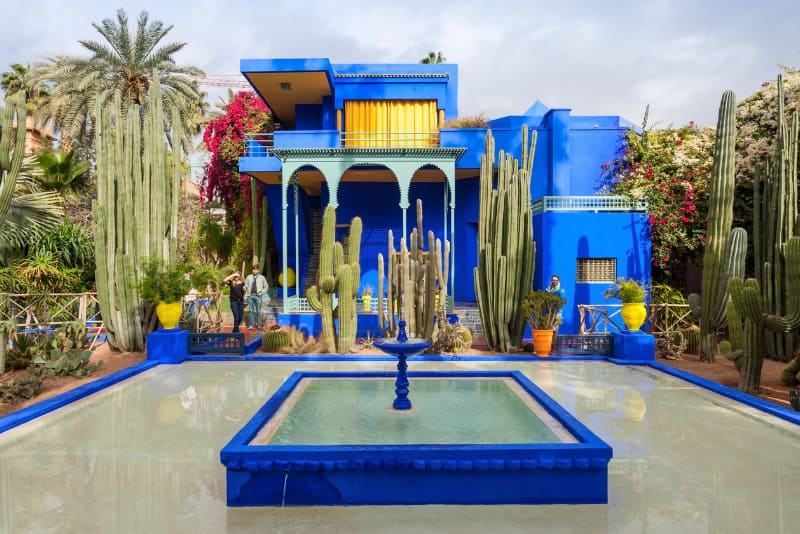
The colour came later and became the thing everyone knows. Majorelle blue is an intense, slightly violet ultramarine that he applied to walls, pots and pergolas, and which he eventually registered under his own name. It works because of what it sits against: the blue reads as it does only next to green foliage and ochre earth, which is why photographs of the villa taken in isolation never quite capture it.
After Majorelle’s death in 1962 the garden declined, and by the 1970s it faced being built on. It was bought in 1980 by Yves Saint Laurent and Pierre Bergé, who restored it, kept it open to the public, and made it their Moroccan home. Saint Laurent’s ashes were scattered here after his death in 2008, and a memorial column stands in the garden. The Pierre Bergé Museum of Berber Arts, installed in the blue villa itself, holds the collection the pair assembled: jewellery, textiles, weapons and everyday objects from across the country. It is the part of the visit most people underestimate.
What you actually see inside
One hectare is small. The value is in density rather than scale, and knowing what to look for turns a twenty-minute walk into a proper visit.
- The Art Deco villa, Majorelle’s studio, in the blue that carries his name. The exterior is the photograph; the interior is the Berber museum.
- The botanical collection: several hundred plant species gathered from five continents, with cacti and succulents as the backbone, and a bamboo grove that forms the garden’s coolest corridor.
- The pools and water channels, which are structural rather than decorative: they cool the air, carry the sound, and reflect the blue.
- The birds. The garden functions as an urban sanctuary and holds a dense resident population; early morning is when you hear it rather than see it.
- The memorial to Yves Saint Laurent, a quiet corner that most visitors walk past.
- The café and bookshop, which are good, busy at midday, and a sensible way to use a slot that falls at an awkward hour.
Photography is allowed and is why many people come, with two constraints worth knowing: tripods and professional shoots need permission, and the villa’s blue wall is a bottleneck where everyone stops. If you want it without a crowd, it has to be the first slot. Mid-morning light flattens the blue; the warmer light of the last hour is noticeably better.
The Yves Saint Laurent Museum next door
Opened in 2017, a few minutes’ walk from the garden gate, the Musée Yves Saint Laurent Marrakech is a separate institution with its own building, its own ticket and its own queue. The architecture is deliberately textile-like: a brick façade laid in a woven pattern, smooth inside like the lining of a jacket.
Inside, a permanent hall presents a rotating selection from the couturier’s archive, organised by theme rather than chronology, alongside temporary exhibitions, an auditorium and a research library. It is a proper museum visit of an hour or so, not an annexe to the garden. If you have the time and the interest, the combined pass is the sensible purchase; if you do not, the garden and the Berber museum stand on their own.
Getting there, and what is nearby
The garden is on Rue Yves Saint Laurent in Gueliz, the twentieth-century new town, and not in the medina. That matters for two reasons: a taxi can actually reach the door, and the walk from the historic centre is longer than visitors expect.
- From Marrakech Menara airport: about fifteen minutes by taxi. Agree the fare or insist on the meter before setting off. Our complete guide to Marrakech Menara airport covers arrivals and transport, and taxis and ride-hailing in Morocco explains how fares work in practice.
- From Jemaa el-Fna: ten minutes by petit taxi, or a thirty-minute walk up Avenue Mohammed V. The walk is pleasant in the morning and unpleasant at midday in summer.
- On foot within Gueliz: most hotels in the new town are fifteen minutes away or less.
Combine it sensibly rather than ambitiously. The garden sits naturally with a morning in Gueliz and an afternoon in the medina, and Jemaa el-Fna is best after sunset anyway, so the two do not compete. If your plan includes shopping in the souks, our guide to what to buy in Morocco is worth reading first. And on the general question visitors ask about the city, see whether Marrakech is safe.
How it compares with the other gardens of Marrakech
Marrakech has several gardens worth a morning, and they are not interchangeable. If you only have time for one, this is the honest comparison rather than the promotional one.
| Garden | What it actually is | Choose it if |
|---|---|---|
| Jardin Majorelle | One hectare, composed as an artwork, plus a museum in the villa | You want the famous blue, a dense collection and a museum, and you will book ahead |
| Le Jardin Secret | A restored riad garden inside the medina, with an Islamic and an exotic garden | You are already in the medina and want calm without leaving it |
| Menara Gardens | A vast historic olive grove and basin, with the Atlas behind it | You want space, a view and almost no entry cost |
| The Palmeraie | A palm grove on the city’s edge, crossed by roads and hotels | You have a half day and transport; it is not a garden visit in the same sense |
Four things visitors get wrong
- “We will buy tickets when we get there.” There is no box office. This is the mistake that ends a visit before it starts, and it accounts for most of the disappointed reviews.
- “It is in the medina.” It is in Gueliz, the new town. From Jemaa el-Fna that is a ten-minute taxi or a thirty-minute walk, not a stroll around the corner.
- “The Yves Saint Laurent museum is part of it.” It is a separate building with a separate ticket. Only the combined pass covers both.
- “It is a big park.” It is one hectare. If you arrive expecting a long walk you will be through it in twenty minutes and feel short-changed; if you arrive expecting a composed, dense, small garden, ninety minutes passes easily.
Practical rules inside the garden
- Arrive at your slot, with a few minutes’ margin. Early is fine, late is a problem.
- Keep to the paths. The planting is a collection, not a lawn, and staff will stop you stepping into it.
- Photo ID for reduced tickets, including student rates. Without it you pay the full rate at the gate.
- Comfortable shoes and a hat. The paths are uneven in places and the shade is intermittent.
- No picnics, and no large bags in the museum. The café is the eating option.
- Accessibility: the main alleys are level and manageable, but some corners involve steps and gravel. Ask at the entrance for the accessible route.
- Do not count on buying a ticket on arrival. It bears repeating, because it is the single most common way a visit fails.
FAQ about the Jardin Majorelle
Can I buy tickets at the entrance?
No. There is no on-site ticket office. All tickets are sold online in advance for a thirty-minute timed slot, and you should book at least a day ahead, more in high season. This is the most important practical fact about visiting.
How much does the Jardin Majorelle cost?
At the time of writing, in the order of 150 dirhams for the garden alone for an international adult, around 200 with the Berber museum, and around 300 for a combined pass including the Yves Saint Laurent Museum. Reduced rates exist for Moroccan nationals and residents and for students, and under-twelves are free. Confirm the current tariff on the official site before booking.
How long should I allow for the visit?
Ninety minutes covers the garden and the Berber museum without rushing. Add an hour for the Yves Saint Laurent Museum, so two and a half hours for the full site. The garden itself can be walked in twenty minutes, which is why so many visitors feel short-changed: the density rewards slowing down.
What is the best time of day to go?
The first slot of the morning, or the last ninety minutes before closing. Between about 10am and 2pm the garden is at its busiest and the overhead light is at its worst for photographs. The slot costs the same whichever you choose.
Is the Yves Saint Laurent Museum included?
Not unless you buy the combined pass. The museum is a separate building a short walk from the garden gate, with its own ticket and its own entrance. Arriving with a garden ticket and expecting to walk into the museum is a frequent disappointment.
Why is it called Majorelle blue?
Because the painter Jacques Majorelle created and used it, and eventually registered the colour under his own name. It is an intense ultramarine with a violet cast, and it only reads the way it does against green foliage and ochre earth, which is the whole composition of the garden.
Is it worth it if I am not interested in plants?
Generally yes, because the garden is a composed artwork rather than a botanical display, and the Berber museum inside the villa is a genuinely good collection of Moroccan jewellery and textiles. If you have no interest in either plants or decorative arts, an hour in Gueliz may serve you better elsewhere.
Can I take photographs?
Yes, for personal use. Tripods and professional or commercial shoots require prior permission. Photography is restricted inside the museums. The blue wall of the villa is the bottleneck where everyone stops, so if you want it uncrowded, take the first slot of the day.
Summary
Book online before you travel, take the first slot of the morning or the last ninety minutes of the day, and decide in advance whether you want the garden alone, the garden with the Berber museum, or the combined pass with the Yves Saint Laurent Museum. Allow ninety minutes for the garden and the villa, two and a half hours for everything. Bring photo ID if you are claiming a reduced rate, keep your ticket available offline, and remember that there is no box office at the gate. Then slow down: one hectare rewards it, and most visitors walk it twice as fast as it deserves.