Getting to Essaouira from Marrakech is one of Morocco’s easiest and most rewarding getaways: it’s roughly 175 km west and a 2.5 to 3-hour drive from the Red City to this Atlantic port town. Formerly known as Mogador, Essaouira charms visitors with its fortified medina, a UNESCO World Heritage Site, its fishing harbour full of blue boats, its wind-battered ramparts and its bohemian atmosphere. A day trip is enough to sample the highlights, but a two-day stay lets you truly slow down and enjoy the beaches, the crafts and the sunsets. Here is our complete guide to planning your visit.
Essaouira from Marrakech: the essentials at a glance
- Distance and duration: ~175 km west of Marrakech, or about a 2.5 to 3-hour drive on a well-maintained road.
- UNESCO medina: the medina of Essaouira has been a UNESCO World Heritage Site since 2001.
- Harbour and blue boats: a lively fishing port with its bright blue vessels and stalls of grilled fish.
- Skala and ramparts: defensive bastions bristling with cannons, facing the Atlantic Ocean.
- Wind and water sports: nicknamed the “Windy City of Africa,” a paradise for surfing, kitesurfing and windsurfing.
- Argan and thuya: a region renowned for argan oil and thuya-wood craftsmanship (marquetry).
Whether you’re after a breath of sea air after the buzz of the souks or a cultural immersion on the coast, heading to Essaouira from Marrakech is always a safe bet. To fit it into a broader itinerary, check out our complete guide to things to do in Marrakech as well as our selection of excursions from Marrakech.
How to get to Essaouira from Marrakech
There are several ways to reach Essaouira from Marrakech, depending on your budget, your independence and the time you have. The single, direct road crosses a classic landscape: farmland, olive groves, then the famous argan groves where you may spot goats perched in the argan trees. The connection is straightforward, with no complicated detours, which is why this getaway is so popular.
By bus
Long-distance bus companies link Marrakech to Essaouira daily. It’s the most economical and reliable option for independent travellers. The journey usually takes around 3 hours, sometimes with a brief stop along the way. Departures are frequent, but it’s wise to book your ticket in advance during high season. Essaouira’s bus terminal is just a few minutes’ walk from the medina.
By taxi or private car
A long-distance taxi or a private car with a driver offers comfort and flexibility, especially if you’re travelling with family or in a small group. You can make stops as you please, for example at an argan cooperative along the road. It’s pricier than the bus, but the time saved and the freedom of movement appeal to many visitors.
By rental car
Renting a car from Marrakech is an excellent option for those who value independence. The road to Essaouira is in good condition and easy to follow. Once there, keep in mind that the medina is pedestrian-only: park in the supervised car parks at the entrance to the ramparts. Driving in Morocco requires a little caution, especially on the outskirts of towns, but the Marrakech–Essaouira route remains one of the simplest in the country.
On an organised tour
An organised Essaouira day trip from Marrakech remains the most popular choice for a single-day visit. Round-trip transport is included, often with a guided stop at a women’s argan cooperative and sometimes a local guide. It’s comfortable and free of logistical stress, ideal if you only have one day. Compare the formats in our dedicated guide to excursions from Marrakech.
Comparison table: transport Marrakech → Essaouira
| Mode of transport | Approximate duration | Comfort | Indicative price (per person) |
|---|---|---|---|
| Long-distance bus | ~3 hrs | Decent, air-conditioned | Economical |
| Organised day trip | ~3 hrs each way | Good, no logistics | Moderate |
| Taxi / private car | 2.5–3 hrs | High, flexible | Higher (per vehicle) |
| Rental car | 2.5–3 hrs | High, independent | Variable (rental + fuel) |
The medina of Essaouira, a UNESCO-listed gem
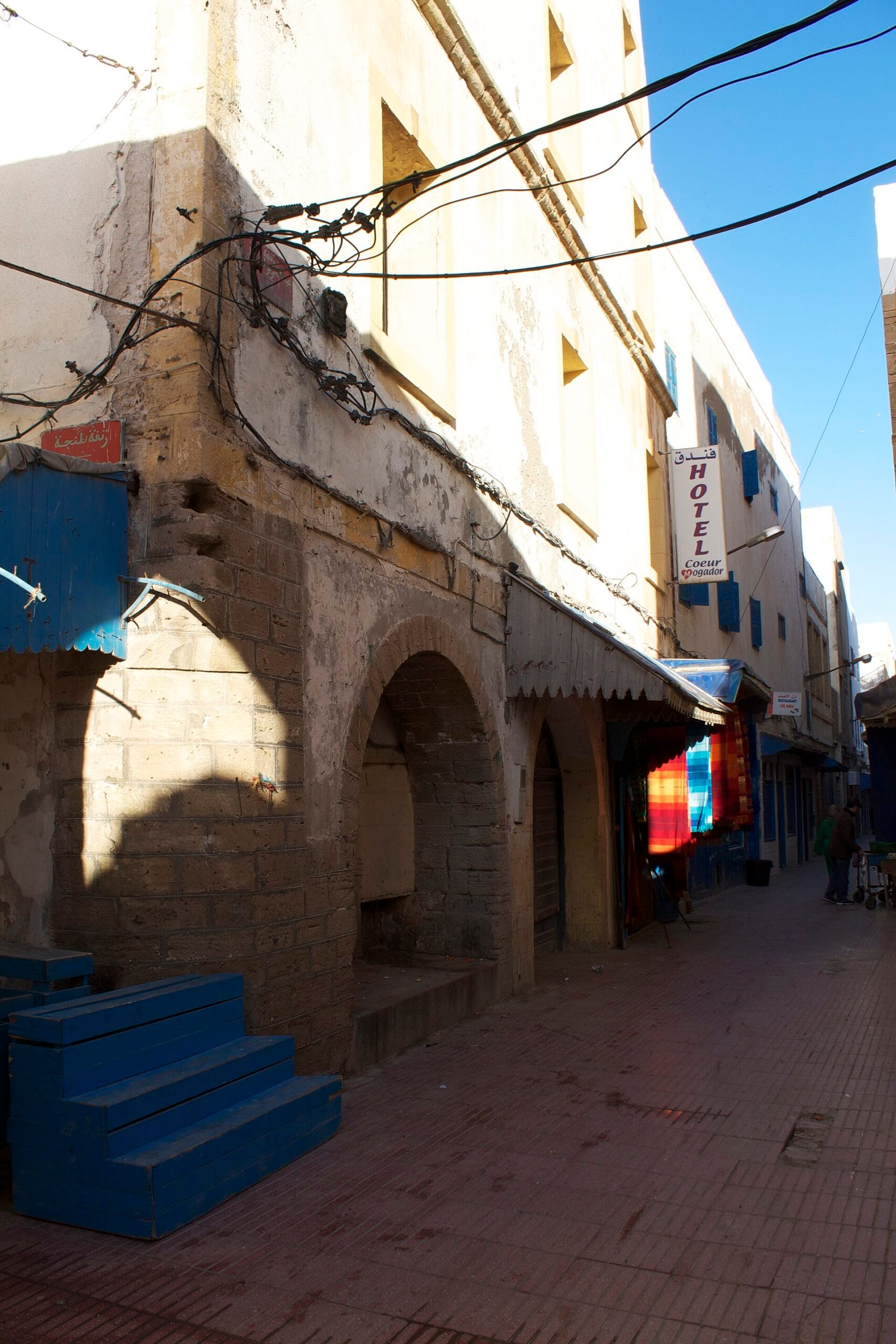
The heart of Essaouira is its medina, inscribed on the UNESCO World Heritage List in 2001. Unlike the medieval maze of Marrakech, Essaouira’s medina follows a regular grid pattern, a rarity in Morocco. This rational layout is the work of the French engineer Théodore Cornut, who redesigned the town in the 18th century under Sultan Mohammed ben Abdallah. The ruler wanted to turn Mogador into a great port open to international trade.
Wandering these lanes is a pleasure: white façades trimmed with blue, weathered wooden doors, quiet little squares and artisans’ workshops create a soothing setting. It’s easy to get around, without the sense of oppression some feel in the larger medinas. To delve deeper into the site’s history, see the official listing for the Medina of Essaouira on the UNESCO website or the Wikipedia article on the medina of Essaouira.
The medina is organised around two main thoroughfares and several monumental gates, including the famous Bab Marrakech. Inside, the souks are grouped by specialty: jewellers, grocers, fabric merchants and woodworkers follow one another in an atmosphere far less pressing than in the great imperial cities. Essaouira’s shopkeepers have a reputation for being more laid-back, which makes strolling and bargaining far more enjoyable for visitors.
The ramparts and the Skala: facing the Atlantic
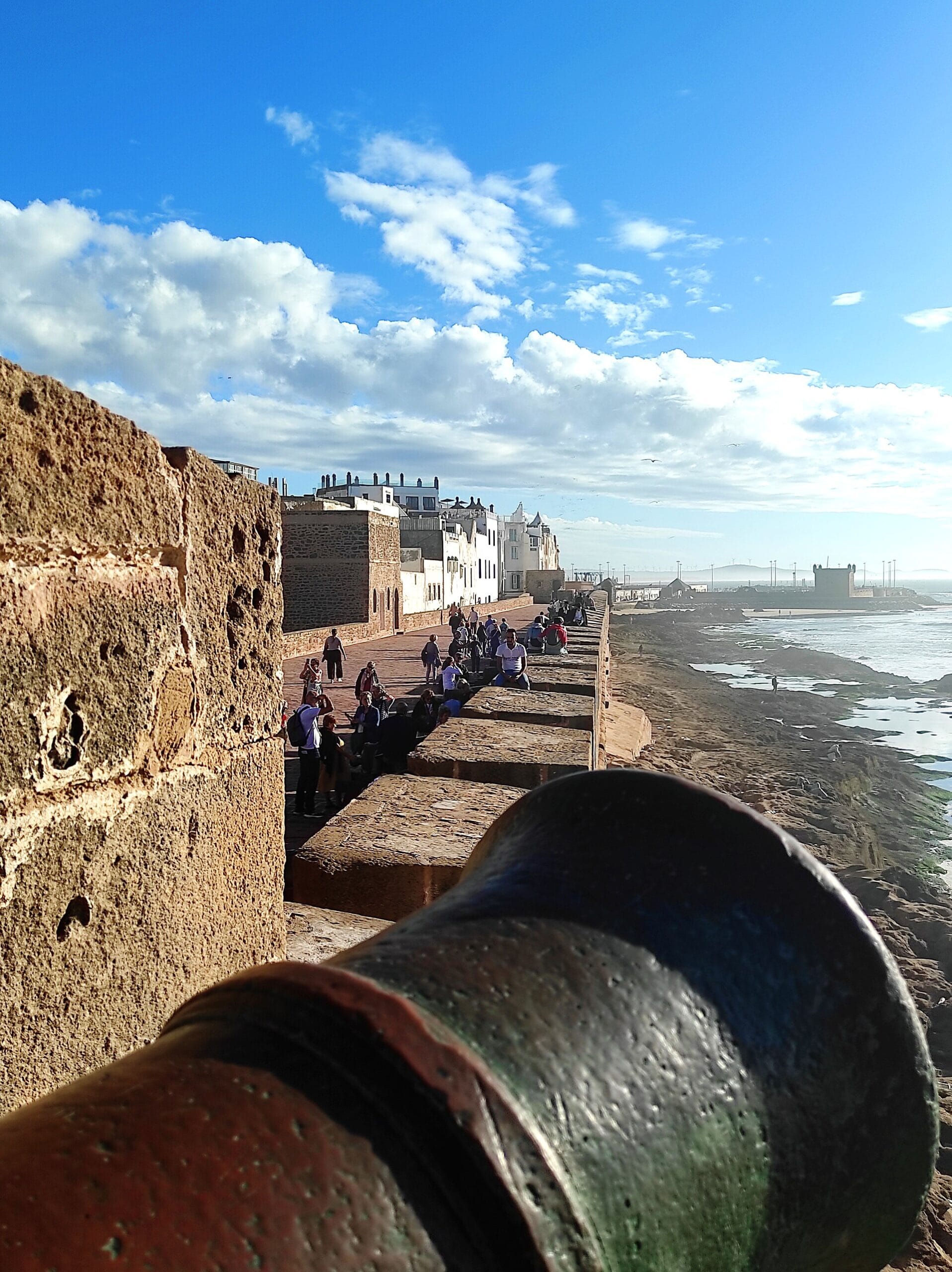
It’s impossible to visit Essaouira without walking its ramparts. The Skala de la Ville, a long artillery platform lined with old bronze cannons, offers a spectacular view over the ocean crashing below. These fortifications, dating from the 18th century, protected the city while asserting its commercial power. The wind blows here almost constantly, carrying sea spray and the cry of the gulls.
A little further on, the Skala du Port and its monumental gate round off the walk. It’s a supremely photogenic spot, especially late in the day when the golden light sets the stone aglow. Film buffs may recognise these fortified silhouettes, often captured on screen. For an overview of the city’s history, the Wikipedia article on Essaouira is a good source.
The fishing harbour and its blue boats
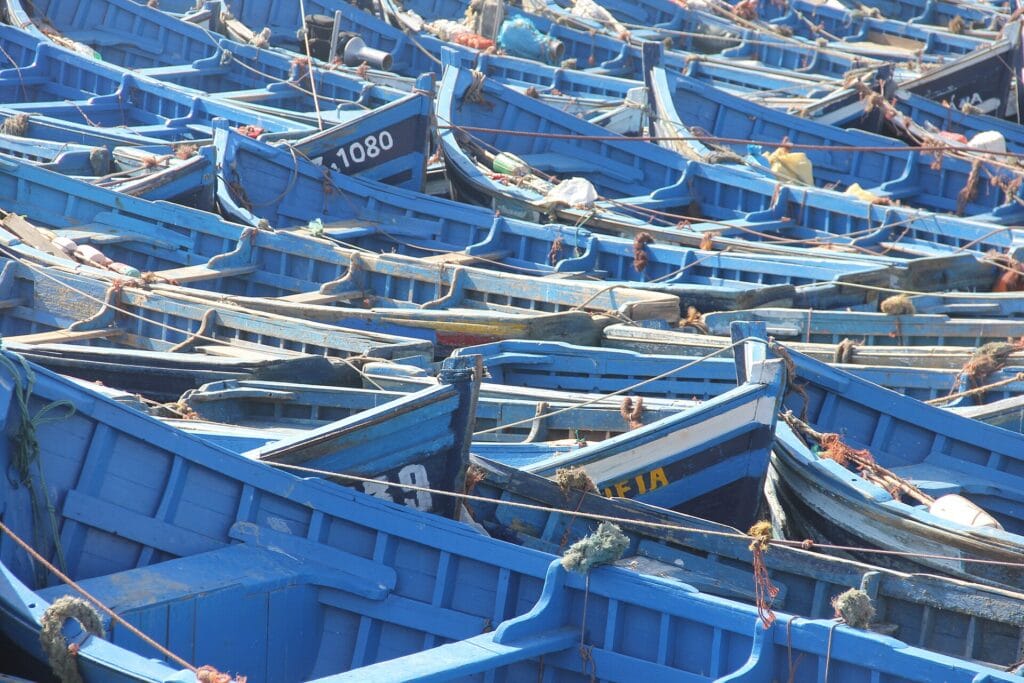
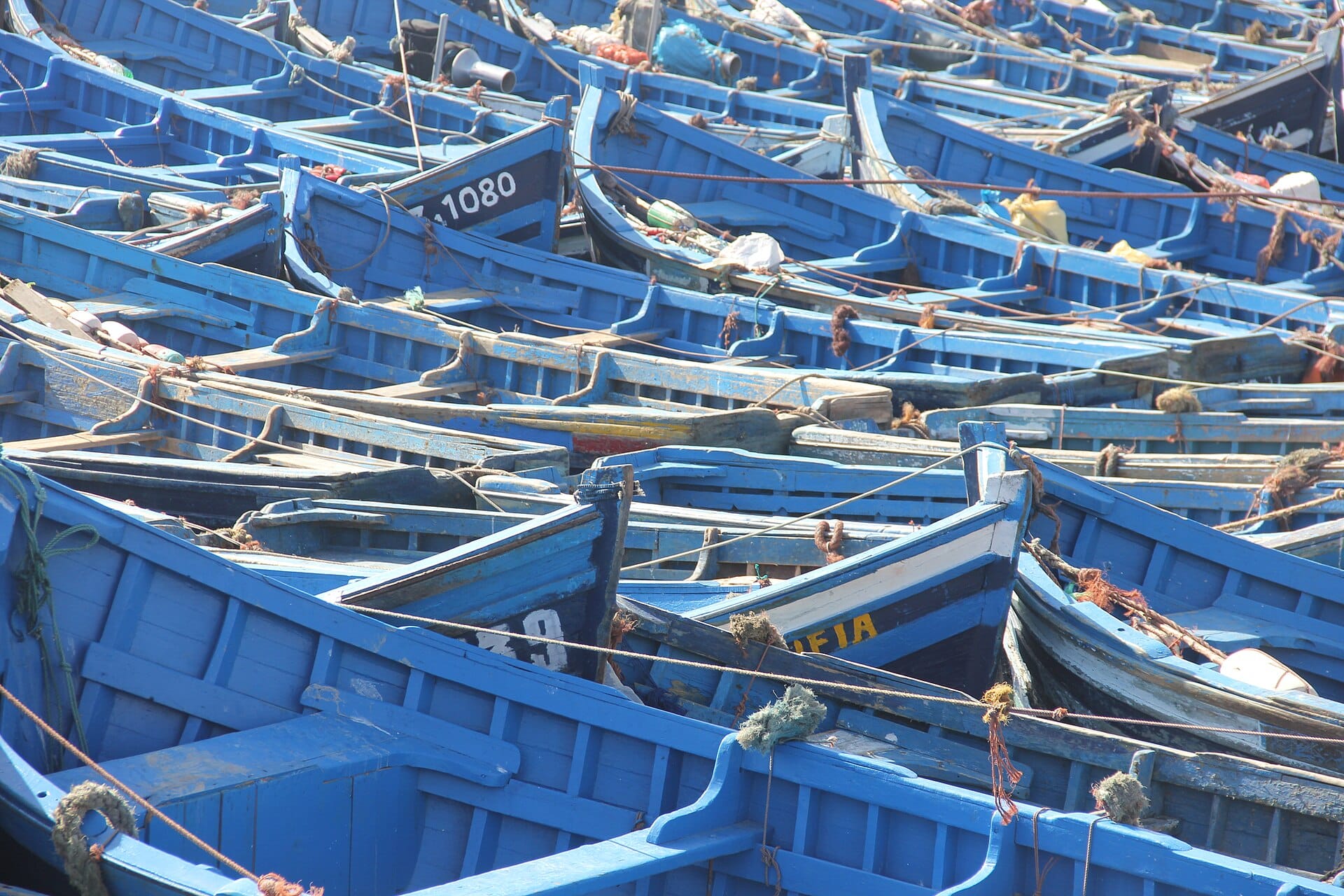
The fishing harbour is the living soul of Essaouira. Each day the bright blue boats return laden with sardines, sea bream and octopus, in a ballet of colour and sound. Fishermen mend their nets, gulls wheel overhead, and the salty smell reigns supreme. It’s an authentic spectacle, a world away from the tourist clichés, a reminder that the sea still makes the town’s heart beat.
On the quays, stalls offer freshly landed fish that you can pick out and have grilled on the spot. It’s one of Essaouira’s most memorable culinary experiences: simple, fresh and generous. Take the time to watch the fish auction and the early-morning bustle, the moment when the harbour reveals all its vitality.
Essaouira’s harbour is more than a backdrop: it’s also a traditional shipyard where the famous blue wooden boats are still built and repaired. This know-how, handed down over generations, reflects the town’s long maritime tradition, once an important Atlantic trading post. As you approach the workshops, you’ll see the boat carpenters at work, in an authentic atmosphere that has stayed clear of mass tourism.
Beaches and wind sports: a surfers’ paradise
Essaouira is nicknamed the “Windy City of Africa,” and with good reason: the trade winds blow steadily across its long sandy bay. This wind, which may put off sun-loungers, is a boon for sports enthusiasts. The town has become a renowned spot for surfing, windsurfing and kitesurfing, with several schools and rental centres along the beach.
The great beach stretching south of the medina is ideal for long walks, horseback or camel rides, and for watching the colourful kitesurfers. Even without taking part, the relaxed seaside vibe contrasts pleasantly with the intensity of Marrakech. If you’re planning this kind of activity, be sure to check the best time to visit the region, as the wind varies by season.
Thuya woodwork and argan oil
Essaouira is a stronghold of Moroccan craftsmanship, particularly the working of thuya wood. Local cabinetmakers shape boxes, trays and decorative objects adorned with refined marquetry, blending light and dark woods. The workshops, often clustered near the ramparts, are open to visitors and you can watch the artisans at work. It’s a craft passed down from generation to generation.
The region is also the cradle of argan oil, produced from the fruit of the argan tree that grows in the hinterland. On the road from Marrakech, many cooperatives, often run by women, explain the traditional production process and sell both culinary oil and cosmetics. To know what to bring home without going wrong, our article on what to buy in Marrakech (argan, thuya) will give you helpful pointers.
These cooperatives play an important social role by providing income and independence to women in rural areas. They distinguish culinary argan oil, with its toasted-hazelnut flavour, used in cooking and in amlou (a paste of almonds, argan and honey), from cosmetic oil, prized for the skin and hair. Taking the time to watch a demonstration of cracking the nuts by hand is a wonderful way to understand the value of this emblematic product of southern Morocco.
Cuisine: grilled fish rules the table
In Essaouira, the cuisine naturally revolves around the sea. Grilled fish, chosen fresh from the harbour stalls or enjoyed in the medina’s restaurants, is a must. Sardines, sea bream, calamari, prawns and octopus are savoured simply grilled, with a squeeze of lemon. The generous portions and the freshness of the produce make it a major foodie stop on your visit.
Beyond fish, you’ll find the Moroccan classics: tagines, Friday couscous, spicy salads and mint tea. The cafés and terraces of Place Moulay Hassan invite you to pause, while small food stalls offer authentic flavours at low prices. A stay in Essaouira is also an invitation to slow down and savour.
The Gnaoua Festival, world music
Essaouira is inseparable from the Gnaoua and World Music Festival, a major event that turns the town into an open-air stage each year. Born from the Gnaoua musical tradition, a spiritual and rhythmic heritage of Morocco, the festival blends these mesmerising sounds with jazz, blues and music from around the world. International artists perform alongside the Gnaoua maâlems (masters) at concerts that are often free.
During the festival, the medina throbs to the beat of the qraqeb and the guembris, and the atmosphere becomes euphoric. If you’re planning your getaway around this time, book your accommodation well in advance, as the town sells out. Even outside the festival, the Gnaoua spirit lingers in the lanes and cafés of Essaouira.
Gnaoua music, with its hypnotic rhythms and ritual trances, is an integral part of Essaouira’s identity, a town that was long a crossroads of mingling peoples from diverse origins. This heritage can be felt in the town’s cosmopolitan, tolerant atmosphere, which as early as the 1960s and 1970s drew artists, musicians and travellers in search of authenticity. That reputation as a creative haven has never faded.
Essaouira on screen: a legendary backdrop
Essaouira’s settings have won over many directors. As early as 1949, Orson Welles shot scenes there for his adaptation of Othello, immortalising the ramparts and the lanes. More recently, the town served as a setting for the series Game of Thrones, where it plays the city of Astapor, with its fortifications facing the sea.
This cinematic vocation is no accident: the Atlantic light, the preserved architecture and the authenticity of the place offer striking natural backdrops. Morocco is, moreover, a renowned filming destination; if movie sets fascinate you, also discover Aït Benhaddou and Ouarzazate from Marrakech, another major hub of the silver screen. As you stroll the ramparts or the lanes of the medina, you may recognise certain angles made famous on the big and small screen, proof that Essaouira’s charm reaches far beyond Morocco’s borders.
Day trip or two-day stay?
The big question: does Essaouira deserve just a day or a longer stay? A day trip from Marrakech lets you discover the essentials: the medina, the ramparts, the harbour and a fish lunch. It’s intense but doable, with about 5 to 6 hours of driving round trip. It’s the ideal format if your time in Marrakech is limited.
However, spending one or two nights on site changes everything. You get to enjoy the evening atmosphere, the sunsets over the Atlantic, the beaches at dawn and a far more relaxed pace. For those who love to wander, surf or simply breathe in the sea air, an extended stay is highly recommended. You can fit Essaouira into a programme like our Marrakech in 3 days itinerary, adding a day if needed.
Our advice: if you have fewer than three days in Marrakech, favour the day trip so you don’t sacrifice discovering the Red City. On the other hand, if your trip is longer or you’re mainly after rest and the seaside, book at least one night in Essaouira. The town reveals itself fully once the day-trippers have left, when the lanes recover their calm and the evening light wraps around the ramparts.
Where to stay and where to eat in Essaouira
Essaouira offers a wide range of accommodation, from charming riads tucked into the medina to seafront hotels facing the ocean, as well as welcoming guesthouses. Staying in the medina lets you live to the town’s rhythm, while beachfront establishments suit water-sports enthusiasts. Book ahead in high season and during the Gnaoua festival.
On the dining side, the harbour fish grills are a must, but the medina is also full of small restaurants, cafés and refined tables. Place Moulay Hassan and its surroundings concentrate many convivial addresses. If you’re looking for accommodation pointers for your base in Marrakech before the trip, our guide on where to stay in Marrakech can help you choose your neighbourhood.
Practical tips: wind, weather and planning
The main factor to anticipate in Essaouira is the wind. Even at the height of summer, the sea air is cooler than in Marrakech, and the trade winds can be brisk, especially in the afternoon. Bring a windbreaker and a jumper, even if the sun is shining. This coolness is actually an asset: when Marrakech swelters in the heat, Essaouira stays pleasantly temperate.
- Clothing: pack layers, a windbreaker and good shoes for walking the medina and the ramparts.
- Timing: leave Marrakech early to make the most of your time on site, especially on a day trip.
- Cash: keep cash for small shops, crafts and the harbour grills.
- Comfortable shoes: the medina and the quays are explored on foot, often on cobbles.
- Sun protection: the wind masks the feel of the sun, but exposure remains strong.
Finally, keep an open mind and take your time: Essaouira is best savoured slowly. Too hurried a pace would miss its very particular charm. To compare with other getaways near the Red City, take a look at the Agafay Desert from Marrakech, a radically different but equally appealing alternative.
Frequently asked questions
How long is the drive between Marrakech and Essaouira?
Allow about 2.5 to 3 hours to cover the roughly 175 km separating Marrakech from Essaouira, on a direct, well-maintained road heading west to the Atlantic Ocean.
Can you visit Essaouira in a day from Marrakech?
Yes, a day trip is entirely possible and very popular. It lets you discover the medina, the ramparts and the harbour and enjoy a grilled-fish lunch, with about 5 to 6 hours of driving round trip.
Why is the medina of Essaouira a UNESCO World Heritage Site?
The medina of Essaouira has been on the World Heritage List since 2001 for its late-18th-century military architecture and its grid layout, a remarkable example of a fortified town designed according to the European principles of the era.
Why is Essaouira so windy?
Its exposed position on the Atlantic coast subjects it to steady trade winds, earning it the nickname “Windy City of Africa.” This wind makes it an ideal spot for surfing, windsurfing and kitesurfing.
What to bring home from Essaouira?
The standout souvenirs are thuya-wood crafts (boxes, trays, marquetry) and the region’s argan oil, culinary or cosmetic, often available at the cooperatives along the road from Marrakech.
What is the best way to get to Essaouira from Marrakech?
It depends on your profile: the bus for economy, the organised tour for simplicity, the taxi or private car for comfort, and the rental car for independence. All these options take the same direct road.
Conclusion
Heading to Essaouira from Marrakech means treating yourself to a striking contrast: going from the ochre heat of the Red City to the blue coolness of the Atlantic in under three hours. Between its UNESCO-listed medina, its wind-battered ramparts, its lively fishing harbour and its musical soul, old Mogador is well worth the detour, whether for a day or an extended stay. Take the time to wander, to taste the grilled fish and to let the wind carry you: Essaouira has that rare gift of staying in your memory.
Editorial independence: this article is written independently, with no commercial partnership. The durations, distances and prices mentioned are given purely as a guide and may vary; always check the latest information (schedules, rates, conditions) before you set off.
Images under free licence via Wikimedia Commons: © Elgaard (CC BY-SA 4.0); © CastlesCatalog (CC BY-SA 4.0); © Patrick Nouhailler’s… (CC BY-SA 3.0). Sources: UNESCO and Wikipedia.