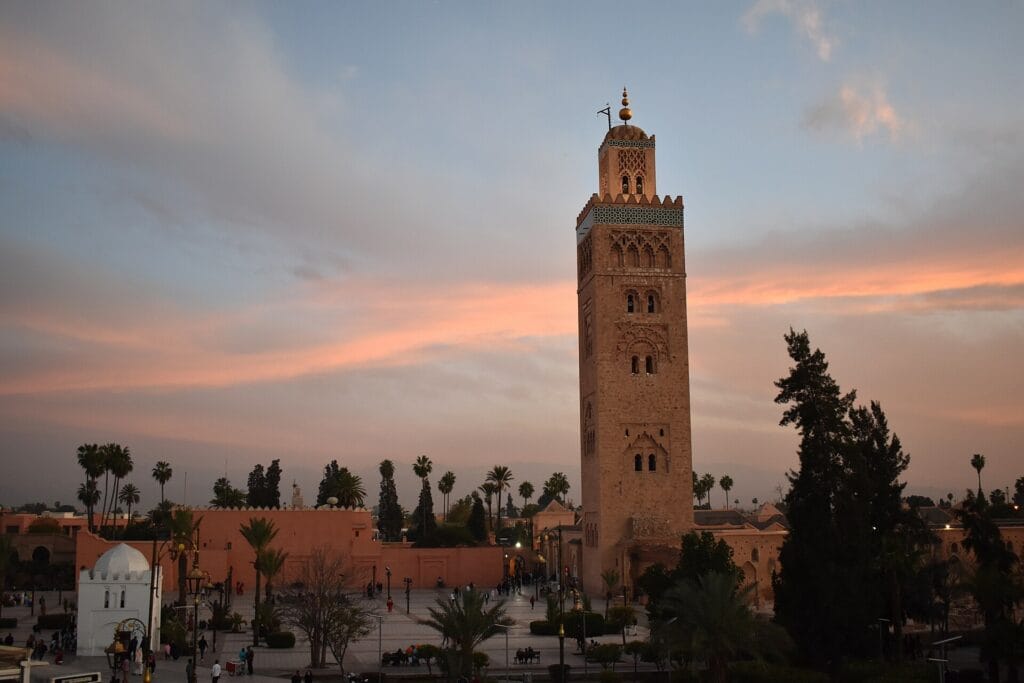
Southeast of the Marrakech medina, a stone’s throw from the Bahia Palace and El Badi Palace, lies a district with a tight-knit layout and a singular past: the Mellah of Marrakech, the city’s former Jewish quarter. Created in 1558, it ranks among the oldest mellahs in Morocco and tells, through its alleyways, synagogues and vast cemetery, several centuries of Jewish presence at the heart of the imperial city.
Quick answer: the Mellah is the historic Jewish quarter of Marrakech, founded in 1558 under the Saadian dynasty. Today people visit it for its distinctive atmosphere, the Slat al-Azama (Lazama) Synagogue and its small museum, the Miâara Jewish cemetery, and the nearby Place des Ferblantiers. Its location, right next to the Bahia, makes it a natural stop when exploring the southern medina. It is a place of memory for Judeo-Moroccan heritage, to be visited with respect.
In brief: the Mellah of Marrakech
- What it is: the former Jewish quarter of Marrakech, created in 1558.
- Where: southeast of the medina, adjoining the Bahia Palace and close to El Badi Palace.
- What to see: the Slat al-Azama (Lazama) Synagogue and its museum, the Miâara cemetery, the characteristic alleyways and balconies, and the Place des Ferblantiers.
- Lazama Synagogue: open every day except Saturday (Shabbat); admission is indicatively around 10 to 20 MAD (approx. 1 to 2 €), in cash.
- Suggested duration: 1 to 2 hours, often combined with the Bahia and El Badi palaces.
- Dress code: modest, covering clothing and a respectful attitude in places of worship.
Independent guide: this information site is affiliated neither with ONDA nor with any official body. Opening hours and prices are given for indicative purposes only and may change; check on site before your visit.
What is the Mellah of Marrakech?
In Morocco, the word “mellah” refers to the district traditionally inhabited by a city’s Jewish community. A mellah is found in many Moroccan cities — Fez, Meknes, Essaouira, Rabat — but the one in Marrakech holds a special place through its age and its immediate proximity to power. For a long time, the Mellah of Marrakech formed a world of its own inside the medina: its gates, alleyways, synagogues, schools and markets made up a dense urban fabric, at once connected to and distinct from the rest of the city.
The mellah was created in 1558, under the Saadian dynasty, while Sultan Moulay Abdallah ruled the city. Marrakech’s Jewish community, long established there, was gathered into this new district set up at the foot of the royal palace, in the kasbah area. This closeness to the palace was no accident: it reflected the particular bond between power and a community that played a notable role in trade, precious-metal craftsmanship, finance and diplomacy. Placed under the sultan’s protection, the mellah’s inhabitants lived just a few hundred metres from the seat of power.
Over the centuries, the district went through periods of prosperity and others that were more difficult. It remained one of the largest centres of Jewish life in Morocco, with numerous synagogues — several dozen at its height — religious schools, workshops and specialised businesses. The creation of the State of Israel in 1948, followed by the great waves of emigration in the 1950s and 1960s, profoundly transformed the quarter: the majority of the Jewish population gradually left Marrakech for Israel, France or North America. Today very few Jewish families still live in the Mellah, but the place preserves its memory, its name and part of its built heritage, now valued and restored. To place this district within the city as a whole, our complete guide to what to do in Marrakech sets the Mellah among the great highlights of the medina.
It is also important to understand that the Mellah was not a district cut off from the rest of the city: it connected with the medina through gates and was part of a network of constant exchange. Merchants from the mellah frequented the souks, its craftsmen worked for the whole city, and the traditions of each group set the rhythm of a long-standing coexistence. This memory of a plural Marrakech, where several communities shared the same urban space, is today an integral part of the city’s identity and heritage appeal.
The Slat al-Azama (Lazama) Synagogue and its museum
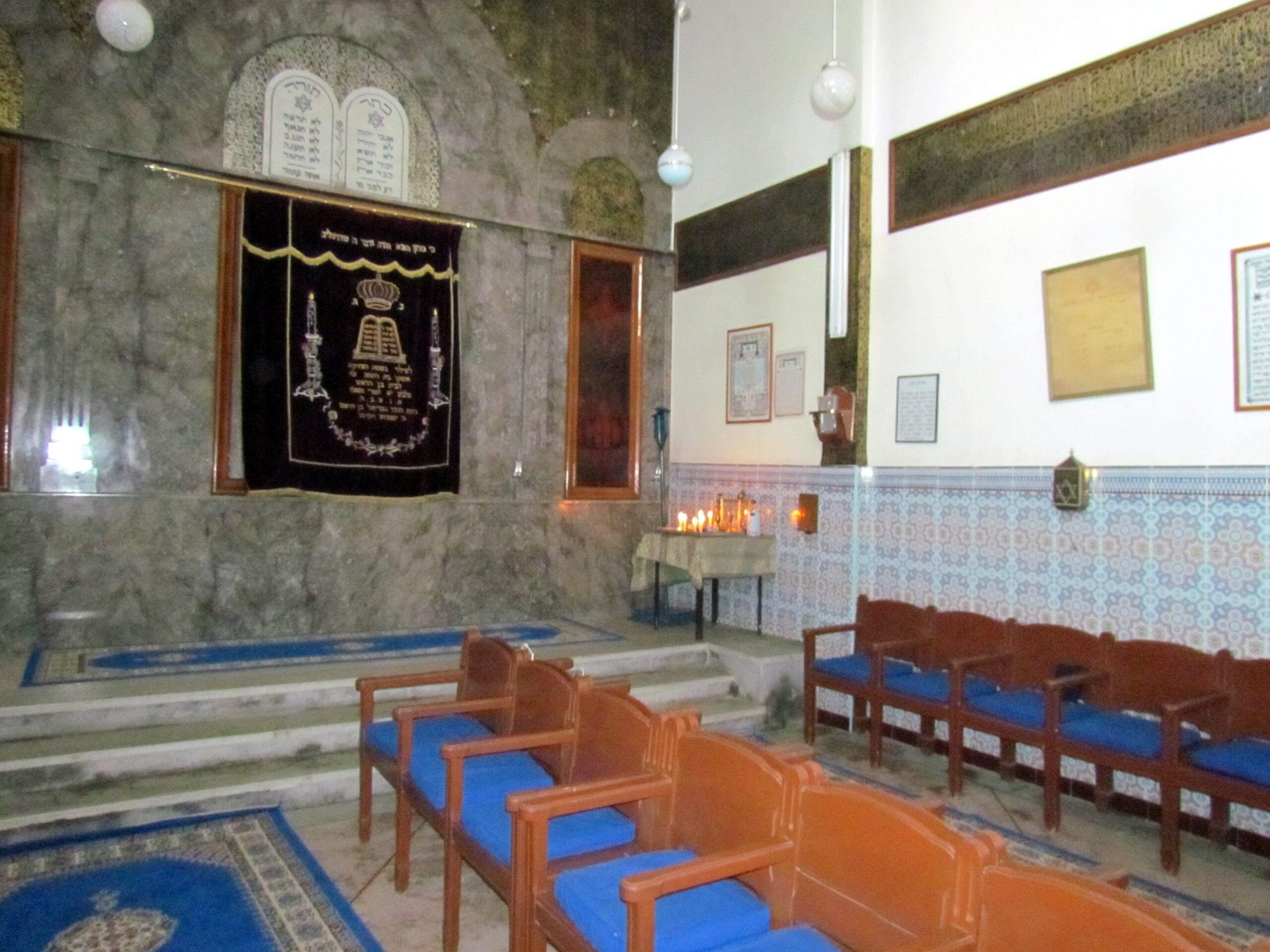
The flagship visit of the Mellah of Marrakech is without question the Slat al-Azama Synagogue, often called the Lazama Synagogue. It is the main synagogue in Marrakech open to visitors and one of the few places where you can still feel, in a concrete and peaceful way, the city’s Jewish history. Its name, “Slat al-Azama,” refers by tradition to the Sephardic Jews expelled from Spain at the end of the 15th century: on reaching Marrakech, these exiles are said to have founded their own place of worship, distinct from that of the local community, hence the nickname sometimes heard of the “synagogue of the expelled” or “of the dissidents.”
The complex is organised, as is often the case in Judeo-Moroccan architecture, around a central patio with dazzling blue walls, bordered by galleries and upstairs rooms. The prayer hall, plain and bright, remains an active place of worship, used during the major festivals and by passing visitors. Around the patio, several rooms have been arranged into a small museum of Moroccan Judaism: old photographs, documents, liturgical objects, costumes and explanatory panels trace centuries of Jewish presence in Morocco and in the south of the country. You come to understand the community’s role in trade, craftsmanship and the life of the city, as well as the ties woven with the rest of Moroccan society.
On the practical side, the Lazama Synagogue is generally open every day except Saturday (the day of Shabbat) and during certain Jewish festivals, when access may be reserved for worshippers. Usual hours run, indicatively, from morning (around 9 a.m.) to late afternoon. Admission is modest: expect around 10 to 20 MAD (roughly 1 to 2 €), payable in cash, as most sites in the medina do not accept cards. The place is discreet, with little signage on its façade: it is best to navigate by the address and, if needed, ask for directions in the neighbourhood. The visit is made in calm, respecting the religious character of the site.
The Miâara Jewish cemetery
A few minutes’ walk from the quarter’s alleyways lies the Miâara Jewish cemetery (sometimes spelled Miara), one of the most moving places in the Mellah of Marrakech. Dating from the 16th century, it is considered the largest Jewish cemetery in Morocco. Behind its high walls, an immense field of lime-whitened tombs stretches as far as the eye can see, in a particular atmosphere of quiet contemplation. The uniform whiteness of the graves, plain and aligned, contrasts with the bustle of the surrounding city.
The cemetery preserves the memory of generations of mellah inhabitants, among them venerated rabbis and sages whose tombs are still the object of pilgrimages. The site is organised into sectors, reflecting the funerary customs of the Marrakech community. For many descendants of Jewish families originally from Marrakech, now scattered across the world, Miâara remains a place of return and remembrance.
Visiting the cemetery is possible, usually in exchange for a small contribution left with the keeper (an indicative and voluntary amount). As with the synagogue, access is in principle closed on Saturday. Visitors should adopt respectful dress and behaviour: this is not a mere tourist curiosity, but a burial ground still in use and deeply meaningful to the community.
The distinctive architecture of the Jewish quarter
Walking through the Jewish quarter of Marrakech, you quickly notice that its urban fabric differs from that of the surrounding Muslim medina. The alleyways are often narrower and more tightly packed, the houses taller and more densely interlocked. This compactness is explained by the district’s history: a bounded and heavily populated space, the mellah grew upward for lack of room to spread out, multiplying storeys and buildings crammed against one another.
The most characteristic detail is surely the presence of balconies and windows opening onto the street. In the traditional architecture of the Muslim medina, houses close in on an inner patio and present to the outside only near-blind walls, preserving privacy. In the mellah, by contrast, you find more balconies looking directly onto the alleyways, more openings and lively façades. This difference, long tied to particular customs and status, gives the quarter a silhouette that is immediately recognisable to the attentive visitor.
While the mellah has its own character, it remains inseparable from the great historic ensemble of Marrakech, whose medina is listed as a UNESCO World Heritage Site. To extend your exploration of this ancient fabric, you can compare its alleyways with those of the Marrakech medina and with the neighbouring kasbah, which housed the Saadian power right next to the mellah.
The market and the Place des Ferblantiers
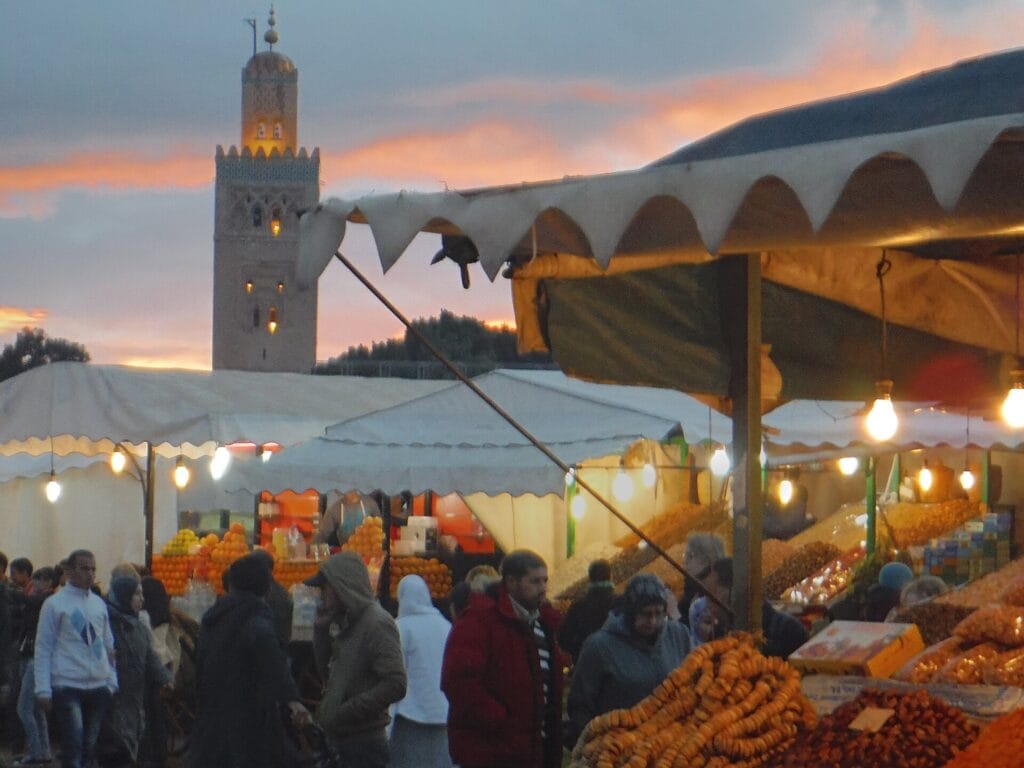
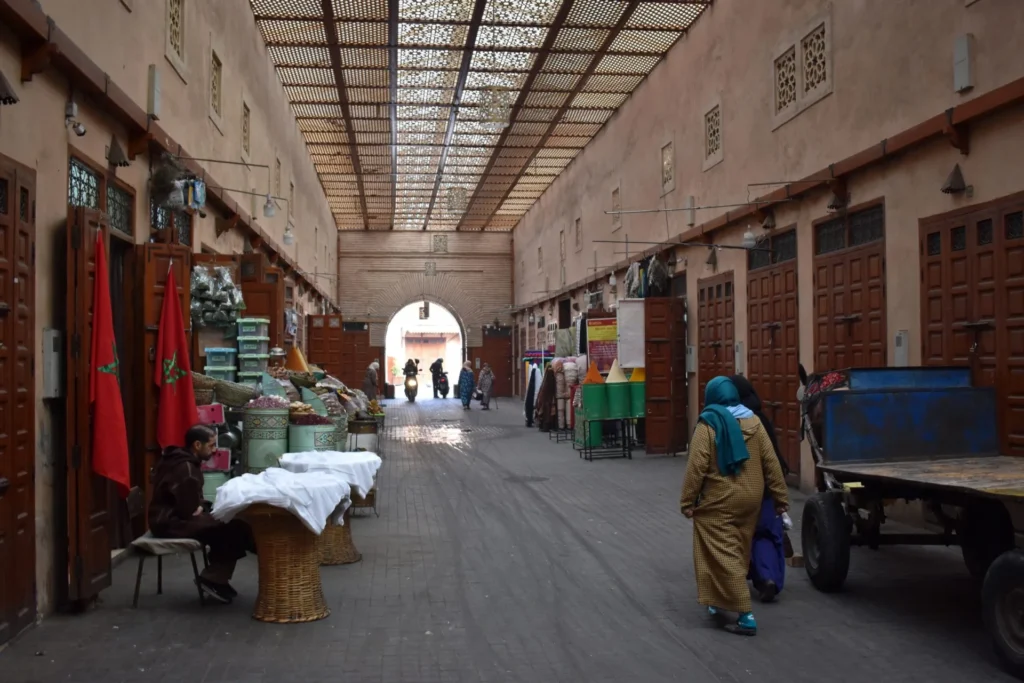
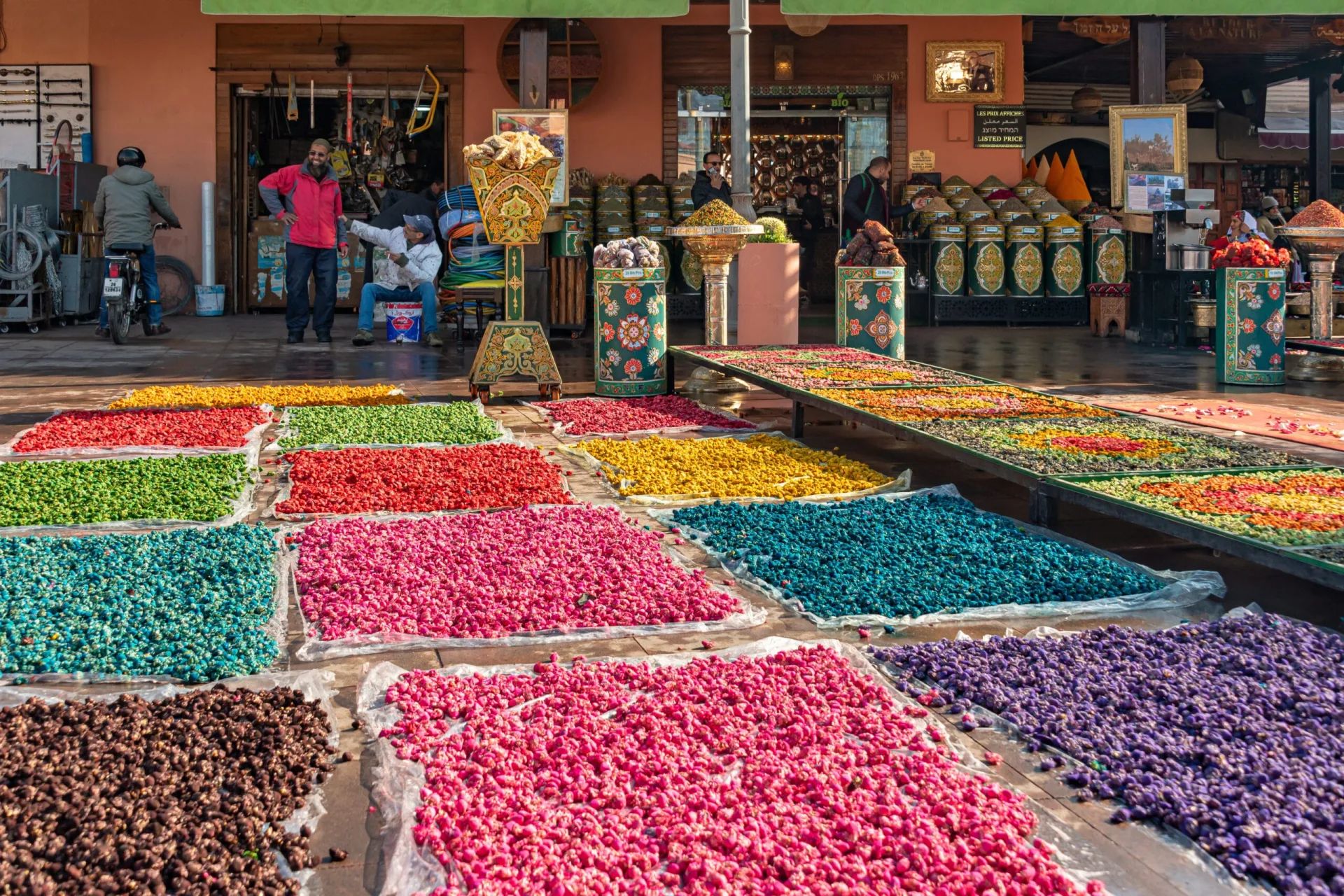
The Mellah has always been a district of trade and craftsmanship, and that vocation is still visible today. Here you find a colourful spice market, herbalists’ stalls, and the memory of a once-flourishing jewellery craft: the Jewish goldsmiths of the mellah were renowned throughout southern Morocco for their work in gold and silver. Strolling through these market lanes, amid the scent of spices and workshop fronts, offers a living glimpse of the quarter’s traditional economy.
On the edge of the Mellah opens the Place des Ferblantiers, one of the most pleasant landmarks in the area. Lined with the workshops of ironworkers and coppersmiths — hence its name (the “tinsmiths’ square”) — the square hosts metalworking, notably the making of lanterns and openwork iron lamps that are part of Marrakech’s reputation. It is a lively crossing point, dotted with café terraces, ideal for a break before resuming the visit. From the square, the Bab Berrima gate opens directly onto the surroundings of El Badi Palace.
This taste for trade and craftsmanship naturally links the Mellah to the rest of the merchant medina. Lovers of shopping and craftwork will gladly extend the experience in the great souks of Marrakech, close by, where the same metal, leather and spice skills come together.
Judeo-Moroccan heritage: context and restoration
Visiting the Mellah also means entering the long history of Jewish presence in Morocco, one of the oldest and most continuous in the Mediterranean world. For centuries, Jewish communities took full part in the country’s economic, artisanal and intellectual life, weaving with Moroccan society complex bonds made of closeness, professional specialisation and shared traditions. The mellah of Marrakech, by its age and size, was one of the great centres of this history.
Over the past few decades, this heritage has been the subject of renewed attention and preservation efforts. Restoration campaigns have covered the quarter, its synagogues and its sites of memory, while the old place names have been reinstated. This recognition is part of a broader acknowledgement of the Hebrew dimension of Moroccan cultural identity. For the traveller, it translates very concretely: better-maintained places, a museum to help understand, and a quarter that has regained a fully assumed place on the map of Marrakech’s heritage.
Approaching the Mellah in this spirit — that of a living, respected heritage rather than a mere backdrop — changes the way you walk through it. You take the time to read the museum panels, observe the architectural details, greet the keepers of the places of worship. It is this heritage-focused, factual approach that makes the visit the richest.
Where is the Mellah and how do you visit it?
The Mellah of Marrakech sits in the southeastern part of the medina, in the extension of the kasbah district. It directly adjoins the Bahia Palace and is a few minutes’ walk from El Badi Palace. This location makes it one of the easiest quarters to fit into an itinerary, since several of the great monuments of the southern medina are concentrated within a very small radius.
The best way to explore the quarter is on foot: the alleyways are narrow, often off-limits or awkward for vehicles, and it is on foot that you best grasp the atmosphere of the place. From Jemaa el-Fna square, allow fifteen to twenty minutes’ walk through the medina, or a short petit taxi ride to the surroundings of the Bahia or the Place des Ferblantiers. To plan your movements around the city, our dedicated page on how to get around Marrakech details the options between taxis, walking and airport transfers.
A logical order of visit is to start with the Bahia Palace, then plunge into the alleyways of the Mellah as far as the Lazama Synagogue, before reaching the Miâara cemetery and finishing with the Place des Ferblantiers and El Badi Palace. This compact circuit, entirely in the southern medina, fits easily into half a day. If you have several days on site, our Marrakech in 3 days itinerary shows how to slot this heritage loop into a broader programme.
What to see around the Mellah?
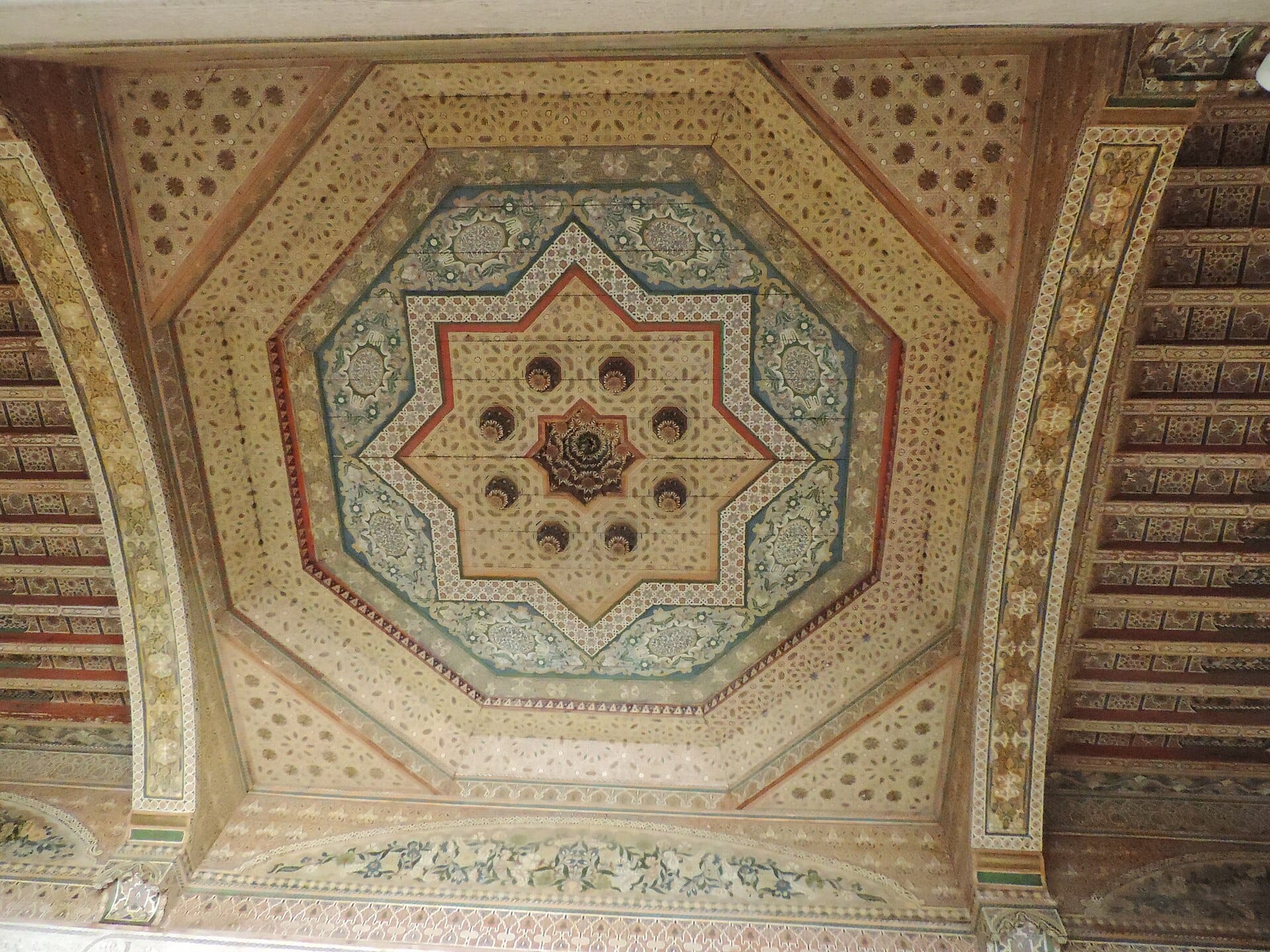
One of the Mellah’s great strengths is the density of remarkable sites in the immediate vicinity. The Bahia Palace, a masterpiece of 19th-century Moroccan architecture with its patios, painted ceilings and gardens, is right next door and makes the most natural continuation. Not far away, El Badi Palace, now reduced to monumental ruins, recalls Saadian splendour and offers fine views over the rooftops and stork nests from its terraces.
Continuing on, you can reach the kasbah of Marrakech and its emblematic mosque, then discover the famous Saadian Tombs, another great site of the area. Fans of fortifications will finally enjoy following the ramparts and gates of Marrakech, several of whose historic gates frame precisely this southern part of the medina, near the Place des Ferblantiers.
This concentration of monuments makes the southern medina one of the richest areas of the city. By combining the Bahia, El Badi, the Mellah, the kasbah and the Saadian Tombs, you cover in a few hours a remarkable concentrate of Marrakech’s history, from Saadian power to the life of the communities that made the city.
Visiting tips for the Mellah of Marrakech
- Choose your day well: the Lazama Synagogue and the Miâara cemetery are in principle closed on Saturday (Shabbat) and during certain Jewish festivals. Favour a weekday visit.
- Bring cash: admissions (indicatively around 10 to 20 MAD for the synagogue, a voluntary contribution at the cemetery) are paid in dirhams, in cash.
- Dress respectfully: in places of worship and at the cemetery, prefer clothing covering shoulders and legs; men may be offered a kippah at the synagogue entrance.
- Stay discreet: these are places of memory and prayer still in use. Lower your voice, ask before photographing people and respect any photography bans.
- Find your bearings in advance: the synagogue is poorly signposted. Note the address and do not hesitate to ask locals politely for directions.
- Combine wisely: pair the Mellah with the Bahia and El Badi for a coherent half-day, during the cooler hours of the morning or late afternoon.
- Stay hydrated and take your time: the alleyways can be labyrinthine; the Place des Ferblantiers offers terraces for a breather.
By approaching the quarter with this preparation and mindset, visiting the Mellah becomes far more than a box to tick: it is a heartfelt immersion into an essential and often overlooked facet of Marrakech’s history.
Frequently asked questions about the Mellah of Marrakech
What is the Mellah of Marrakech?
It is the former Jewish quarter of Marrakech, created in 1558 under the Saadian dynasty, southeast of the medina, near the royal palace. It ranks among the oldest mellahs in Morocco and brought together the synagogues, schools, workshops and businesses of the city’s Jewish community.
Can you visit a synagogue in the Mellah?
Yes. The Slat al-Azama Synagogue, known as Lazama, is open to visitors and houses a small museum of Moroccan Judaism. It is generally accessible every day except Saturday, for a modest admission (indicatively around 10 to 20 MAD, payable in cash).
Are there still Jews living in the Mellah?
Very few. After the creation of Israel in 1948 and the waves of emigration in the 1950s and 1960s, the vast majority of the community left Marrakech. The quarter nonetheless remains a living place of memory, with its synagogues, its cemetery and its preserved and restored heritage.
Where is the Mellah and how do you get there?
The Mellah occupies the southeast of the medina, adjoining the Bahia Palace and close to El Badi Palace. From Jemaa el-Fna square, allow fifteen to twenty minutes’ walk, or a short petit taxi ride to the surroundings of the Bahia or the Place des Ferblantiers.
How much time should you set aside to visit the Jewish quarter?
Allow 1 to 2 hours for the Mellah alone (Lazama Synagogue, Miâara cemetery, alleyways and Place des Ferblantiers). By pairing it with the nearby Bahia Palace and El Badi Palace, you get a coherent half-day of sightseeing in the southern medina.
How should you behave during the visit?
Adopt covering clothing and a discreet attitude: these are places of worship and memory still in use. Lower your voice, ask before photographing people, and respect any photography bans and the closing days linked to Shabbat and Jewish festivals.
To learn more, consult the reference resources on the Mellah of Marrakech and on the listing of the Marrakech medina as a UNESCO World Heritage Site.
Images under free licence via Wikimedia Commons: © David Berkowitz (CC BY 2.0); © Jorge Franganillo (CC BY 2.0); © Vassia Atanassova – Spiritia (CC BY-SA 4.0). Sources: Wikimedia Commons.Photo credits: illustrative images of the Mellah of Marrakech, the Place des Ferblantiers and the Bahia Palace. Please credit the respective authors and sources (royalty-free image banks or photographers) when publishing.