You are planning your trip and one question keeps coming up: do you need a guide in Marrakech to make the most of the city? The short answer is nuanced. To wander through the medina, sip a mint tea on a rooftop terrace and lose yourself in the souks, a guide is absolutely not essential: Marrakech is very easy to explore on your own, with a map and a little common sense. On the other hand, an official guide becomes a real asset the moment you want to understand the history of the monuments, decode the architecture of the palaces or head out of town for an excursion into the Atlas Mountains or the desert.
There is, however, one pitfall to know about before you go: the fake guides of Marrakech, those people who approach you in the street to “show you the way” and then demand money, or steer you toward shops where they earn a commission. In this complete guide, we therefore answer the real question — do you need a guide, when is it useful, how do you recognise an official guide, how do you politely turn down the fake ones, and how much does it all cost. The goal: to help you make an informed decision and travel with peace of mind.
In short: do you need a guide in Marrakech?
- For the city: a guide is not essential. The medina, the souks and Jemaa el-Fna square are easy to discover on your own.
- To understand: an official guide adds enormous value at the monuments (Bahia Palace, Ben Youssef Madrasa, Saadian Tombs).
- For excursions: Atlas Mountains, Agafay Desert, Ourika, Aït Benhaddou, Essaouira — here a guide or a driver-guide is genuinely recommended.
- Official guide: a professional card with photo and number issued by the Ministry of Tourism. Expect roughly 200 to 400 MAD (approx. 20-40 EUR) for a half-day in the medina.
- Fake guides: very common. They approach you in the street, “show you the way” then demand money. Decline politely but firmly.
Do you need a guide in Marrakech?
Let’s start with the essentials: no, you do not need a guide to visit Marrakech. The city is perfectly accessible to independent travellers. Every year, millions of tourists roam the medina, find their way through the souks and reach the major monuments without ever hiring anyone. Distances in the old town are short, the main landmarks (the Koutoubia, Jemaa el-Fna square) are visible or easy to find again, and most of the major sites are well signposted and can be visited with a simple entry ticket.
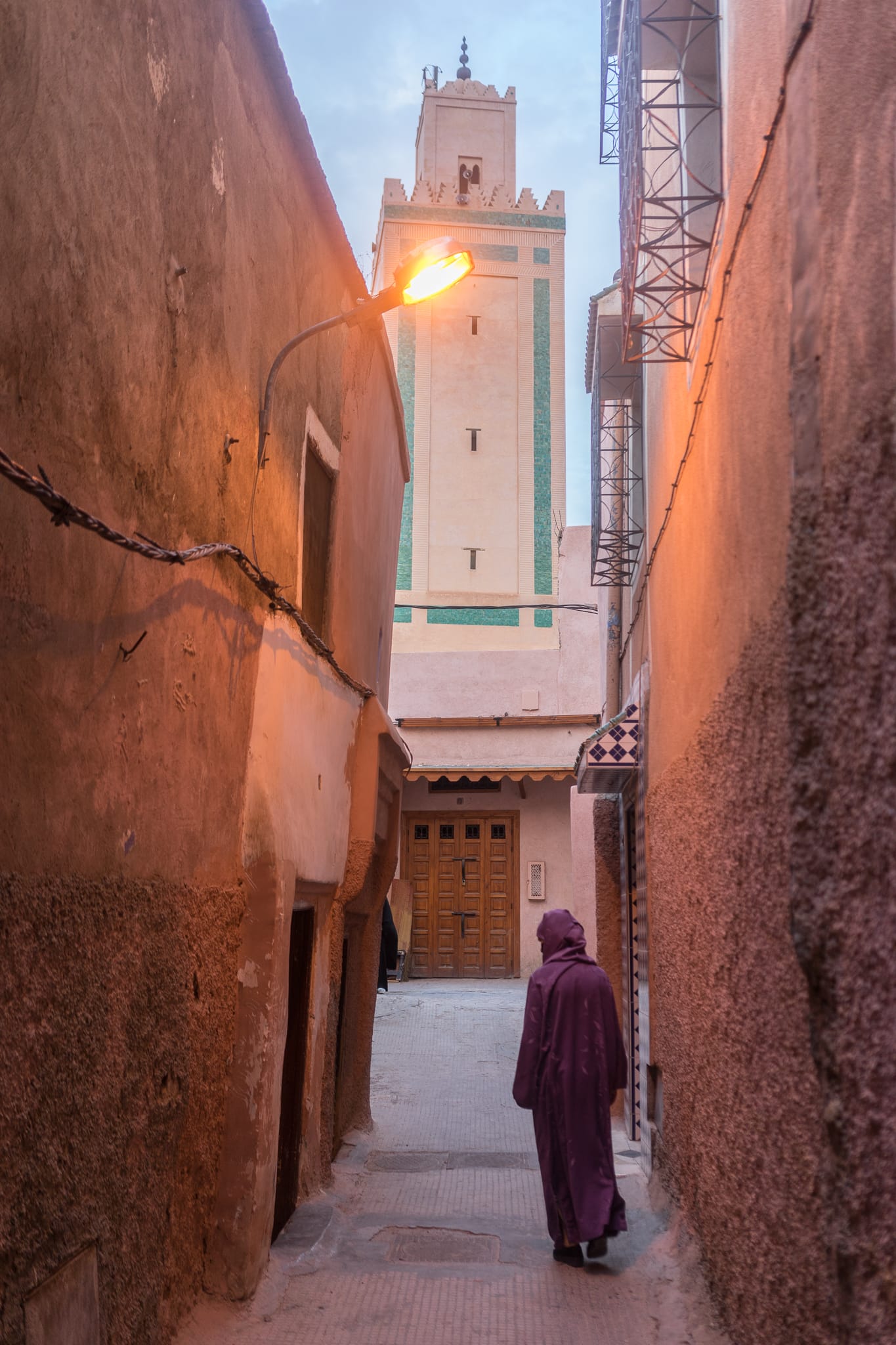
So why does the question do you need a guide in Marrakech come up so often? Because the medina can be disorienting at first: alleys that all look alike, no conventional street map, constant sales pressure, and a layout of the souks organised by artisan guilds that is anything but intuitive. This labyrinth-like impression pushes some visitors to want to be “taken in hand”. That’s understandable, but it isn’t a necessity: with a little preparation, a mapping app and a willingness to get a bit lost (which is part of the charm), you’ll manage just fine.
The right way to frame the question, then, is not “do I need a guide?” but rather “what do I want from my visit?”. If you mainly want the atmosphere, the colours, the street food and the sensory experience, do it independently. If you want to understand why a palace is laid out the way it is, what a carved door tells us, or the story of the Saadian dynasty, then an official guide transforms the visit. To go further on the must-sees, check out our complete guide to things to do in Marrakech.
Official guides: how to recognise them, where to find them, prices
An official guide in Marrakech is a professional accredited by the Ministry of Tourism. They have completed training, passed an examination and obtained a professional card. This is the only category of people legally authorised to accompany and comment on tourist visits. Hiring an official guide means you are dealing with someone competent, insured and accountable — the exact opposite of a fake guide you cross paths with in the street.
How to recognise an official guide
- The professional card: an official badge with a photo and accreditation number. A genuine guide shows it without hesitation if you ask.
- Transparency: they state a clear rate in advance, explain the programme and do not try to drag you into shops you didn’t choose.
- Booking: you don’t find an official guide by being approached on a street corner. You book them in advance, through a reliable channel.
- Languages: official guides generally speak several languages (French, English, Spanish, Arabic) and can prove it.
The simplest reflex: always ask to see the card. Someone who refuses, dodges the question or changes the subject is not an official guide. You can also ask for their accreditation number — a genuine professional shares it without any problem.
Where to find an official guide in Marrakech
- Your accommodation: riads and hotels work with trusted accredited guides. This is the safest and simplest route.
- Reputable local travel agencies, which organise guided tours of the medina and excursions.
- Activity booking platforms, where you can read reviews and book a Marrakech guided tour in advance.
- The tourist office, which can point you toward accredited guides.
How much does an official guide cost
As a rough guide, expect around 200 to 400 MAD (approx. 20-40 EUR) for a half-day guided tour of the medina with an official guide. Rates vary depending on duration, whether the tour is private or in a group, the guide’s experience and what is included. For a more comprehensive tour (four to six hours, several monuments), the range can climb toward 400 to 600 MAD, or even more for a high-end private service. These amounts are indicative: always agree on the price and the programme before you begin, to avoid any misunderstanding.
Be careful: entry tickets to the monuments (Bahia Palace, Saadian Tombs, Ben Youssef Madrasa, etc.) are generally not included in the guide’s fee. Budget for this separately. To anticipate your overall spending on the ground, our Marrakech travel budget guide details the costs to plan for.
Fake guides in Marrakech: how to spot them and politely avoid them
It’s impossible to tackle the question “do you need a guide in Marrakech” without talking about the phenomenon of fake Marrakech guides. These are unaccredited people who approach tourists, especially in the medina and around Jemaa el-Fna square. Their method is well practised: they spot a visitor who seems hesitant, spontaneously offer to “show the way” to a square or a monument, strike up a friendly conversation, then demand money once you arrive — sometimes insistently. Another variant: they deliberately lead you toward workshops or shops (tanneries, carpets, spices) where they earn a commission on whatever you buy.
How to spot a fake guide
- They approach you spontaneously in the street, without you having asked for anything.
- They claim “it’s closed”, “it’s this way”, “the square is on the other side” to make you change direction.
- They offer to “show you the way” or take you to a supposedly hidden site.
- They cannot present any professional card and stay vague about their status.
- They insist on taking you to shops belonging to “a friend”, “a cousin” or “a cooperative”.
How to politely avoid them
The key is to stay courteous but firm. A simple “no thanks, I’m fine” (or “la, choukran”) said with a smile and without stopping is enough in the vast majority of cases. Don’t over-explain yourself, don’t get into a long discussion: the more you engage in conversation, the harder it becomes to decline afterwards. Avoid following anyone who has approached you in the street, even if the person seems friendly and speaks your language.
- Don’t stop and keep a steady walking pace as you decline.
- Look like you know where you’re going, even if you don’t: check your phone discreetly, off to one side.
- Never take a “service” for granted: if someone tags along despite your refusal, don’t feel obliged to pay.
- If they insist, step into a shop or a café to break contact.
This topic is part of a broader set of precautions worth knowing. For a complete overview, read our dedicated article on safety and scams in Marrakech, which details the other classic traps and how to handle them calmly.
Visiting Marrakech without a guide: map, apps and landmarks in the medina
Good news: visiting Marrakech on your own is entirely doable, even on a first trip. The medina is compact and, even if you get lost, you always end up back at a major landmark. Here’s how to organise yourself so you can do without a guide in town.
Finding your way with a map and apps
- An offline mapping app: download the map of Marrakech before you arrive so you can navigate even without a signal. The medina’s alleys are increasingly well detailed on them.
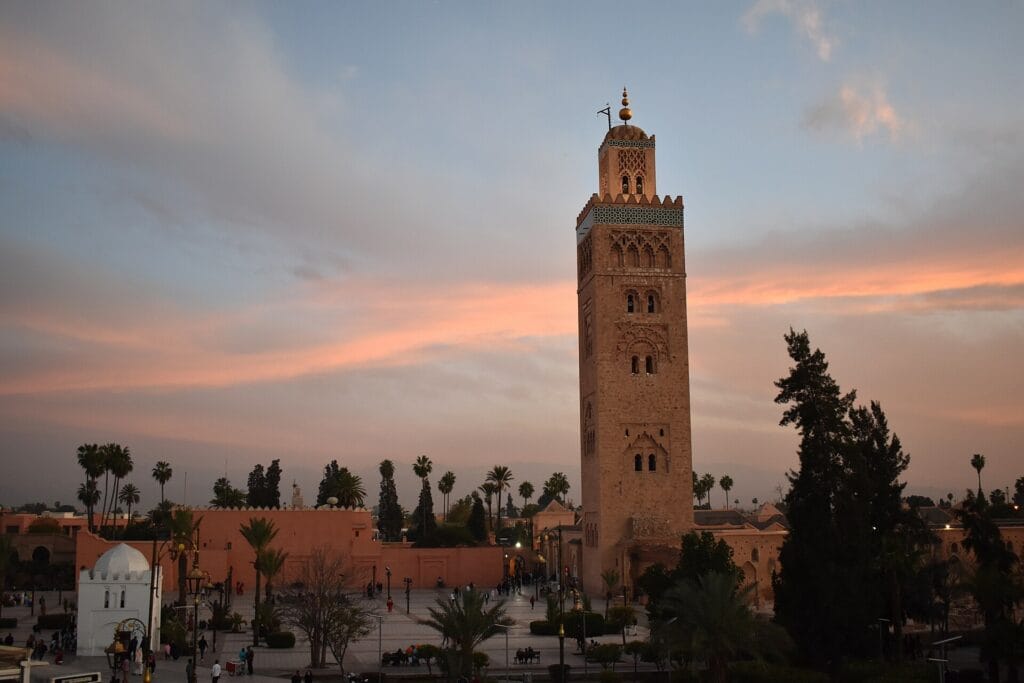
- The main landmarks: memorise the Koutoubia (the tallest minaret, visible from afar) and Jemaa el-Fna square, the nerve centre from which most of the main routes radiate.
- Your riad’s name written in Arabic: useful for asking directions from an established shopkeeper (not a stranger who approaches you).
- Fallback points: identify one or two cafés or squares you know how to get back to if in doubt.
Deliberately getting lost in the medina is part of the experience. As long as you stay in busy alleys and keep your cool, you risk nothing more than a pleasant detour. To prepare for your exploration of the alleys, read our article on the Marrakech medina and the one on the souks of Marrakech, which explain how the areas are organised by artisan districts.
Getting around and organising your days
Outside the medina (Guéliz, Hivernage, Majorelle Garden, Menara), distances are greater and a means of transport becomes useful. Petits taxis, buses and apps make getting around easy. Our guide to getting around Marrakech explains how to use taxis, negotiate or insist on the meter, and reach the main districts. As for planning, if you’re short on time, a 3-day Marrakech itinerary lets you structure your visit without missing anything essential — and without a guide if you prefer.
When a guide is genuinely useful: medina, monuments, excursions
While a guide is not essential, there are situations where they add real value. Here are the cases where hiring an official guide truly makes sense.
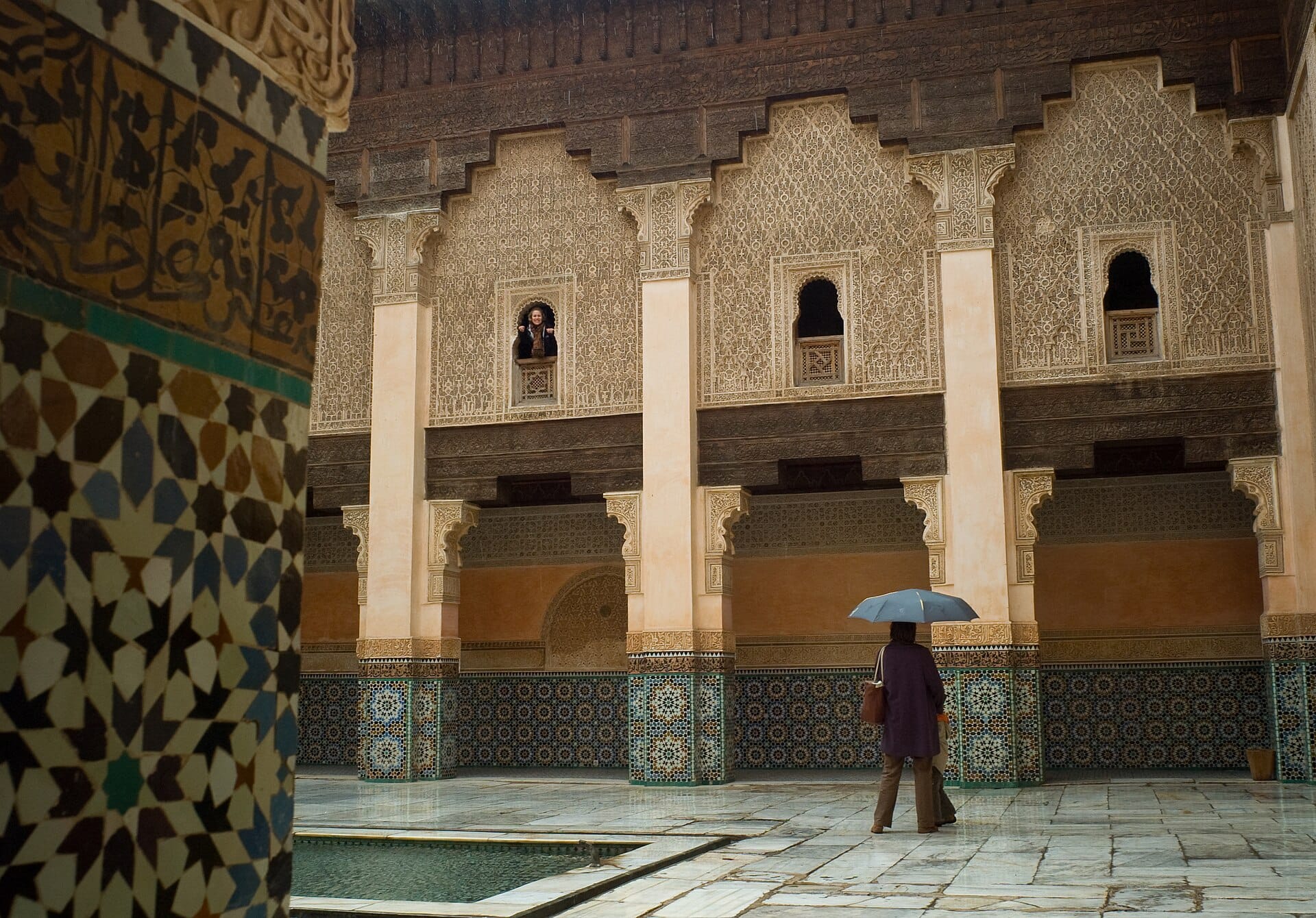
- Understanding the monuments: the Bahia Palace, the Ben Youssef Madrasa, the Saadian Tombs or the El Badi Palace take on a whole new dimension when someone tells you their history, architecture and symbolism. Without commentary, you admire; with a guide, you understand.
- Making the most of a short stay: if you only have a day or two, a guide saves you time by taking you straight to the essentials and avoiding back-and-forth.
- Getting off the beaten track: a good guide knows authentic artisan workshops, viewpoints and hidden corners you wouldn’t find on your own.
- Comfort and peace of mind: accompanied by an official guide, you are far less bothered by fake guides and touts, who leave visitors who are already accompanied alone.
- Excursions outside the city: this is the case where a guide (or driver-guide) is most recommended, for reasons of logistics, language and safety.
In other words, the real question “do you need a guide in Marrakech” has no single answer: it all depends on your travel style. Many visitors opt for a very effective hybrid formula — a guided half-day at the start of the trip to understand the city and get your bearings, then the rest on your own.
Organised guided tours: walking and themed
Between the bespoke private guide and the fully independent visit, there is a very popular middle ground: the organised Marrakech guided tour. These formats, bookable in advance, frame your discovery while remaining affordable.
- Walking tours of the medina: two to four hours in the company of a guide, generally around Jemaa el-Fna, the souks and two or three flagship monuments. Ideal for a first introduction.
- Themed tours: food tours (tasting street specialities), craft circuits, exploring the architecture or the Jewish history of the Mellah. They focus on a specific interest.
- Small-group tours: cheaper than a private guide, they let you meet other travellers while enjoying quality commentary.
- Private tours: more flexible and personalised, they adapt to your pace and your wishes, for a higher price.
The advantage of organised tours is twofold: you know exactly what you’re paying for and you can rely on traveller reviews before booking. It’s also an excellent way to avoid fake guides, since you arrive with a service already confirmed. Just check that the tour is led by an accredited official guide.
Guides for excursions: Atlas, desert and Essaouira
It is probably in the context of excursions that the question “do you need a guide in Marrakech” finds its clearest answer: yes, to leave the city, a guide or driver-guide is strongly recommended. Excursions involve road travel, sometimes unpaved tracks, rural areas where French or English isn’t necessarily spoken, and logistics that are hard to manage alone in a single day.
- The Ourika Valley and the High Atlas: about an hour from Marrakech, this lush valley lends itself to hiking and to discovering Berber villages. A local guide makes it easier to reach the waterfalls and enriches the visit. See our article on the Ourika Valley from Marrakech.
- The Agafay Desert: this stony desert on the city’s doorstep offers sunsets, dinners under the stars and rides. Services there are almost always supervised. Details in our guide to the Agafay Desert near Marrakech.
- Aït Benhaddou and Ouarzazate: on the other side of the Atlas, this listed ksar is worth a guide to grasp its history and its earthen architecture. See our article on Aït Benhaddou and Ouarzazate from Marrakech.
- Essaouira: the Atlantic seaside town, three hours’ drive away, is often visited on a day trip with transport and a guide.
For these outings, favour reputable agencies and accredited driver-guides. Agree on the programme, the stops and the price before departure, and beware of “too good to be true” offers that pile on the shopping stops. Aït Benhaddou, like the Marrakech medina, is in fact a UNESCO World Heritage Site, a testament to the region’s rich history.
How much it costs: price summary
The rates below are given as a rough guide and may vary depending on the season, the duration, whether the service is private or in a group, and what is included. Always negotiate and confirm the price in advance.
- Official guide, half-day in the medina: roughly 200 to 400 MAD (approx. 20-40 EUR).
- Official guide, full day or extended tour: roughly 400 to 700 MAD (approx. 40-70 EUR), or more for a private service.
- Small-group walking tour: often 150 to 400 MAD (approx. 15-40 EUR) per person depending on the format.
- Food tour or themed visit: variable, generally 300 to 700 MAD (approx. 30-70 EUR) per person.
- Full-day excursion with driver-guide: from a few hundred dirhams per person in a group to several hundred for a private outing.
- Monument entry fees: to budget for separately, a few dozen dirhams per site.
Remember that a transparent rate, clearly stated in advance, is the first sign of a serious professional. Conversely, someone who refuses to name a price or talks about “whatever you like” is usually setting you up for an unpleasant surprise at the end.
Tipping: what are the customs?
In Morocco, tipping (baksheesh) is part of the service culture. After a guided tour you’re happy with, it’s customary to leave a small tip for the official guide, even though their service has been paid for. Reckon on a few dozen dirhams depending on the length and your satisfaction — it’s an appreciated gesture, never an obligation. The tip rewards the quality of the service: if it was mediocre, no one will hold it against you.
That said, don’t confuse this gesture with the money demanded by a fake guide. If someone has tagged along without your consent and demands payment, you are not obliged to give in to the pressure. A tip is a voluntary thank-you for an agreed service, not an extorted sum.
Mistakes to avoid with guides in Marrakech
- Following someone who approaches you in the street: this is the open door to the fake-guide scenario. Always book in advance.
- Not agreeing on the price beforehand: the number-one source of misunderstandings. Set the rate and the programme from the start.
- Confusing a guide with a salesperson: if your “guide” spends their time taking you to shops, they’re working on commission, not for you.
- Not asking for the professional card: a simple reflex that immediately rules out fake guides.
- Believing a guide is mandatory everywhere: in the city, no. Don’t let yourself be guilt-tripped by those who claim otherwise.
- Going without a guide for a complex excursion: conversely, for the Atlas or the desert, the support is genuinely worth its price.
- Forgetting the entry tickets: they are not included in the guide’s fee, so plan for them.
FAQ: do you need a guide in Marrakech?
Do you really need a guide to visit Marrakech?
No, it’s not essential for the city. The medina, the souks and the major monuments are easy to visit on your own, with a map and a mapping app. An official guide becomes genuinely useful for understanding the history of the monuments and, above all, for excursions outside the city.
How do you tell an official guide from a fake one?
The official guide holds a professional card with a photo and accreditation number issued by the Ministry of Tourism, which they show without hesitation. They are booked in advance and state a clear rate. The fake guide, on the other hand, approaches you spontaneously in the street, has no card and often tries to drag you into commission-based shops.
How much does an official guide cost in Marrakech?
As a rough guide, expect around 200 to 400 MAD (approx. 20-40 EUR) for a half-day in the medina, and more for a full day or a private tour. Monument entry tickets are generally not included. Always agree on the price and the programme before you begin.
How do you politely avoid fake guides?
Stay courteous but firm: a “no thanks” with a smile, without stopping, is enough in most cases. Never follow someone who approaches you in the street, look like you know where you’re going and, if they insist, step into a shop or a café to break contact.
Is a guide useful for excursions around Marrakech?
Yes, this is in fact the case where it’s most recommended. For the Atlas, the Ourika Valley, the Agafay Desert, Aït Benhaddou or Essaouira, an accredited guide or driver-guide brings comfort, safety and an understanding of the places, while handling the day’s logistics.
Should you tip the guide?
It’s an appreciated custom in Morocco. After a satisfying tour, it’s common to leave a few dozen dirhams for the official guide on top of the agreed rate. This gesture remains voluntary and rewards the quality of the service; it should not be confused with the money demanded by a fake guide.
In summary, the answer to “do you need a guide in Marrakech” is up to you: not essential for exploring the city freely, invaluable for understanding its heritage and all but unavoidable for excursions. Always choose an official guide, be wary of fake guides, and you’ll experience Marrakech as it should be. To go further, the city’s history is detailed on Wikipedia.
Independent guide: moroccoairport.com is an information website not affiliated with ONDA or any official authority.
Images under free licence via Wikimedia Commons: © Omalihy (CC BY-SA 4.0); © Pierre André Leclercq (CC BY-SA 4.0); © Lars Plougmann (CC BY-SA 2.0). Sources: Wikimedia Commons.Photo credits: illustrative images of Marrakech (medina, souks and monuments). Please credit the respective authors of the photographs used.