Morocco’s airports by the numbers hit a historic record: according to the National Airports Office (ONDA), the Kingdom’s airports welcomed 36.3 million passengers in 2025, an increase of 11% over the 32.7 million recorded in 2024. Casablanca-Mohammed V remains the leading hub with more than 11 million travellers, while Marrakesh-Menara crossed the 10-million mark for the first time. This article brings together the official traffic data, the ranking of airports by passenger volume, the international/domestic split and the outlook of the “Airports 2030” strategy. The figures, schedules and statistics quoted are subject to change: always verify with ONDA.
In brief: Morocco’s airports by the numbers
- 36.3 million passengers in 2025 (historic record, +11% year-on-year), according to ONDA.
- 32.4 million international passengers and 3.9 million on domestic routes.
- Casablanca-Mohammed V: 1st airport, more than 11 million passengers, around 32% of national traffic.
- Marrakesh-Menara: 10-million mark crossed for the first time, nearly 28% of traffic.
- Agadir-Al Massira: 3rd hub, around 10% of total traffic.
- Tangier (+17%) and Rabat (+26%) among the strongest growth rates of 2025.
- Around 265,000 aircraft movements (+9%) and nearly 100,000 tonnes of cargo.
- “Airports 2030” strategy: 38 billion dirhams to raise capacity to 80 million passengers.
How many passengers use Morocco’s airports by the numbers?
The direct answer: Morocco’s airports by the numbers totalled 36.3 million passengers over 2025, a level never reached before. This result, announced by ONDA, marks an 11% rise on 2024, a year that had itself set a record with 32.7 million travellers (+21% on 2023). Over two years, Moroccan air traffic has therefore jumped by roughly a third, a momentum driven by tourism, the launch of new routes and major sporting events such as the 2025 Africa Cup of Nations (AFCON) hosted in the Kingdom.
Some press outlets mentioned a slightly higher total, around 36.6 million passengers; ONDA’s official statement retains the figure of 36.3 million. We prioritise the official figure here. These numbers consolidate Morocco’s position as one of North Africa’s main air crossroads, alongside Egypt, and confirm the country’s tourist appeal, having passed the 17-million tourist mark in 2024.
International and domestic traffic: the breakdown
International traffic makes up the bulk of the flows: 32.4 million passengers in 2025, compared with 3.9 million on domestic routes. In other words, nearly 9 out of 10 passengers travel to or from abroad. This dominance is explained by the weight of European tourism and by Casablanca’s role as a connecting hub towards sub-Saharan Africa, North America and the Middle East. Domestic traffic, long limited, is regaining solid growth thanks to routes linking Casablanca, Marrakesh, Agadir, Dakhla and Laayoune.
Aircraft movements and air cargo
Beyond passengers, Morocco’s airports by the numbers also mean around 265,000 aircraft movements in 2025 (landings and take-offs), up 9%, and nearly 100,000 tonnes of air cargo handled. Financially, ONDA posted revenue of around 5.8 billion dirhams (+9%) and net profit close to 1.3 billion dirhams (+16%), a sign of the good health of the national airport sector.
Ranking of Morocco’s airports by the numbers (2025)
ONDA manages 25 airports in Morocco, but traffic is highly concentrated: three hubs (Casablanca, Marrakesh, Agadir) alone gather around 70% of passengers. The table below summarises the 2025 market shares and volumes confirmed or estimated from official data. Volumes marked “estimate” are derived from the market shares released by ONDA and should be treated as orders of magnitude.
| Rank | Airport | Share of 2025 traffic | 2025 passengers (approx.) |
|---|---|---|---|
| 1 | Casablanca-Mohammed V (CMN) | ~32% | More than 11 million |
| 2 | Marrakesh-Menara (RAK) | ~28% | ~10 million |
| 3 | Agadir-Al Massira (AGA) | ~10% | ~3.6 million (estimate) |
| 4 | Tangier-Ibn Battouta (TNG) | ~8% | ~2.9 million (estimate, +17%) |
| 5 | Fes-Saiss (FEZ) | ~6% | ~2.2 million (estimate) |
| 6 | Rabat-Sale (RBA) | ~6% | ~2.2 million (estimate, +26%) |
| 7 | Nador-Aroui (NDR) | ~3% | ~1.3 million (estimate) |
| 8 | Oujda-Angad (OUD) | ~3% | ~1.1 million (estimate) |
Casablanca-Mohammed V, the national hub
Casablanca-Mohammed V airport (IATA code: CMN) remains the Kingdom’s main gateway. In 2025 it topped the 11-million passenger mark for the first time, about 32% of national traffic. The historic base of Royal Air Maroc, it concentrates most long-haul connections, notably towards North America (New York, Montreal, Washington), West and Central Africa and the Middle East. It is also the country’s leading cargo airport.
Marrakesh-Menara, the 10-million milestone
Marrakesh-Menara (RAK) crossed the symbolic threshold of 10 million annual passengers in 2025, a first in its history, representing nearly 28% of traffic. This performance confirms Marrakesh’s status as Morocco’s leading tourist destination, driven by a dense supply of low-cost flights from Europe (Ryanair, easyJet, Transavia) and by the multiplication of routes to France, the United Kingdom, Spain and Italy. The gap with Casablanca narrows year after year.
Agadir, Tangier, Rabat, Fes: the rising hubs
Behind the leading pair, several airports show remarkable growth. Agadir-Al Massira, the gateway to seaside tourism, accounts for around 10% of traffic. Tangier-Ibn Battouta grew by 17% in 2025, driven by the economic dynamism of the north and the Tanger Med port. Rabat-Sale posted the strongest relative growth (+26%), thanks to the development of the administrative capital and the rise of new routes. Fes-Saiss, meanwhile, is consolidating its position as the gateway to cultural and imperial tourism. To compare ways of reaching the city from these hubs, see our comparison of airport transfers in Morocco.
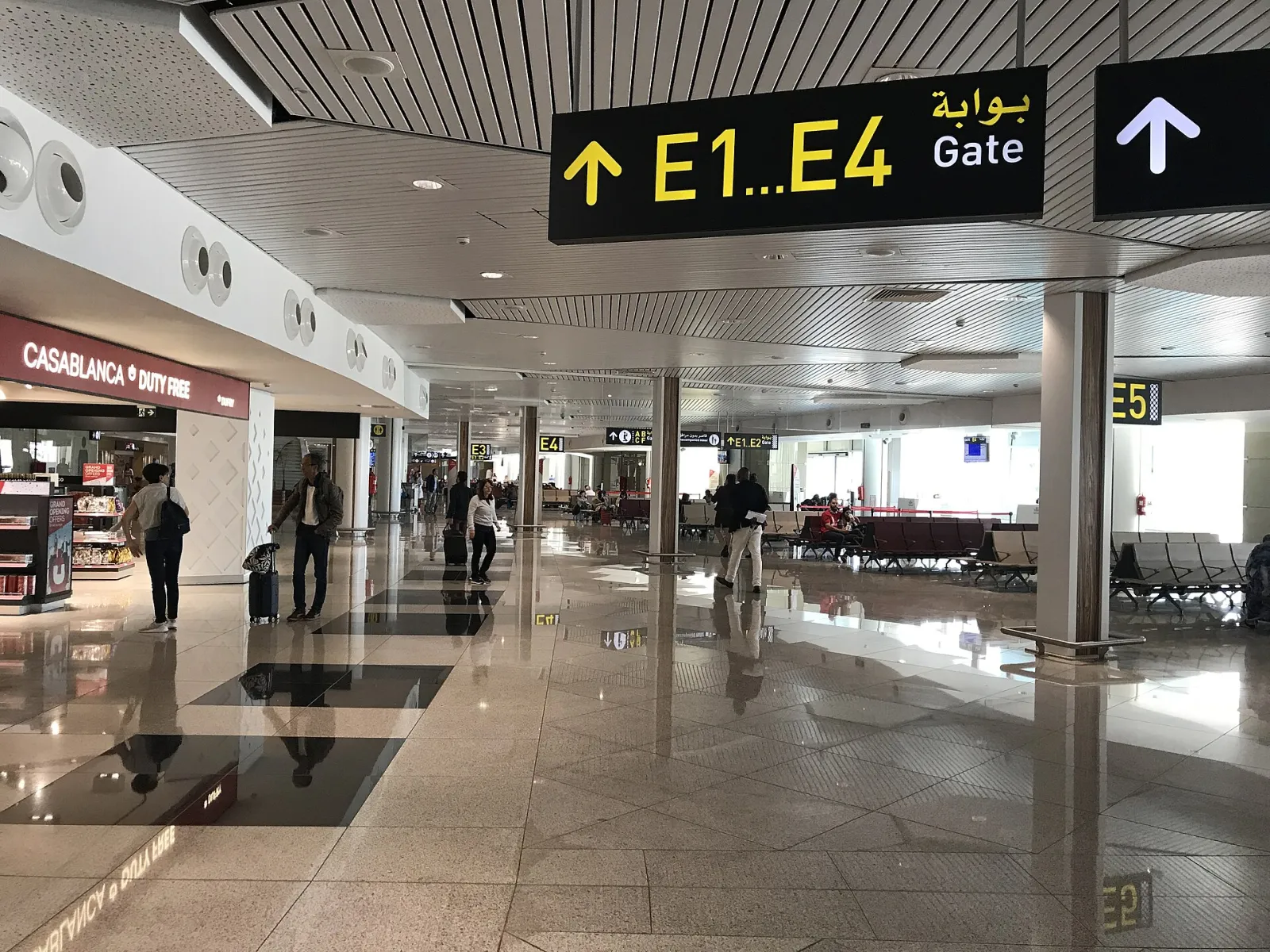
Morocco’s airports by the numbers in 2026 (first 7 months)
The momentum continues in 2026. Over the first seven months of the year (January to July), ONDA recorded 22,282,997 passengers, up 8.77% on the same period in 2025. International traffic reached 19.89 million travellers (+8.82%) and domestic 2.39 million (+8.36%). This more recent, airport-by-airport data offers a reliable snapshot of the current hierarchy of Morocco’s hubs.
| Rank | Airport | Passengers (Jan-Jul 2026) |
|---|---|---|
| 1 | Casablanca-Mohammed V (CMN) | 6,953,695 |
| 2 | Marrakesh-Menara (RAK) | 6,407,303 |
| 3 | Agadir-Al Massira (AGA) | 2,179,857 |
| 4 | Tangier-Ibn Battouta (TNG) | 1,711,764 |
| 5 | Rabat-Sale (RBA) | 1,446,355 |
Where do international passengers come from?
The origin of international travellers confirms the weight of Europe. Over the first seven months of 2026, ONDA counts 16.54 million passengers to or from Europe (+9.29%), 1.18 million for Africa (+13.74%), 581,000 for North America (+14.54%), 1.24 million for the Middle East and Far East (-4.12%) and nearly 63,000 for South America (+34.21%). Europe remains by far the top source market, but Africa and North America are growing markedly, illustrating Morocco’s diversification strategy.
Traffic growth and evolution (2023-2025)
To gauge the scale of the post-pandemic recovery, the following table traces the evolution of total traffic at Morocco’s airports. After the 2020-2021 collapse, the sector rebounded and then far exceeded its pre-crisis levels.
| Year | Passengers (total) | Change |
|---|---|---|
| 2023 | ~27 million | Post-Covid recovery |
| 2024 | 32.7 million | +21% |
| 2025 | 36.3 million | +11% |
| 2026 (7 months) | 22.3 million | +8.77% |
As a historical benchmark, the 2023 ranking (public data) placed Casablanca at 9.79 million passengers, Marrakesh at 6.9 million, Agadir at 2.3 million, Tangier at 1.91 million, Fes at 1.72 million, Rabat at 1.20 million, Nador at 1.03 million and Oujda at 938,000. The comparison with 2025 illustrates the speed of growth, particularly at Marrakesh (roughly +45% in two years) and Rabat.
Why is Moroccan air traffic breaking records?
Several factors explain this surge. First, tourism: Morocco has passed the 17-million tourist mark and is aiming higher. Second, air connectivity: Royal Air Maroc, but also low-cost and scheduled carriers, have multiplied frequencies and opened new routes. For a full overview, see our guide to the airlines flying to Morocco.
Major events have also acted as accelerators. The 2025 Africa Cup of Nations (AFCON), hosted in Morocco, generated an exceptional influx of fans from across the continent and beyond. Above all, the country is preparing to co-host the 2030 World Cup with Spain and Portugal, a horizon that shapes the entire airport strategy. We detail these stakes in our feature on Morocco’s airports and the 2030 World Cup.
Airports 2030: aiming for 80 million passengers
To absorb this growth, ONDA has launched the “Airports 2030” strategy, backed by an envelope of around 38 billion dirhams. The goal: to raise the network’s capacity to 80 million passengers a year by 2030, a doubling of current capacity. The flagship project is a new hub terminal at Casablanca-Mohammed V, together with a new runway, a new control tower and intermodality with the high-speed rail line (LGV), for around 25 billion dirhams. This work aims to raise Casablanca’s capacity to 35 million passengers by 2029.
Extensions also concern Marrakesh, Agadir, Tangier, Fes, Rabat and Tetouan. The remaining 13 billion or so dirhams are allocated to maintenance, modernisation and land acquisition. This programme is part of the preparation for the 2030 World Cup and of the ambition to make Morocco a benchmark air hub between Europe, Africa and the Americas. Smaller airports are not forgotten: for example, the modernisation of regional hubs such as Tetouan-Sania Ramel airport supports the opening up of the territories.
Morocco’s regional and secondary airports
While attention often focuses on Casablanca and Marrakesh, the Moroccan network includes many regional airports that play a key role in connectivity and niche tourism. Nador-Aroui and Oujda-Angad, in the Oriental region, capture a significant share of traffic from Moroccans living abroad (MRE), particularly during the summer. In 2023, Nador exceeded 1 million passengers and Oujda approached 940,000, volumes that have continued to grow since. Both hubs are strongly connected to Belgium, the Netherlands, Germany and France.
In the south, the Hassan I airport in Laayoune and the one in Dakhla support the development of the Saharan provinces, with mostly domestic but growing traffic. Dakhla, a popular kitesurfing destination, passed 230,000 passengers in 2023. Finally, airports such as Essaouira-Mogador and Ouarzazate serve specialised tourist markets: Essaouira attracts European visitors seeking authenticity, while Ouarzazate remains the gateway to the desert and to film studios. These hubs, though modest in volume, are strategic for regional planning.
| Airport | City / region | 2023 passengers (reference) |
|---|---|---|
| Nador-Aroui (NDR) | Nador (Oriental) | 1,025,652 |
| Oujda-Angad (OUD) | Oujda (Oriental) | 938,058 |
| Hassan I (EUN) | Laayoune | 254,768 |
| Dakhla (VIL) | Dakhla | 234,831 |
| Essaouira-Mogador (ESU) | Essaouira | 180,302 |
| Ouarzazate (OZZ) | Ouarzazate | 138,454 |
Seasonality: when does traffic peak?
Morocco’s airport traffic by the numbers reveals strong seasonality. July and August concentrate the peaks, with the massive arrival of European tourists and the return of the MRE for the summer holidays. As an illustration, the first seven months of 2026 already accumulated 22.3 million passengers, a pace that points to an annual total close to, or even above, that of 2025. Spring (April-May) and autumn are dynamic shoulder seasons, particularly for Marrakesh and Agadir, driven by a mild climate. Winter remains quieter, apart from the year-end holidays and festival periods.
This seasonality calls for fine management of airport capacity. At summer peak hours, hubs such as Marrakesh or Agadir operate at saturation, which justifies the extension projects planned under the Airports 2030 strategy. For travellers, this means it is wise to anticipate waiting times at security checks during the high season and to book transfers in advance.
Morocco, a heavyweight of African skies
With 36.3 million passengers in 2025, Morocco ranks among the very top air markets in Africa, competing with Egypt and South Africa for the continental lead. Casablanca-Mohammed V is a durable fixture in the top three busiest African airports, while Marrakesh establishes itself as one of the continent’s leading tourist airports. This position rests on Royal Air Maroc’s connectivity strategy, which has made Casablanca a preferred connecting hub between Europe, North America and West and Central Africa, with flights to more than thirty African destinations.
The rise of Moroccan air transport has a direct economic impact: jobs, tourism revenue, appeal to investors and diplomatic influence. The air sector is also a lever for hosting major events. The combination of AFCON 2025 and the prospect of the 2030 World Cup places Morocco on a trajectory of sustained growth, provided the infrastructure keeps pace, which is precisely the purpose of the ongoing investments.
How to read and verify these figures?
Understanding Morocco’s airports by the numbers requires knowing where the data comes from. ONDA, a public body under the Ministry of Transport, publishes monthly and annual traffic statistics. The passenger count corresponds to the total of arrivals and departures (a connecting passenger may be counted twice depending on the methodology), which sometimes explains slight differences between press sources. Likewise, a “provisional” annual total published in January may be revised in spring: this is the case for the 2025 figure, first announced as an estimate and then consolidated at 36.3 million.
For a reliable analysis, always prefer the primary source (ONDA’s statements) over secondary re-reports, and systematically note the reference year. Market shares (32% for Casablanca, 28% for Marrakesh) are more stable than absolute volumes, which change every month. Finally, bear in mind that air traffic is sensitive to circumstances: sporting events, the opening or closing of routes, fuel prices and the geopolitical context can cause these figures to vary from one year to the next. That is why we remind you that all the data in this article is subject to change.
FAQ: Morocco’s airports by the numbers
How many passengers did Morocco’s airports welcome in 2025?
According to ONDA, Morocco’s airports welcomed 36.3 million passengers in 2025, a historic record up 11% on 2024 (32.7 million).
What is the largest airport in Morocco?
Casablanca-Mohammed V (CMN) is the largest airport in Morocco, with more than 11 million passengers in 2025, around 32% of national traffic. It is the Kingdom’s main international and connecting hub.
Which Moroccan airport has the strongest growth?
In 2025, Rabat-Sale posted the strongest relative growth at +26%, ahead of Tangier-Ibn Battouta (+17%). Marrakesh-Menara achieved the most striking performance by volume, crossing 10 million passengers.
What is the share of international traffic in Morocco?
International traffic makes up the bulk of the flows: 32.4 million passengers in 2025, versus 3.9 million domestic, or about 89% of the total. Europe is the top source market.
How many airports does Morocco have?
ONDA manages 25 airports in Morocco, around fifteen of which are open to international traffic. Traffic is nonetheless very concentrated: Casablanca, Marrakesh and Agadir together gather around 70% of passengers.
What is the goal of the Airports 2030 strategy?
ONDA’s “Airports 2030” strategy, backed by around 38 billion dirhams, aims to raise the capacity of Morocco’s airports to 80 million passengers a year by 2030, notably through a new hub terminal at Casablanca.
Is traffic still rising in 2026?
Yes. Over the first seven months of 2026, Morocco’s airports welcomed 22.3 million passengers, up 8.77% year-on-year, confirming the record trend of previous years.
Where can I find official statistics for Morocco’s airports?
Official statistics are published by ONDA (onda.ma), which issues monthly and annual press releases. For precise, up-to-date figures, consult the ONDA website directly.
In summary
Morocco’s airports by the numbers reflect a spectacular success: 36.3 million passengers in 2025 (+11%), a 10-million mark crossed at Marrakesh, a Casablanca hub beyond 11 million, and growth that continues into 2026. Driven by tourism, air connectivity and major sporting events, this momentum feeds the “Airports 2030” strategy and its target of 80 million passengers. Keep in mind that these statistics are subject to change: for any travel or analytical decision, refer to ONDA’s official publications.
Official sources
- National Airports Office (ONDA) — official statistics and press releases.
- Médias24 — 2025 traffic review and Airports 2030 strategy.
- Air Journal — Morocco’s record air traffic in 2025.
- Morocco World News — first seven months 2026 traffic by airport.
- Le Desk — Airports 2030 strategy and the 80-million passenger target.
Photo credit
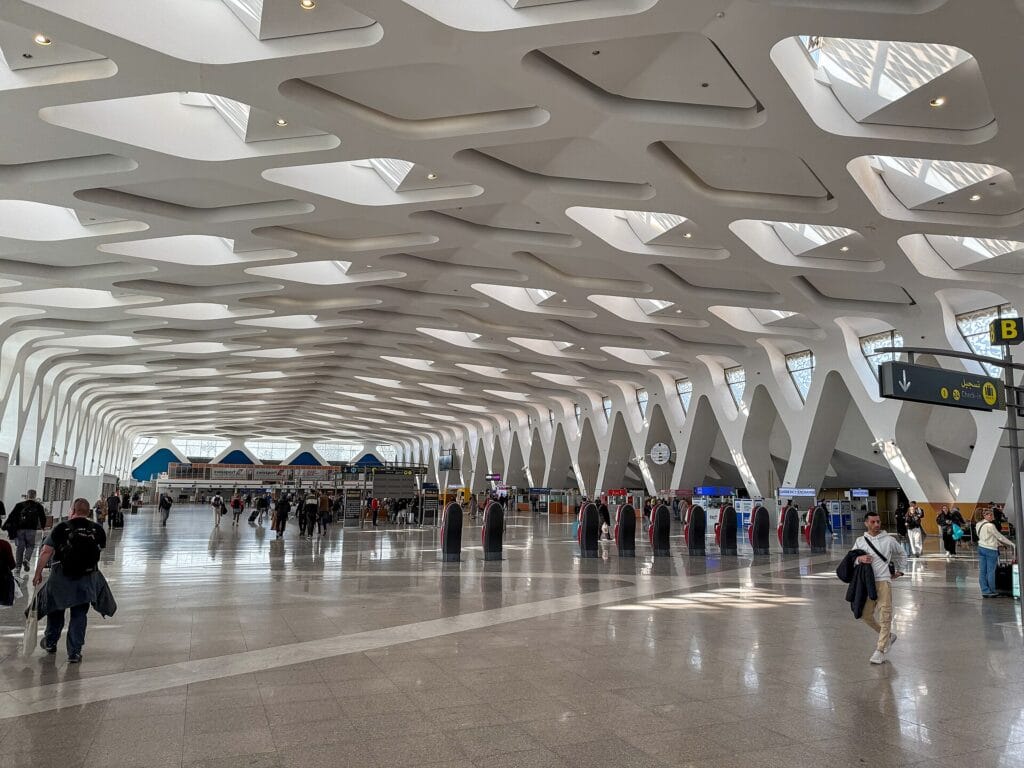
Illustrations : « Flight departure board, Perth Airport » — Bahnfrend (CC BY-SA 4.0) ; « Mohammed V International Airport – Terminal 1 » — Hamza Izourane (CC BY-SA 4.0), via Wikimedia Commons.