For anyone living in Switzerland, travel insurance for Morocco from Switzerland is not an optional extra: basic LAMal/KVG cover pays only for emergency treatment in Morocco, capped at twice what the same care would have cost in Switzerland, and it never pays for medical repatriation. Everything else — evacuation, a medically escorted flight home, the deposit a private clinic in Marrakech asks for before treating you — depends entirely on what you arranged before boarding in Geneva, Zurich or Basel.
Information verified in September 2026.
In short
- Swiss basic health insurance covers emergency treatment abroad up to twice the amount that would have been paid in Switzerland, under Article 36 of the Health Insurance Ordinance (OAMal/KVV), as the Federal Office of Public Health confirms.
- Medical repatriation is not a basic-insurance benefit: it depends on supplementary cover, a travel policy or Rega.
- Rega patronage costs CHF 40 a year for an adult and is free for children and young people until 15 May following their 18th birthday; it includes medical repatriation to Switzerland, but Rega states plainly that it is not an insurance company.
- No vaccination is required to enter Morocco from Switzerland; hepatitis A and up-to-date routine vaccinations are the most consistent recommendations.
- Morocco has been certified malaria-free by the World Health Organization since 2010, so no antimalarial treatment is needed.
- Private Moroccan clinics expect payment up front, in cash or by card depending on the facility.
- Moroccan emergency numbers: 19 (urban police), 177 (Royal Gendarmerie outside towns), 15 (civil protection and ambulance), 141 (SAMU), 112 from a mobile.
Quick facts: health and travel insurance for Morocco from Switzerland
This table sums up what a Swiss resident should have settled before departure. The figures are those published by the institutions concerned in September 2026; private insurance premiums vary by insurer and age and must be checked individually.
| Item | Situation for a Swiss resident |
|---|---|
| Basic LAMal cover in Morocco | Emergencies only, up to twice the Swiss tariff (Art. 36 OAMal) |
| Medical repatriation | Not covered by basic insurance |
| Rega patronage | CHF 40 a year per adult; free until 15 May following the 18th birthday |
| Rega number from Morocco | +41 333 333 333, around the clock |
| FDFA Helpline | +41 800 24-7-365 or +41 58 465 33 33, around the clock |
| Compulsory vaccination on entry | None from Switzerland (yellow fever certificate only if arriving from an endemic area, to be checked) |
| Malaria | Country certified malaria-free by the WHO since 2010 |
| Paying for care on site | Payment in advance in the private sector, card or cash depending on the clinic |
| Time difference with Switzerland | Morocco moved back to GMT (UTC+0) on 20 September 2026: one hour behind Switzerland in winter, two hours in summer |
| Flight time from Switzerland | Roughly 3 h to 3 h 45 depending on the departure airport and the destination |
What does Swiss basic insurance actually cover in Morocco?
Compulsory Swiss health insurance covers treatment carried out as an emergency in Morocco, meaning illness or injury that makes a return to Switzerland medically inadvisable. The Federal Office of Public Health states that such costs are reimbursed up to twice the amount that would have been paid had the treatment taken place in Switzerland. Other medical services provided abroad are in principle not covered.
This double-tariff rule comes from Article 36 OAMal, and it has a consequence few travellers anticipate. It protects you very well in a country where care costs less than in Switzerland, which is the case in Morocco, and far less well in the United States or Japan. For a stay in Marrakech or Agadir the reimbursement ceiling is almost never the real problem. The real problem lies elsewhere: what basic insurance refuses to pay for by design, and the money you have to produce on the spot.
Hospital stays: the ceiling drops to 90 per cent
For an inpatient stay abroad, the FOPH explains that reimbursement is capped at 90 per cent of the equivalent Swiss cost, because when someone is hospitalised in Switzerland the cantons pay at least 55 per cent of the bill. In other words, the cantonal share does not follow the patient across the border. Over a hospital stay of several days, the gap quickly runs into thousands of francs.
Deductible, co-payment and the detail everyone forgets
The minimum annual deductible remains CHF 300 for an adult, with a 10 per cent co-payment capped at CHF 700 a year. The FOPH adds a point most people miss: the share you pay abroad is not credited against your Swiss deductible and co-payment. You can therefore pay your part in Morocco and still pay your full deductible in Switzerland in the same calendar year. That is not an error by your insurer; it is the rule.
The European Health Insurance Card is worthless in Morocco
The European Health Insurance Card you use in France or Italy carries no weight in Morocco, which is outside the EU/EFTA coordination area. There is no direct-billing arrangement between a Swiss health insurer and a Moroccan facility. In practice you pay, you keep the original invoices, and you claim reimbursement once home, with translations if your insurer asks for them.
Why repatriation is the real hole in Swiss cover
Medical repatriation does not appear in the benefit catalogue of Swiss basic insurance. If a road accident near Essaouira or a heart attack in Casablanca requires a medically supervised transfer back to Switzerland, neither LAMal nor the Moroccan health system pays for it. The bill is yours, unless supplementary cover, a travel policy or Rega steps in.
There is no official price for a repatriation: everything depends on the patient’s condition, the means of transport and the distance. The gap between a scheduled-flight ticket with a nurse escort and a chartered air ambulance, which runs into tens of thousands of francs, is enormous. Morocco has a geographical advantage here: three and a half hours of flying from Switzerland, which makes an escorted return on a scheduled flight possible in many situations. What Rega does publish shows the collective financial stake: the foundation says it waived more than CHF 14 million in intervention costs for its patrons over one year. Someone still has to organise that return and pay for it.
Rega: what CHF 40 a year really buys
Swiss Air-Rescue Rega offers patronage at CHF 40 a year for an adult, free for children and young people until 15 May following their eighteenth birthday. Worldwide, patronage gives access to round-the-clock medical advice from Rega’s operations centre and to the organisation of a medical repatriation flight to Switzerland for people resident in Switzerland and Swiss nationals living abroad.
The nuance matters, and Rega states it without hedging: it is not an insurance company and has no legal obligation to assume costs. Its conditions of patronage speak of waiving or reducing the costs of an operation when no insurer is liable for them, decided case by case on medical, social and operational grounds. A patron therefore gets organisation and a probable financial waiver, not a contractual right.
The number to save before you leave
From Morocco, Rega is reached on +41 333 333 333, available at all hours. The short number 1414 works only inside Switzerland. Save the international number in your phone before take-off and write it on paper as well: a lost phone or a dead battery at the wrong moment remains the most ordinary of scenarios. Check too that your Swiss mobile plan lets you call Switzerland from Morocco without a nasty surprise, a question covered in our guide to using a Swiss mobile plan in Morocco.
Travel insurance for Morocco from Switzerland: supplementary policy, credit card or ETI booklet?
Three families of solutions exist in Switzerland to fill the gap basic insurance leaves: supplementary insurance under the Insurance Contract Act, taken out with your health insurer; annual travel insurance, of which the TCS ETI booklet is the best-known product; and the benefits attached to certain Swiss credit cards. They are not equivalent and they overlap, which explains how many travellers end up paying twice for the same guarantee.
| Solution | Medical costs in Morocco | Repatriation | Watch out for |
|---|---|---|---|
| LAMal (basic insurance) | Emergencies, up to twice the Swiss tariff | No | Reimbursement after the fact, against invoices |
| LAA accident insurance (employees) | Accidents, up to twice the Swiss tariff | Depends on the accident insurer | Accidents only, not illness |
| Rega patronage (CHF 40/year) | Not covered | Organised; waiver likely but discretionary | A foundation, not an insurer |
| Supplementary insurance | Depends on the policy | Usually yes | Health questionnaire when joining |
| TCS ETI booklet | Medical expenses in the Plus version | Covered if organised by the ETI centre | TCS membership required |
| Swiss credit card | Varies by issuer and card: Viseca advertises CHF 250,000 of medical costs with its Gold cards and CHF 500,000 with Visa Platinum | Viseca: CHF 250,000 with a Gold, unlimited with Visa Platinum; elsewhere per the conditions | Private trips of 90 days maximum at Viseca; some issuers require the trip to have been paid with the card |
The credit card trap
Swiss Gold and Platinum cards come with travel insurance benefits that look generous on paper. The conditions published by Viseca, one of the main Swiss issuers, give the scale: CHF 250,000 of medical costs and CHF 250,000 of repatriation with a Gold card, CHF 500,000 of medical costs and unlimited repatriation with a Visa Platinum, for cardholders resident in Switzerland and for private trips of 90 days at most. Three reflexes are essential before relying on them in Morocco.
- Read the trigger condition: depending on the issuer, the guarantee only activates if the trip, or a defined share of it, was paid with the card. Viseca does not set that condition in the travel assistance benefits published on its site; other issuers do. Where it applies, a Geneva-Marrakech ticket settled by bank transfer is enough to void the cover.
- Check the length of stay covered: at Viseca the guarantee applies to private trips of 90 days at most. A longer stay, or a trip that is not private, falls outside the cover even if everything else is in order.
- Separate assistance from reimbursement: many cards provide a telephone assistance centre without paying the full medical bill or the repatriation. The word “assistance” is not a synonym for payment.
The contractual detail, outside the Swiss context, is developed in our guide to travel insurance for Morocco, which compares the guarantees worth looking for whatever your country of departure.
Accident rather than illness: the quiet role of LAA cover
In Switzerland, an employee working at least eight hours a week for the same employer is insured against non-occupational accidents by compulsory accident insurance, not by their health insurer. That distinction, invisible day to day, becomes very concrete in Morocco: a quad-bike fall in the palm grove or a scooter accident in Agadir is a matter for the LAA insurer, not for LAMal.
The reimbursement principle is comparable: Article 17 of the Accident Insurance Ordinance (OLAA) provides that the cost of necessary medical treatment undergone abroad is reimbursed only “up to twice the amount that would have resulted from treatment in Switzerland”. What matters most is the administrative reflex: once home, an accident report must go to your employer, who passes it to the accident insurer. Sending Moroccan invoices to the health insurer when the case is an accident is the leading cause of claims stuck for months.
If you are self-employed, retired, a student without gainful activity or employed for fewer than eight hours a week, accident cover must be included in your health insurance. One phone call to your insurer before departure settles the question.
Which vaccinations before leaving Switzerland?
No vaccination is required to enter Morocco from Switzerland, apart from a yellow fever certificate if you are arriving from a country where the disease is endemic, a requirement to verify with the Moroccan representation if your itinerary passes through sub-Saharan Africa or South America. The useful recommendations are therefore prudential, not entry conditions.
- Routine vaccinations up to date: diphtheria, tetanus, pertussis, polio, measles-mumps-rubella. This is the baseline and the one most often neglected by adults.
- Hepatitis A: broadly recommended for Morocco, since transmission is through water and food.
- Hepatitis B: recommended for long or repeated stays, or where medical exposure is possible.
- Typhoid: considered depending on the length and the conditions of the stay, particularly away from hotel circuits.
- Rabies: discussed for rural stays, long stays and young children, Morocco having a stray dog population.
These recommendations are published on safetravel.ch, the Swiss travel-medicine platform, and are best discussed in consultation. Allow four to six weeks for a complete schedule, more if rabies is on the table. Travel medicine clinics at the university hospitals in Geneva, Lausanne, Bern, Basel and Zurich, along with many private practices, administer these vaccines; reimbursement by basic insurance is partial and varies by vaccine, which is worth asking about when you book the appointment.
There is no malaria in Morocco
Morocco was certified malaria-free by the World Health Organization in 2010, a certification the WHO grants only after several consecutive years with no local transmission. No antimalarial prophylaxis is needed, including in the south and in the oases. The cases recorded in the country are imported by travellers coming from endemic areas. Good mosquito protection nevertheless retains its value for comfort and for arboviral infections.
The detail of vaccines, boosters and special situations is developed in our health and vaccinations guide for Morocco.
Water, food and minor health troubles
Traveller’s diarrhoea is by far the leading reason a tourist consults a doctor in Morocco. It is rarely serious, but it easily ruins three days out of seven and causes fast dehydration when it is 38 degrees in Marrakech in July. The rules are well known and they work.
- Sealed bottled water for drinking and, if your stomach is sensitive, for brushing your teeth. Mains water is treated in the big cities, but its flora is not the one you are used to.
- Be careful with ice in modest establishments, with raw vegetables washed in tap water, and with fruit you have not peeled yourself.
- Food served piping hot in a busy local eatery is often safer than a lukewarm buffet kept standing for hours.
- Wash your hands or use sanitiser before every meal: the highest-yield habit of the trip.
- See a doctor if diarrhoea lasts more than 48 hours, if there is blood, a high fever or signs of dehydration, especially in a child or an older person.
Two risks are underestimated by travellers leaving Switzerland. Heat first: someone flying out of Geneva at 22 degrees lands in Marrakech at 42 degrees in August, with no transition for the body. Then the road: traffic accidents are statistically the most real danger for a tourist in Morocco, far ahead of exotic diseases. A rental car with poor insurance and a night drive on a secondary road combine both bad ideas.
Where to get treatment in Marrakech, Casablanca and Agadir?
Morocco runs two parallel networks: a public system built around university hospital centres and regional hospitals, and a private clinic sector that is well developed in the large cities and tourist areas. For a Swiss traveller the usual reflex is the private clinic: short waiting times, French-speaking staff, modern equipment in the leading facilities, but payment in advance every time.
| City | Private reference point | Public reference point | Note |
|---|---|---|---|
| Marrakech | Clinique Internationale de Marrakech, CIM Santé group, emergencies 24/7 | CHU Mohammed VI | Best-equipped city in the south for tourists; verify contact details before departure |
| Casablanca | Clinique Internationale, 102 boulevard Anoual, emergencies advertised 24/7 | CHU Ibn Rochd | Widest offering in the country, including heavy specialties |
| Agadir | Private clinics in the city centre; ask your hotel which one it works with | Public regional hospital | Seaside resort heavily visited from Switzerland in winter; a narrower offering than Casablanca for serious cases |
One piece of advice that costs nothing: on arrival day, ask your hotel or riad — a traditional courtyard house converted into accommodation — which clinic they call when there is a problem and which doctor makes house calls. These places work with practitioners used to foreign guests, and that information gathered calmly beats a frantic search at two in the morning.
How much does care cost and how do you pay up front?
Care in Morocco costs considerably less than in Switzerland, which makes the double-Swiss-tariff ceiling more than sufficient for a consultation or a visit to A&E. The difficulty is not the final amount: it is immediate cash flow, because private clinics ask for payment or a guarantee before treating, and no direct-billing agreement links a Swiss insurer to a Moroccan facility.
One official benchmark helps set the scale: Morocco’s national reference tariff, the reimbursement basis for local compulsory health insurance, sets a general practitioner consultation at 80 dirhams and a specialist consultation at 150 dirhams. That basis is old and the gap with reality is acknowledged by the institutions themselves: the CNSS management noted that the cost actually borne by the insured person reaches at least 150 dirhams for a general practitioner and at least 250 dirhams for a specialist. A revision of this tariff was approved by the CNSS board in June 2019 and new national conventions were initialled in January 2020. These figures are reimbursement bases for Moroccan insured patients, not the prices a private clinic charges a foreign patient, which are higher and freely set. They still give the order of magnitude: tens of francs for a consultation, not hundreds.
- Carry a credit card with enough available limit: a hospital admission requires a guarantee that quickly exceeds the daily ceiling on a debit card.
- Tell your Swiss bank you are travelling to Morocco if your card is geoblocked by default.
- Always insist on a detailed, receipted invoice naming the facility, the date, the procedures performed and bearing a stamp. A Swiss insurer rejects vague paperwork.
- Photograph every document on the spot: an original lost during a hotel transfer is unrecoverable once you are home.
- Keep pharmacy receipts too, with the matching prescription.
One last reflex: check your daily withdrawal limit with your Swiss bank. A deposit demanded on a Sunday evening, when the weekly ceiling has already been eaten into by holiday spending, takes far longer to settle than you would expect.
Moroccan emergency numbers and the reflexes that help
Dialling the right number saves long minutes. In Morocco the split is not the Swiss one: the police operate in urban areas only, the Royal Gendarmerie covers the countryside and the roads, and medical rescue falls to the civil protection service or the SAMU depending on the city. All these numbers are free from a landline or a mobile.
| Service | Number | When to call |
|---|---|---|
| Police (urban areas) | 19 | Assault, theft, accident in town |
| Royal Gendarmerie | 177 | Roads, countryside, outside towns |
| Civil protection, fire, ambulance | 15 | Medical emergency, fire, rescue |
| SAMU | 141 | Medical emergency in cities that have a SAMU |
| European number from a mobile | 112 | When you do not know which to dial |
| Rega, from abroad | +41 333 333 333 | Medical advice and repatriation to Switzerland |
| FDFA Helpline | +41 800 24-7-365 or +41 58 465 33 33 | Any urgent consular question, 24/7 |
Two Swiss steps complete the list. First, download the Federal Department of Foreign Affairs’ free Travel Admin app, which replaced Itineris. It lets you register your trip, receive FDFA push notifications in a crisis, locate Swiss representations and reach the Helpline. Second, note the details of the Swiss embassy in Rabat, which covers the whole of Morocco, and check on the FDFA website before departure whether an honorary representation exists in the region where you are staying. The Helpline also answers by email, at helpline@eda.admin.ch.
Pharmacies and the kit to bring from Switzerland
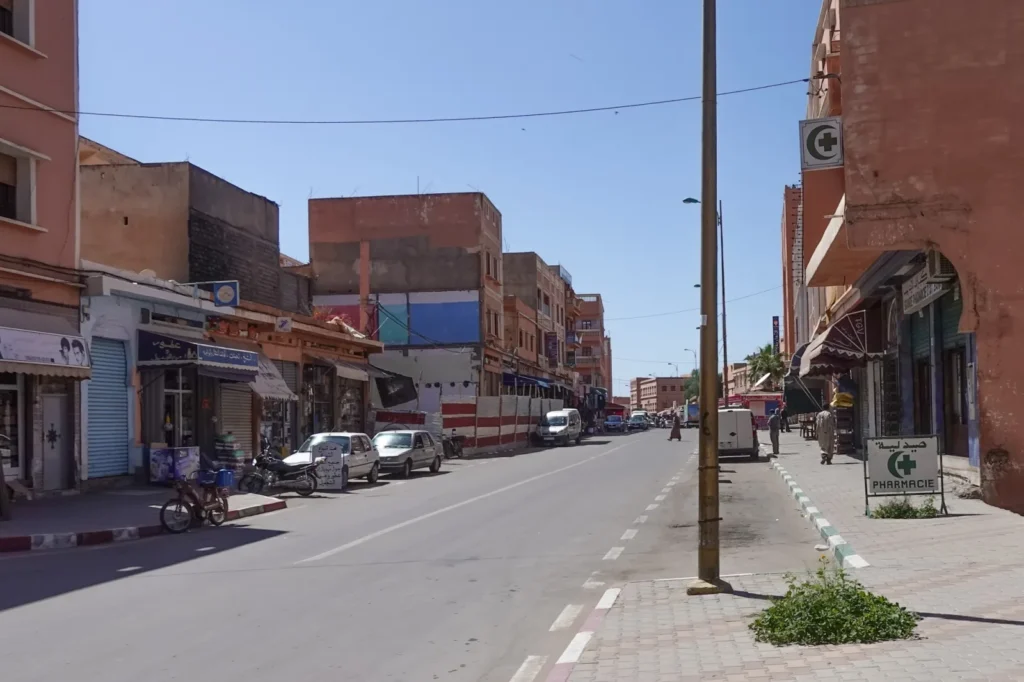
Morocco’s pharmacy network is dense, including in medium-sized towns, and the duty pharmacy system provides night and public holiday cover, usually posted in the window of closed pharmacies. Pharmacists almost always speak French, and many common medicines are available without prescription at prices below Swiss levels.
That does not excuse leaving your own treatment behind, for three reasons: your exact brand may not be marketed in Morocco, trade names often differ, and interrupting a chronic treatment while travelling is an avoidable risk. Bring enough for the stay with a margin, in original packaging, together with the prescription. For sensitive treatments — psychotropics, opioids, narcotics, injectables — Moroccan customs rules are strict and an authorisation or declaration may be required. The FDFA points out that importing medicines containing narcotics or substances used to treat mental disorders is subject to special rules in many countries. Check with the Moroccan customs administration or the Moroccan consulate in Switzerland before leaving; rules change, and a written answer beats an assumption.
- Personal treatment in sufficient quantity, original packaging, prescription in French using international non-proprietary names.
- Oral rehydration sachets, an antidiarrhoeal, an antispasmodic.
- Paracetamol, an antihistamine, skin disinfectant, dressings.
- High-factor sunscreen and sunglasses: the sun in southern Morocco bears no relation to a summer on the Swiss Plateau.
- A paper copy of your insurance card, your supplementary policy and your Rega patron card.
Special cases nobody covers
Generic guides assume every traveller leaving Switzerland is a Swiss citizen insured under LAMal in Switzerland. Reality in the border cantons and the large cities is more varied, and three situations deserve a precise answer.
Swiss resident of another nationality
What counts for health cover is your affiliation, not your passport. A Portuguese, French or Moroccan national domiciled in Switzerland and insured under LAMal receives exactly the same benefits in Morocco as a Swiss citizen. The difference is consular: in a serious incident, assistance from the FDFA and the Swiss embassy in Rabat is for Swiss nationals. A non-Swiss resident falls under their own country’s representation, which stops neither Rega patronage nor a travel policy taken out in Switzerland from working, since both follow domicile and contract.
Swiss-Moroccan dual nationality
Moroccan authorities treat a dual national as a Moroccan national on the Kingdom’s territory. That changes nothing about your LAMal cover, which follows your Swiss domicile, but it can limit the room for Swiss consular intervention in a matter governed by Moroccan law. Medically, a dual national domiciled in Switzerland is not affiliated to Moroccan compulsory health insurance unless they contribute to it: they pay like any foreign patient in the private sector. The consequences for entry formalities are set out in our article on entering Morocco from Switzerland.
Cross-border workers and departures from EuroAirport
Many travellers from the Basel region fly out of EuroAirport Basel-Mulhouse-Freiburg, a binational airport where a Swiss sector and a French sector coexist. The point of departure has no bearing whatsoever on your health cover: your domicile, your affiliation and your contracts determine your rights. A cross-border worker insured in France under the right of option, or a posted worker, should however check with their own scheme what applies outside Europe, since the rules differ appreciably from LAMal.
Mistakes to avoid before leaving for Morocco
- Assuming basic insurance is enough. It covers the emergency on site, never the medically supervised return.
- Relying on the European Health Insurance Card: it has no value in Morocco.
- Paying three times for the same guarantee. A supplementary policy with repatriation, an ETI booklet and a Platinum card largely cover the same risks. Take stock before buying another policy.
- Taking out travel insurance after booking, when cancellation cover generally applies only to events arising after the policy starts.
- Forgetting to report an accident to your employer on your return, and sending the invoices to the wrong insurer.
- Travelling without a prescription for a chronic treatment, or with medicines out of their packaging.
- Waiting until you are on site to look for a number: the international Rega line, the FDFA Helpline and your city’s reference clinic go in your notes before take-off.
- Skimping on rental car insurance, when the road is the single most real risk of the trip.
Around the health file: the other things to prepare
The medical side is only one part of the departure file. Three other subjects are best handled at the same time, ideally four to six weeks before the flight, because they drive concrete decisions: passport validity and entry rules, budget and payment methods, and connectivity, without which you cannot reach an insurer from southern Morocco. Morocco recorded 19.8 million tourist arrivals in 2025 according to the Moroccan Ministry of Tourism, a record that translates into plentiful air links from Switzerland and into private clinics well used to international patients in the tourist cities.
- Routes and real flight times from the three Swiss airports are summarised on our page about flights between Switzerland and Morocco.
- Currency exchange, withdrawals and payment methods are covered in our guide to money in Morocco.
- If you travel with bulky medication, medical equipment or liquids, plan for security screening and keep medicines in the cabin, never in the hold: a mislaid suitcase with the insulin inside turns a setback into an emergency.
FAQ: health and travel insurance for Morocco from Switzerland
Will my Swiss health insurer reimburse a consultation in Morocco?
Yes, but only for emergency treatment that makes a return to Switzerland medically inadvisable, and only up to twice the amount that would have been paid in Switzerland under Article 36 OAMal. A convenience consultation or a check-up planned during the holidays is not covered. Keep the detailed, receipted invoice, which is essential for reimbursement.
Is Rega patronage enough as travel insurance?
No. Rega organises medical repatriation to Switzerland and may waive operation costs for its patrons, but it states itself that it is not an insurance company and decides case by case. It covers neither hospital costs on site, nor cancellation, nor baggage. It complements a supplementary policy or travel insurance; it does not replace them.
Is insurance compulsory to enter Morocco?
No, Morocco does not require proof of travel insurance on entry for a tourist arriving from Switzerland. That absence of obligation says nothing about the financial risk: without repatriation cover, a medical evacuation is entirely at your expense. Check current entry conditions with the Moroccan representation before departure.
How much does a medical repatriation from Morocco cost?
There is no official tariff: the cost depends on the patient’s condition, the means of transport and the distance. It ranges from a simple scheduled-flight ticket with a nurse escort to a chartered air ambulance running into tens of thousands of francs. Morocco being three and a half hours by air from Switzerland, an escorted return on a scheduled flight is often possible, which keeps the bill down. One rule applies in every case: let Rega or your insurer organise the transport, because a repatriation decided without their prior agreement may not be reimbursed.
Which vaccinations are compulsory for Morocco from Switzerland?
None are compulsory for a traveller arriving from Switzerland. The only possible exception is a yellow fever certificate if you are coming from a country where the disease is endemic, to be checked against your itinerary. Recommendations cover up-to-date routine vaccinations and hepatitis A, with typhoid, hepatitis B and rabies depending on the profile of the trip.
Can you drink tap water in Morocco?
Better not to. Mains water in the large cities is treated, but its microbiological make-up and heavily chlorinated taste frequently upset visitors who are not used to it. Prefer sealed bottled water for drinking, and for brushing your teeth if you have a sensitive stomach. Avoid ice in modest establishments.
What should you do in a serious medical emergency in Morocco?
Call the local services first: 15 for civil protection and ambulance, 141 for the SAMU in cities that have one, or 112 from a mobile. Then contact Rega on +41 333 333 333 for medical advice and possible repatriation, then your insurer. Finally alert the FDFA Helpline if consular help is needed.
Does my supplementary insurance already cover Morocco?
Often yes, but rarely in full. Many Swiss supplementary policies include travel assistance with repatriation, sometimes capped by length of stay or by amount. Ask your insurer in writing for three precise points: the maximum length of stay covered, the ceiling on medical expenses abroad and whether medically supervised transport is paid for. A written answer counts as proof.
In summary
Leaving Switzerland for Morocco requires no compulsory vaccination and no antimalarial treatment, and care there costs less than in Switzerland: the ordinary health risk is low and well managed. The financial risk concentrates on the two points basic insurance leaves open, medical repatriation and paying up front in a private clinic. Forty francs of Rega patronage, a supplementary or annual travel policy read line by line, a credit card with a workable limit and a properly stocked kit settle the essentials for a trivial cost next to that of an evacuation. The rest comes down to three numbers saved before take-off and a Moroccan invoice kept in proper form.
Official sources
- Federal Office of Public Health — Care abroad for people insured in Switzerland
- Rega — Conditions of patronage
- FDFA — Travel advice for Morocco
- safetravel.ch — Swiss travel medicine recommendations
- WHO — Countries and territories certified malaria-free
- Moroccan Customs and Indirect Taxes Administration
Informational article: it does not replace medical advice or guidance from your insurer. Prices, cover ceilings, vaccination recommendations and healthcare facility details are liable to change; verify them on official websites before you travel.
Photo credit
Images: featured image « File:University Hospital Center in Tangier (general view).jpg » — Flaspec (CC BY-SA 4.0); « File:Ambulance Marokko.jpg » — Dickelbers (CC BY 4.0); « File:Ait Baha Pharmacy Morocco.jpg » — Bernhard Holub (CC BY-SA 4.0), via Wikimedia Commons.