Things to do in Ouarzazate are easier to choose once you understand what this town actually is: not a destination in its own right, like Marrakech or Essaouira, but a base. Set at an altitude of 1,150 metres, where the road over the Atlas tips towards the oases, it is the starting point for almost everything worth seeing in southern Morocco: the mud-brick kasbahs, the Drâa valley, the gorges and the desert. This guide separates what you can see in the town itself from what you can see from the town, because confusing the two is the first cause of disappointment among visitors.
In short
- The town itself takes half a day: the Taourirt kasbah and the film studios make up most of it.
- Aït Ben Haddou has been a UNESCO World Heritage Site since 1987 and lies about thirty kilometres away.
- Ouarzazate is a base, not a closed destination: you sleep here and fan out from it.
- Altitude changes the climate: nights are cool all year, including in summer.
- The film studios are an attraction in their own right, and a world-class oddity.
- The Drâa valley starts here and runs south, lined with palm groves and fortified villages.
- Ouarzazate airport is modest but has a few direct flights from Europe, though none from the UK or Ireland in our route data.
- Two to three nights let you combine the town, the kasbahs and a foray towards the desert.
- A car is very useful here, unlike in Essaouira or Fes.
- The road from Marrakech crosses the Tichka pass: spectacular, but long.
Is Ouarzazate worth visiting?
Yes, with the right expectations. Travellers who treat Ouarzazate as a lunch stop on the way to the dunes tend to find it flat and unremarkable. Those who treat it as a base for two nights find a very different place: a quiet town with a handsome kasbah, a cinema industry you will not find anywhere else, one of the most famous earthen villages in the world on its doorstep, and a sky that is hard to forget after dark.
If you only want a big-name monument, you may be better served elsewhere. If you want to understand how southern Morocco fits together, with its valleys, ksour and long, empty roads, there is no better starting point.
Taourirt kasbah, the historic heart of the town
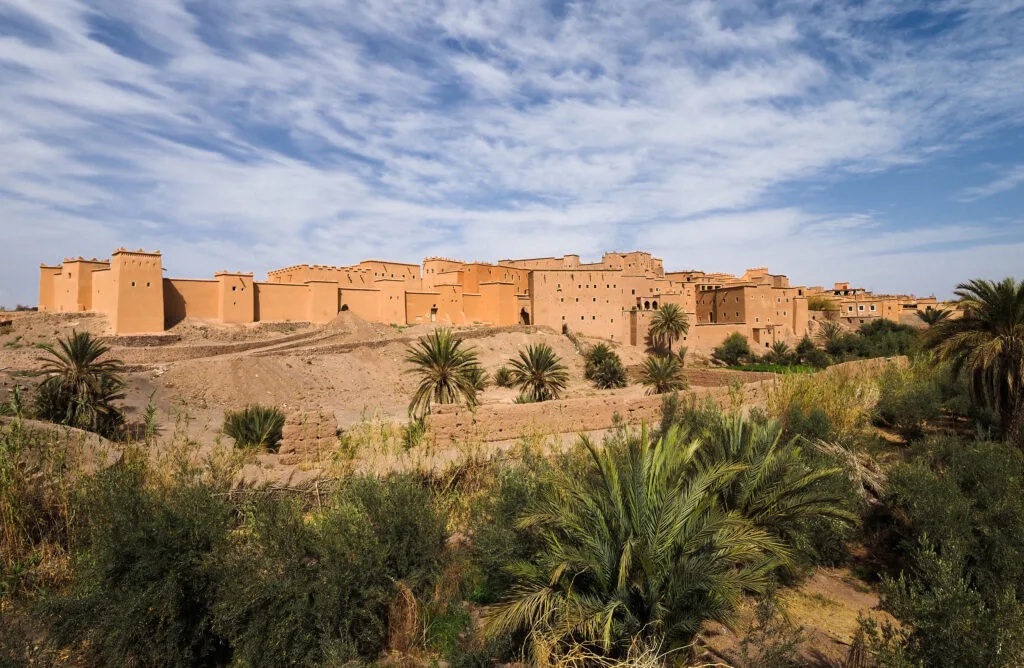
This is the central visit in Ouarzazate itself. The Taourirt kasbah is a complex of unfired earth, built in rammed earth using the traditional technique of southern Morocco, and it was the residence of a powerful local family. Inside you walk through rooms with painted wooden ceilings, narrow staircases and terraces, and you see how these earthen buildings were laid out.
The building is fragile by nature: raw earth needs constant restoration, and some parts are closed depending on the progress of the works. That is normal and takes nothing away from the visit. Allow a good hour, longer if you are interested in painted decoration. Opening hours and ticket prices change, so check them at the entrance rather than relying on an old article.

Opposite, the old quarter behind the kasbah can be explored freely. It is a short but instructive walk: you see the same building techniques applied to ordinary housing, and you realise how much upkeep this material demands.
The film studios, Ouarzazate’s one-of-a-kind attraction
Ouarzazate is one of the few places in the world where cinema is part of the local economy. The studios on the edge of town have served for decades as a backdrop for international productions, which come looking for desert landscapes, constant light and large sets. The region has hosted productions such as Gladiator and Game of Thrones, which is why the question of the studios comes up so often in searches.
Guided tours walk you through sets kept between shoots: temples, ramparts, palace interiors. You need to approach it for what it is, a behind-the-scenes visit and not a theme park, and accept that the sets are built of plaster and wood. For children, it is often the most memorable part of the stay.
A cinema museum, set opposite the Taourirt kasbah, completes the picture with equipment and props from film shoots. It is more modest, but practical if you are short of time. On ticket prices, which people often search for, we prefer not to quote a figure that may be out of date: ask at the entrance or at your accommodation, and check whether guided visits are included.
Aït Ben Haddou, the listed site thirty kilometres away
This is the most famous image of southern Morocco: a whole ksar, in other words a fortified earthen village, clinging to a hill above the river bed. UNESCO inscribed it on the World Heritage List in 1987, noting that it is an outstanding example of earthen architecture in southern Morocco.

The climb to the communal granary at the top takes about twenty minutes and needs a little puff. The view over the valley justifies the effort. Go early in the morning or in the late afternoon: at midday the light is harsh and visitor numbers are at their peak. Our guide to the day trip to Aït Benhaddou and Ouarzazate from Marrakech describes the one-day option in detail.
How many days to stay in Ouarzazate
The answer depends entirely on what you plan to do from the town, since the town itself is quickly seen. These are the most common formats.
| Length of stay | What you cover | Comment |
|---|---|---|
| A few hours | A stop on the road from Marrakech to the desert | The most common option, often too short |
| One night | Town, kasbah, studios, Aït Ben Haddou | The sensible minimum |
| Two nights | Add the Drâa valley or the gorges | The recommended balance |
| Three nights or more | A base for a full tour of the south | For those with a car |
Many travellers pass through Ouarzazate in an hour, long enough for lunch, on the way to Merzouga or Zagora. That is a pity: the town deserves a night, if only to see Aït Ben Haddou outside the busy hours.
The Drâa valley and the roads that start here
Ouarzazate is a crossroads. To the south, the road follows the Drâa valley through a succession of palm groves and fortified villages as far as Zagora, then on towards the dunes. To the east, it leads to the gorges and the Valley of the Roses. To the north, it climbs back to Marrakech over the Tichka pass.
These routes are made by car, with a driver or on an organised tour. Distances are long and the roads wind: a stage that looks short on the map can easily take half a day. Our guide to the Sahara desert from Marrakech compares the two main options in the south, Merzouga and Zagora. If you are searching for the journey from Ouarzazate to Merzouga, plan an overnight stop on the way rather than a single hard day.
When to go: altitude changes everything
Ouarzazate is not the hot desert you might imagine. At more than a thousand metres, nights are cool all year round and decidedly cold in winter, while the days can stay mild and sunny. The gap between day and night is the figure most often underestimated by visitors.
Spring and autumn are the best seasons: pleasant daytime temperatures and ideal light on the ochre earth. Summer is very hot in the afternoon, which means timing your visits for early morning and late in the day. Winter is bright and quiet, but you need warm clothes for the evening.
| Season | What to expect | What to pack |
|---|---|---|
| Spring | Pleasant days, cool nights, the best light for photography | Layers and a light jacket |
| Summer | Very hot afternoons, cool early mornings | Sun protection, plenty of water and a fleece for the night |
| Autumn | Warm days, golden light, fewer people | Layers and walking shoes |
| Winter | Clear, bright days, cold nights | A warm jacket, hat and gloves for the evening |
For a comparison of the months across the whole country, our guide to the best time to visit Morocco sets the regions side by side.
Things to do in Ouarzazate with kids
This is a destination that works well for families, as long as you pace the journeys. The film studios are the attraction that children grasp most easily: recognisable sets, a guided tour and plenty of space. The kasbah often goes down well too, because you can climb up and down it.
The point to watch is elsewhere: the roads in the south are long and winding. Chaining Marrakech, Ouarzazate and the desert into three days with young children means spending most of the time in the car. It is better to settle into a base in Ouarzazate and make half-day outings from there.
Ouarzazate at night
Nightlife is very quiet: this is a town of passage and work, not a town for going out. The evening is generally spent at the hotel or guesthouse, often over a dinner served on a terrace or in a patio. If you are wondering what there is to do in Ouarzazate at night, the honest answer is very little, and that is partly the point.
What you come here for in the evening is the sky. The altitude, the dry air and the weak lighting once you leave the centre give remarkable starry nights. Many places outside the town make a selling point of it, and rightly so.
Getting to Ouarzazate by air
Ouarzazate airport (code OZZ) has a single terminal and is modest in size: it handled 136,007 passengers in 2019. Its international offer is limited but real, and it has the advantage of removing the long road from Marrakech.
| Airline | Cities served |
|---|---|
| Royal Air Maroc Express | Casablanca, Zagora |
| Ryanair | Barcelona, Marseille |
| Transavia | Paris-Orly |
Frequencies vary strongly by season and remain low in absolute terms, so check the operating days before you build an itinerary around them. Today’s timetable is on our page for Ouarzazate airport, and live information is on the departures and arrivals board.
Flying from the UK and Ireland
There is no direct flight from the UK or Ireland to Ouarzazate in our route data. British and Irish travellers normally fly to Marrakech, which is served by a very wide range of carriers and airports, and then continue by road over the Tichka pass; the alternative is to fly to Casablanca and take a domestic flight with Royal Air Maroc Express, if the timetable suits.
Time is not a factor: since 20 September 2026 Morocco has stayed on GMT all year, so the UK and Ireland are on the same time in winter and one hour ahead in summer. Take out travel insurance before you go, since the UK’s Global Health Insurance Card does not cover Morocco, and bear in mind that medical facilities are far apart once you leave the town.
Getting there by road, and what the Tichka pass is like
Most visitors arrive from Marrakech by the High Atlas road, which crosses the Tichka pass. It is a spectacular journey, and also a long one: the road climbs, twists a lot and demands a moderate speed. People prone to travel sickness should know this beforehand. Searches such as the drive time or taxi price from Ouarzazate to Marrakech tend to produce a wide range of answers, because the real figure depends on traffic, weather, stops and your driver; allow several hours and build in a margin.
Three formats coexist: the coach, the long-distance taxi and the private vehicle with a driver. The last is the most comfortable on this route, because it lets you stop at viewpoints, which the others do not. Our airport transfers comparison sets the options side by side.
Do you need a car in Ouarzazate?
Here the answer differs from the one we give for the imperial cities: yes, a car is very useful. The town is spread out, the interesting sites are outside the centre, and distances to the valleys are counted in tens of kilometres. Without a vehicle, you depend on organised excursions, which work but impose their timetables.
If you do not drive, the most flexible solution is a car with a driver by the day, very common in the south. The small taxis cover journeys within the town and to the airport. If you prefer to rent, our guide to car rental at Morocco’s airports explains how it works, and the advice on night driving below applies to everyone.
Where to stay: in town or near the kasbahs
You have three choices, and they produce very different stays. Sleeping in Ouarzazate itself is the practical solution: shops, cash machines, restaurants, a petrol station and direct access to the airport. It is what you want if you arrive late or leave early.
Sleeping at Aït Ben Haddou is the most photogenic option. Several guesthouses face the ksar on the other side of the river and let you see it at sunrise and sunset, once the coaches have gone. The downside is that you are about thirty kilometres from everything else.
Finally, sleeping on the outskirts, in one of the houses set outside the built-up area, is where you enjoy the night sky and often a pool. You need a vehicle. One point to check in every case: heating. Altitude makes nights cold for a good part of the year, and not all properties are equipped in the same way.
Eating in Ouarzazate
Cooking in the south is more rustic and more fragrant than in the northern cities. Tagine is king, often cooked for a long time, and the version with prunes and almonds is a regional classic. Couscous is traditionally served on Fridays, a custom still widely followed.
In practice, the choice falls into three categories. The restaurants on the main avenue, simple and inexpensive, serve everyday Moroccan food. The tables of the guesthouses, by reservation, usually offer a set menu and are often the best addresses in town. Finally, places along the tourist routes offer a quick formula suited to groups.
One tip specific to this region: if you set off for the day towards the valleys, take water and something to eat. Not all the villages you pass through have a shop, and distances between stops are long.
Linking Ouarzazate with another stop
The town is a road junction: that is its historic function and still its interest for a traveller. The table below sums up the classic combinations and what they really involve.
| Next stop | Direction | What to allow for |
|---|---|---|
| Marrakech | North, Tichka pass | A mountain road, winding and not to be underestimated |
| Zagora and the Drâa valley | South | Palm groves and ksour, half a day on the road |
| Merzouga and the big dunes | East | A long journey: plan an overnight stop |
| Todra and Dades gorges | North-east | Combines well with the road to Merzouga |
| Agadir | West | A long crossing: compare it with flying |
One arrangement comes up often among experienced travellers: enter through Marrakech and leave through another airport, or the other way round, to avoid driving back over the Tichka pass. That means booking an open-jaw ticket rather than a standard return. If you would rather finish by the sea, things to do in Essaouira offers a very different atmosphere on the Atlantic coast, and things to do in Rabat covers the capital. For a wild ocean right at the other end of the country, see things to do in Dakhla.
What to know about the roads in the south
Three realities surprise travellers discovering the region. The first is journey times. Distances look modest on a map, but mountain and valley roads impose a low average speed. Always double your estimate.
The second is that night falls quickly and there is no street lighting outside built-up areas. Driving at night in the south is not recommended, especially as you meet animals and slow vehicles with no warning signs. Plan your stages so that you arrive before dusk.
The third is that autumn storms can temporarily cut some roads at river crossings. It is rare but real, and it is best checked locally on the day rather than in advance.
A note on the solar complex
Outside the town stands a large solar complex, the Noor Ouarzazate site, which regularly appears in searches about the town. It is an industrial installation rather than a visitor attraction, so do not plan your day around it; if you are curious, ask at your accommodation whether any visit or viewpoint is possible.
What to bring home from Ouarzazate
The crafts of the south differ from those of the big medinas. You mainly find regional rugs with Berber geometric patterns, pottery and silver jewellery in the Amazigh tradition. Prices are negotiable, as everywhere, and quality varies a lot from one shop to the next.
Two practical tips. For a rug, ask about its origin and look at the back: the regularity of the knotting says more than the pattern. For silver, be aware that old and new pieces coexist and are not equal in value; a serious seller will say so unprompted. Finally, keep in mind the weight limits of your return luggage, particularly on low-cost airlines.
Before you go
Three points specific to this region are worth settling beforehand. First, clothing: a fleece or warm jacket for the evenings, even in summer, and good shoes for the climbs in the ksour. Second, cash: outside the town, card payments are far from universal. Third, water and sun protection, because the dry air hides the reality of dehydration.
For entry formalities and the question of withdrawing cash on arrival, our guides to visa and entry requirements for Morocco and money in Morocco cover the essentials. The full list of the country’s airports is on our page of airports in Morocco.
Frequently asked questions about Ouarzazate
Is Ouarzazate worth a night or just a stop?
A night at least if you want to see Aït Ben Haddou outside the busy hours and visit the studios without rushing. A lunch stop does not let you see either properly.
Is Aït Ben Haddou in Ouarzazate?
No, the ksar is about thirty kilometres from the town, on the road to Marrakech. You reach it by taxi, by car or on an excursion. Allow half a day for the round trip including the visit.
Can you see the desert from Ouarzazate?
Not the big dunes, which are further away, towards Merzouga or beyond Zagora. From Ouarzazate you can, however, reach the stony desert landscapes and the palm groves of the Drâa valley, which begin immediately to the south.
Is it cold in Ouarzazate?
Nights are cool all year because of the altitude, and decidedly cold in winter, while days are often mild and sunny. Always take a warm layer for the evening.
Are there direct flights to Ouarzazate?
Yes, but only a few: Ryanair from Barcelona and Marseille, Transavia from Paris-Orly and domestic services with Royal Air Maroc Express. There are none from the UK or Ireland in our data, and frequencies are seasonal, so check them before building an itinerary.
How long is the drive from Marrakech?
The journey crosses the High Atlas by the Tichka pass: it is a winding mountain road where average speed stays low. Allow considerably more time than the distance suggests, with stops if you are sensitive to bends.
What is the best season to photograph the kasbahs?
Spring and autumn, early and late in the day. Raw earth takes on a warm colour in low light, whereas at midday it looks washed out. Winter also offers very clear light, with a sky that is often cloudless and far fewer people on the sites.
Can you visit Ouarzazate without a car?
Yes for the town itself, where the small taxis are enough. Not for the region, whose sites are several tens of kilometres away. Without a vehicle, the usual solution is a driver by the day or an organised excursion, which work well but impose their timetables.
What is there to do in Ouarzazate at night?
Very little in the way of nightlife: dinner on a terrace or in a patio, then the stars. The sky is the main evening attraction once you move away from the lights of the centre.
In summary
Ouarzazate is best understood as a base: half a day for the Taourirt kasbah and the studios, then everything else within reach by car, including UNESCO-listed Aït Ben Haddou, the Drâa valley, the gorges and the road to the desert. Allow at least one night, pack a warm jacket whatever the season, and choose between the direct flight, rare but real, and the Tichka road from Marrakech, spectacular but long.
Sources
Listing of the ksar of Aït Ben Haddou as a World Heritage Site: UNESCO World Heritage Centre. Ouarzazate airport traffic and the services mentioned come from our airport database; frequencies vary by season and should be checked with the airlines.
Image credits
Photos: Petar Milošević (CC BY-SA 4.0), via Wikimedia Commons.