Quick answer: to eat well in Marrakech, match the place to the experience you are after. The food stalls of Jemaa el-Fna square offer the liveliest street food (allow 60 to 150 dirhams a meal). The rooftops around the square serve tagines and panoramic views (100 to 250 dirhams). The riad-restaurants of the medina serve refined Moroccan cuisine as set menus (300 to 700 dirhams), while Guéliz and Hivernage are home to modern, international tables. As for specialities, don’t leave without tasting the tanjia marrakchia, the tagine, the Friday couscous, the méchoui and a glass of mint tea. This guide details each style, each district and each dish so you know exactly where to eat in Marrakech according to your budget.
In brief: where to eat in Marrakech?
- Street food & atmosphere: food stalls of Jemaa el-Fna square, in the evening from 6 p.m.
- Panoramic view: rooftops around the square and the Koutoubia.
- Refined cuisine: riad restaurants in the medina, often by reservation.
- Modern & international: Guéliz and Hivernage districts (new town).
- Specialities to taste: tanjia, tagine, Friday couscous, méchoui, pastilla, harira, mint tea.
- Budget: from 60 dirhams (street food) to 700 dirhams (fine-dining table) per person.
Where to eat in Marrakech according to your style and budget
Marrakech is one of Morocco’s great culinary capitals, and the question “where to eat in Marrakech” has no single right answer: it all depends on the atmosphere, the budget and the time of day. The city can be read as two great culinary worlds. On one side, the medina, the historic heart listed as a World Heritage Site, where you find the popular food stalls, the street food, the rooftops perched on the terraces and the exceptional tables hidden behind the walls of the riads. On the other, the new town — the Guéliz and Hivernage districts — more open, modern, with design cafés, international restaurants and trendy addresses.
To plan your meals on site, it is useful to know that Marrakech cuisine blends Berber tradition, Arab-Andalusian heritage and Saharan influences. Spices — cumin, saffron, ginger, turmeric, ras el-hanout, cinnamon — are the common thread of almost every dish. Before diving into the districts and specialities, keep in mind that the best strategy is to vary the experiences: an evening of street food on the square, a tagine lunch in the souks, a riad dinner for a special occasion, a rooftop café for the view. If you are planning a short stay, our Marrakech in 3 days itinerary naturally weaves in these different food stops.
Eating on Jemaa el-Fna square: the essential street food experience
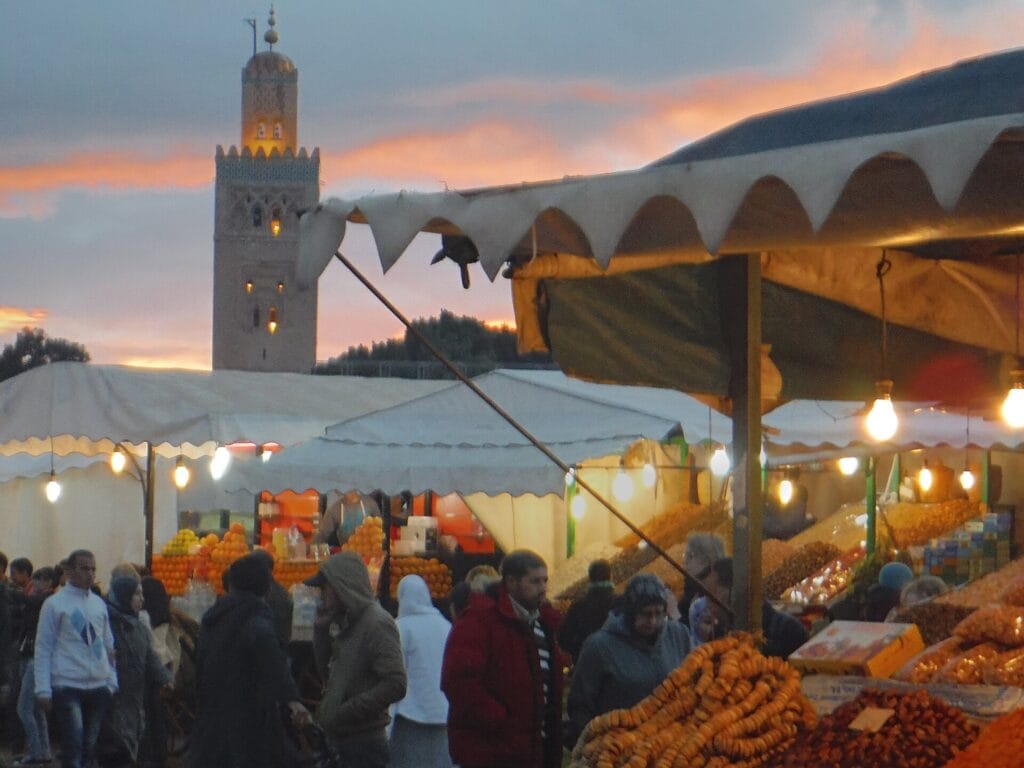
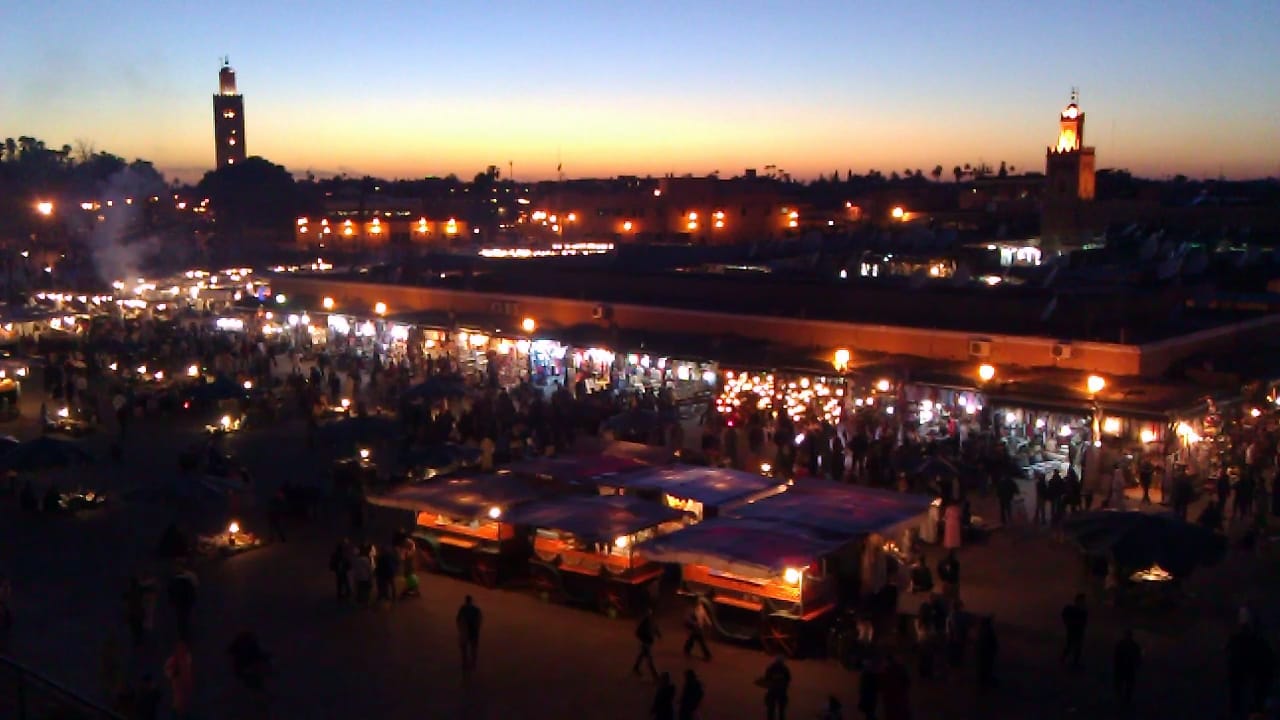
It is impossible to talk about eating in Marrakech without starting with Jemaa el-Fna square. As night falls, from around 6 p.m., the square turns into a huge open-air restaurant: dozens of food stalls (numbered booths) set out their benches, light their braziers and wrap the square in a cloud of fragrant smoke. Thousands of meals are served here every day, in an electric atmosphere where locals and travellers share the same communal tables.
On the menu at these stalls: brochettes (meat, kefta, liver), grilled merguez, harira (traditional soup), fried fish, cooked salads, couscous, tagines and, for the most curious, the famous snail soup (“babbouche”) served in a small bowl, or lamb’s head. Finish with a glass of freshly squeezed orange juice from the colourful stalls that line the square — one of the symbols of Marrakech.
Good to know: prices are not always displayed and some bargaining is sometimes in order. Allow around 60 to 150 dirhams per person for a full meal. Ask the price before sitting down, be wary of the “complimentary” plates that appear without being ordered, and favour the stands very busy with Moroccans: high turnover = guaranteed freshness. Right next to the square, the visit to the souks ideally continues with a street food break.
Marrakech street food beyond the square
Marrakech street food is not limited to the evening stalls. In the alleys of the medina and around the markets, you can nibble all day long for a few dirhams. The must-tries:
- Msemen and harcha: flaky flatbreads or semolina breads, served at breakfast with honey, olive oil or cheese (5 to 15 dirhams).
- Sfenj: golden Moroccan doughnuts, to be enjoyed warm in the morning.
- Bissara: a velvety broad-bean soup topped with olive oil and cumin, a winter breakfast dish among ordinary people.
- Snails (babbouche): served in their spiced broth with digestive virtues, a local institution.
- Sandwiches and makla khfifa: keftas, merguez, fries and mixed salads in a round bread, sold at the small counters of working-class districts.
The area around Place des Épices (Rahba Kedima) and the famous “méchoui alley”, near the souks, are hotspots for food lovers. It is there, in particular, that you find oven-roasted lamb from the morning onward (see below). Eating in these alleys remains one of the most authentic — and most economical — ways to discover Marrakech cuisine.
The rooftops of Marrakech: dining with a view
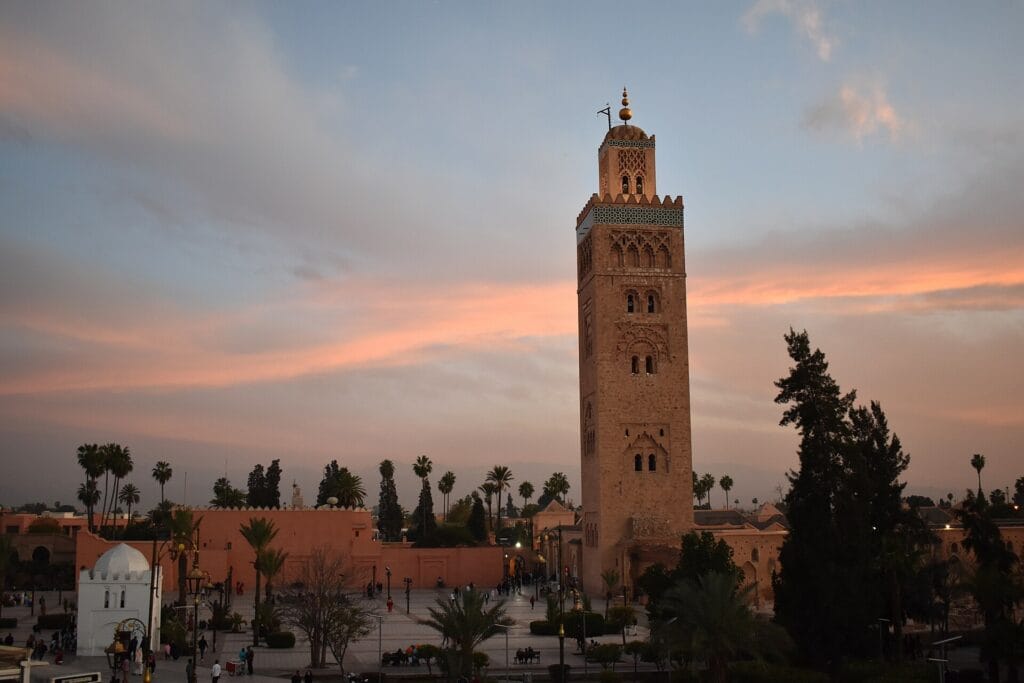
The panoramic terraces are one of the great signatures of Marrakech. Around Jemaa el-Fna square and along the alleys of the medina, many cafés and restaurants open their roofs onto a spectacular setting: the bustling square below, the minaret of the Koutoubia, the ochre rooftops of the medina and, in clear weather, the snow-capped line of the Atlas Mountains.
The rooftops are perfect for a quiet lunch in the shade of a parasol, for a mint tea in the middle of the afternoon, or to watch the sunset and the gradual lighting up of the square. The menu is often classic — tagines, couscous, Moroccan salads, brochettes — but the experience is above all about the setting. Allow on average 100 to 250 dirhams per person. Book a table by the railing at the end of the day: those are the most sought-after spots, especially at sunset.
Dining in a riad: refined Moroccan cuisine
For a more intimate and gastronomic experience, nothing beats a dinner in a riad. These traditional houses organized around a patio, often invisible from the street, house some of the finest tables in the city. The setting — zelliges, carved wood, candles, central fountain and sometimes live music — is an integral part of the meal.
They generally serve a full Moroccan menu: an assortment of cooked and raw salads to start, then pastilla, slow-cooked tagines, couscous or méchoui, before the honey-and-almond pastries accompanied by mint tea. It is the best place to taste festive dishes that require hours of preparation. Prices reflect the quality and the setting: allow 300 to 700 dirhams per person, more at the most prestigious tables. Reservation is strongly recommended, often essential. Many travellers also choose to stay in this type of establishment — our guide where to stay in Marrakech details the districts and types of accommodation, riads included.
Guéliz and Hivernage: modern, international Marrakech
Fancy a break from the bustle of the medina? Head to the new town. The Guéliz district, with its tree-lined avenues and shops, is home to European-style cafés, international restaurants (Italian, French, Japanese, Lebanese), brunches and vegetarian or healthy addresses. It is also an excellent spot for pastries and speciality coffee.
Hivernage, nearby and more chic, lines up hotels, lounges and fine-dining tables. Here you eat more modern, sometimes fusion cuisine, in a hushed atmosphere. Prices there are variable but often higher than in the medina for international cuisine. These districts are ideal for longer stays, when you want to alternate between traditional Moroccan cuisine and the flavours of the world. They are easily accessible from Marrakech-Menara Airport, located just a few minutes from the new town.
The specialities of Marrakech you absolutely must taste
Knowing where to eat in Marrakech also means knowing what to order. Here are the great specialities of Marrakech and Moroccan cuisine, to look out for on the menus. To explore the history of these dishes further, the reference resource remains the article Moroccan cuisine on Wikipedia.
The tanjia marrakchia, the city’s emblematic dish
The tanjia is the signature dish of Marrakech, the one you won’t find as well prepared anywhere else. Pieces of meat (often veal or lamb) are placed in a clay amphora with saffron, cumin, garlic, preserved lemon, olive oil and smen (fermented clarified butter). The vessel is sealed then entrusted to the keeper of the district hammam, who buries it in the warm ashes of the furnace for a very slow cooking of several hours. The result: tender, confit meat, incredibly fragrant. Nicknamed “the bachelors’ dish” because traditionally prepared by men, the tanjia is enjoyed in the popular food stalls and some traditional restaurants (around 60 to 120 dirhams).
The tagine, king of the Moroccan table
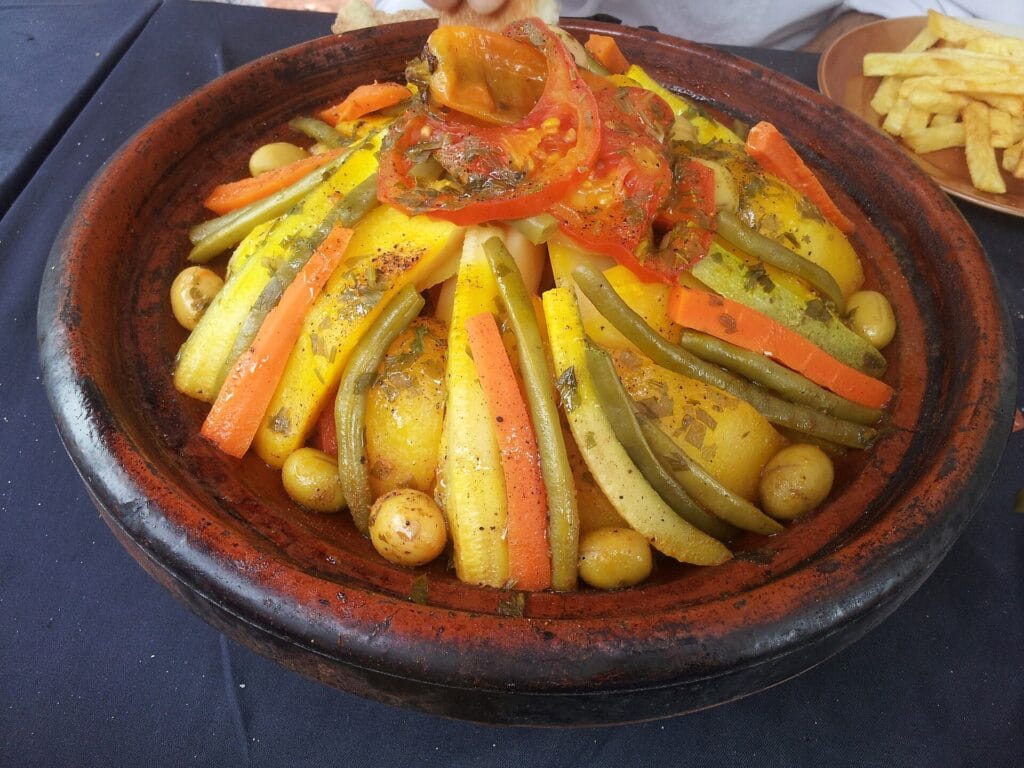
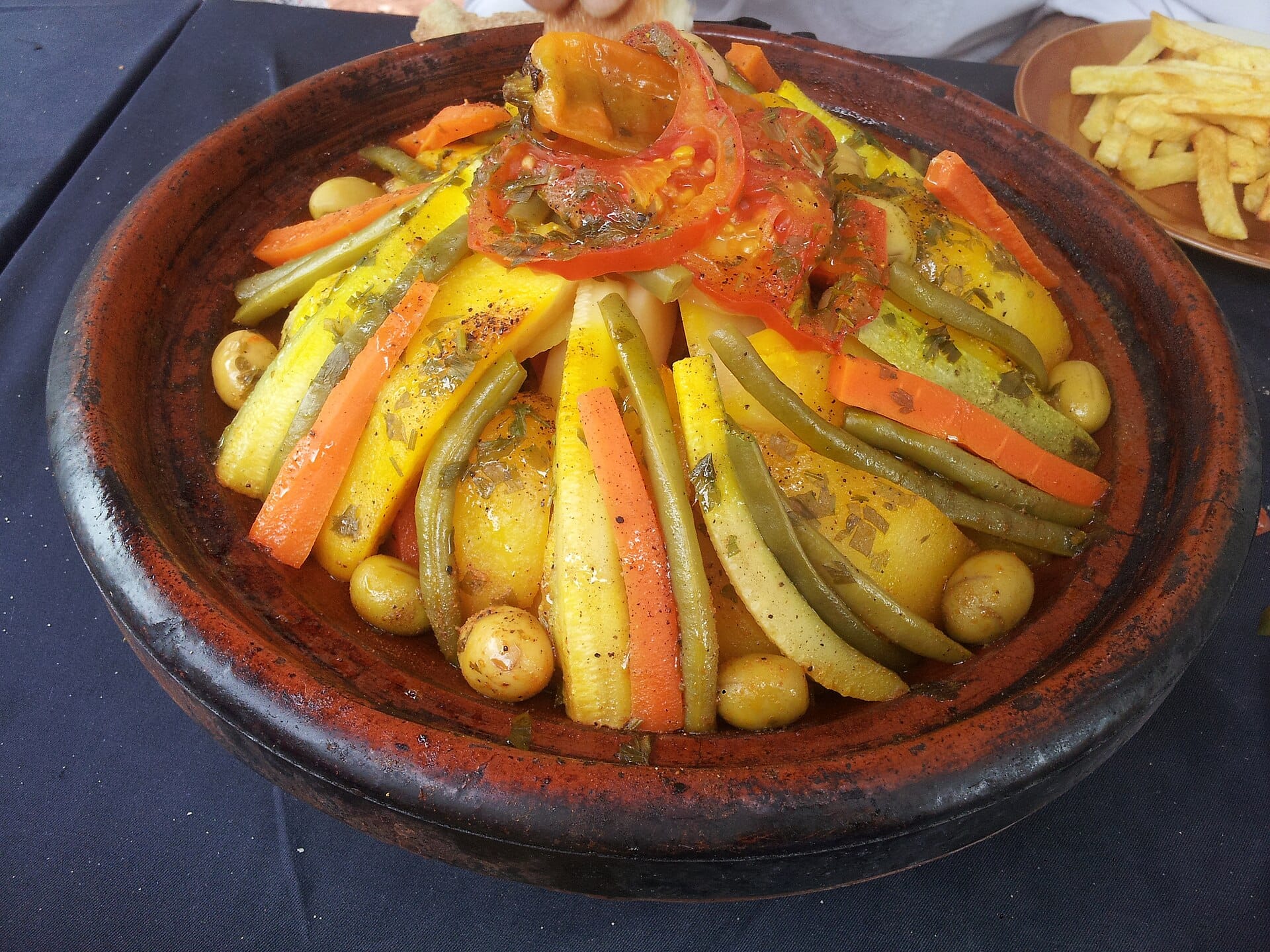
The tagine refers both to the conical-lidded earthenware dish and the food that simmers in it. The variations are endless: chicken with preserved lemon and olives, lamb with prunes and almonds, kefta (meatballs) with egg, chermoula fish, or vegetable tagine. The slow, gentle cooking concentrates the flavours. You find it absolutely everywhere, from the food stall to the fine-dining restaurant, at prices ranging from 50 to more than 150 dirhams depending on the place.
The Friday couscous
In Morocco, couscous is traditionally the Friday dish, the day of the great prayer, shared with family. Hand-rolled semolina, fragrant broth, seasonal vegetables (squash, turnip, carrot, cabbage, courgette), chickpeas and meat: it is a generous, convivial dish. If you are in Marrakech on a Friday lunchtime, it is the ideal time to order it — many restaurants then put it in the spotlight.
The méchoui
The méchoui is a whole lamb or sheep slowly roasted in a clay oven until the flesh falls off on its own. In Marrakech, the famous “méchoui alley”, near Place des Épices, offers this lamb by weight from the late morning. The meat, simply seasoned with salt and cumin, is remarkably tender. A tip: come before noon, as the best cuts are often sold out by early afternoon.
The pastilla
The pastilla (or bastilla) is a sweet-and-savoury masterpiece of Arab-Andalusian heritage: thin, crisp sheets of brick pastry enclose a filling traditionally based on pigeon (today often chicken), almonds, eggs and spices, all dusted with icing sugar and cinnamon. There are versions with fish and seafood, and a dessert version with milk and almonds. A festive dish not to be missed, often served as a starter in riad menus.
The harira
The harira is the comforting soup par excellence: tomatoes, lentils, chickpeas, coriander, a little meat and a light thickening. Nourishing and cheap (often 5 to 15 dirhams in the food stalls), it is eaten all year round but becomes essential during Ramadan, when it breaks the fast, accompanied by dates and chebakia (a honey-and-sesame pastry).
The briouates
The briouates are small triangular or cigar-shaped pastries, fried or oven-baked. Savoury version: spiced minced meat, chicken, cheese or seafood. Sweet version: almonds and honey. Crisp and addictive, they are nibbled as a starter, an aperitif or a dessert.
Mint tea and pastries
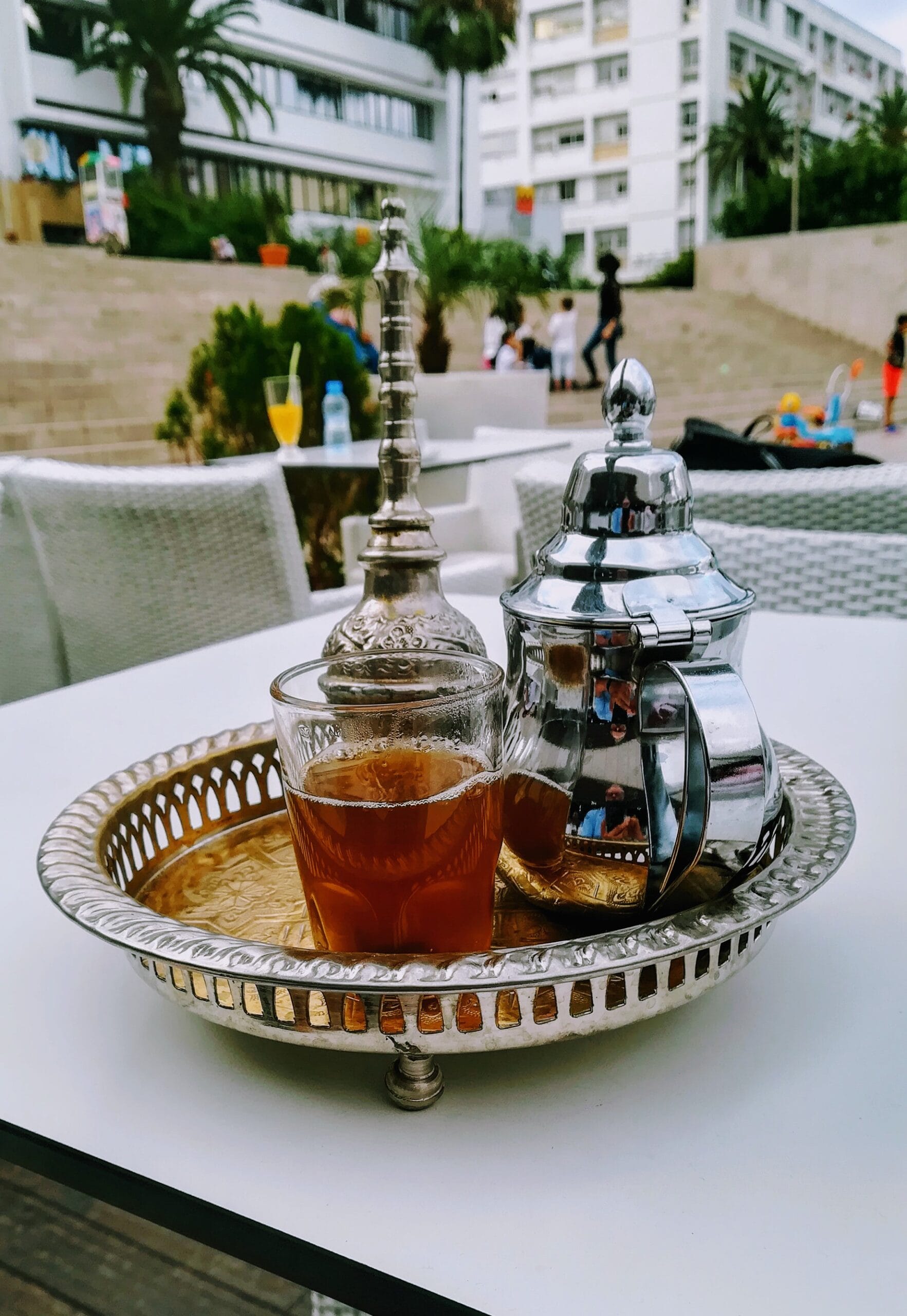
No meal ends without mint tea, a symbol of Moroccan hospitality, prepared with green tea, an abundance of fresh mint and plenty of sugar, poured from a height to make it froth. It accompanies Moroccan pastries: gazelle horns (kaab el ghzal) filled with almond paste, ghriba (shortbread), chebakia, makrout, feqqas… enough to end any meal sweetly, or simply to take an afternoon break on a terrace.
Eating vegetarian in Marrakech
Good news for vegetarians: Marrakech cuisine offers many meat-free options. Vegetable tagines, zaalouk (smoked aubergine dip), taktouka (peppers and tomatoes), cooked salads, lentil and chickpea dishes, bread dipped in olive or argan oil are widely available. Guéliz also has several specifically vegetarian or vegan addresses.
Practical tip: always specify “bla lhem” (without meat), as some broths — notably those of harira or couscous — are prepared with meat. Likewise, check the composition of simmered dishes. Most restaurants gladly adapt to the request.
Indicative budgets: how much to plan for eating in Marrakech
Marrakech suits every budget. Here are indicative ranges per person, for one meal:
- Street food / food stalls: 30 to 80 dirhams (small budget).
- A meal on Jemaa el-Fna square: 60 to 150 dirhams.
- Traditional restaurant / rooftop: 100 to 250 dirhams.
- Riad restaurant with set menu: 300 to 700 dirhams.
- Fine-dining table / palace: 700 dirhams and up.
These prices are given for guidance and vary depending on the season, the location and the content of the order. The tip (around 10%) is appreciated in restaurants with table service. Plan to carry cash: many food stalls and small addresses do not accept bank cards.
Hygiene tips and good practices
Eating Marrakech street food is an experience to be had, provided you follow a few common-sense rules to avoid trouble:
- Favour very busy stands: a large crowd guarantees a quick turnover of products, hence freshness.
- Go for food that is well cooked and served hot: brochettes grilled in front of you, steaming tagines, boiling soups.
- Be wary of poorly washed raw vegetables and room-temperature sauces if you have a sensitive stomach.
- Drink capped bottled water and avoid ice cubes whose origin you don’t know.
- Wash or sanitize your hands before eating with your fingers, as tradition dictates.
- Introduce street food gradually at the start of your stay, to let your body get used to it.
Times and Ramadan: when to eat in Marrakech
Moroccan timings are fairly flexible. Lunch is generally taken between 12 and 3 p.m., dinner from 7-8 p.m., but the food stalls on the square and many restaurants stay open late. Cafés, for their part, open early in the morning and are places of life all day long.
During Ramadan (whose dates change each year according to the lunar calendar), life is organized around the fast: many establishments in the medina close or reduce their hours during the day, while the city comes alive in the evening at the time of the ftour (breaking of the fast). It is a period with a particular charm, with festive dinners and an ever-present harira, but you have to adjust your expectations during the day. In the tourist districts and the new town, more restaurants stay open for travellers. Out of respect, avoid eating, drinking or smoking ostentatiously in public during fasting hours.
Wherever you eat, keep in mind that the medina of Marrakech is a UNESCO World Heritage Site: its squares, its souks and its culinary way of life are part of a living heritage. To explore everything the city offers beyond the table, see our complete guide: things to do in Marrakech.
Frequently asked questions: where to eat in Marrakech
Where to eat cheaply in Marrakech?
The food stalls of Jemaa el-Fna square in the evening and the small street food booths of the souks and working-class districts are the best economical options. A full meal there often costs between 30 and 80 dirhams. Look for the stands packed with Moroccan customers: it is the mark of good value and freshness.
What is the culinary speciality of Marrakech?
The emblematic speciality of Marrakech is the tanjia marrakchia, meat confit for several hours in a clay amphora buried in the ashes of the hammam furnace. The city is also associated with the tagine, the Friday couscous, the méchoui and the pastilla.
Can you eat vegetarian in Marrakech?
Yes, easily. Vegetable tagines, zaalouk, taktouka, salads, lentils and chickpeas are everywhere. Specify “bla lhem” (without meat), as some broths contain meat. The Guéliz district also has vegetarian and vegan restaurants.
Is Marrakech street food safe?
It is, if you choose busy stands, food that is well cooked and served hot, bottled water and if you avoid dubious raw vegetables. Introduce it gradually at the start of your stay and wash your hands before eating.
Where to find the best rooftops in Marrakech?
The most sought-after panoramic terraces are concentrated around Jemaa el-Fna square and the Koutoubia, offering a view of the square, the minaret and the Atlas. They are ideal for a mint tea in the afternoon or a dinner at sunset. Book a table by the railing at the end of the day.
Do you need to book to dine in a riad in Marrakech?
Yes, reservation is strongly recommended, even essential for the most renowned riad tables, which often offer full set menus. These addresses, hidden in the medina, offer the best of refined Moroccan cuisine in a traditional setting.
The essentials to remember
Where to eat in Marrakech? Everywhere, provided you choose the right experience at the right time. Jemaa el-Fna square for street food and atmosphere, the rooftops for the view, the riads for refined cuisine, Guéliz and Hivernage for the modern and international. On the plate, let the specialities guide you: tanjia, tagine, Friday couscous, méchoui, pastilla, harira, briouates, not forgetting mint tea and pastries. By varying the districts and styles, following a few hygiene rules and keeping cash on you, you will make each meal a highlight of your stay. Enjoy your meal — bssaha!
Images under free license via Wikimedia Commons: © Khammal92 (CC BY-SA 4.0); © Munfarid1 (CC BY-SA 4.0); © YoTuT from United States (CC BY 2.0). Sources: UNESCO and Wikipedia.Disclaimer: the prices, times and availability mentioned in this article are given for guidance only and may change. The budget ranges are average estimates observed and may vary depending on the season, the establishment and your order. Always check practical information locally, particularly during Ramadan. This article recommends no establishment by name and holds no commercial partnership.