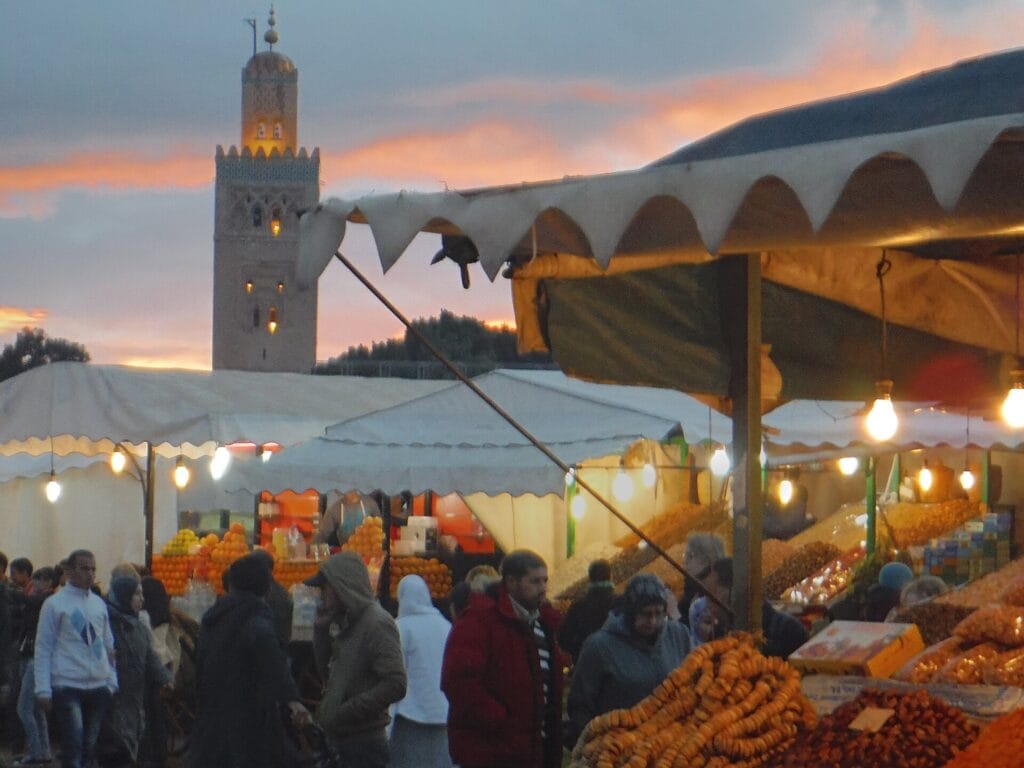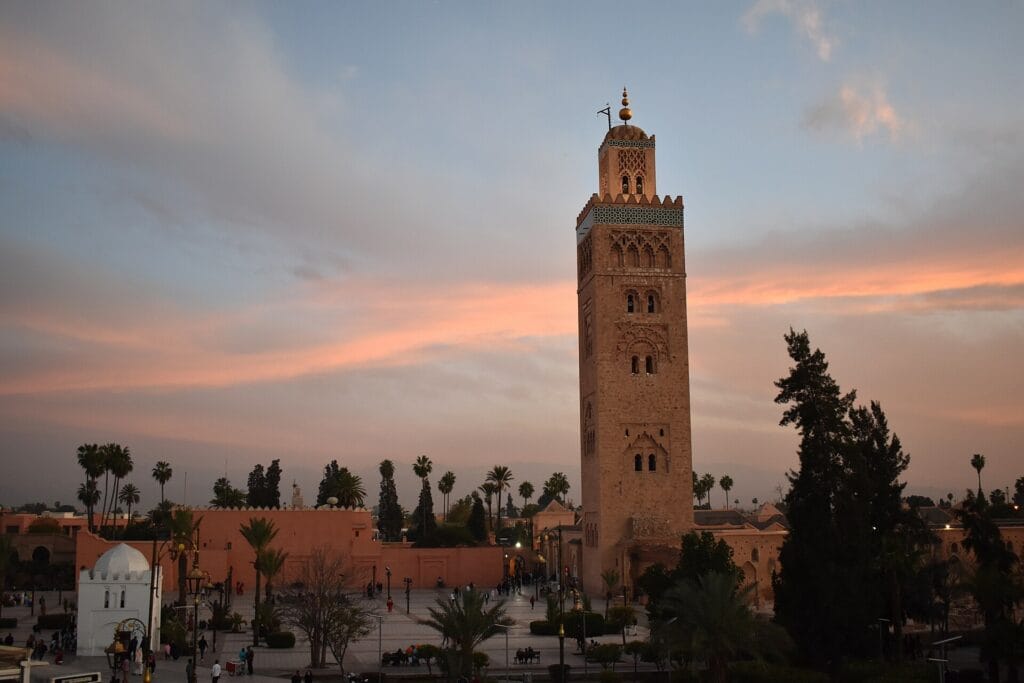
The Kasbah of Marrakech is the historic royal quarter located south of the medina, founded at the end of the 12th century by the Almohads as a fortified princely city. Today, the Marrakech Kasbah district remains one of the most fascinating parts of the city: within a few hundred metres it brings together some of Morocco’s most iconic monuments, such as the Kasbah Mosque (Moulay el-Yazid Mosque), the Almohad gate of Bab Agnaou, the Saadian Tombs and the El Badi Palace, all while keeping a quieter, more residential atmosphere than the touristic heart of the medina. Allow 2 to 3 hours to discover the essentials on foot. Here is a complete guide to understanding its history, its monuments and how to prepare your visit.
In brief: the essentials on the Kasbah of Marrakech
- Almohad royal quarter founded at the end of the 12th century as a fortified princely city.
- Located south of the medina of Marrakech, a few minutes’ walk from Jemaa el-Fna square.
- Heart of the district: the Kasbah Mosque (Moulay el-Yazid) and the monumental gate of Bab Agnaou.
- Right nearby: the Saadian Tombs and the El Badi Palace.
- A more peaceful and residential feel than the centre of the medina, among narrow lanes, ramparts and craftsmanship.
- Best explored in 2 to 3 hours, ideally in the morning.
History: the Kasbah of Marrakech, an Almohad royal city
In the Arab-Muslim world, the word “kasbah” refers to a citadel or a fortified quarter housing the seat of power. In Marrakech, the Kasbah fits this definition precisely: it was conceived as a genuine city within the city, reserved for the sovereign, his court, his guard and the administration. Its creation dates back to the end of the 12th century, under the reign of the Almohad sultan Yacoub el-Mansour (Abu Yusuf Yaqub al-Mansur), one of the great builders of the dynasty.
The Almohads, who came from the High Atlas, had made Marrakech their capital. To separate the seat of power from the mercantile and working city, they built a royal city south of the medina, surrounded by its own ramparts and endowed with palaces, gardens, a great mosque and monumental gates. This urban plan, inherited from the great Muslim capitals of the era, aimed at both the prestige and the security of the sovereign.
Yacoub el-Mansour, who reigned at the end of the 12th century, has gone down in history as one of the most powerful rulers of the Muslim West. It was under his reign that Marrakech experienced a remarkable architectural boom, of which the Kasbah was one of the major achievements alongside the Koutoubia Mosque. By creating this royal city south of the existing town, the sultan had a coherent complex at his disposal: palaces, an official mosque, gardens, barracks, markets and outbuildings, all protected by its own enclosure and connected to the medina through controlled gates. This layout reflected a conception of power in which the sovereign lived apart from the population, in a controlled and prestigious space.
Over the centuries, successive dynasties – Marinids, Saadians and then Alaouites – remodelled, enlarged or rebuilt some of the buildings. The Saadians, in the 16th century, left their most spectacular mark on the district with the El Badi Palace and the necropolis of the Saadian Tombs. Even today, the Kasbah remains the seat of the Royal Palace of Marrakech, perpetuating its original purpose: to house the seat of power. The medina of Marrakech as a whole, of which the Kasbah is part, is inscribed on the World Heritage List of UNESCO.
This layering of eras is one of the great appeals of the district: in just a few steps, you move from 12th-century Almohad remains to 16th-century Saadian works, then to more recent Alaouite additions. The Kasbah can thus be read like an open-air history book, where each dynasty has left a trace without ever completely erasing that of its predecessors. This also explains the variety of styles found here, from the powerful austerity of Almohad art to the decorative refinement of the Saadians.
To place the district within the wider context of the city, you can consult our guide to the Marrakech medina, of which the Kasbah is the historic southern extension.
The Kasbah Mosque (Moulay el-Yazid Mosque)
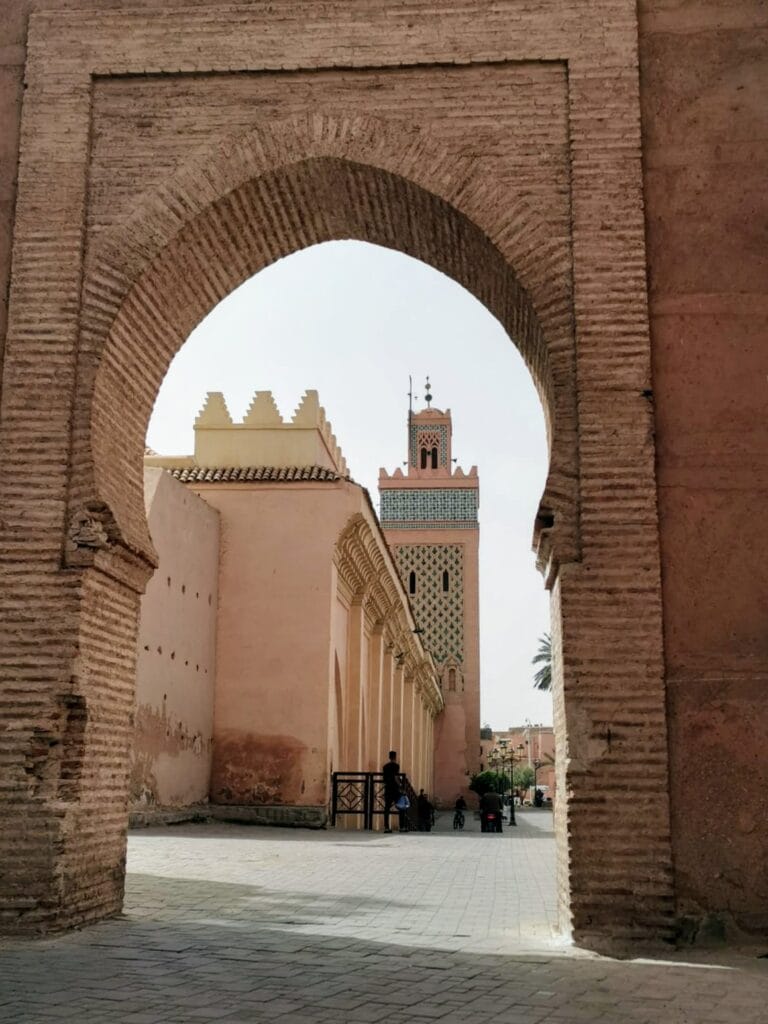
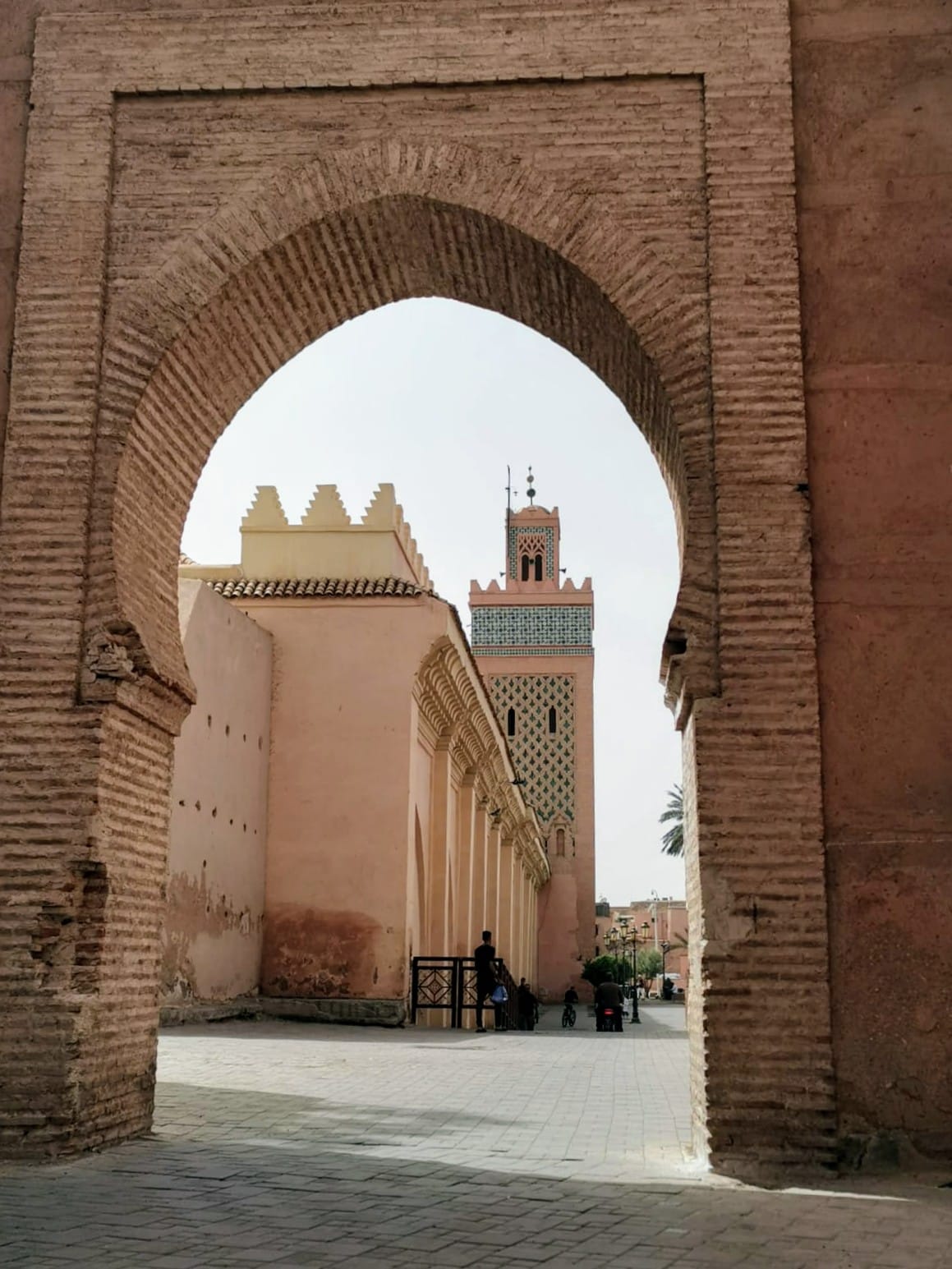
At the heart of the Marrakech Kasbah district stands the Kasbah Mosque, also known as the Moulay el-Yazid Mosque. Built at the end of the 12th century under Yacoub el-Mansour, it was the official mosque of the royal city, used by the sovereign and his court. It is one of the great Almohad monuments of Marrakech, contemporary with the famous Koutoubia that dominates the north of the medina.
Its minaret is particularly striking: adorned with geometric lozenge patterns and colourful ceramics, it serves as a visual landmark for the district and a fine example of Almohad art. The mosque has undergone several restorations over the centuries, notably after damage caused by time and by historic explosions of gunpowder stored nearby, but it has retained its original plan and spirit.
Architecturally, the Kasbah Mosque illustrates the principles of Almohad art: restrained volumes, an interplay of brick and plaster, and a minaret that towers over the district. The minaret’s decoration, arranged as a network of interlaced lozenges (the so-called “darj w ktef” motif) topped by a frieze of ceramics, appears in similar forms on other great monuments of the same period. The large inner courtyard and the prayer hall, structured by rows of arches, follow a logic of clarity and grandeur characteristic of the era.
The name of Moulay el-Yazid, a late-18th-century Alaouite sultan buried nearby, is a reminder that the building has passed through the dynasties and been the object of successive restorations. These reconstructions explain why the mosque combines its original Almohad plan with later interventions, without losing its overall unity.
Like most working mosques in Morocco, it is in principle not open to non-Muslim visitors inside. It is therefore admired from the outside, by walking around the building to appreciate its minaret and facade. Its position is strategic: it adjoins Bab Agnaou and lies a few steps from the entrance to the Saadian Tombs, making it a central landmark for finding your way around the district. To learn more, see the encyclopaedic entry on the Kasbah Mosque of Marrakesh.
Bab Agnaou, the monumental gate of the Kasbah
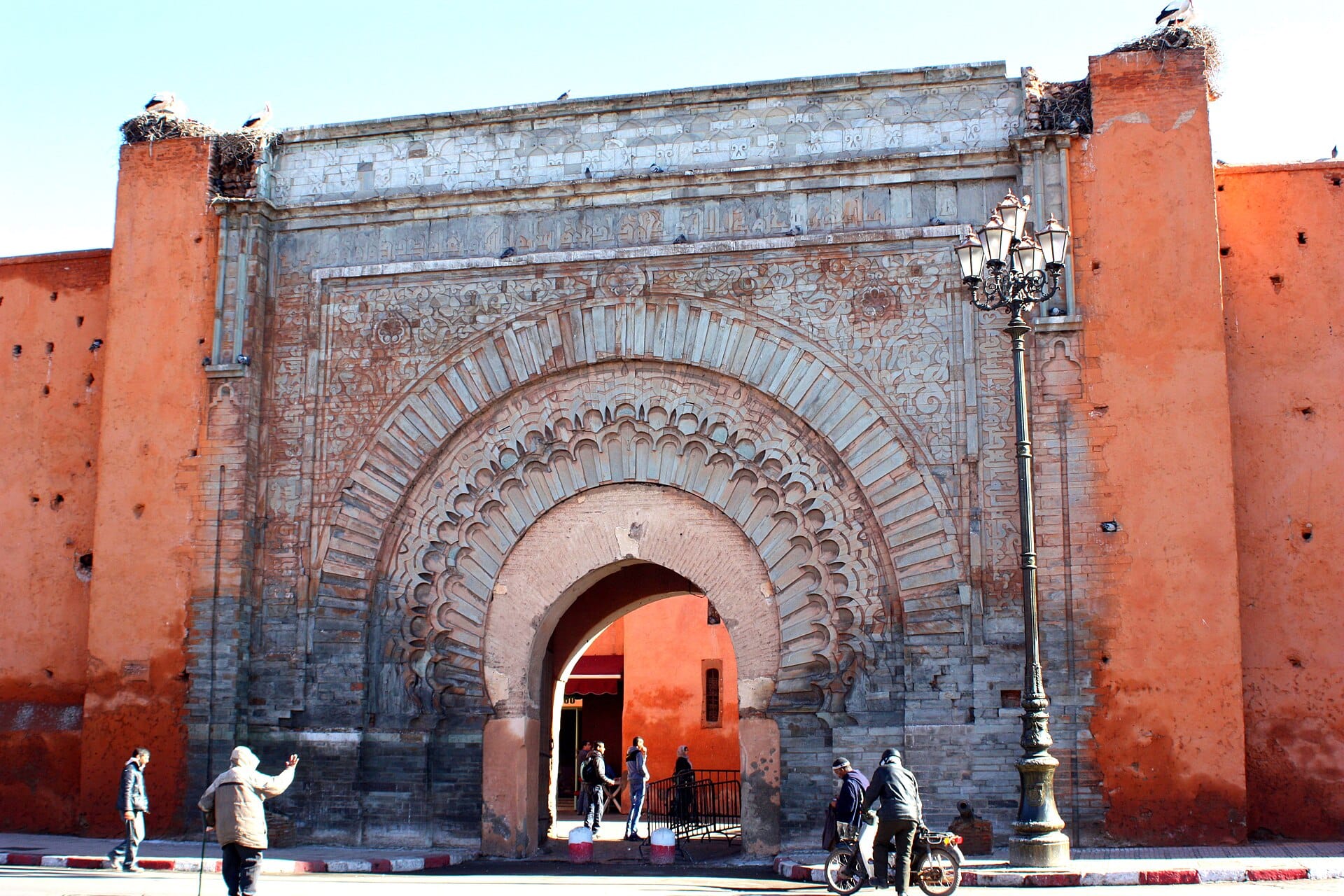
Bab Agnaou is arguably the most famous gate in Marrakech. Unlike the other gates of the city, cut into the earthen ramparts to let caravans through, Bab Agnaou was a ceremonial gate: it gave access to the royal city of the Kasbah. Also dating from the Almohad period (end of the 12th century), it reflects the care lavished on the entrance to the seat of power.
What is striking is the refinement of its decoration: carved from stone in ochre and bluish tones, the gate is organised around an arch framed by bands sculpted with floral and geometric motifs, as well as a Quranic inscription in Kufic script. The concentric arches and the shells carved into the spandrels create an effect of depth that catches the light differently depending on the time of day. The whole, restrained yet refined, illustrates the elegance of Almohad art.
The contrast is striking with the other gates of Marrakech, generally pierced through the rammed-earth ramparts and designed above all for defence and passage. Bab Agnaou, on the other hand, plays the card of display: it asserted the dignity of the royal city to anyone approaching it. It is this dual dimension, defensive and symbolic, that makes it a precious witness to Almohad town planning. Now pedestrian, Bab Agnaou is one of the district’s essential landmarks and a first-rate photographic subject. To find out more, see the page dedicated to Bab Agnaou.
The Saadian Tombs
A stone’s throw from the Kasbah Mosque lies one of the most visited sites in Marrakech: the Saadian Tombs. This royal necropolis dates from the 16th century, under the Saadian dynasty, particularly during the reign of Sultan Ahmad al-Mansur. It is reached through a narrow corridor running along the mosque, a discreet passage that opens onto gardens and funerary halls of great beauty.
The jewel of the site is the so-called “Hall of the Twelve Columns”, where the sultan and his family rest: Carrara marble, finely carved plaster, worked cedar and zellij tilework make up a decor of refined luxury. The marble columns, the plaster stalactites (muqarnas) and the ornate domes create an atmosphere that is at once solemn and intimate. The site comprises several spaces: two main funerary buildings, outbuildings and a planted garden where other, more modest graves are scattered among the pathways.
Long walled up and forgotten after the fall of the Saadians, the Tombs were rediscovered and restored to prominence in the early 20th century, which paradoxically preserved them from remodelling and destruction. This slumber of several centuries is partly responsible for their exceptional state of preservation. Because of the narrowness of the access corridor and the site’s popularity, it is best to arrive early in the morning to enjoy the place without too much waiting. It is now an essential visit in the district. We devote a detailed guide to it: the Saadian Tombs of Marrakech.
The El Badi Palace
East of the Kasbah stretches the El Badi Palace, literally “the Incomparable”. Built at the end of the 16th century by the Saadian sultan Ahmad al-Mansur to celebrate a military victory, this palace was meant to dazzle visitors and ambassadors with its splendour. It is said to have been adorned with gold, onyx, marble and precious materials brought from afar.
The construction of the palace mobilised materials from several regions and was, according to tradition, financed in part by the ransoms and spoils linked to the sultan’s victories. The decor combined gold, onyx, Italian marble and precious woods, in a profusion meant to impress. A century later, the Alaouite sultan Moulay Ismail had much of this wealth dismantled to adorn his new capital, Meknes, which explains the monument’s stripped-bare state today.
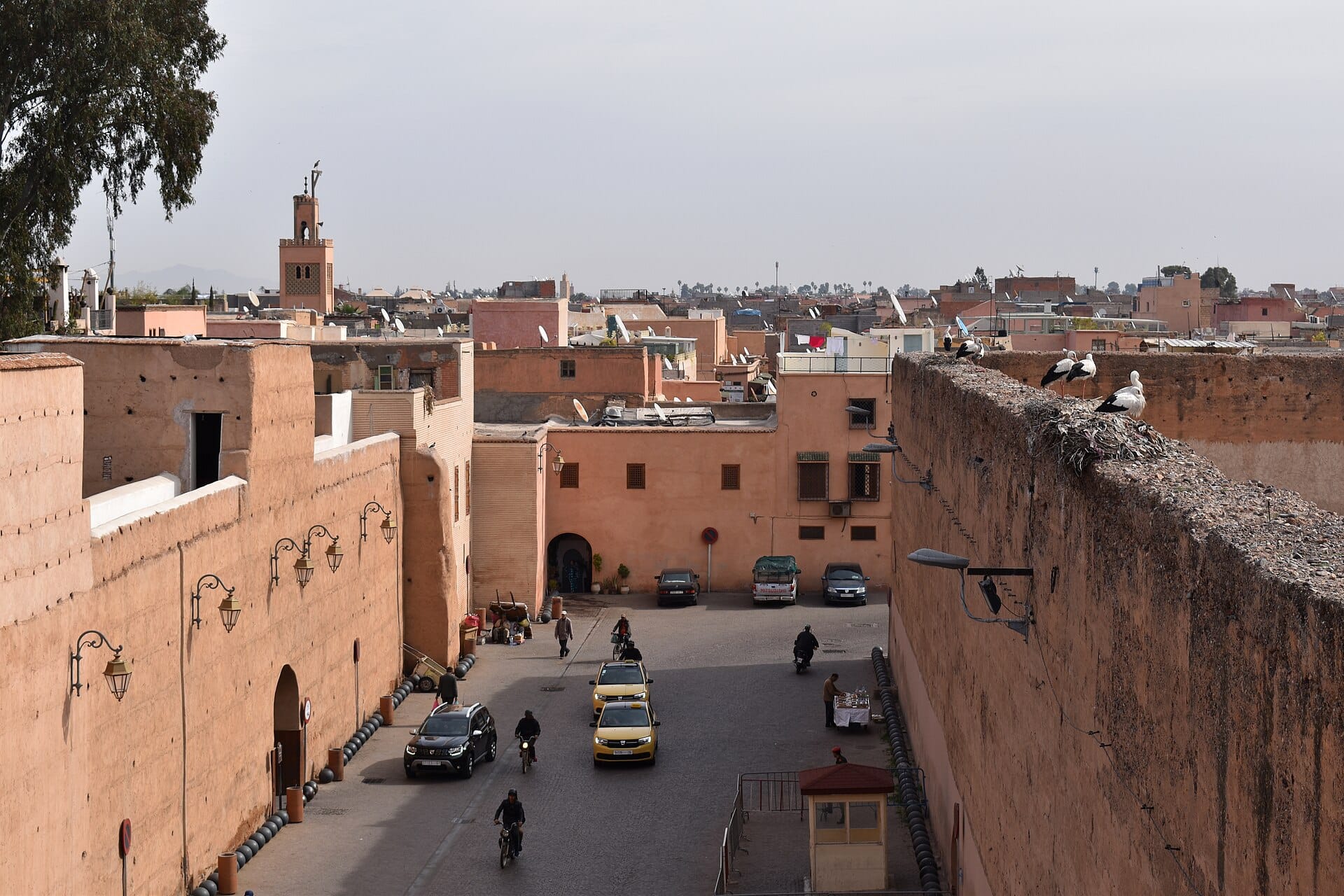
Today, El Badi appears as vast open-air ruins: high rammed-earth walls, an immense rectangular courtyard with a central pool, sunken gardens planted with orange trees and the remains of pavilions. This bare silhouette has its own evocative power, and the storks that nest atop the ramparts add to the charm of the place. You can climb onto the terraces for a fine view over the district and, on a clear day, over the snow-capped peaks of the Atlas in the distance. The site also houses, in some of its halls, displayed heritage pieces, including an ancient minbar. To prepare for this stop, consult our guide to the El Badi Palace of Marrakech.
The Royal Palace (Dar el-Makhzen)
The Kasbah remains true to its original purpose: it houses the Royal Palace of Marrakech, known as Dar el-Makhzen. It is one of the official residences of the King of Morocco when he stays in the city. As such, the palace is not open to visitors and occupies a vast area in the south of the district.
Dar el-Makhzen occupies a vast area and stands in direct continuity with the Almohad royal city: for eight centuries, it is this very sector of the city that has housed the sovereign power. The complex comprises palaces, gardens and outbuildings that are not open to the public, and of which one can only make out, from the street, the high walls and the monumental gates.
In practical terms, for the visitor, this means walking alongside high walls, guarded gates and open squares without being able to enter. The presence of the palace partly explains the peaceful and somewhat solemn atmosphere of certain parts of the Kasbah, as well as the excellent upkeep of its surroundings, notably around the vast esplanade known as the Méchouar. It is advisable to remain discreet near the monitored areas and to avoid photographing the guard posts. This official dimension is part of the district’s identity: here, the history of power does not belong only to the past, it continues into the present.
The Mellah and the Place des Ferblantiers, right nearby
Just to the north-east of the Kasbah, you enter the Mellah, the old Jewish quarter of Marrakech. Created in the 16th century, this dense and lively quarter bears witness to the long presence of the Jewish community in the city. It still has synagogues, a Jewish cemetery (the Miaara) and a distinctive architecture with balconies opening onto the street, unlike the rest of the medina.
Historically, the Mellah was the quarter where the Jewish community lived, often connected to trade, the craft of precious metals and dealings with the seat of power. Its location, right next to the palace, was no accident: it reflected the close link between certain economic functions and royal authority. The urban fabric of the Mellah, denser and more vertical, remains recognisable today and makes up a lesser-known but fascinating facet of the city.
Between El Badi, the Mellah and the Bahia Palace opens the Place des Ferblantiers, a lively meeting point lined with the workshops of ironworkers and lantern-makers. It is here that the famous Moroccan lanterns of openwork metal are made and sold, their cut-outs casting patterns of shadow once lit. You can watch the artisans at work, hammering and piercing brass and tin-plate with gestures handed down from generation to generation. The square, shaded and lively, makes a natural transition between the Kasbah and the rest of the medina. A few minutes away, moreover, stands the sumptuous Bahia Palace, which can easily be combined with a visit to the Kasbah.
Strolling through the Kasbah quarter and discovering the crafts
Beyond its major monuments, the Kasbah of Marrakech is also best savoured by wandering. The quarter has kept a residential character: its lanes are often quieter and less crowded than the big commercial thoroughfares in the centre of the medina. Here you come across residents, children playing, neighbourhood stalls, old doorways and stretches of rampart.
Craftsmanship is very much present, without the bustle of the big souks: small leather, metal and pottery workshops, babouche (slipper) shops, grocers and simple cafés where you can have a mint tea. In the area, and on the nearby Place des Ferblantiers, you will find crafts emblematic of Marrakech: ironwork and lantern-making, leatherwork, basketry, ceramics and textiles. This know-how, often handed down within families, is an integral part of the medina’s identity.
Shopping in these small stalls takes place in a calmer atmosphere than in the heart of the souks, conducive to conversation and to watching the work being done. Haggling is still customary, but it is best practised with courtesy and good humour. For those who want a more intense shopping experience, the great souks of Marrakech lie further north, around Jemaa el-Fna. The Kasbah, for its part, offers a more authentic and relaxed immersion, ideal for grasping the daily rhythm of the medina away from the crowds.
The monuments of the Kasbah at a glance
| Monument | Type | Good to know |
|---|---|---|
| Kasbah Mosque (Moulay el-Yazid) | Almohad mosque (12th c.) | Fine minaret; interior reserved for worshippers, to admire from outside |
| Bab Agnaou | Monumental Almohad gate | Ceremonial gate of the royal city, richly carved; free access |
| Saadian Tombs | Royal necropolis (16th c.) | Hall of the Twelve Columns; entry ticket; queues are frequent |
| El Badi Palace | Ruined Saadian palace (16th c.) | Large courtyard, pool, terraces with a view; entry ticket |
| Royal Palace (Dar el-Makhzen) | Working royal residence | Not open to visitors; view from outside, without photographing the guards |
| Place des Ferblantiers & Mellah | Craft square / historic quarter | Metal lanterns, synagogues, lively atmosphere; free access |
Walking itinerary to visit the Kasbah
Here is a logical sequence for discovering the Marrakech Kasbah district in half a day, starting from Jemaa el-Fna square:
- From Jemaa el-Fna, head south towards the Kasbah (a 10- to 15-minute walk).
- Pass under Bab Agnaou and take the time to observe its carved decoration.
- Make your way to the Kasbah Mosque and walk around it to admire the minaret.
- Continue with the Saadian Tombs, whose entrance is very close by (arrive early to avoid the queue).
- Walk to the El Badi Palace and climb onto the terraces for the view.
- Finish at the Place des Ferblantiers and a glimpse of the Mellah, before heading up towards the Bahia Palace if time allows.
Allow about 2 to 3 hours for the essentials, more if you take your time over cafés and shops. This itinerary fits perfectly into a broader programme: see our suggested Marrakech in 3 days to arrange it alongside the city’s other must-sees.
Opening hours and tickets for the monuments (indicative)
The district’s paid monuments – the Saadian Tombs and the El Badi Palace – are generally open every day, during the daytime, with a moderately priced entry ticket. Hours can vary depending on the season, public holidays and the religious calendar (notably during Ramadan). It is therefore wise to check up-to-date information before your visit, on site or through your accommodation.
- Saadian Tombs: entry ticket; open during the daytime; heavy crowds in the morning in high season.
- El Badi Palace: entry ticket; sometimes a supplement for a particular area; open during the daytime.
- Kasbah Mosque and Bab Agnaou: freely visible from the outside, no ticket.
- Royal Palace (Dar el-Makhzen): not open to visitors.
Tip: arriving right at opening time lets you avoid both the heat and the tour groups, especially at the Saadian Tombs, where access is through a narrow corridor that easily creates queues.
Practical tips and safety
- Comfortable shoes: the lanes are cobbled or uneven, and the whole itinerary is done on foot.
- Respectful attire: you are in a residential and religious quarter; covered shoulders and legs are appreciated, especially near the mosques.
- Morning recommended: soft light, fewer crowds and more bearable temperatures.
- Photos: avoid photographing the guard posts of the Royal Palace, and ask before photographing people.
- Fake guides: politely ignore people who offer to “accompany” you without being official guides; if in doubt, go through a licensed guide.
- Cash: bring small change for tickets, cafés and crafts.
The district is generally safe and quiet. As everywhere in a medina, keep an eye on your personal belongings in busy moments and stay alert to two-wheelers in the lanes.
How to get to the Kasbah of Marrakech
The Kasbah lies south of the medina, which makes it easily accessible from the historic centre. From Jemaa el-Fna square, a 10- to 15-minute walk south is enough to reach Bab Agnaou and the entrance to the district. This is the most pleasant way to get there, crossing the lively lanes of the medina.
By taxi (petit taxi), ask to be dropped off at Bab Agnaou or near the Saadian Tombs; vehicles do not go into the narrow lanes. From modern districts such as Guéliz or Hivernage, expect a short ride to the edge of the Kasbah. If you are arriving from Marrakech-Menara Airport, the journey to the medina is brief, and you then reach the Kasbah on foot. To organise your whole stay and string your visits together, our complete guide to things to do in Marrakech will give you an overview.
Editorial independence note: this guide is written independently and does not promote any provider. The hours, prices and access conditions mentioned are given for indicative purposes and may change; we encourage you to check them with official sources or on site before your visit.
Frequently asked questions
What is the Kasbah of Marrakech?
It is the historic royal quarter located south of the medina, founded at the end of the 12th century by the Almohads as a fortified princely city. It brings together the Kasbah Mosque, Bab Agnaou and, nearby, the Saadian Tombs and the El Badi Palace.
How long do you need to visit the Kasbah?
Allow 2 to 3 hours for the essentials on foot: Bab Agnaou, the Kasbah Mosque, the Saadian Tombs and the El Badi Palace. Plan for more if you wander through the lanes or also visit the Mellah and the Bahia Palace.
Can you go inside the Kasbah Mosque?
Like most working mosques in Morocco, it is in principle not open to non-Muslim visitors. It is admired from the outside, in particular its decorated Almohad minaret, located near Bab Agnaou.
Can you visit the Royal Palace of Marrakech?
No. The Royal Palace (Dar el-Makhzen), located in the Kasbah, is an official residence of the king and is not open to visitors. You can only walk alongside its walls, without photographing the guard posts.
How do you get from Jemaa el-Fna to the Kasbah?
The Kasbah is a 10–15 minute walk south of Jemaa el-Fna square. You can also take a petit taxi and be dropped off near Bab Agnaou or the Saadian Tombs, then continue on foot.
Is the Kasbah of Marrakech worth visiting?
Yes. It is one of the most history-rich quarters of the city, with major Almohad and Saadian monuments gathered within a small area, in a quieter atmosphere than the heart of the medina.
Conclusion
The Marrakech Kasbah district concentrates, within a few hundred metres, eight centuries of history: the Almohad royal city, the Kasbah Mosque and Bab Agnaou, the Saadian splendours of the Tombs and El Badi, and even the still-functioning Royal Palace. To this exceptional density of heritage is added a residential atmosphere more peaceful than the rest of the medina, ideal for strolling and discovering the crafts. Easily accessible from Jemaa el-Fna, the Kasbah fully deserves half a day in any stay in Marrakech. To go further, continue with our complete guide to Marrakech and find out how to connect this quarter to the city’s other treasures. For the overall historical context, the page dedicated to Marrakesh offers useful background.
Images under free licence via Wikimedia Commons: © Safia Shutterbug (CC BY-SA 3.0); © Jeanne Griffin (CC BY-SA 4.0); © Misa.stefanovic.07 (CC BY-SA 4.0). Sources: UNESCO and Wikipedia.