Arriving soon in the ochre city and wondering how to get around Marrakech without overspending or getting ripped off? Good news: it’s easier than it looks. For most of your stay, two modes are enough — your own two feet in the medina, where cars can’t go, and the little beige taxi for everything else. You can cross the historic centre from one point to another on foot in just a few minutes, and a taxi ride across town rarely costs more than 20 to 50 dirhams (roughly 2 to 5 €).
The rest comes down to a few simple habits: insist on the meter (or agree on the price before you get in), keep small change on you, and know which mode of transport suits which trip. This guide runs through every option for getting around Marrakech — petit taxi, grand taxi, horse-drawn carriage, Alsa city buses, the Ménara airport shuttle, ride-hailing apps, cycling and walking — with up-to-date indicative fares and tips to avoid the classic scams. The goal: that you know exactly how to move around Marrakech from your very first hour in the city.
In brief: getting around Marrakech in 30 seconds
- In the medina: on foot, almost always. The narrow lanes are closed to cars.
- Around town (Guéliz, Hivernage, stations): beige petit taxi, meter on or price agreed in advance.
- Typical ride in town: 20 to 50 MAD (2 to 5 €) by day, with a surcharge of about 50 % at night.
- Airport → centre: the L19 bus at 30 MAD, or a taxi at 100 to 150 MAD depending on your bargaining.
- Horse-drawn carriage: a sightseeing ride at around 150 MAD an hour, to be negotiated.
- Golden rule: agree on the price BEFORE getting in, and keep small change on you.
| Mode of transport | Best for | Indicative price | Key tip |
|---|---|---|---|
| Petit taxi (beige) | Trips around town, short distances | 20–50 MAD (2–5 €) | Insist on the meter or fix the price first |
| Grand taxi | Trips out of town, groups | 100–150 MAD (10–15 €) | Negotiate the whole ride, not the seat |
| Horse-drawn carriage | Scenic sightseeing ride | ~150 MAD/hour (~14 €) | Agree on duration and price first |
| Alsa city bus | Long trips on the cheap | 4–5 MAD (~0.45 €) | Exact change, patience at rush hour |
| L19 airport shuttle | Airport ↔ centre | 30 MAD (3 €) | Every 30 min, 7am–9.30pm |
| Ride-hailing (app) | Fixed price, no haggling | Varies by ride | Check availability once on the ground |
| On foot | Medina, souks, monuments | Free | The fastest way around the historic centre |
The petit taxi: your best ally for getting around Marrakech
The petit taxi is the most practical and most affordable way to get around Marrakech as soon as a distance becomes too long to walk. In Marrakech they are beige (each Moroccan city has its own colour: red in Casablanca, blue in Rabat). They are small cars, often Dacias or Peugeots, allowed to operate only within the city limits. They take a maximum of three passengers — and it’s not unusual for a driver to pick up a second fare along the way if they’re heading in the same direction, a perfectly normal practice in Morocco.
How much does a taxi cost in Marrakech?
The flag fall starts at around 7 MAD, then the meter ticks up a few dirhams per kilometre. In practice: a short ride in the centre works out to 15–30 MAD (about 1.50–3 €), a longer crossing to 30–50 MAD (3–5 €). After 8pm (sometimes 9pm) a night tariff applies: reckon on roughly 50 % more than by day. These are indicative amounts: they vary with traffic, the time of day and the exact distance.
The meter: the touchy subject
Officially, the meter (the “counter“, or “contour” as you’ll often hear it) is compulsory. In reality, many drivers refuse to switch it on for tourists, especially around Jemaa el-Fna square and the tourist areas, and offer an inflated “flat rate” instead. You have two strategies:
- Ask for the meter as you get in (“compteur, s’il vous plaît“). If the driver refuses, let it go and hail another — they’re everywhere.
- Negotiate the price in advance if the meter is refused. Name a realistic range (20–40 MAD depending on the trip) and stick to it calmly. A “no thanks” with a step backwards often brings the price down instantly.
The tip that changes everything: ask your riad or hotel the normal price for the trips you’ll make often. Once you know the “fair price”, negotiating becomes a ten-second formality. Always keep small change: the driver’s classic “I have no change” is a polite way of rounding up in their favour.
How to hail a petit taxi
Nothing could be simpler: raise your arm at the roadside. A free taxi has its light on (or is simply empty). You’ll find them near Jemaa el-Fna, outside the big hotels, in Guéliz and near the medina gates (Bab Doukkala, Bab Agnaou and others). At rush hour, it’s better to walk to a busy avenue than to wait in a narrow lane.
One last point on sharing: since the driver can pick up other passengers along the way, don’t be surprised to travel part of the route with a stranger. Everyone pays their own fare according to their distance, and it doesn’t increase your price. It’s often a sign, in fact, that the meter is being used properly. If you’re unsure about the route, name a well-known landmark (a medina gate, a big hotel, a square) rather than a precise address: the medina’s streets don’t always have a readable name and the addressing system there is baffling, even for locals.
The grand taxi: for getting out of town
The grand taxi is the big beige saloon car (nowadays often a Dacia Lodgy, once an indestructible Mercedes) that handles intercity links and trips to the outskirts. They work in two ways: either “shared”, where each passenger pays for a seat and the taxi leaves once full (six people squeezed in is the local norm); or “private hire”, where you rent the whole vehicle.
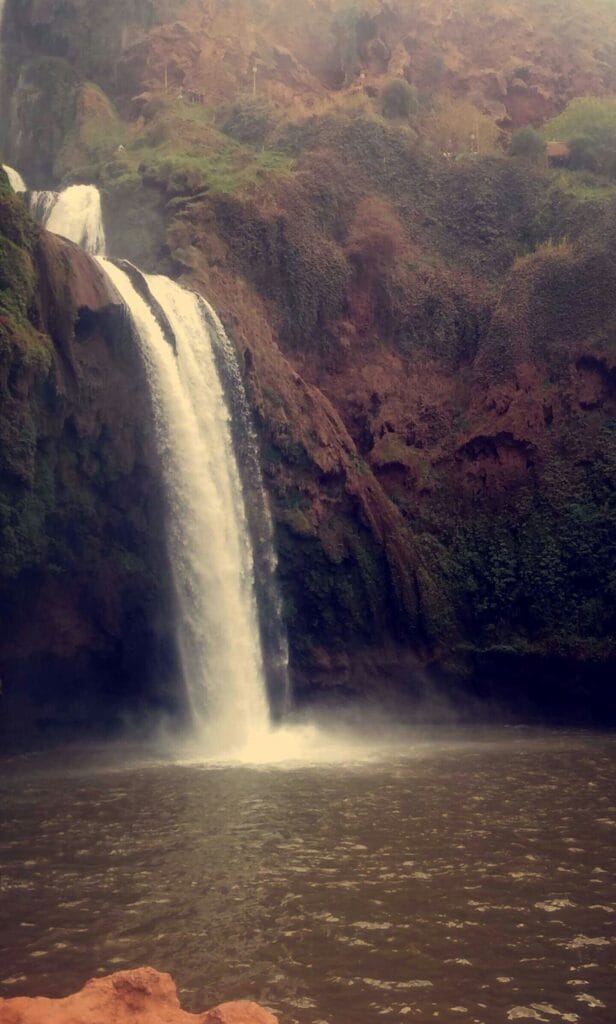
For a tourist, the grand taxi is mainly useful for reaching the Palmeraie, a slightly out-of-the-way area, or for a day trip. A ride from the centre to the Palmeraie runs to around 100–150 MAD (10–15 €) as a private hire. As always, fix the total price before setting off and be clear about whether it’s a one-way trip or a return with waiting time. For bigger excursions (the Ourika Valley, the Ouzoud waterfalls, Essaouira), a grand taxi negotiated for the day can be economical with several people, but an agency or a rental car is often more comfortable. More on that below.
The horse-drawn carriage: the romantic (and touristy) ride
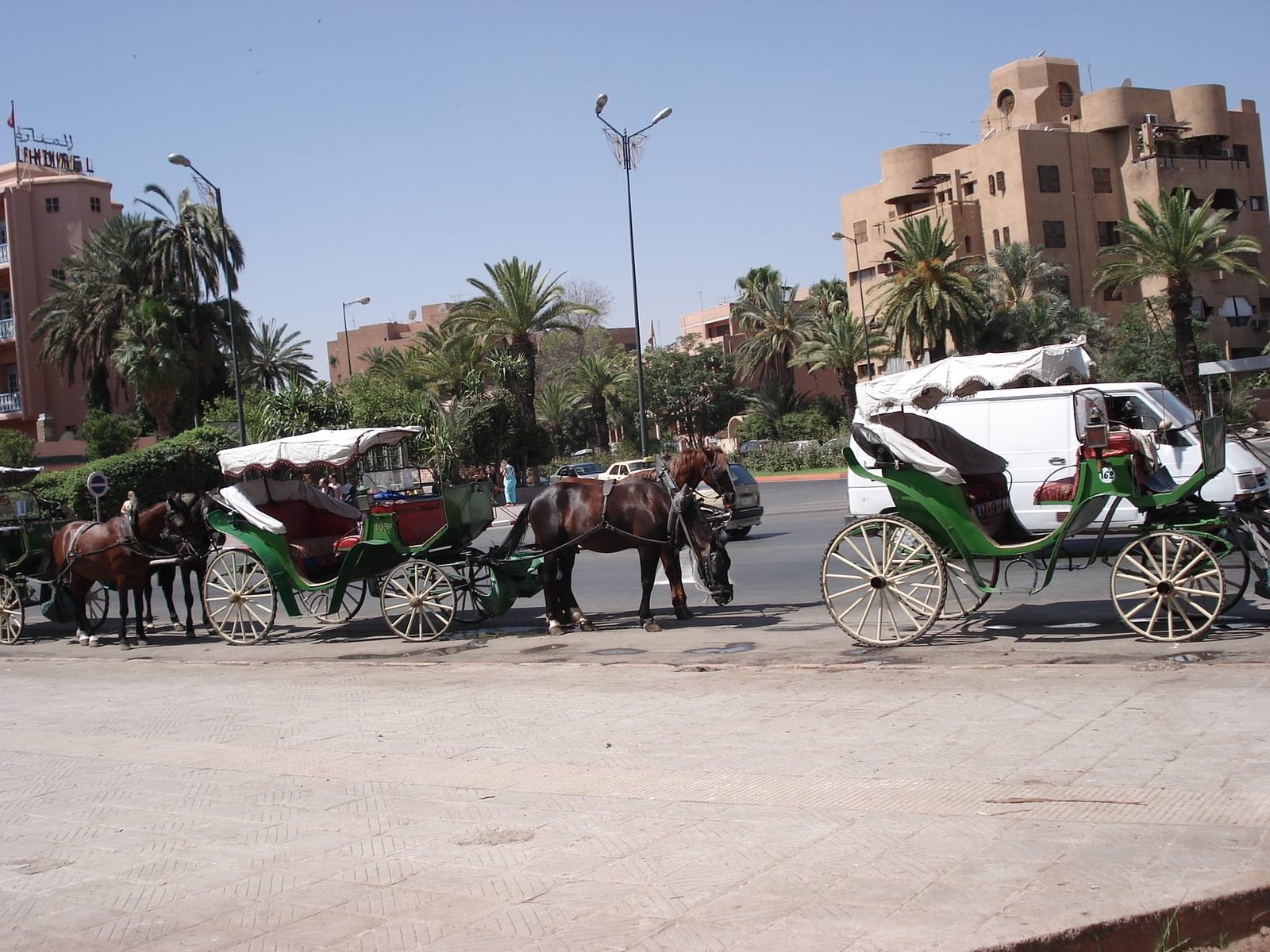
You can’t miss the horse-drawn carriages, those horse-pulled vehicles lined up along the edge of Jemaa el-Fna square and near the big hotels. It’s not a “useful” way to get from point A to point B, but a pleasant scenic ride, especially in the late afternoon when the light turns the ramparts golden. A carriage can hold up to four or five people.
The fare is by the hour: reckon on around 150 MAD an hour (about 14 €), an amount that is in theory regulated but almost always up for negotiation, especially in high season or when setting off from the most touristy spots, where you’ll first be quoted a far higher price. The two most popular routes are the loop around the ramparts and gardens (one to two hours) and the circuit via the Palmeraie (longer). Agree clearly on both the duration AND the price before getting in, and confirm that it’s a rate per carriage and not per person.
Alsa city buses: the cheapest option
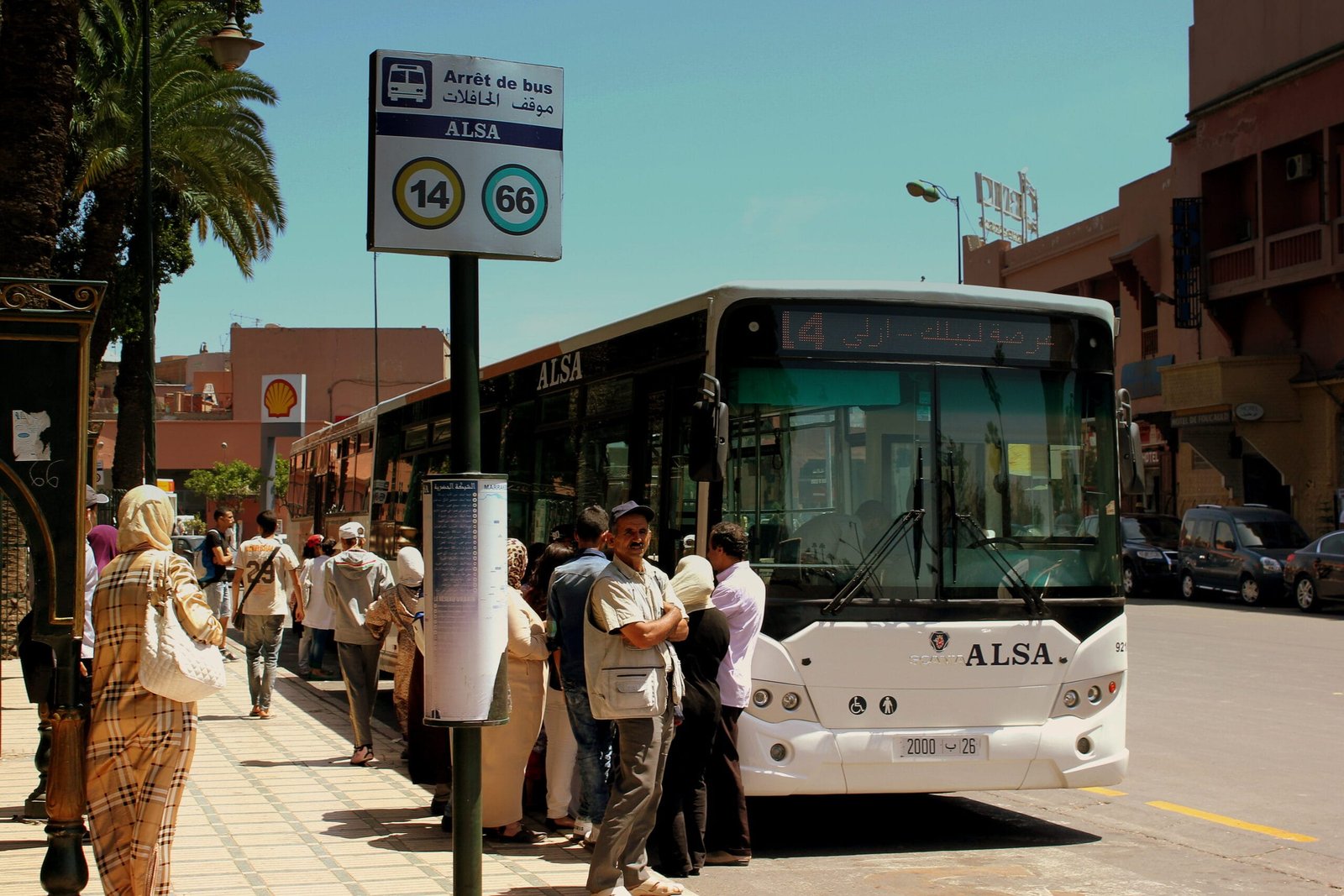
The city bus network is run by the company Alsa, which serves Marrakech with dozens of lines and a dense web of stops. It is by far the most economical mode of transport: a single ticket costs just 4 to 5 MAD (less than 0.50 €), paid as you board. The bus is perfect if you’re travelling on a tight budget and you’re not in a hurry.
In practice, most visitors use it little within the centre, where walking and the petit taxi are faster. The bus comes into its own for longer, regular trips: linking Guéliz to the medina, reaching an outlying neighbourhood, or heading to the station. A few tips: bring exact change, avoid rush hour when buses are packed, and watch your belongings as on any crowded public transport. Lines and timetables change: check locally or via a journey-planning app for the line that concerns you.
To and from Ménara airport
Marrakech-Ménara international airport is very close to the centre: barely 4 to 6 km from the medina and Jemaa el-Fna square, or about twenty minutes by car depending on traffic. This proximity is a real plus: no need for a long transfer like in other major cities. You have three main options for reaching your accommodation.
The L19 bus shuttle
This is the most economical and, price-wise, the most reliable option. The L19 line links the airport to the city centre (Jemaa el-Fna stop) for around 30 MAD one way (3 €), with a slightly discounted return fare. Buses run on average every 30 minutes, generally from 7am to 9.30pm, and serve several handy points along the way such as Guéliz, Hivernage and Bab Doukkala. You catch the bus right outside the terminal, a few dozen metres behind the taxi rank. Ideal if you’re travelling light and your accommodation is near a stop.
The taxi from the airport
Faster and more comfortable, especially with luggage or arriving at night. Be warned: airport taxis charge higher fares than in town and the meter is often “forgotten”. Reckon in general on 100 to 150 MAD (10–15 €) to reach the medina, a little more at night. Negotiate firmly before getting in and bear in mind that the trip is short. To avoid any discussion, many travellers book a private transfer in advance through their riad: the driver waits for you with a sign, the price is fixed, and they drop you as close as possible within the medina (where taxis can’t always enter).
To compare transfer options calmly from one Moroccan airport to another, see our comparison of airport transfers in Morocco. A useful reminder: this guide is independent and is affiliated neither with ONDA nor with any transport company; all the fares quoted are given for indicative purposes only.
Ride-hailing and apps: a fixed price with no haggling
Long complicated in Morocco, the ride-hailing offer (private-hire cars booked via an app) has grown markedly. Several apps now operate in Marrakech, notably inDrive, Careem, Bolt, Heetch and Yango; Uber made its return to the city in late 2025, working exclusively with licensed private-hire operators. Their big advantage: the price is shown in advance in the app, which puts an end to negotiation and reassures those who dread nasty surprises.
A few caveats, though. Availability varies by time, neighbourhood and season: there can be few cars on some evenings. Around the airport and near the medina, pick-ups can create friction with petit taxi drivers, who are very protective of their turf; you’ll sometimes be asked to move one street over. Our advice: download one or two apps before you leave, check how available they really are once you’re on the ground, and keep the petit taxi as a fallback — it remains king of the city.
On foot in the medina: transport mode number one
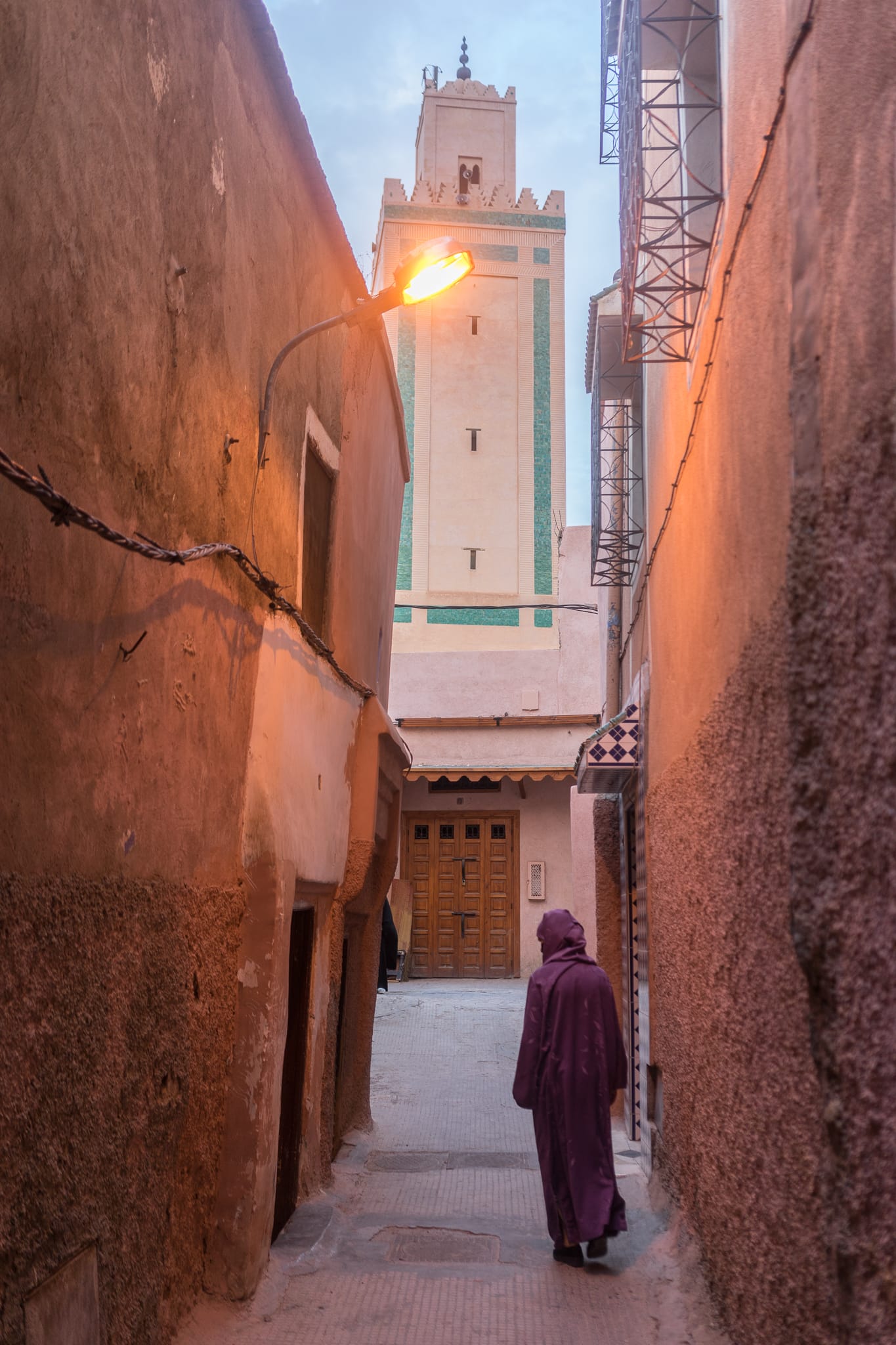
Here’s the secret everyone works out after a day: in the medina, the best way to get around Marrakech is on foot. The historic centre is a maze of narrow lanes, often too narrow for cars, and the distances between the main sights are short. From Jemaa el-Fna square, you can reach the main souks, the Ben Youssef Madrasa, the Bahia Palace or the tanneries in a few minutes’ walk.
Walking is also the best way to experience the city: the scents of spices, the artisans at work, the hidden little squares. Bring good shoes, as the ground is uneven in places, and watch out for the motorbikes and scooters that weave everywhere — stay to the side and listen behind you. Expect to get lost: it’s almost a rite of passage, and a local child will quickly offer to “guide” you for a few dirhams. An offline GPS or a downloaded map helps a lot. To plan your routes, our guide to the Marrakech medina and the one on the souks of Marrakech will save you from going round in circles.
After a ready-made itinerary? Our articles on what to do in Marrakech and Marrakech in 3 days combine walking and taxis for a smooth stay.
Bicycles and scooters: who are they really for?
Bicycles and electric scooters do exist in Marrakech, but let’s be honest: they don’t suit everyone. In the medina, the density of pedestrians, the narrow lanes and the uneven ground make cycling impractical. In the modern districts like Guéliz and Hivernage, however, which are wider and better laid out, or for reaching the Palmeraie along its main roads, two wheels can be enjoyable and a good workout.
Rental outfits offer standard bikes and mountain bikes, and you’ll occasionally come across scooters for hire. If you give it a go, ride carefully: Marrakech traffic is dense and right of way is negotiated more by instinct than by the highway code. Wear a helmet, avoid rush hour and the busiest main roads. For most visitors, this will be an occasional activity rather than a real everyday means of getting around.
Renting a car: useful or not?
For getting around Marrakech itself? Frankly, no. A car is more of a headache than an asset: heavy traffic, one-way streets, complicated and paid parking, and a medina completely off-limits to vehicles. Between the cheap petit taxi and walking, you have no need for a car to visit the city.
Car rental makes full sense for excursions: the Ourika Valley, the Ottat Valley, the Ouzoud waterfalls, Essaouira on the coast, or even a road trip towards the desert and the Atlas valleys. There, having your own vehicle offers precious freedom. If you rent, take full insurance, keep your documents to hand for road checks (frequent and courteous), scrupulously respect the speed limits, and ideally pick up the car on the day you set off on your excursion rather than keeping it needlessly in town. For an easy first taste of nature, see our guide to the Ourika Valley from Marrakech.
Anti-scam tips and tipping
Marrakech is a warm and, on the whole, safe city, but as in any major tourist destination, a few classic traps target visitors. Nothing nasty, just enough to stay alert so you don’t pay the “tourist” price. Here are the habits that make the difference:
- Always fix the price before getting in (taxi, carriage, grand taxi) if the meter isn’t switched on.
- Keep small change: 20 and 50 MAD notes, coins. The “I have no change” line is common.
- Don’t follow spontaneous “guides” who tell you a street is “closed” or that a square is “that way”: they’ll demand a tip.
- Be wary of prices quoted in euros: always think in dirhams, the real local currency.
- Know the fair price by asking your hotel before heading out: it’s your best protection.
As for tipping, the culture of “baksheesh” is very real in Morocco but stays modest. For a taxi driver, rounding up by a few dirhams is enough; it’s not compulsory but appreciated for good service or help with luggage. Always stay polite and smiling: firmness works far better with a smile than with irritation. To dig deeper, see our dedicated guide to safety and scams in Marrakech, as well as our pointers on travel budget in Marrakech to calibrate your spending well. And to choose where to lay down your bags closest to the action, take a look at our selection of where to stay in Marrakech.
Frequently asked questions
What’s the best way of getting around Marrakech?
The walking + petit taxi combination covers 95 % of your needs. On foot in the medina, where cars don’t go, and a beige petit taxi for any longer trip to Guéliz, Hivernage or the stations. It’s simple, fast and inexpensive.
How much does a petit taxi cost in Marrakech?
A ride in town generally costs 20 to 50 MAD (2 to 5 €) by day, with a flag fall of around 7 MAD. After 8pm, a surcharge of about 50 % applies. Insist on the meter or fix the price before getting in.
How do you get from Ménara airport to the centre?
Three options: the L19 bus shuttle (around 30 MAD, every 30 min from 7am to 9.30pm), a taxi (100–150 MAD, to be negotiated), or a private transfer booked in advance. The airport is only 4–6 km from the centre, about twenty minutes away.
Should you rent a car in Marrakech?
Not to visit the city: traffic, parking and the pedestrian medina make it useless, even painful. Car rental is, however, very useful for excursions around Marrakech (Ourika, Ouzoud, Essaouira, the Atlas), where it offers real freedom.
Do apps like Uber or inDrive work?
Yes, several ride-hailing apps operate in Marrakech (inDrive, Careem, Bolt, Heetch, Yango, and Uber since late 2025), with a price shown in advance. Availability varies by time and neighbourhood: keep the petit taxi as a fallback, especially near the airport and the medina.
How much does a horse-drawn carriage cost in Marrakech?
Reckon on around 150 MAD an hour (about 14 €), to be negotiated before getting in. It’s not a useful means of transport but a pleasant sightseeing ride, especially around the ramparts at the end of the day. Confirm that the price is per carriage and not per person.
In summary
Getting around Marrakech is nothing complicated once you’ve grasped the local logic: you walk in the medina, you take the petit taxi for everything else, and you keep a few price benchmarks in mind so you never pay more than necessary. Transport in Marrakech is abundant, cheap and picturesque — from the beige taxi to the horse-drawn carriage by way of the Alsa bus. Fix your prices in advance, keep change on you, stay smiling, and you’ll move around the ochre city like a regular. To go further, the Marrakech page on Wikipedia offers a good general overview of the city and its history.
Images under free licence via Wikimedia Commons: © calflier001 (CC BY-SA 2.0); © mwanasimba (CC BY-SA 2.0); © Omalihy (CC BY-SA 4.0). Source: Wikimedia Commons.Photo credits: royalty-free illustrative images (Marrakech). The fares mentioned are indicative and may change; this guide is independent and not affiliated with ONDA or any transport operator.