Packing for Marrakech almost always raises the same question, especially among women travellers: what can you wear without feeling out of place, without overheating, and while still respecting the local culture? Good news: Marrakech is an open tourist city, used to visitors from all over the world, and there is no obligation to wear a veil and no legal dress code for tourists. The rule fits in one sentence: choose an outfit that is comfortable and respectful, covering shoulders and knees in the medina, while enjoying far more freedom at the pool, in your hotel or in the modern neighbourhoods. This guide answers, in detail, exactly what to wear in Marrakech.
In this complete guide, we look together at what to wear in Marrakech depending on the setting (medina, souks, monuments, pool, rooftop) and on the season, with practical tips for women and men alike. The goal is not to dictate how you should behave, but to help you enjoy the city to the fullest, at ease and confident, while avoiding the few missteps that can attract stares. Whether you travel in summer under 40 °C or in winter under a mild sky, you will know exactly what to put in your suitcase.
Independent guide written for informational purposes: we are not affiliated with ONDA or with any official Moroccan body.
In short: the ideal outfit in Marrakech
- No obligation to wear a veil for tourists: you dress freely, while respecting local customs.
- In the medina and the souks: shoulders and knees covered, light and flowing fabrics.
- At the pool, in the hotel, in a riad: swimsuit, shorts and bare arms are perfectly fine (private areas).
- Modern neighbourhoods (Guéliz, Hivernage): more freedom, a relaxed and cosmopolitan vibe.
- Watchwords: comfort, breathable fabrics (cotton, linen), and a light scarf always in your bag.
- Footwear: closed and comfortable for walking on the uneven cobbles of the medina.
Do you really have to cover up in Marrakech? Setting the record straight
Let’s start by clearing up a common misconception. Morocco is a Muslim country, but it is also one of the most touristy destinations in North Africa, and Marrakech is its showcase. There is no law requiring tourists to cover up, no obligation to wear a headscarf, or to hide your hair or your face. Moroccan women themselves dress in very varied ways: some wear the veil, others do not, and in the city’s modern neighbourhoods you’ll come across resolutely Western outfits.
The question, then, is not legal but cultural and practical. Morocco remains a society where modesty in dress is a traditional value, particularly in the old quarters, rural areas and near places of worship. Dressing a little more coveringly in the medina is not an imposed religious constraint: it is simply a mark of respect that makes interactions with locals easier, reduces persistent stares, and lets you blend in more naturally. Many women travellers report that a well-judged outfit makes their stay more pleasant and more serene.
You also need to understand the logic of zones, because it is the key to the whole dress code in Marrakech. The city works as a succession of spaces with different codes. The historic medina, its souks and its lanes are the traditional heart: there you adopt a more discreet outfit. Modern neighbourhoods such as Guéliz or Hivernage, with their cafés, shops and restaurants, are far more relaxed. And private spaces (hotels, riads, pools, private beaches) offer almost total freedom. Understanding this geography already means knowing what to wear in Marrakech without stress.
Finally, keep the climate in mind. Marrakech has a semi-desert climate where temperatures can range from 6 °C in winter to nearly 40 °C in summer. Covering up wisely does not mean being hot: on the contrary, loose cotton or linen clothing protects from the sun and lets air circulate, exactly as locals have done for centuries.
What to wear in Marrakech for women (medina, souks, monuments)
Let’s turn to the topic that concerns the most travellers: what to wear in Marrakech when you are a woman exploring the medina, the souks and the monuments. The guiding principle is simple and easy to remember: cover your shoulders and knees. In other words, avoid spaghetti-strap tank tops, very plunging necklines and very short shorts in the traditional areas. That’s all. From there, a huge variety of elegant and comfortable outfits is open to you.
Here are the pieces that work particularly well for a successful outfit in Marrakech:
- The maxi dress: the star piece. Flowing, cool, elegant, it covers the legs while staying airy. In cotton or linen, it is the perfect ally for hot days.
- Wide or flowing trousers: linen trousers, harem trousers or palazzo pants. Comfortable for walking, they cover the legs and let the skin breathe.
- The midi or long skirt: below the knee, it combines coolness with respect for local customs.
- Loose tunics and blouses: ideal for covering the shoulders and torso without stifling. Long, light sleeves also protect from the sun.
- The light scarf: an indispensable multi-purpose accessory. It turns into a shoulder cover inside a monument, sun protection, or a touch of elegance.
As for shorts, the subject of many questions: they are not banned and no one will make an official comment. But in the medina and the souks, short shorts can attract stares. If you’d rather wear them, opt for long shorts (Bermuda) that reach the knee, or a skirt. In the modern neighbourhoods and tourist areas, shorter shorts are no problem. This flexibility sums up the spirit of the city well: the closer you get to the traditional heart, the more you cover up; the more you are in modern or private areas, the freer you are.
As for hair: there is no obligation to cover it. Tourists do not wear a scarf over their hair in everyday Moroccan life, and no one expects it of you. The only exception concerns certain very formal religious visits (see the dedicated section). Simply keep a scarf within reach; it can always come in handy. If you are planning a family trip, our article on Marrakech with family adds to this advice for dressing children according to your activities too.
In short, the woman who nails her outfit in Marrakech relies on natural fabrics, loose cuts and colours that aren’t afraid of a little dust. A long linen dress, a pretty scarf, comfortable sandals: you are ready to wander Jemaa el-Fna square and lose yourself in the souks of Marrakech with complete peace of mind.
At the pool, in the hotel and on the rooftop: time to relax
Good news for anyone dreaming of lounging around: in private spaces, the rules relax completely. At your hotel or riad pool, on a private beach or in a beach club, a swimsuit (one-piece or two-piece) is perfectly accepted. You don’t have to cover up any more than you would anywhere else in the world. These places are designed for relaxation and welcome an international clientele.
Within the hotel grounds in general, dress is free: shorts, a summer dress, a tank top, bare shoulders and legs pose no problem. Do bring along a sarong or a light tunic for moving between the pool and your room, or for going to the hotel restaurant, where a slightly dressier outfit is appreciated in the evening.
Marrakech’s famous rooftops, those panoramic terraces where you sip tea or a cocktail facing the sunset, are cosmopolitan and chic spots. There you can wear a lovely dress, a smarter outfit, without necessarily covering your shoulders. It’s the moment to bring out your nicest pieces. Just bear in mind that to get to the rooftop, you may cross the medina: a scarf or a light cardigan in your bag lets you cover your shoulders for the walk, then take it off once you arrive. After a day of walking, many travellers also love treating themselves to a wellness break: check out our selection of hammams and spas in Marrakech to extend the relaxation.
What to wear in Marrakech for men
The topic is often centred on women, but men also have every reason to take care with their outfit in Marrakech, following slightly more relaxed logic. The basic rule: in the medina, favour trousers or long shorts. A bare-chested man, or one in very short shorts in the souks, stands out and can be seen as a lack of respect, especially near mosques.
In practice, the ideal men’s wardrobe for Marrakech looks like this:
- Light cotton or linen trousers: comfortable, breathable, perfect for the medina as well as for dinners in town.
- Bermuda shorts or knee-length shorts: acceptable almost everywhere, including for excursions.
- T-shirts, polos and linen shirts: prefer sleeves (short or long) over tank tops in the traditional areas.
- A shirt or a light sweater for the evenings, which can be cool, notably in the shoulder seasons and in winter.
As with women, private spaces (pool, hotel, beach) allow a swimsuit and lighter clothing. And in the modern neighbourhoods, shorts and a t-shirt are no problem. The male traveller will therefore remember one simple rule: cover up a minimum in the medina, relax in the tourist and private spaces.
What to wear depending on the season in Marrakech
Knowing what to wear in Marrakech depends a great deal on when you travel. The city’s semi-desert climate is marked by scorching summers and mild winters with cool nights. Adapting your suitcase to the season changes everything when it comes to comfort. If you are still unsure about your dates, our guide on the best time to visit Marrakech will help you choose.
In summer (June to September): the battle against the heat
Summer in Marrakech is intense: temperatures regularly climb to 38–40 °C, peaking in July and August. The natural instinct would be to bare as much skin as possible, but that’s a mistake: under such a sun, covering your skin with loose, light-coloured clothing protects better than bare, exposed skin. It’s the paradox of the desert, one that locals know well.
- Rely on cotton and linen, breathable and temperature-regulating, and on light colours that reflect the light.
- Flowing maxi dresses, loose trousers, light sleeved tunics: the winning combination.
- A wide-brimmed hat, sunglasses and sunscreen are essential.
- A light scarf to protect the back of your neck and shoulders during the hottest hours.
- Avoid synthetic fabrics that cling to the skin and trap heat.
To survive the summer furnace in comfort, find our detailed tips in the article dedicated to Marrakech in summer.
In winter (December to February): mild by day, cool by night
Marrakech winters often surprise travellers. The days are pleasant and sunny, with highs around 18–21 °C, ideal for sightseeing. But as soon as the sun sets, the temperature drops quickly and can fall below 5 °C, sometimes close to 0 °C. The layering system is the best strategy.
- During the day: jeans or trousers, a long-sleeved t-shirt, a light sweater.
- In the evening: add a warm jacket, a coat or a thick scarf. Traditional riads can be chilly, so an indoor sweater is welcome.
- Bring closed shoes and, possibly, a small raincoat: a few showers are possible.
In the shoulder seasons (March–May and September–November): the perfect balance
Spring and autumn are often considered the best times to visit Marrakech, with mild temperatures ranging between 20 and 30 °C. The suitcase becomes light and versatile: summer outfits for the day (dresses, light trousers, tunics) and a jacket or cardigan for the still-cool evenings. It’s the ideal season to enjoy the terraces without suffering from the heat.
Footwear: walking comfortably in the medina
We rarely think about it when packing, and yet shoes make all the difference in Marrakech. The medina is a labyrinth of cobbled, uneven and sometimes dusty lanes, where you walk a lot. Unsuitable shoes can turn a lovely day of sightseeing into agony for your feet.
- Favour closed, comfortable shoes: trainers, sturdy flats, thick-soled walking sandals.
- Avoid high heels and thin flip-flops, poorly suited to cobbles and uneven ground.
- Opt for pairs you don’t mind getting dirty: dust is part of the scenery.
- A pair of comfortable sandals is enough for the pool and moments of relaxation.
Little bonus: the souks are full of soft, light leather babouches (slippers). It’s the chance to buy a pair for strolling leisurely through the medina, while bringing home an authentic souvenir.
What to pack in your suitcase for Marrakech
To make packing easier, here is a versatile clothing checklist, suited to most trips. Adjust the quantities according to the season and length of stay.
- 2 to 3 long or midi dresses in cotton or linen (women).
- 2 loose or flowing trousers and 1 long skirt.
- Several sleeved tops (tunics, blouses, t-shirts).
- 1 light scarf or shawl (shoulder cover, sun protection, places of worship).
- 1 cardigan or light jacket for the evenings (essential outside summer).
- 1 swimsuit + 1 sarong for the pool.
- Comfortable closed shoes + a pair of sandals.
- Hat, sunglasses, sunscreen.
- A warm coat and a sweater in winter.
- A small backpack or cross-body bag that closes securely (practical and safe in the crowds).
Tip: travel light and leave some room. You’ll almost certainly fall for local clothing and accessories. For ideas on souvenirs to bring back, see our guide on what to bring back from Marrakech.
Mistakes to avoid when dressing for Marrakech
A few missteps come up regularly among travellers. Knowing them in advance makes them easy to avoid and your stay smoother.
- Very revealing tank tops and plunging necklines in the medina: nothing illegal, but they attract stares. A sleeved top is more comfortable psychologically.
- Very short shorts in the souks: prefer Bermuda shorts or a long skirt in the traditional areas.
- Underestimating the cold of winter evenings: leaving without a warm jacket is a classic mistake.
- New shoes or heels: a guarantee of blisters on the cobbles. Break in your shoes before you leave.
- Too much synthetic fabric in summer: these materials trap heat and perspiration.
- Pristine white clothing: the medina’s dust will quickly get the better of it. Opt for forgiving shades.
- Neglecting sun protection: the Marrakech sun is powerful, even outside summer.
Finally, an overly ostentatious look (flashy jewellery, very visible luxury bags) can draw unwanted attention in the crowd. Staying discreet is not only a matter of respect, it’s also a matter of peace of mind. To go further on this point, our article on safety and scams in Marrakech offers good pointers.
Respecting religious sites
Marrakech has many monuments with a strong spiritual dimension. Most working mosques are closed to non-Muslims in Morocco, so you generally won’t have to worry about what to wear to enter them. Historic and cultural sites open to visitors (Ben Youssef Madrasa, Saadian Tombs, heritage monuments), on the other hand, welcome everyone.
In these places steeped in history, adopt a covering outfit out of respect: shoulders and knees covered is the right reflex. This is where your light scarf comes into its own: kept in your bag, it unfurls in seconds to cover the shoulders or hair if the site requires it. For example, at some large mosques open to visits, such as the Hassan II Mosque in Casablanca, a scarf is required to enter. In Marrakech, this level of formality is rarely asked for, but a sober outfit is always appreciated at religious and heritage sites. Respecting these places is part of the travel experience, just like discovering the rich history of Marrakech.
Buying clothes locally in the souks
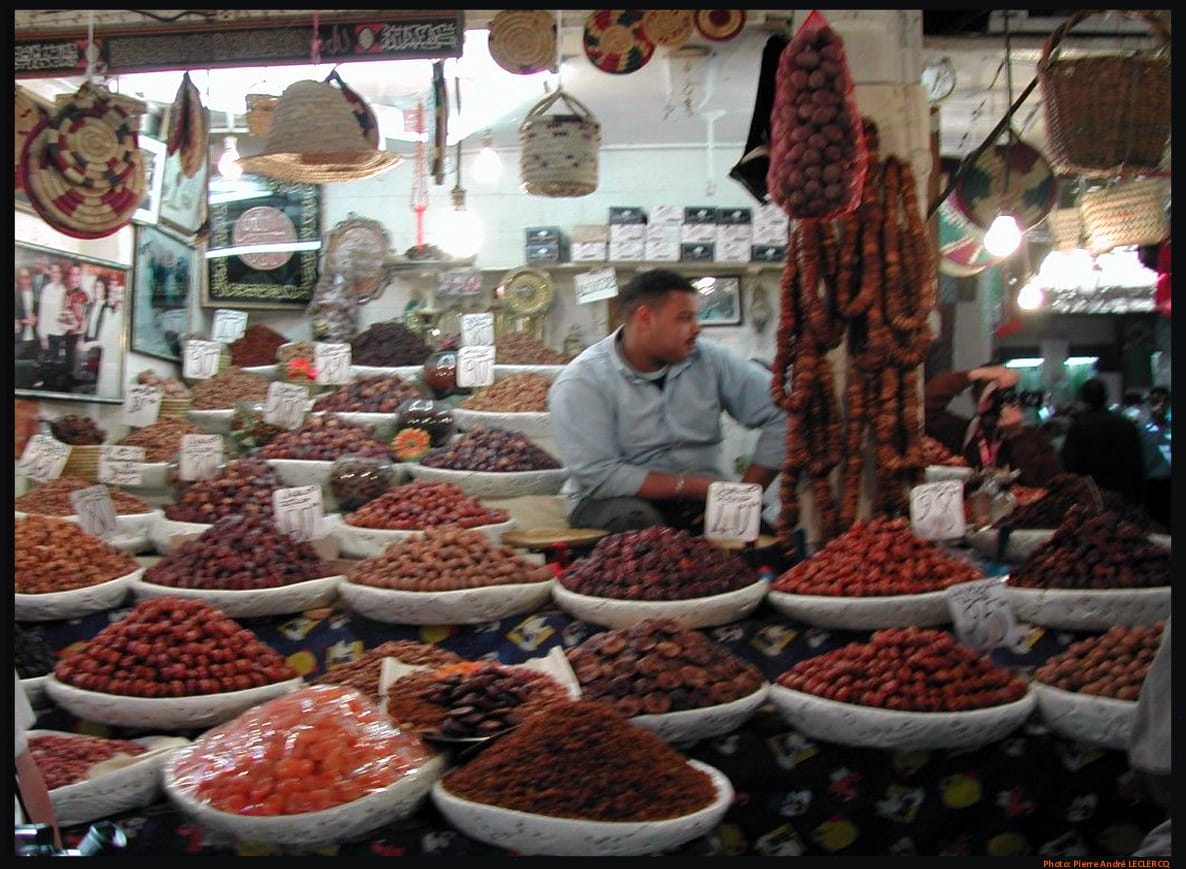
What if your finest Marrakech outfit were bought… in Marrakech? The souks of the medina are a paradise for anyone who loves textiles and craftsmanship. It’s the chance to complete your wardrobe with local pieces, perfectly suited to the city’s climate and atmosphere.
- Kaftans and djellabas: the djellaba, a long hooded tunic, is cool, loose and covering, ideal for the medina. The dressier kaftans make superb evening outfits.
- Cotton tunics and dresses: light and colourful, perfect for the heat.
- Scarves and shawls: in cotton, silk or light wool, inexpensive and very useful.
- Leather babouches: comfortable and iconic.
- Leather bags and accessories: Marrakech is renowned for its leatherwork.
Remember to haggle: it’s the custom in the souks, and it’s part of the game, in good spirits. Take your time, compare, and don’t hesitate to try things on. To learn all about this fascinating world, dive into our dedicated guide to the souks of Marrakech. And to plan all of your outings, our complete guide on what to do in Marrakech will accompany you from start to finish of your stay.
FAQ: your questions about what to wear in Marrakech
Do you have to wear a veil in Marrakech as a tourist?
No. There is no legal or social obligation to wear a veil for tourists in Marrakech. You don’t have to cover your hair in everyday life. A simple scarf in your bag is enough, useful occasionally for certain religious sites or to protect you from the sun.
Can you wear shorts in Marrakech?
Yes, it’s not banned. In the modern neighbourhoods and tourist areas, shorts are no problem. In the medina and the souks, long knee-length shorts (Bermuda) are preferable to stay discreet and respectful. Very short shorts attract more stares there.
What should a woman wear in Marrakech in summer without overheating?
Rely on natural, breathable fabrics (cotton, linen) and light colours. Flowing maxi dresses and loose trousers cover the skin while letting air circulate: they protect from the sun better than bare, exposed skin. Add a hat, sunglasses and sunscreen.
Can you wear a swimsuit in Marrakech?
Yes, in private spaces: hotel and riad pools, beach clubs, private beaches. A one-piece or two-piece swimsuit is perfectly accepted there. However, you don’t walk around in a swimsuit in the medina or the city streets.
What outfit should you plan for winter in Marrakech?
Adopt the layering system. The days are mild (18–21 °C) but the nights cool, sometimes close to 0 °C. Plan for trousers, long-sleeved tops, a sweater and, above all, a warm jacket or coat for the evening. As riads can be chilly, an indoor sweater is useful.
What is the dress code for men in Marrakech?
For men, the rule is more relaxed but it exists: avoid going bare-chested and wearing very short shorts in the medina, where trousers or Bermuda shorts are preferable. In the modern and private areas, shorts and a t-shirt are welcome. A swimsuit is reserved for private spaces.
Conclusion: at ease and respectful, the winning duo
You now know what to wear in Marrakech with complete peace of mind. Remember the essentials: no obligation to wear a veil for tourists, an outfit covering shoulders and knees in the medina, plenty of freedom in private spaces and modern neighbourhoods, and light fabrics suited to the season. By following these few simple guidelines, you’ll blend naturally into the city’s atmosphere, you’ll be comfortable in the sun, and you’ll fully enjoy the magic of Marrakech with an easy mind. Have a great trip!
Images under free licence via Wikimedia Commons: © Omalihy (CC BY-SA 4.0); © Pierre André Leclercq (CC BY-SA 4.0); © Angeline A. van Achterberg (CC BY-SA 4.0). Sources: Wikimedia Commons.Photo credits: royalty-free illustrative images. This guide is independent and provided for informational purposes.