The Marrakech tanneries are one of those places that divide opinion: some travellers come away with a strong, authentic memory, while others remember nothing but pushy touts and mint “offered” for free and then billed. The truth lies somewhere in between. Yes, it is an interesting, age-old spot, one of the few places where you can still watch leather being worked by hand exactly as it was eight centuries ago. But yes, it is also one of the corners of the medina most prone to petty scams. The short answer: it is worth the detour if you love craftsmanship and authentic slices of everyday life, provided you arrive prepared.
How do you visit with peace of mind? By knowing in advance what awaits you: the smell (strong), the geography (the Bab Debbagh district, in the north-east of the medina), and above all the game of “fake guides” who grab hold of you before you even reach the entrance. If you know the rules of the game — decline politely, agree a price first, accept nothing “for free” — the visit goes very smoothly. In this guide we explain where the Marrakech tanneries are, how the traditional process works, the common scams, whether you need a guide, what to buy and how to haggle, the difference with the famous tanneries of Fez, and a few honest words on the question of animal welfare.
In brief
- Where: the Bab Debbagh district, north-east of the Marrakech medina.
- Entry price: the site has no official ticket office, but you will be asked for a “tip” (reckon on 20 to 50 MAD / 2 to 5 €, never more).
- Duration: 20 to 40 minutes is plenty.
- Trap number one: fake guides and the sprig of mint “offered” then billed.
- What to bring: closed shoes, a scarf, and small change.
- Verdict: authentic and photogenic, but to be approached with caution.
MoroccoAirport.com is an independent travel guide. We are affiliated neither with ONDA nor with any tannery, cooperative or guide in Marrakech; our advice is neutral and intended to help you enjoy the place without being ripped off.
Where the Marrakech tanneries are (Bab Debbagh)
The Marrakech tanneries are concentrated in the Bab Debbagh district, literally the “gate of the tanners”, at the far north-east edge of the medina. This is no accident: since Almoravid times, in the 12th century, the leather trade has always been pushed out to the fringes of the historic city. The reason is very practical — the smell. Treating the hides gives off powerful fumes that could not be tolerated near mosques, food souks or residential areas. So the vats were set up close to the ramparts, near a gate and a water source, to flush away the waste.
In practical terms, to reach Bab Debbagh you have two options. Either you set off on foot from the heart of the medina — allow 20 to 30 minutes of walking from Jemaa el-Fna square, through a maze of alleys that becomes more and more working-class and less and less touristy the closer you get. Or you take a petit taxi and ask for “Bab Debbagh” or “Place Moukef”, the nearest crossroads. From there, signs and above all locals will point you towards the tanneries (sometimes a little too eagerly, as we will come back to).
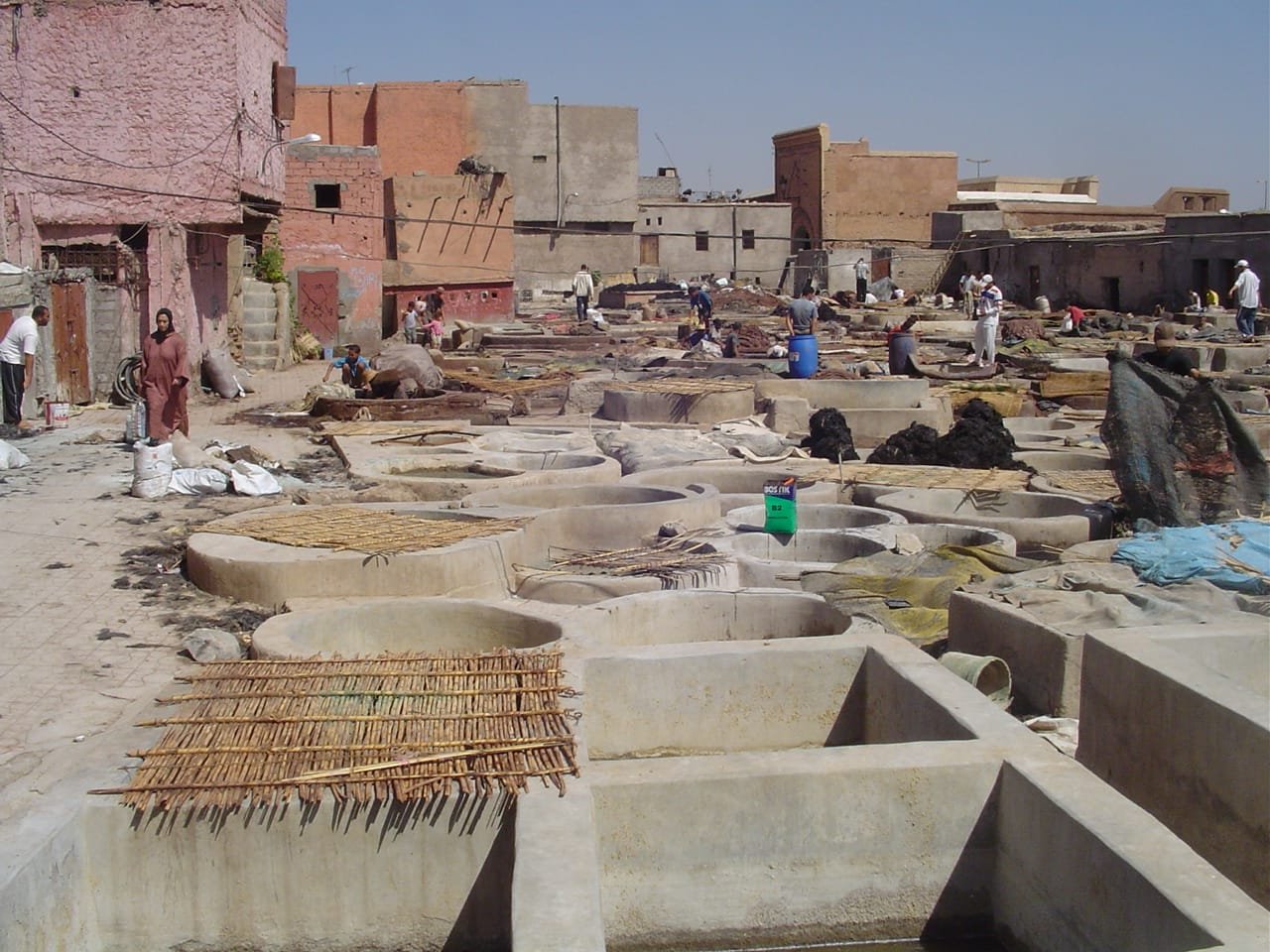
You need to understand the nature of the place: these are not “tanneries” in the sense of a fenced-off attraction with a ticket booth and opening hours. They are very real working workshops, scattered around the gate, where craftsmen operate day to day. So you are stepping into a place of production, not into a museum. That is the whole charm of the spot — and the whole difficulty, because with no official framework, the door is wide open to middlemen of every kind. To place Bab Debbagh within the old town as a whole, our guide to the Marrakech medina and the one on the ramparts and gates of Marrakech will help you picture the district.
A word on getting there from outside the city: if you are arriving from the airport or another neighbourhood, the simplest option is still the petit taxi. We cover all the transport options in our article on how to get around Marrakech, including indicative fares and using the meter.
How a traditional tannery works
What makes a Marrakech tannery so fascinating is that the process has barely changed in centuries. Everything is done by hand, with no machinery and no industrial chemicals. The sight of dozens of circular vats dug into the ground, filled with coloured or milky liquids, with men plunging the hides in up to their thighs, looks like a scene straight out of the Middle Ages.
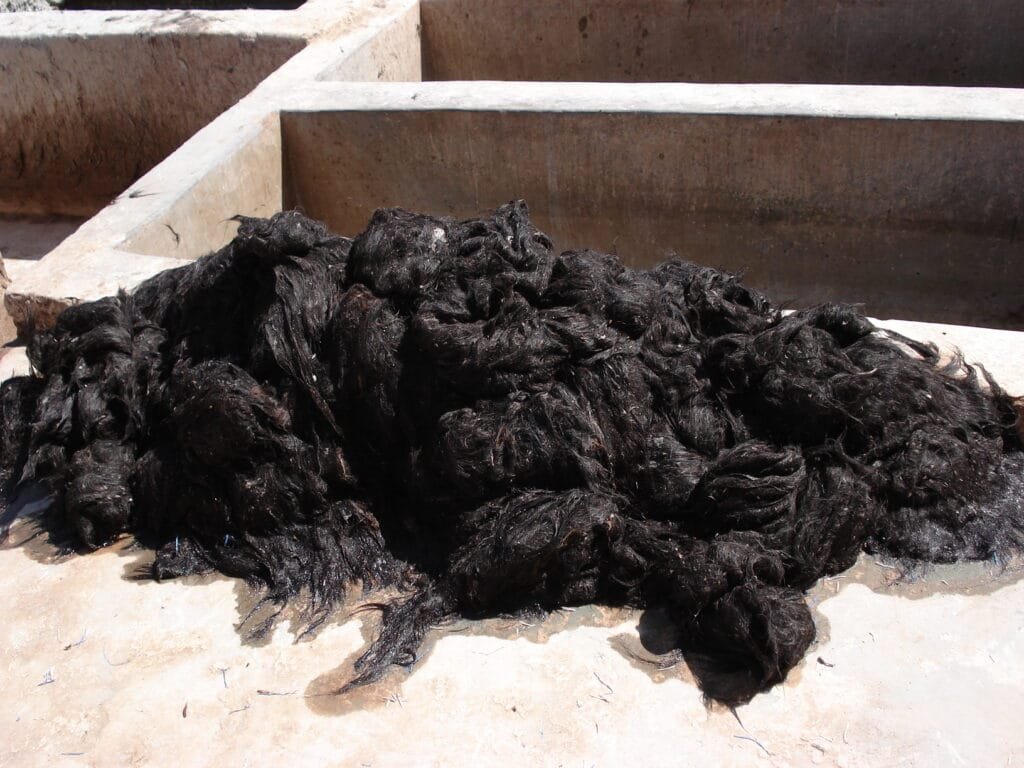
The work begins with the arrival of the raw hides — cattle, sheep, goat, dromedary — still covered in hair and flesh. They are first dipped in vats of quicklime mixed with water and salt. This stage serves to swell the skin, loosen the hair and remove any residual tissue. The hides stay there for several days, sometimes several weeks, before being scraped with a knife to strip off whatever remains.
Then comes the stage most surprising to a visitor: the softening bath. The hides are soaked in a fermented mixture rich in ammonia, whose most famous traditional ingredient is pigeon droppings. This is not a tourist legend: the ammonia in the droppings attacks the keratin and makes the leather supple and pliable. Many tanneries even used to keep their own pigeon loft to secure the raw material. Animal urine and other natural agents are sometimes added too. It is largely this bath that gives the place its distinctive smell.
Once softened, the hides move on to dyeing. Here again, tradition favours natural pigments: saffron or mint for yellow, henna for orange, poppy or madder for red, indigo for blue, pomegranate bark or mint for green. The craftsmen knead the hides in the colour tubs, by hand and by foot, for one to three days depending on the intensity wanted. Finally, the leathers are spread out in the sun, on terraces or right on the ramparts, to dry. It is this last image — dozens of coloured hides hung out — that appears in so many photos of Marrakech leather.
This craft is physically gruelling. The tanners often work barefoot in the vats, exposed to the fumes and the lime, in a trade passed down from father to son. Watching it up close is to understand why Moroccan leather has a worldwide reputation — and why a good pair of babouches or a quality pouffe carries a real price.
The smell and the famous sprig of mint
Let’s talk frankly about the smell, because it is the first thing that hits you. Between the lime, the fermentation and above all the pigeon droppings, the air in the tanneries is thick with acrid fumes that catch at your throat. It is not unbearable for everyone, but sensitive people can feel queasy, especially in hot weather, when the vats heat up in the sun.
Hence the tradition of the sprig of mint, jokingly nicknamed the “Moroccan gas mask”. At the entrance, someone will almost always hand you a bunch of fresh mint to hold under your nose: the minty smell effectively masks the stench. It is a useful gesture, rooted in local custom.
Be careful, though: hidden in this apparently hospitable gesture is one of the most common micro-scams of the place. The mint is presented as “a gift”, “cadeau, cadeau”, but at the end of the visit the same person will demand a coin, or even several euros, for this “service”. The best move is to bring your own sprig of mint — you can buy some for a few dirhams at the souk stalls before you arrive — or simply a scarf that you dampen and hold in front of your nose. If you accept the mint offered by a stranger, assume from the outset that it is not free and set aside a small coin, no more.
Common scams at the Marrakech tanneries and how to avoid them
This is the heart of the matter, and the reason so many travellers come away frustrated. The Marrakech tanneries concentrate several classic scams. Knowing them is already half the battle in defusing them.
The fake guide who “accompanies” you
This is the king of scams. As you approach Bab Debbagh, a friendly young man strikes up a conversation, warns you that “the tanneries are that way but it’s complicated”, or that “it’s closed today, follow me, I know another way in”. He walks along with you, vaguely comments on the vats, hands you a sprig of mint… then, at the exit, demands a “tip” that is anything but symbolic: 100, 200 dirhams, sometimes more, with an insistence that turns uncomfortable. And all of it without being an official guide. Remember: real guides in Morocco carry an official badge issued by the authorities. Anyone offering their services without a badge is, by definition, a fake guide.
The mint “for free”
Already mentioned: the sprig of mint presented as a gift, then billed at the end. A small sum, but unpleasant because it is built on a lie.
“It’s closed / you have to go through the shop”
You are told that the only way into the tanneries is through a leather shop, from whose terrace “you get a better view”. In reality, that terrace exists mainly to place you in the hands of a salesman who will subject you to heavy pressure to buy once the visit is over. You are never obliged to go through a shop to see the vats.
The pressure to buy
Once you feel “indebted” (because someone showed you around, gave you something, explained things), the sale kicks in: tea is served, items are piled up in front of you, opening prices are outrageous, and then that guilt-tripping line — “you’re the one keeping the craftsman alive”. You have every right to say no and walk away.
How do you avoid all this? A few simple rules:
- Decide in advance to accept nothing “for free” — no mint, no escort, no tea.
- Decline politely but firmly: a “la, choukran” (no thank you) without slowing your step is very effective.
- Agree the price BEFORE any service. If you agree to be shown around, say clearly “20 dirhams, no more” and stick to it.
- Keep small change separate from the rest of your money, so you don’t flash a big note.
- Don’t be afraid to walk away. No purchase is compulsory, whatever the performance.
These reflexes apply, in fact, to the whole medina. We set them out in detail in our guide to safety and scams in Marrakech, recommended reading before your trip.
Do you need a guide to visit the tanneries?
The question is worth thinking about. Technically, no: you can visit the tanneries freely, without a guide, since there is neither a ticket office nor a set route. Many travellers go on their own and do just fine by applying the anti-scam rules above.
That said, an official guide (badge to prove it) offers real advantages in this particular context. First, their mere presence deters touts from approaching you. Second, they know the craftsmen, can take you into a genuine workshop rather than a tourist trap, and actually explain the process to you. Finally, they save you from getting lost in the poorly signposted alleys of the district. The rate for an official guide for a half-day in the medina is generally negotiated at around 200 to 400 MAD (20 to 40 €), the tanneries included among other stops.
Our honest advice: if the tanneries are your only goal, a guide is not essential — come prepared and stay firm. But if you plan to explore the whole medina and the idea of facing the touts alone stresses you out, an official guide booked through your riad or a reputable agency is an investment that changes the experience. We have devoted a whole article to this decision: do you need a guide in Marrakech?. The golden rule stays the same: never accept the services of a “guide” who approaches you in the street without a badge.
What to buy and how to haggle
The leather worked in the tanneries feeds a large part of the city’s craft trade. Around Bab Debbagh, as in the souks, you will find a whole range of Marrakech leather goods:
- Babouches: the famous pointed slippers, from the plain model (from 80-150 MAD / 8-15 €) to the quality embroidered one (200-400 MAD / 20-40 €).
- Bags and pouches: depending on size and finish, from 200 to 800 MAD (20 to 80 €); a fine hand-stitched bag can go much higher.
- Pouffes: sold empty (to be stuffed at home), from 250 to 600 MAD (25 to 60 €) depending on the hide and the tanning.
- Belts, wallets, cushions, bookbindings: small, easy-to-carry purchases, from a few dozen to a few hundred dirhams.
These prices are purely indicative: they vary enormously depending on quality, your bargaining skill and the season. Haggling here is the norm, not the exception. A few principles to avoid being fleeced: the first price quoted is often inflated to two or four times the real value. Calmly offer a third, or even a quarter, and let the discussion settle at roughly half the opening price. Stay smiling, don’t show too much eagerness, and don’t hesitate to pretend to leave: that is often when the “real” price appears. Always check the quality — an aggressive chemical smell, seams coming apart or a colour that rubs off on your fingers are bad signs.
A practical tip: don’t buy in a rush at the exit of the tanneries, under pressure. Scout, compare, then buy in the souks of Marrakech, where the choice is wider and competition drives prices down. For ideas on bringing home the best of the leather and local crafts, also see our guide on what to bring back from Marrakech.
Marrakech tanneries vs Fez tanneries
Many travellers mix up the two, or expect to see in Marrakech what they saw in photos of Fez. Let’s set the record straight, because the difference is significant. The most famous tanneries in Morocco — and probably in the world — are those of Fez, notably the Chouara tannery, with its striking chessboard of coloured vats admired from the terraces of the surrounding shops. It is a spectacular, vast sight, and the emblematic image of Moroccan leather.
The Marrakech tanneries, at Bab Debbagh, are noticeably more modest in size and less “postcard-worthy”. They are more scattered, less staged, and the overlooking viewpoint is less photogenic. In return, they are often seen as more authentic and less overrun by tour coaches than Chouara. You feel more the atmosphere of a neighbourhood workshop than of a site to be visited.
The honest conclusion: if you dream of the iconic image of vast multicoloured vats, it is to Fez you should go, not Marrakech. If you are in Marrakech and curious to see the process up close, Bab Debbagh is worth a look, as long as you don’t expect the grand setting of Fez. Torn about your itinerary between the two cities? Our comparison Marrakech or Fez will help you decide.
Practical tips for your visit
A few concrete recommendations so your visit to the Marrakech tanneries goes as well as possible:
- The time: come in the morning, ideally between 9 and 11 am. That is when the tanners are most active, the light is soft and the heat (and so the smell) stays bearable. In the middle of a summer afternoon, the vats heat up and the smell becomes more aggressive.
- What to wear: closed shoes are a must — the ground is wet, muddy, slippery and soiled. Avoid light-coloured clothes you care about; splashes are possible. A scarf around your neck can double as an anti-odour mask.
- The camera: photos are tolerated, but always ask before photographing a tanner up close. Some ask for a coin in exchange for a shot: up to you, but settle the principle before you start snapping to avoid a surprise demand.
- Cash: keep small notes (10, 20 dirhams) accessible separately. This avoids pulling out a big note and finding yourself “short of change” facing a salesman only too happy to keep the difference.
- Overall timing: 20 to 40 minutes is enough. Don’t devote your whole day to it; combine the visit with a stroll through the northern medina and the surrounding ramparts.
- Safety: the district is working-class and generally safe, but not very touristy. Stay aware of your belongings and avoid venturing there alone after dark, when the alleys empty out.
To fit this stop into a coherent programme, take a look at our complete guide to things to do in Marrakech, which places the tanneries among the must-sees and the more relaxed experiences of the city.
Is it ethical? Animal and human welfare
Let’s be honest, because it is a legitimate question. A tannery transforms animal hides: cattle, sheep, goats, dromedaries, the vast majority of them from the food chain (the animals are not slaughtered for their skin, which is a by-product of the meat). In that sense, Marrakech leather makes use of a material that would exist anyway.
Two points, however, deserve to be raised plainly. First, traditional tanning is not very eco-friendly: lime, organic residues and certain dyes end up in the wastewater, with a real local environmental impact. Efforts to modernise exist, but the age-old vats remain artisanal. Second, the working conditions of the tanners are harsh: prolonged contact with lime and ammonia fumes, heat, physical effort, for modest incomes. The respect we owe these craftsmen also means not reducing them to a photo attraction.
Does that mean you should boycott the tanneries? Not necessarily. Visiting with respect, paying a fair price for a quality item that properly rewards the craftsman, and avoiding feeding the ecosystem of fake guides are ways to support a threatened craft without condoning its excesses. Everyone will decide according to their own sensibility — the important thing is to come informed.
FAQ — The Marrakech tanneries
Is there a charge to visit the Marrakech tanneries?
There is no official entry ticket. In practice, you will be asked for a “tip” for access or for being shown around. A sum of 20 to 50 MAD (2 to 5 €) is already generous; don’t give in if you are asked for 100 dirhams or more.
How do you get to Bab Debbagh from Jemaa el-Fna?
On foot, allow 20 to 30 minutes through the medina, heading north-east. By petit taxi, ask for “Bab Debbagh” or “Place Moukef”; the ride within the city costs a few dozen dirhams on the meter.
Is the smell of the tanneries really unbearable?
It is strong, because of the lime and the pigeon droppings, but manageable for a few minutes. A sprig of mint or a scarf under your nose is enough to make it bearable. Very sensitive people will find it unpleasant, especially in hot weather.
Can you visit the tanneries without a guide?
Yes, access is free. An official guide (with a badge) brings comfort and peace of mind by keeping the touts away, but is not compulsory if you come prepared and know how to firmly decline the approaches.
Are the Marrakech tanneries as good as those of Fez?
No, in size and spectacle those of Fez (the Chouara tannery) are far more impressive. Those of Marrakech, at Bab Debbagh, are more modest but often more authentic and less overrun by tourists.
Should you buy leather directly at the tanneries?
It is not compulsory and often not the best idea, because the pressure to buy is strong there. Compare and buy instead in the souks, where the choice is wider and you can haggle with peace of mind.
To go further, you can consult the Wikipedia entry on tanning and its page dedicated to Marrakech.
In short, the Marrakech tanneries offer a rare plunge into a thousand-year-old craft — provided you arrive informed, decline the fake “free” services and keep a hand on your wallet. Well prepared, you will come away with a beautiful slice of authentic everyday life rather than a bad memory of being scammed.
Images under free licence via Wikimedia Commons: © mwanasimba (CC BY-SA 2.0); © Pierre André Leclercq (CC BY-SA 4.0); © Omalihy (CC BY-SA 4.0). Sources: Wikimedia Commons.Photo credits: royalty-free illustrative images. Prices in dirhams (MAD) and euros (€) are given purely for indication and may vary depending on the season, the quality of the items and your negotiation.