Every year, companies, families and couples choose Morocco for the events that matter most to them, and the reasons are easy to list: a two to three hour flight from western Europe, settings that no conference centre can manufacture, hotel infrastructure built to international standard, and costs that compare favourably with anywhere in southern Europe. What is harder to find is a clear account of how the practical side works — when to book, which city suits which kind of event, what to verify before you commit, and what your guests will actually need to get there. That is what this guide covers.
In brief
- Marrakech for celebration, Casablanca for business. Marrakech holds the overwhelming share of weddings, milestone birthdays and brand events; Casablanca is the centre for conferences, trade shows and large-scale corporate meetings.
- Book four to six weeks ahead as an absolute minimum for anything significant, and several months for a wedding or a date that falls in a European school holiday.
- Dates to avoid or plan carefully around: European school holidays, Eid al-Fitr, Eid al-Adha, New Year, and Ramadan, which changes catering and licensing entirely.
- Best seasons: April to early June and September to November, when an outdoor evening is comfortable. July and August are too hot inland for a daytime event.
- Get everything in writing, and specifically: what the quoted price includes, delivery and installation, who is on site during the event, the deposit and the exact conditions for its return.
- Check the venue against your plans before you sign: floor type and load, minimum surface area, ceiling height, power supply and water access decide what is actually possible.
- Your guests need passports valid six months beyond the trip, and most nationalities need no visa for stays under 90 days — but confirm for every nationality on your list, not just your own.
- Allow more time at Moroccan airports than in Europe: screening happens at the terminal entrance, before check-in, which adds a queue your guests will not expect.
Why Morocco works as an event destination
The Moroccan National Tourist Office treats business tourism and events, the segment usually abbreviated to MICE, as one of the more dynamic parts of the country’s tourism economy, and the reasons are structural rather than promotional.
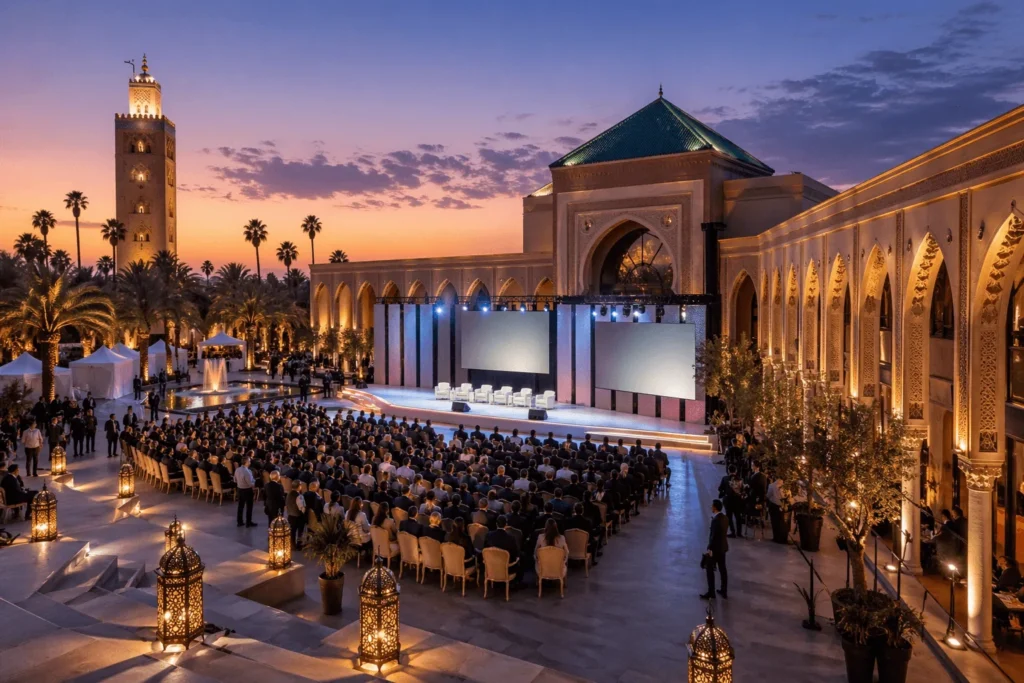
Proximity is the first. Marrakech, Casablanca and Rabat are two to three hours from Paris, Madrid or London, which puts a three-day corporate programme within reach without the fatigue of a long-haul trip or the cost of an extra night each way. The second is the range of settings available within a short drive of a single airport: a century-old riad inside a walled medina, a contemporary hotel ballroom, a villa in the palm grove, a camp in stony desert an hour from the city, a clifftop terrace on the Atlantic. Few destinations let you change register that completely without changing region.
The third is depth of supply. Marrakech in particular has a mature ecosystem: hundreds of specialist suppliers, five-star hotels with proper conference facilities, established decoration and entertainment agencies, and local logistics used to demanding briefs. The practical consequence for a first-time organiser is that almost nothing needs importing, and that short lead times are more achievable here than the distance suggests.
Marrakech or Casablanca: which city for which event
This is the question most organisers ask first, and the answer follows from what the event is for rather than from which city is better.
| City | Strongest for | What it gives you | Where it is weaker |
|---|---|---|---|
| Marrakech | Weddings, milestone birthdays, brand activations, incentive trips | Riads, villas, palm groves, the densest supplier base, a city that photographs well in any light | Large plenary formats; summer daytime heat |
| Casablanca | Conferences, trade shows, large B2B meetings | Modern congress facilities, the widest business hotel stock, the country’s economic centre | Less visually distinctive; fewer celebration venues |
| Rabat | Institutional and diplomatic events | Administrative capital, calm, good hotels, a growing flight network | Smaller supplier base than Marrakech |
| Agadir | Incentives and large groups on a beach format | Resort hotels with capacity, reliable winter sun | Little historic texture |
| Essaouira and Fes | Small, distinctive events | Strong character, UNESCO-listed medinas | Limited capacity; suppliers often travel in from Marrakech |
For events in the smaller cities, note the last line of that table carefully: suppliers frequently come from Marrakech, which is workable but means travel and accommodation for crew appear in your budget, and it tightens your lead time.
The main types of event, and what each one needs
Destination weddings
The wedding is the emblematic Moroccan event, organised by Moroccan families and by foreign couples alike, and Marrakech is consistently among the most searched international wedding destinations. The appeal is a celebration that blends long-standing tradition with a contemporary production, in a setting that gives guests a cultural experience rather than just a venue.
Three things decide whether it runs smoothly. The legal paperwork for a marriage conducted in Morocco is a separate matter from the celebration and should be settled with your own consulate well in advance; many couples marry at home and hold the celebration here, which removes the question entirely. Guest logistics are the second, and they are the part most couples underestimate: see the section below. The third is the season, because a wedding is usually an outdoor evening event, and that rules out July and August inland.
Corporate events and team building
Morocco has become a natural choice for seminars and incentive programmes, on the strength of flight times, stability, hotel standards and value. What distinguishes a good programme here is using the place rather than importing a format: a cookery workshop in a riad, a day in the Agafay desert, a round on one of the golf courses in Marrakech, a hammam and spa afternoon, a walk in the Atlas foothills. These work because they are specific to where you are, which is the entire point of taking a team abroad.
Private parties and brand events
Groups of friends or family travelling together can take over a villa, a riad or a dedicated event space and build an evening around it, which is why milestone birthdays are a growing category. Brand activations and product launches are growing too, carried by the city’s increasing weight as a creative and media hub for companies looking at African and Arab markets. Both formats share a practical requirement: a venue that is genuinely private, because a partial buy-out of a hotel rarely delivers the control the brief assumes.
Venue types and what to verify before signing
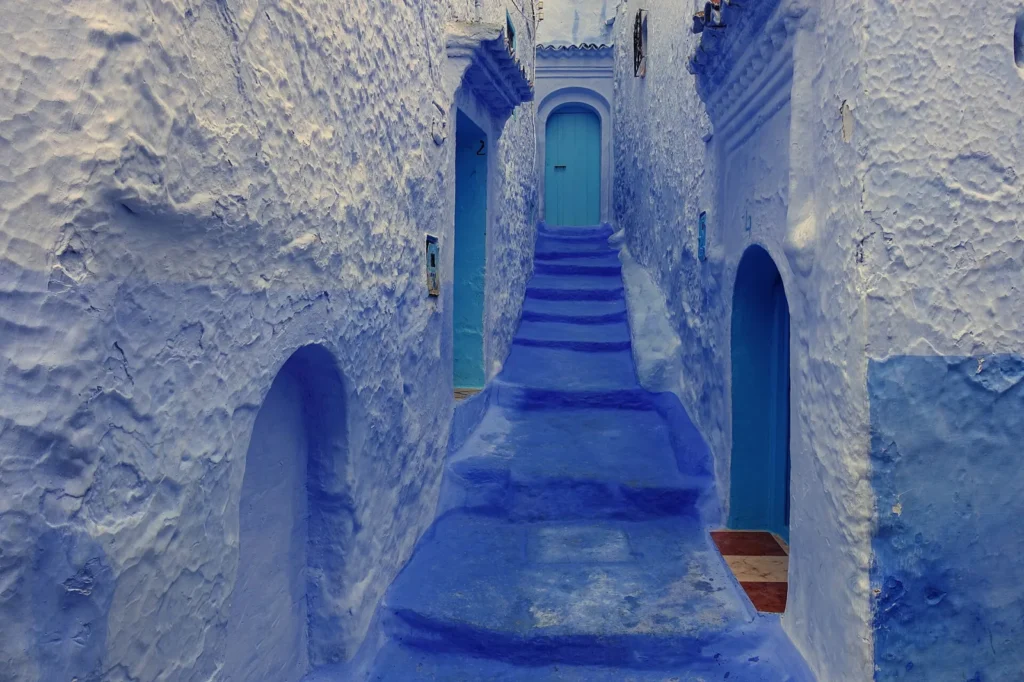
A riad is a traditional house built around a courtyard. It is the most atmospheric option and the most constrained: access is on foot through medina lanes closed to vehicles, which affects everything from furniture delivery to how your older guests arrive. A villa, usually in the Palmeraie or on one of the roads out of the city, gives you space, vehicle access and a pool, at the cost of some of the character. A hotel gives you capacity, back-of-house and a single point of accountability. An outdoor site — desert camp, garden, terrace — gives you the picture everyone remembers, and the weather risk.
Whichever you choose, five physical checks decide what is actually possible, and they are worth settling by photograph or floor plan before you commit rather than discovering on the day:
- Usable surface area and layout, measured rather than described, including where guests queue and where crew work.
- Floor type and load, which governs staging, dance floors and anything heavy.
- Ceiling height, which governs lighting, screens and anything suspended.
- Power supply: how many circuits, where, and whether a generator is needed. This is the single most common cause of a problem on the night.
- Water access and drainage, which matters for catering far more than people expect.
For vehicle access specifically, remember that medina venues cannot be reached by car: your guests will be dropped at the nearest gate and walked in, exactly as they would be arriving at a riad hotel. Build that into the invitation rather than leaving guests to discover it in evening clothes.
Lead times and the dates to avoid
Marrakech runs a continuous events calendar, and the pressure is concentrated in predictable windows. Weekends, European school holidays and the major local festivals fill supplier diaries quickly.
| Event | Minimum lead time | Comfortable lead time |
|---|---|---|
| Wedding or large private celebration | Four to six months | Nine to twelve months, more for a peak weekend |
| Corporate seminar or incentive, 20 to 100 people | Six to eight weeks | Three to four months |
| Conference or trade show in Casablanca | Three months | Six to twelve months |
| Small private party, under 30 people | Four to six weeks | Two months |
Four periods deserve particular thought. European school holidays raise both flight prices and venue demand; our guide to the best time to visit Morocco sets out which weeks those are. Eid al-Fitr and Eid al-Adha are major family festivals, with reduced commercial activity and heavy domestic travel. New Year is the single busiest week for upmarket venues in Marrakech. And Ramadan changes the nature of an event entirely: daytime catering, licensing and working hours all shift, and an evening celebration takes on a quite different rhythm, which our guide to Marrakech during Ramadan explains. None of these is a reason not to come; all of them are reasons to know before you set a date.
Choosing suppliers: the checks that matter
Supply here is plentiful and uneven, which means the selection process matters more than the shortlist. Four criteria separate a supplier who will carry the event from one who will hand the problems back to you.
Demonstrable event experience
Favour suppliers who can show concrete references: photographs of comparable events, contactable past clients, and a clear written statement of their terms. A serious supplier will also give you a single named contact for the whole job, which is worth more than a lower quotation from a company where you deal with whoever answers.
Who actually handles the logistics
Delivery, installation, configuration, on-site assistance and collection afterwards should all sit with the supplier, in writing. This is where non-specialist providers fall down, and it matters disproportionately if you are organising from abroad and do not know the city. Ask specifically who will be physically present during the event and for how long.
Price transparency
The most common unpleasant surprise for visitors organising an event here is cost that appears after the quotation: delivery, installation, labour, overtime, a security deposit. Ask for an all-inclusive figure, and ask what is excluded rather than what is included, which produces a more honest answer. Where a refundable deposit is requested — a normal and reasonable practice that protects both sides — the conditions for its return must be written, specific and unambiguous before you pay it.
Fewer suppliers, not more
For a complete event it is usually easier to work with one provider covering a broad range than to coordinate five specialists across a language and a time zone. The exception is anything structural or technically complex, where you want the specialist and you want them on site.
Logistics for guests arriving from abroad
This is the part that first-time organisers underestimate, and it is the part guests remember. Four points cover most of it.
- Passports and visas. Passports must be valid at least six months beyond the planned departure from Morocco. Most nationalities need no visa for a stay under 90 days, but you have a guest list with several nationalities on it: check each one against our guide to visa and entry requirements and tell guests early, because a passport renewal takes weeks.
- Airport timings. At Moroccan airports, bags and passengers are screened at the terminal entrance before check-in, so departure takes longer than guests expect. Tell them two hours minimum for an international flight, two and a half to three in summer. Which airport suits which guest is covered on our page listing airports in Morocco, and Marrakech Menara has its own guide.
- Transfers. Arrange these centrally rather than leaving each guest to negotiate a taxi after a late flight. Our comparison of airport transfers sets out the options and the price ranges, and a single booked transfer per arrival wave removes most of the friction of day one.
- Money. The dirham cannot be bought outside the country, so every guest arrives with no local currency. Say so in the invitation, point them at the cash machines in the arrivals hall, and remember that souks, small shops and taxis do not take cards.
Where to put everyone is its own decision, and proximity to the venue usually beats the star rating: see our guides to where to stay in Marrakech and where to stay in Casablanca. For guests extending their trip, our Morocco travel guide and our list of things to do in Morocco are worth sending with the invitation.
Budget realities
The honest summary is that the same budget buys a more ambitious event here than in western Europe, on venue hire, catering and crew in particular. That is the genuine advantage and it is why the destination grew. Two cautions belong beside it.
First, the saving is on local costs, not on everything: anything that has to be flown in, and the travel and accommodation of guests, costs what it costs. For a wedding with sixty guests coming from Europe, flights and rooms will dominate the budget regardless of how well you negotiate locally. Second, short lead times are more achievable here than you would expect — local suppliers are used to installing complex set-ups in hours rather than days — but that flexibility is not a reason to leave the date and the venue late, because those two are exactly the things that do sell out.
Frequently asked questions
How far in advance should you book an event in Morocco?
Four to six weeks is the practical minimum for a small private event, and four to six months for a wedding or a large celebration, with nine to twelve months being comfortable for a peak weekend. The constraint is almost never the suppliers, who work to short lead times routinely, but the venue and the date, which do sell out in European school holidays and over New Year.
Marrakech or Casablanca for a corporate event?
Casablanca for a conference, a trade show or a large meeting, because that is where the modern congress facilities and the business hotel stock are. Marrakech for an incentive trip, a team programme or anything where the setting is part of the message, because the supplier base is deeper and the city does the work for you. Rabat is the choice for institutional events.
What is the best time of year for an outdoor event?
April to early June and September to November, when an evening outdoors is comfortable without heating or cooling. July and August are too hot inland for a daytime event, though the Atlantic coast remains workable. Winter days are mild and pleasant, but nights drop sharply, so an outdoor winter event needs a serious answer on heating.
Can you hold an event inside the medina?
Yes, and riads are among the most memorable venues in the country, but access is the constraint rather than an afterthought. The lanes are closed to vehicles, so guests are dropped at the nearest gate and walked in, and everything that has to be brought in arrives by handcart. Confirm the delivery route with the venue before you commit, and tell guests about the walk in advance.
Do guests need a visa for Morocco?
Most nationalities need no visa for a tourist stay under 90 days, including nationals of the European Union, the United States, Canada, the United Kingdom and Australia. The passport itself must be valid at least six months beyond departure from Morocco. Because a guest list usually spans several nationalities, check each one rather than assuming, and send the information out early.
What should you get in writing from a supplier?
An all-inclusive price with exclusions stated; delivery, installation and collection; who is on site during the event and for how long; the deposit amount and the exact conditions for its return; and a named contact. Those five points cover almost every dispute that arises, and asking for them is also a reliable way to tell a specialist from an improviser.
In summary
Morocco gives an event something a venue cannot supply on its own, and it does so within three hours of most of western Europe. The organisational task reduces to four decisions taken in order: the city, which follows from what the event is for; the date, which follows from the seasons and the festivals; the venue, checked physically rather than described; and the suppliers, chosen on written terms rather than on photographs. Settle those four and the local flexibility that makes this destination work will absorb almost anything else. Leave the date and the venue late and no amount of flexibility will help.
Sources
- Moroccan National Tourist Office for business tourism and the MICE segment.
- ONDA, Office National Des Aéroports for airport procedures and timings.
- Consular services of the Kingdom of Morocco for entry conditions and passport validity.
Informational guide, reviewed in November 2026. Lead times, prices and entry conditions change: confirm them with the official sources cited and directly with venues and suppliers before committing. This guide is independent and recommends no particular venue, agency or supplier; it is not affiliated with ONDA or with any tourist board.