The Chouara Tannery (Dar Dbagh Chouara) is the largest of the three traditional tanneries still working inside the medina of Fes (often spelled Fez): you view it for free from the terraces of the leather shops that surround it, close to Seffarine Square, in exchange for a purchase or a small tip. Below you, hundreds of stone vats filled with white lime and ochre, red or brown dyes form the most photographed checkerboard in Morocco. The postcard, though, tells you nothing about the smell, the touts, the right time to come or how to buy a jacket without paying twice its price. This guide covers only Chouara and its two sisters, Sidi Moussa and Ain Azliten; for the rest of the city, our guide to things to do in Fes takes over.
At a glance
- Chouara is the biggest of the three historic tanneries still operating in Fes, alongside Sidi Moussa and Ain Azliten; Moroccan press reports put it at about 1,200 vats and close to 500 master tanners.
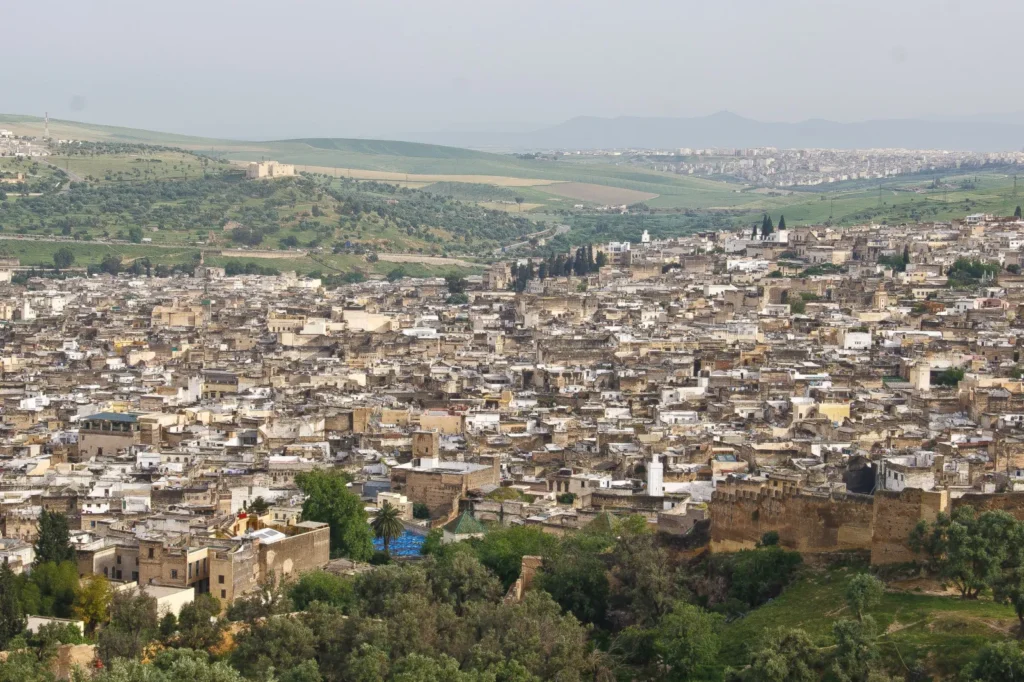
- It lies in Fes el-Bali, the medina inscribed on the UNESCO World Heritage List in 1981, along the Oued Fes river, a few minutes’ walk from Seffarine Square.
- You do not go down into the pits: the view is taken from the terraces of leather shops, with no official ticket, in return for a tip or a purchase.
- Hides (sheep, goat, cow, camel) first go into white vats of lime, salt and water, then into a bath based on pigeon droppings, before dyeing and drying in the sun.
- The site was thoroughly rehabilitated between 2015 and 2017 under the royal programme to restore the medina, with rebuilt vats and a wastewater treatment system.
- Morning is the best time: the workers are in the vats, the light falls on the pits and there are fewer groups.
- There are no official leather prices: everything is negotiated, and quality should be checked before you start bargaining.
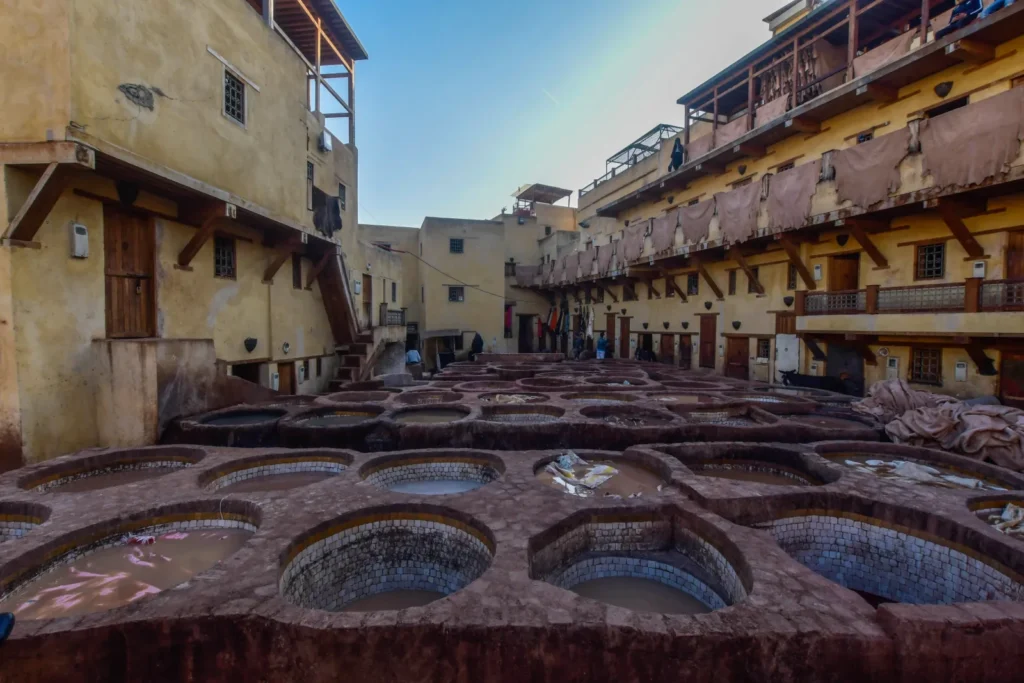
The Chouara Tannery from above: what you actually see
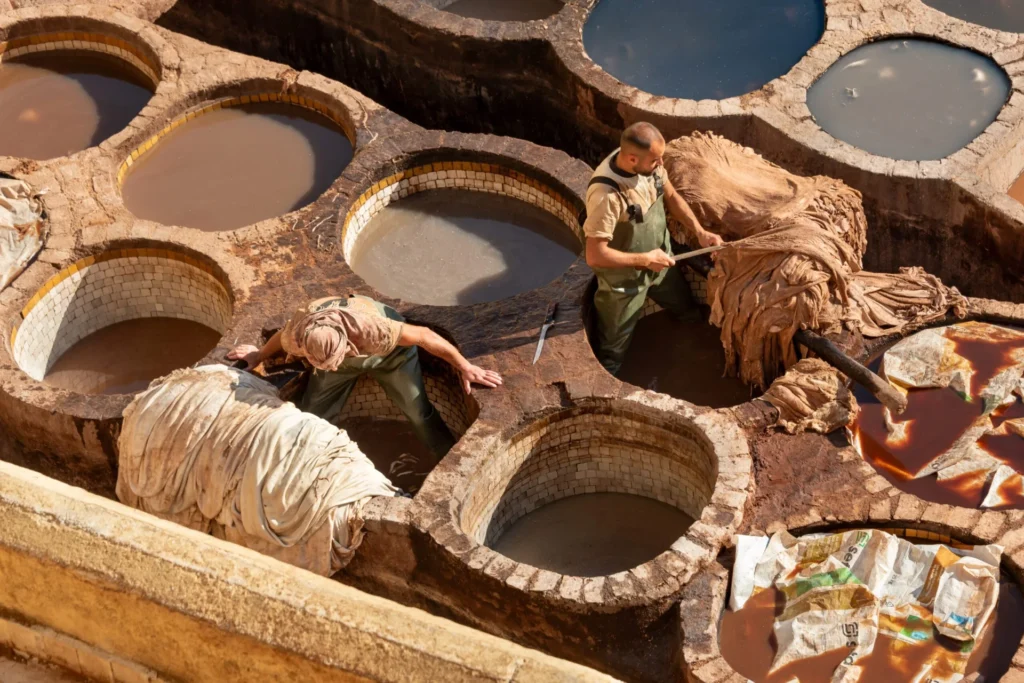
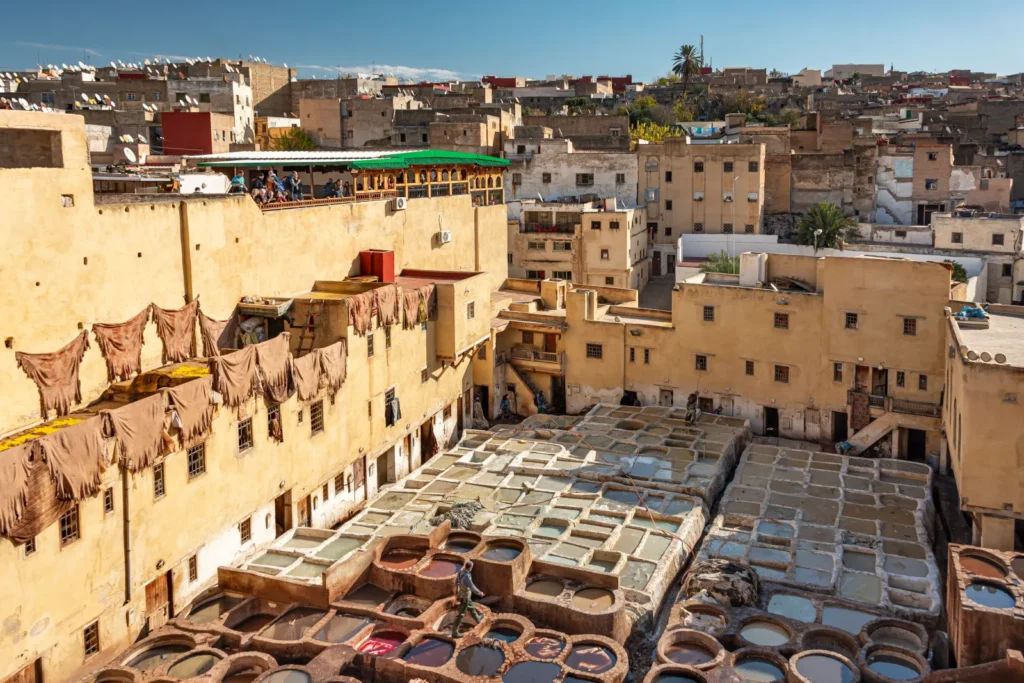
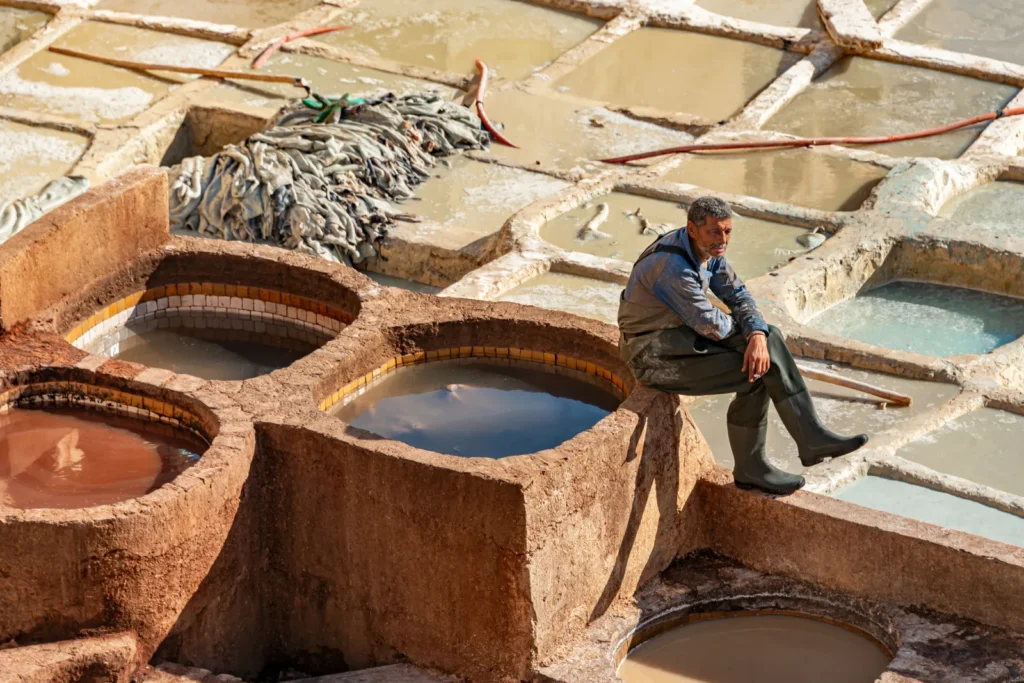
The first impression comes down to three words: colour, noise, smell. You climb a narrow staircase between stacked bags, poufs and babouche slippers, go up two or three floors, and the facade suddenly opens onto a hollow framed by ochre houses. At the bottom, round and square vats are packed together like the cells of a honeycomb. Men in rubber boots, often bare-chested in summer, walk along the dividing walls, dip the hides, turn them, tread them underfoot. Donkeys loaded with wet leather wait in a side alley. On the neighbouring roofs, saffron- and brick-coloured skins dry flat or hang from the railings.
Two zones to tell apart: white and colour
Your eye goes first to the coloured pits, but the key to understanding the place lies elsewhere. On one side is an area of whitish, greyish, almost lunar vats: this is where raw hides are cleaned, stripped of their hair and softened with lime. On the other is the coloured grid where leather that has already been prepared takes on its shade. In between are work areas, piles of hides and low walls worn smooth by generations of bare feet. When a salesman tells you that “the white is for camel milk”, just smile: it is lime.
The terraces, a business model in their own right
The tannery itself is a workplace, not a museum. It is ringed by buildings whose upper floors have been turned into leather shops with panoramic balconies. Access to the view is therefore inseparable from a visit to the shop: you are taken up, the work is explained to you, then you are led back down through the showrooms. That is not a scam in itself; it is the system that pays for the view. The problem starts when the “free” visit turns into a demand for payment or pressure to buy. We come back to this below with precise advice.
Not all terraces are equal. The highest give the full panorama over the hollow with the roofs of the medina behind; the lowest bring you closer to the workers and make the gestures easier to understand. If you have time, the two viewpoints complement each other. For an overview of the whole city, the panoramas of Fes are covered in our article on the best viewpoints in Fes; here the point is the opposite, seeing the work up close.
History of the Chouara Tannery: what is established and what is tradition
You will read everywhere that Chouara is “the oldest tannery in the world” or that it dates from the 11th century. Reality is more nuanced. Local tradition traces tanning in Fes back to the city’s earliest days, when it was founded by the Idrisids at the end of the 8th and beginning of the 9th century, but historians stress that the sources do not allow the first tanneries to be located precisely. The first tannery attested in writing is in fact Sidi Moussa, mentioned in a medieval chronicle, the Rawd al-Qirtas, for the early 12th century. For Chouara, the founding date therefore remains unestablished: the 11th-century date, common in the press and among shopkeepers, is not demonstrated by first-rank sources.
What is solid, on the other hand, is the scale of the activity. In the Almohad period (late 12th to early 13th century), texts mention around 86 tanning workshops in the city; under the Marinids (late 13th to 15th century), there were about a hundred. Leather from Fes was exported far afield, and the trade shaped entire neighbourhoods. Of that network, only three large tanneries remain today, and Chouara is the most extensive. The accurate phrasing is therefore: the largest tannery in Fes and one of the oldest still in operation, which is more than enough to justify the visit.
| Period | Milestone | Degree of certainty |
|---|---|---|
| Late 8th – early 9th century | Founding of Fes by the Idrisids; tradition links the beginnings of tanning to it | Tradition, undocumented for the tanneries |
| Early 12th century | First written mention of a tannery, Sidi Moussa, in the Rawd al-Qirtas | Written source |
| Late 12th – early 13th century | About 86 tanning workshops under the Almohads | Figure handed down by historical sources |
| Late 13th – 15th century | Around a hundred tanneries under the Marinids | Historical order of magnitude |
| Late 18th century | Creation of the Ain Azliten tannery, in the north of the medina | Date cited by reference sources |
| 1981 | Medina of Fes inscribed on the UNESCO World Heritage List | Established |
| 2015 – 2017 | Rehabilitation of the three tanneries under the royal programme to restore the medina, carried out with ADER-Fes | Established; exact completion date varies between sources |
The full name, Dar Dbagh Chouara, simply means “the Chouara tanning house”. The surrounding quarter, between Seffarine Square and the canalised course of the Oued Fes, grew up around an industry that needs two things: plenty of water and room to dry. Chouara’s low-lying position near the river is no accident.
How a hide is tanned at Chouara, step by step
The process relies on manual labour; you will see practically no machinery in the pits. The steps vary with the type of hide and the end product, but the general pattern described by Moroccan sources is as follows. The full cycle takes several weeks; a duration of about a month is often quoted and should be taken as an order of magnitude.
- Soaking in lime. Raw hides are immersed for two to three days in the white vats, a mixture of quicklime, salt and water (some sources add cow urine). The bath attacks the hair and remaining fat.
- Dehairing and fleshing. Workers scrape the hide by hand to remove hair and residual flesh. It is the most physical stage after treading.
- The pigeon-dropping bath. The hides then go into a solution containing pigeon droppings, rich in ammonia, which softens them and makes them receptive to dye. It is one of the main sources of the smell.
- Treading. The tanners tread the hides with their feet in the vats, sometimes for several hours, so that the products penetrate evenly.
- Dyeing. The leathers are plunged into the colour vats, then rinsed.
- Drying. They then dry in the sun, spread out on the terraces and neighbouring roofs, often for several days, before being sold to the craftsmen who will cut them.
Natural dyes… but not all of them
Salesmen insist on plant-based dyes, and they do exist. But honesty is required: since the 19th century, chromium salts and chemical dyes have spread through tanning in Fes, and it is precisely this pollution that drove the rehabilitation projects. Part of the production is still tanned and dyed using the old methods, part is not. If “100% natural” leather is a sales pitch, ask to see and smell, and keep a little scepticism.
| Colour | Plant or mineral source cited | Note |
|---|---|---|
| Red | Poppy flower | A shade very present in the far vats |
| Orange | Henna | Also used in cosmetics in Morocco |
| Blue | Indigo | Rarer vats, often sought out by photographers |
| Green | Mint | Shade cited by the Moroccan press |
| Brown | Cedar wood | Classic colour for bags and belts |
| Dark brown | Pomegranate bark | Red-brown tones, deeper than those from cedar |
| Yellow | Saffron | The most expensive spice on the list |
The tanner’s trade today
The work is still largely handed down from father to son, and the vats are shared out between families and master craftsmen. According to figures published by the Moroccan business press, Chouara employs several hundred tanners, a significant share of the country’s traditional tanners, and leather weighs heavily in the city’s craft economy. Behind the picturesque, it is hard work: constant damp, heavy loads, contact with lime and dyeing products. Photographing the workers from the terrace is accepted; aiming a telephoto lens at them for minutes on end or shouting at them to pose is not. A wave of the hand is enough, and many wave back.
The Chouara Tannery restoration and the pollution question
For decades, effluent from the tanneries, laden with lime, salts and chromium, flowed into the Oued Fes. Several projects were considered, including moving the tanneries out of the medina altogether. The Fes-born architect Aziza Chaouni, who led a rehabilitation project for the Oued Fes, proposed moving the most polluting stage, dyeing, to the Ain Nokbi area, which was better equipped to treat the waste, and turning the site into a leather centre. The option finally chosen was different: keep the tanners in their neighbourhood, but modernise the infrastructure on site.
The work is part of the royal programme to restore the historic monuments of the medina of Fes, launched by King Mohammed VI and implemented with the Agency for the De-densification and Rehabilitation of the Medina (ADER-Fes). All three tanneries benefited. In October 2015, the local press reported that Sidi Moussa and Ain Azliten had already been rehabilitated and that more than half of the Chouara site was complete. In February 2016, a blog kept by residents of the medina still described work in progress, with cranes, rebuilt dye vats and the installation of a wastewater treatment system. Depending on the source, the end of the works is placed in 2016 or 2017.
For visitors, the result is immediately visible if you compare with older photos: vats redone, facades freshly rendered, balconies more regular. Some regret a slightly “new” look. That is understandable, but the restoration above all kept a living activity going where it could have disappeared. And after a few years of daily work, the patina has come back.
Visiting the Chouara Tannery: access, hours, cost and dress
| Item | Practical information |
|---|---|
| Location | Fes el-Bali, the quarter north-east of Seffarine Square, alongside the Oued Fes |
| Access | On foot only inside the medina; taxis to the gates, for example Bab Rcif or Bab Boujloud |
| Entry ticket | No official ticket office; view from the shop terraces |
| Usual tip | Up to you; around ten to twenty dirhams per person is often mentioned, with no official scale |
| Hours | No official hours published; shops generally open from mid-morning to late afternoon, check on site |
| Best time | Morning, when the tanners are working in the vats |
| Duration | 20 to 45 minutes for the view and explanations, more if you shop |
| Dress | Closed shoes, clothes covering shoulders and knees out of respect for the neighbourhood |
How to get there on foot
From Bab Boujloud, the blue gate of the medina, walk down the Talaa Kebira, the main sloping street, to the area around the Qarawiyyin Mosque, then make your way to Seffarine Square, recognisable by the coppersmiths hammering metal. Allow 20 to 30 minutes’ walk depending on your pace, stops and inevitable detours. From Seffarine Square, it is only a few minutes: follow the “Tanneries” or “Chouara” signs and the alleys where leather shops multiply; the smell will do the rest. From Bab Rcif, to the east, where many petits taxis drop passengers, walk up into the medina towards Seffarine Square; it is the shortest approach if you are coming from the new town.
An offline map app is still useful, but GPS often loses accuracy in the narrow lanes. If you are flying into the city, the options for reaching the medina from the airport are detailed in our page on Fes-Saiss Airport.
What time should you go?
Go in the morning, ideally mid-morning. The tanners start early, the vats are in full swing, freshly dyed hides are spread out and the low light brings out the colours. In the early afternoon, activity often slows and organised groups follow one another on the terraces. In summer, the heat makes the smell stronger: one more reason to come early. On Friday, the day of the main weekly prayer, activity may be reduced, especially around midday; the same goes for public holidays and some periods of Ramadan. As no official calendar is published, check on site.
Cost, tipping and sales pressure
There is no official ticket to see the Chouara Tannery. The principle is simple: a shop opens its terrace to you, an employee explains the process, then you walk through the shop. If you buy nothing, a tip is expected; the amount is up to you, and giving around ten to twenty dirhams per person is common practice, with no written rule. Decide on that amount before you go up and stick to it.
The pressure comes mainly from the street. In the neighbourhood, young men offer to “show you the tanneries”, sometimes claiming that the main entrance is closed, that it is “the last day of the Berber festival” or that you have to go through their cousin. The tannery is not closed; these touts take a commission on your purchases and then ask for their own payment. A firm, smiling “no thank you”, repeated without stopping, works better than a discussion. The various tricks of the medina are reviewed in our article on scams and fake guides in Fes.
The smell, the sprig of mint and what to wear
At the entrance to most terraces, you are handed a sprig of fresh mint to hold under your nose. The gesture is kind and it helps a little, no more. The smell, a mix of ammonia, lime and animal hides, is strongest near the white vats and in hot weather. Most visitors find it quite bearable within a few minutes; people sensitive to smells or pregnant women prone to nausea would do well to stay on the highest terraces and keep the visit short. Wear closed shoes: the ground in the lanes around the tannery is often wet and donkeys pass through. Clothes covering shoulders and knees are preferable out of respect for a residential, working-class neighbourhood.
Buying leather at the Chouara Tannery without getting ripped off
The terrace shops sell everything: babouches, bags, belts, jackets, poufs, wallets. Quality ranges from very good to frankly poor, and being next to the tannery guarantees neither a better price nor better workmanship. Items are generally made elsewhere in the medina, from leather that may or may not have been tanned on site. Here is how to sort them.
- Smell the item. Properly tanned and dried leather hardly smells at all. A strong tannery smell on a new bag signals rushed drying; it can linger for weeks.
- Rub it with a damp tissue. If the dye comes off noticeably, it will stain your clothes.
- Look at the stitching and the inside. Regular stitches, tight thread, neatly fixed lining, zips that slide without catching.
- Bend the leather. It should stay supple without cracking; cracks on the grain betray leather that is too dry or of poor quality.
- Ask which animal. Goat and sheep give thin, supple leather (jackets, babouches); cow and camel give thicker leather (bags, poufs). A serious seller answers without hesitating.
- Be wary of mass-produced “handmade” stitching. Twenty perfectly identical copies are not a one-off piece.
As for prices, none is official, and the first offers made to tourists are often well above what the seller will finally accept. The ranges below are cautious orders of magnitude, based on prices commonly seen in the medina, and should not be taken as a binding reference.
| Item | Indicative order of magnitude | What makes the price vary |
|---|---|---|
| Simple babouches | About 100 to 300 MAD | Stitched or glued sole, leather, finish |
| Belt | About 100 to 300 MAD | Thickness, buckle, stitching |
| Wallet | About 100 to 350 MAD | Number of compartments, lining |
| Pouf cover (unstuffed) | About 250 to 700 MAD | Size, embroidery, leather thickness |
| Handbag or tote | About 400 to 1,500 MAD | Size, lining, fastenings, finish |
| Leather jacket | About 1,500 to 4,000 MAD and up | Type of hide, cut, lining, alterations |
Our advice: buy nothing on your first pass through the terrace. Note the pieces you like, compare in two or three other shops, then come back. A good bargaining rule is to offer a price well below the first quote and to be willing to walk away if the gap stays too wide; the seller will often call you back. Pay in dirhams rather than euros, as improvised conversions are rarely in your favour. To widen your shopping ideas beyond leather, see our selection of what to buy in Fes, and for how the markets are organised by trade, our feature on the souks of Fes.
Chouara, Sidi Moussa or Ain Azliten: which tannery to choose?
Chouara draws most of the visitors, but the medina’s two other historic tanneries deserve attention, especially if you are looking for a less commercial atmosphere.
Sidi Moussa is in the Guerniz quarter, not far from the zawiya of Moulay Idris II and the Nejjarine Museum. It is the tannery with the oldest documentation, built on a spring called Ayn ad-Debbaghin, the “tanners’ spring”. It specialised in cow hides, and its structural restoration was completed in 2015. Ain Azliten, in the north of the medina, is the most recent of the three, created at the end of the 18th century. Smaller and little visited, it too has been rehabilitated, with new changing rooms and toilets for the workers. You see the same work there, with far fewer people and often tanners more willing to explain what they do.
| Criterion | Chouara | Sidi Moussa | Ain Azliten |
|---|---|---|---|
| Size | The largest | Medium | The smallest |
| Documented age | Founding not dated with certainty | Mentioned from the early 12th century | Late 18th century |
| Location | Near Seffarine Square, Oued Fes | Guerniz quarter, near the Moulay Idris zawiya | North of the medina |
| Crowds | Very heavy | Moderate | Light |
| View | Spectacular panoramas from the shops | More limited view | Close-up, more intimate view |
| Best for | First visit, photographers | Curious visitors combining it with the religious centre | Travellers avoiding crowds |
Our view: if you see only one tannery, choose Chouara for its scale, in the morning. If you have a second day, make a detour to Ain Azliten to understand the trade in peace. Sidi Moussa fits easily into a walk around the Moulay Idris shrine and Nejjarine Square.
Around the tanneries
Chouara is in one of the densest parts of Fes el-Bali, and everything is a few minutes away on foot. Nearby Seffarine Square rings with the hammering of coppersmiths shaping cauldrons and trays; it is one of the medina’s rare open squares, with its trees and workshops. On the square stands the Seffarine Madrasa, the oldest Marinid madrasa in the city, founded in the late 13th century. A few steps away rises the Qarawiyyin Mosque, whose courtyard can be glimpsed from some of its doors (the interior is reserved for Muslims), together with its associated library.
Heading east, Bab Rcif and its square mark the junction with the right bank, the Andalusian quarter and the Andalusian Mosque. It is also a good exit point for finding a petit taxi. For lunch, the small popular restaurants around Seffarine and Bab Rcif serve tagines and brochettes at prices unrelated to those of the tourist terraces. Just avoid eating right before the tannery visit if you have a sensitive stomach.
Mistakes to avoid at the tanneries
- Following a stranger who claims that “the tannery is closed” or that you need a guide to get in.
- Agreeing to go up to a terrace without deciding in advance what you are willing to leave.
- Buying in the very first shop, under the spell of wonder and mint.
- Coming late in the afternoon in high summer: less activity, more heat, more smell.
- Photographing a worker in close-up at length without his agreement.
- Wearing open sandals or light-coloured shoes you care about.
- Paying for a jacket the same day without trying it on and checking the lining: alterations are possible, but ask for a clear deadline.
FAQ about the Chouara Tannery
Do you have to pay to enter the Chouara Tannery?
There is no official ticket. The view is taken from the terraces of the leather shops, free in principle, but a tip is expected if you buy nothing. Around ten to twenty dirhams per person is common practice, with no official scale.
Is Chouara really the oldest tannery in the world?
That claim is not proven. Chouara is the largest tannery in Fes and one of the oldest still working, but its founding date is not established. In Fes itself, it is Sidi Moussa that has the oldest written mention, in the early 12th century.
When is the best time to visit?
In the morning, mid-morning: the tanners are in the vats, the light is flattering and there are fewer groups. On Friday around midday and on public holidays, activity may be reduced.
Is the smell unbearable?
It is strong, especially in hot weather and near the white vats, but most visitors get used to it within a few minutes. The sprig of mint offered at the entrance helps a little. The highest terraces are the most bearable.
Do you need a guide to see the tanneries?
No. You can get there alone by following the signs from Seffarine Square. If you want a guide for the whole medina, choose an official guide carrying his card, booked through your accommodation or an authorised office, rather than a tout met in the street.
Can you go down into the pits?
In principle, no. The tannery is a workplace and the visit is made from the terraces. The walkways between the vats are slippery and the products used are not harmless; keep your distance, even if someone offers to take you “down for the photo”.
Is leather sold on site cheaper than elsewhere?
Not necessarily. The terrace shops pay for the view and receive a constant flow of tourists; their opening prices are often high. Compare with other workshops in the medina and negotiate in every case.
Have the tanneries been restored?
Yes. The three historic tanneries were rehabilitated under the royal programme to restore the medina, with ADER-Fes. At Chouara, work carried out around 2015-2017 rebuilt vats and added a wastewater treatment system, while keeping the activity on site.
In summary
The Chouara Tannery is the largest traditional tannery still active in Fes and a workplace before it is an attraction. You watch it from the terraces of the leather shops, preferably in the morning, with a sprig of mint, closed shoes and a tip amount decided in advance. Its history is long, even if the legend of “the oldest tannery in the world” goes beyond what the sources prove. The site was rehabilitated in the mid-2010s without being moved. To buy, take your time: smell, rub, compare, negotiate. And if the crowds weigh on you, Ain Azliten shows the same trade in peace.
Official sources
- UNESCO: Medina of Fes, World Heritage
- Moroccan National Tourist Office (Visit Morocco)
- Wikipedia: Chouara Tannery (historical references)
- Wikipedia: Sidi Moussa Tannery
- ONDA: Airports of Morocco
This article is for information only and reflects the information available at its last update (September 2026). Tips, leather prices, shop hours and visiting conditions at the tanneries are subject to change: check them on site.
Photo credit
Images: featured image « File:Fez Chouara Tannery (54239949701).jpg » — Jorge Franganillo (CC BY 2.0); « File:Chouara Tannery.jpg » — Houssain tork (CC BY-SA 4.0); « File:Fez Chouara Tannery (54238811661).jpg » — Jorge Franganillo (CC BY 2.0), via Wikimedia Commons.