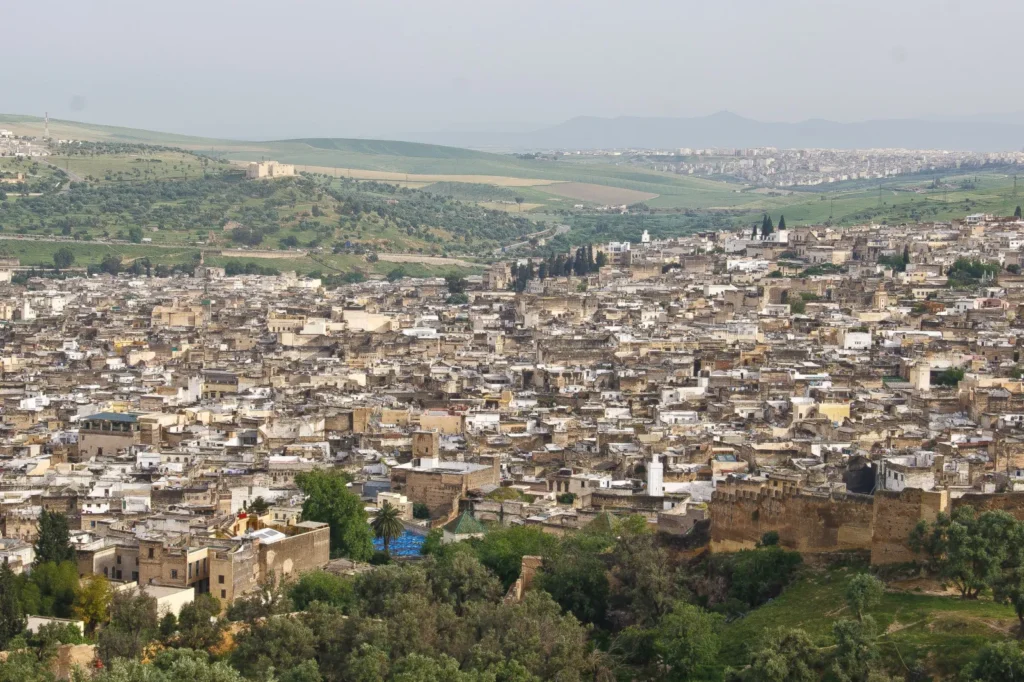
Fes el-Jdid is the royal city that the Marinid sultan Abu Yusuf Ya’qub began building in 1276 to the west of the old medina: it is the district of the Royal Palace, the great mechouar squares, the Bab Semmarine gate and the busy Grande Rue, a historic Fes that is more open and far less touristy than Fes el-Bali. The name means “New Fes” (the city is also spelled Fez); in Arabic it is written فاس الجديد (Fas al-Jadid), in French Fès el-Jdid or Fès Jdid, and medieval chronicles called it Madinat al-Bayda, “the White City”.
This page is about the district itself: why it exists, how it is laid out, what you see as you walk from Bab Semmarine to the mechouars, what is open and what is not, and how to combine it with its immediate neighbours. The Royal Palace, the Mellah and Jnan Sbil garden each have their own dedicated article, linked as we go; for an overview of the whole city, our guide to things to do in Fes brings every visit together.
Information verified in September 2026
At a glance
- Fes el-Jdid was founded in 1276 by the Marinid sultan Abu Yusuf Ya’qub as a royal citadel and seat of government, set apart from the medina of Fes el-Bali.
- The district is part of the “Medina of Fes” property inscribed on UNESCO’s World Heritage List in 1981.
- The Grande Rue links Bab Semmarine in the south with the Old Mechouar in the north, along a straight axis lined with shops and the al-Hamra and al-Beida mosques.
- The Royal Palace (Dar el-Makhzen) covers about 80 hectares of the district and is not open to the public; you only see its gates and walls.
- The mosques of Fes el-Jdid, including the Great Mosque built between 1276 and 1278, are closed to non-Muslims, as are most active mosques in Morocco.
- The walk is free and can be done independently on foot in two to three hours, Mellah included.
- The mechouars host concerts of the Fes Festival of World Sacred Music, notably in front of Bab Makina.
Fact sheet: Fes el-Jdid at a glance
Fes el-Jdid can be visited freely and at no cost at any hour, because it is a lived-in neighbourhood rather than a ticketed monument: you enter through Bab Semmarine, from Place des Alaouites or via the mechouars, and two to three hours are enough to cover the Grande Rue, the royal squares and the neighbouring Mellah.
| Item | Details |
|---|---|
| District | Fes el-Jdid, between Fes el-Bali (east) and the Ville Nouvelle (south-west) |
| Access from a landmark | From Bab Boujloud: on foot through Jnan Sbil garden then Bab Makina, roughly 15 to 20 minutes to the Old Mechouar (check at your own pace). From the Ville Nouvelle: petit taxi to Place des Alaouites. |
| Opening hours | District open at all times; Grande Rue shops open during the day, hours vary by shopkeeper (check on site) |
| Price | Free (public space). Royal Palace closed to the public, mosques closed to non-Muslims |
| Recommended time | 2 to 3 hours for the Grande Rue, the mechouars and the Mellah; half a day if you add Jnan Sbil |
| Best time | Weekday mornings for the market bustle; late afternoon for low light on the mechouar walls |
| Dress | Shoulders and knees covered recommended, closed shoes (cobbles, high kerbs) |
| Accessibility | Easier than Fes el-Bali: wide, mostly level streets, but cobbles, uneven pavements and scooter traffic (check for wheelchairs) |
What is Fes el-Jdid? The history of the Marinid royal city
Fes el-Jdid is a second walled city, separate from the medina founded by the Idrisids at the end of the 8th century: the Marinids created it in 1276 to house the sultan, his administration and his troops, and for centuries it remained the centre of power in Fes, a role it still holds symbolically through the Royal Palace.
1276: why the Marinids built a new city
The Marinids, a Zenata Berber dynasty from the steppes of eastern Morocco, took Fes in the mid-13th century and made it their capital in place of Marrakech. Rather than settle in the dense and sometimes rebellious medina of Fes el-Bali, Sultan Abu Yusuf Ya’qub had a separate administrative city built from 1276 to the west, on then-open ground beside the Oued Fes river. The model was not new in the Islamic world: a palace-city held at a distance from the merchant city, protecting the ruler and displaying his authority.
The new foundation was named Madinat al-Bayda, “the White City”. It was enclosed by a double line of walls, which met on the east and west but spread apart to the north and south to enclose gardens and intermediate districts. Inside stood the palace, the Great Mosque, barracks and housing for the garrisons. According to historians, some of these troops were foreign contingents, including archers of Syrian origin settled in the southern sector, which took the name Hims before later becoming the Mellah.
The Great Mosque of Fes el-Jdid was begun at the same time as the city and completed in 1278; its minbar, the pulpit used for the Friday sermon, dates from 1279. In 1320, Sultan Abu Sa’id Uthman II added a madrasa, meaning a religious college with lodgings for students, the second one the Marinids built in Fes. Over the Marinid period, the Grande Rue also acquired neighbourhood mosques, including the al-Hamra Mosque.
From the Alaouites to the 20th century: what changed
After the Marinids, Fes el-Jdid lost its role as permanent capital but remained the seat of power whenever the court stayed in Fes. The Alaouite dynasty, which still reigns, reshaped it profoundly. Around 1670, Moulay Rashid built the Kasbah Cherarda to the north to house his tribal troops, freeing space inside the city. In the 18th century, Moulay Abdallah, who reigned intermittently between 1729 and 1757, created a new district to the north-west around a large mosque and a royal necropolis that still bear his name.
The great builder of the 19th century was Moulay Hassan I (reigned 1873-1894). He enlarged the palace, restored Bab Dekkakin in 1884-1886, created the Dar al-Makina arsenal in 1885-1886 and, for the first time, linked Fes el-Jdid to Fes el-Bali with a broad corridor of walls enclosing royal gardens, including Jnan Sbil. Under the French protectorate, in 1924, the bent entrance of Bab Semmarine was altered to let vehicles through. Finally, between 1969 and 1971, the monumental palace gates on Place des Alaouites were built, facing the Ville Nouvelle.
| Date | Event | What you can see today |
|---|---|---|
| 1276 | Foundation of Fes el-Jdid by Abu Yusuf Ya’qub (Marinids) | Line of the walls, Bab Semmarine, Bab Dekkakin |
| 1276-1278 | Construction of the Great Mosque of Fes el-Jdid | 22.8 m minaret near the palace (interior closed to non-Muslims) |
| 1320 | Madrasa of Fes el-Jdid (Abu Sa’id Uthman II) | Incorporated into the Royal Palace, not open to visitors |
| 14th century and later | Al-Hamra Mosque, then al-Beida Mosque, on the Grande Rue | Minarets visible from the street |
| Mid-15th century | Jewish community settles in the Mellah, to the south | Balconied houses of Rue des Mérinides |
| c. 1670 | Kasbah Cherarda of Moulay Rashid, to the north | Enclosure near Bab Segma |
| 1729-1757 | Moulay Abdallah district and mosque-necropolis | Minaret and residential quarter to the north-west |
| 1884-1886 | Restoration of Bab Dekkakin, creation of Dar al-Makina | Old and New Mechouar, Bab Makina |
| 1924 | Bab Semmarine remodelled for vehicles | The gate’s two present-day arches |
| 1969-1971 | Palace gates on Place des Alaouites | Facade of zellij, cedar and gilded bronze |
Grande Rue of Fes el-Jdid: what to see from Bab Semmarine to the Old Mechouar
The Grande Rue of Fes el-Jdid is the shopping street that crosses the district in an almost straight line, from the Bab Semmarine gate in the south to the Old Mechouar in the north; along it you see neighbourhood shops, the minarets of the al-Hamra and al-Beida mosques and the openings of residential lanes, over about fifteen minutes of walking without detours.
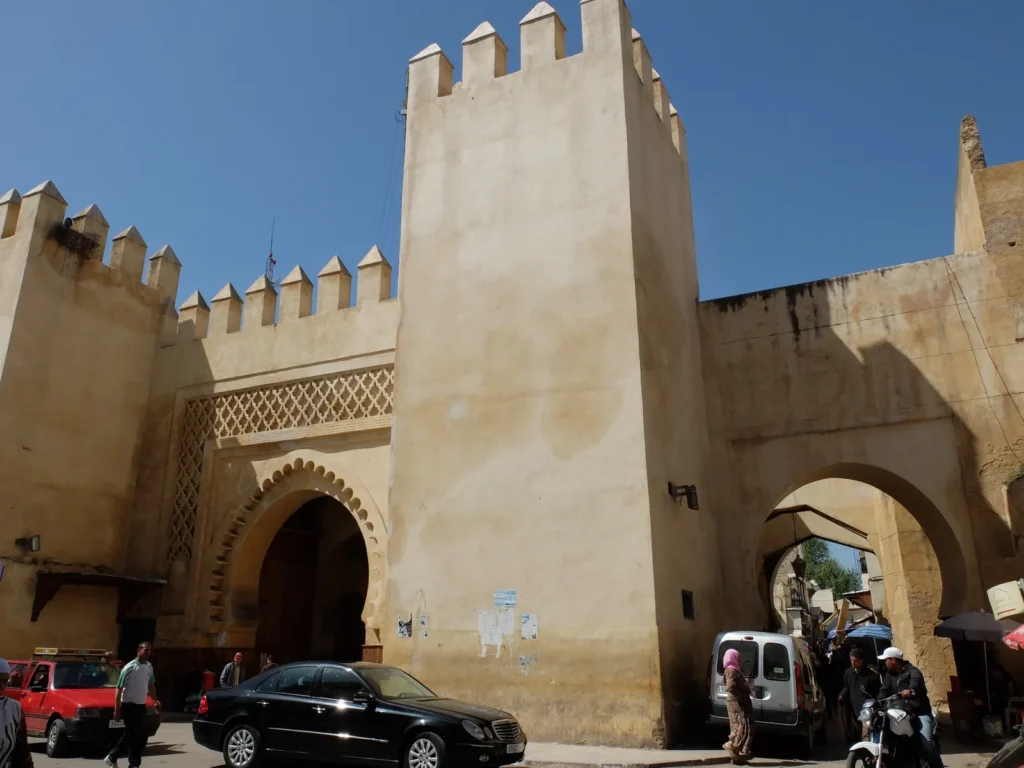
Bab Semmarine, the Gate of the Farriers
Bab Semmarine means “Gate of the Farriers”, recalling the blacksmiths who once worked nearby. It was first called Bab ‘Oyun Sanhaja, “Gate of the Springs of the Sanhaja”. Built around 1276 with the city, it was the southern entrance; the creation of the Mellah further south later placed it inside the walls, as a threshold between the Jewish quarter and the Muslim city.
Look at the outer facade: blind polylobed arches, meaning scalloped arches applied to the wall without an opening, and darj wa ktaf decoration, a Moroccan geometric motif of interlaced lozenges whose name means “step and shoulder”. Originally the passage made a right-angled bend, a defensive device that prevented a straight charge. In 1924 the protectorate administration heavily remodelled the gate, or even rebuilt it according to some historians, to let vehicles through: its present silhouette, with two arches side by side, dates from that work. Attached to the western flank of the gate, a large vaulted market hall, rebuilt in the 20th century, echoes the style of the Marinid granaries that once stood in this area.
The street’s two minarets: al-Hamra and al-Beida
Walking north, you pass the al-Hamra Mosque, the “Red Mosque”. Lacking a foundation inscription, it has never been precisely dated; historians place it in the 14th century, some between 1331 and 1348 under Sultan Abu al-Hasan. Its square minaret, about 23.8 metres tall, carries darj wa ktaf panels and a band of zellij, the mosaic of small hand-cut ceramic tiles. The origin of the name is debated: the colour of an earlier minaret, or, according to one tradition, a Marinid princess who funded the building.
Further north, the al-Beida Mosque, the “White Mosque”, was built after al-Hamra according to the historian Roger Le Tourneau, although no firm foundation date is known. Its entrance on the Grande Rue, now flanked by shops, is recognisable by its horseshoe arch, carved stucco and small canopy of carved wood topped with green tiles. Both are active places of prayer: admire the facades and minarets from the street, without going in if you are not Muslim. Other neighbourhood mosques, such as Lalla Ghriba and Lalla ez-Zhar, stand in the lanes east of the main axis.
The atmosphere: a souk for residents
What sets the Grande Rue apart from the souks of Fes el-Bali is its customers. The stalls cater first to local families: clothes, fabrics, shoes, kitchenware, fruit and vegetables, groceries. Souvenir shops exist but are a minority, and touting is noticeably more discreet than in the lanes around the Qarawiyyin. The street is wide, straight and bright; you cannot get lost. It is the ideal place to observe everyday Fes and buy a few ordinary items at local prices, as long as you accept that there are no tanneries or open madrasas along the way.
Mechouar of Fes el-Jdid: the squares of power
A mechouar is a vast fortified esplanade in front of a Moroccan royal palace, where parades, audiences and official ceremonies took place; Fes el-Jdid has two, the Old Mechouar and the New Mechouar, connected by Bab Dekkakin and bordered by the Dar al-Makina arsenal.
The Old Mechouar and Bab Dekkakin
The Old Mechouar, where the Grande Rue ends, was originally a fortified bridge spanning the Oued Fes between two gates. To the north-east, Bab Dekkakin closes the square: it was the northern gate of the Marinid city, founded around 1276, then called Bab es-Sebaa, “Gate of the Lion”, perhaps after a carved lion that has since disappeared. Its current name, “Gate of the Benches”, first referred to the palace entrance, where benches seated visitors waiting for an audience; it later shifted to this gate.
Bab Dekkakin keeps two pairs of massive square towers, typical of Marinid military architecture, and a facade decorated with interlacing floral patterns on tilework and carved stone frames. During its restoration under Moulay Hassan I in 1884-1886, the central passage was opened in a straight line, replacing the original bent entrance. Take the time to walk under the gate: the contrast in scale between the arch and the towers gives a good idea of the staging the sultans intended.
The New Mechouar, Bab Makina and Dar al-Makina
Beyond Bab Dekkakin stretches the New Mechouar, a long esplanade enclosed by high walls, laid out in the late 18th or the 19th century depending on the source. On its west side rises Bab Makina, the entrance to Dar al-Makina, “the house of the machine”: an arms factory founded by Moulay Hassan I in 1885-1886 with the help of Italian officers, Fes’s first attempt at industrialisation to modernise the army in the face of European powers. The gate’s Italianate style contrasts with the neighbouring Marinid gates. Inside, a series of vast vaulted halls recalls Morocco’s royal granaries.
The building no longer has any industrial use and was long described as abandoned and partly ruined; it was included in a programme to restore about a hundred monuments in Fes planned for 2018 to 2023. Its current condition and any public opening should be checked on site. The esplanade in front of Bab Makina, on the other hand, is known to every Fassi: it is one of the main stages of the Fes Festival of World Sacred Music, whose evening concerts are held at the foot of the wall. North of the New Mechouar, Bab Khibbat es-Smen opens towards the Bab Segma area and the Kasbah Cherarda.
Fes el-Jdid, the Royal Palace and the Mellah: how the districts fit together
Fes el-Jdid is organised around the Royal Palace, which takes up most of it: to the north, the Great Mosque and the mechouars; to the south and south-west, the Mellah, the former Jewish quarter, and Place des Alaouites; to the north-west, the Moulay Abdallah district; to the east, the Grande Rue and its residential lanes.
The Royal Palace, the closed heart of the district
Dar el-Makhzen, the Moroccan name for the royal palace, covers about 80 hectares. It remains an active royal property and cannot be visited. What travellers can see are its facades: the gates on Place des Alaouites, built in 1969-1971, and the walls along the Old Mechouar, the former ceremonial entrance before the main access was turned towards the Ville Nouvelle. We devote a full article to these gates, their decoration and photography etiquette: the Royal Palace of Fes (Dar el-Makhzen).
The Great Mosque and the madrasa of Fes el-Jdid
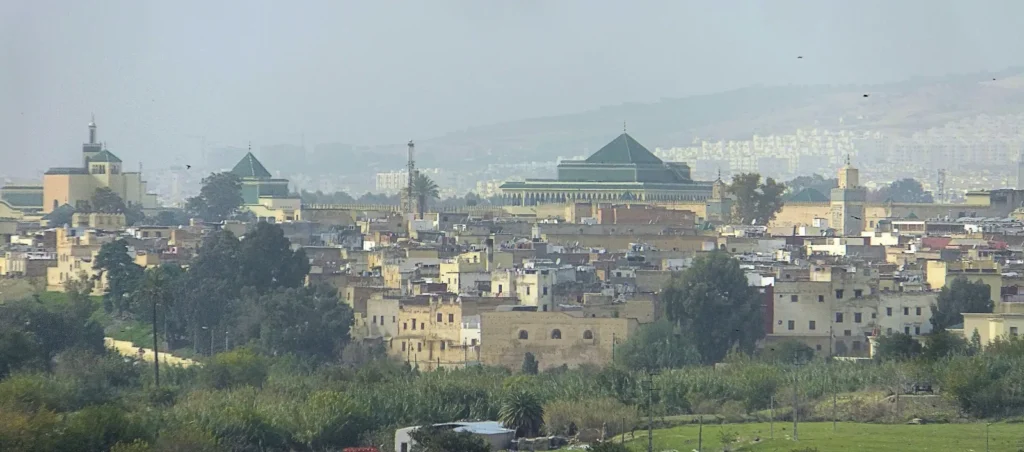
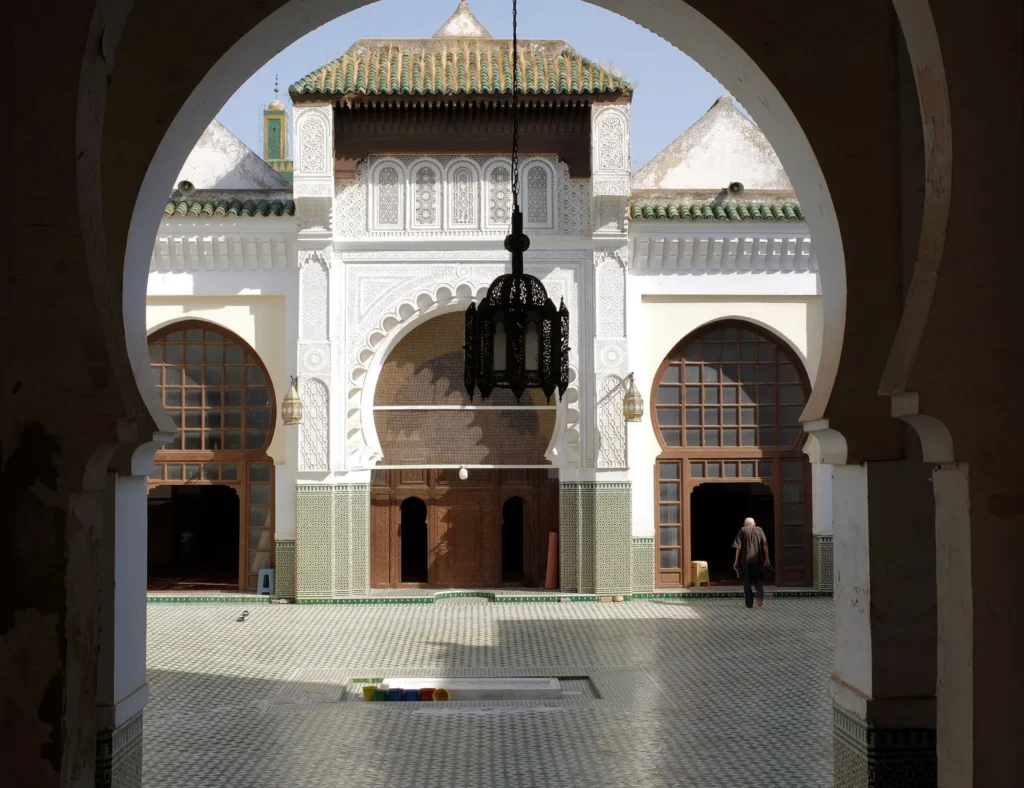
The Great Mosque, in the north of the district, was connected to the palace by a private passage reserved for the sultan. Its T-shaped plan covers about 2,000 m², with a hypostyle prayer hall, a large courtyard with a fountain and a square minaret 5.7 metres wide and 22.8 metres tall, decorated with brick and zellij. A tradition places the tomb of Sultan Abu Inan, who died in 1358, here, though no inscription confirms it. The madrasa founded in 1320 just to the south was incorporated into the palace under Moulay Hassan I: it still exists, but behind the royal enclosure. So do not expect to visit an equivalent of the Bou Inania Madrasa here.
The Mellah, the southern extension of Fes el-Jdid
The Mellah, the name given in Morocco to the Jewish quarter, grew up south of Bab Semmarine, in the former Hims sector. The exact date the Jewish community moved from Fes el-Bali is debated; historians place it around the mid-15th century. It is therefore an integral part of Fes el-Jdid, and most walks combine the two. Ibn Danan Synagogue, the Jewish cemetery, houses with balconies open to the street: everything is covered in our article on the Mellah of Fes and the Ibn Danan Synagogue.
The Moulay Abdallah district and its royal necropolis
To the north-west, the Moulay Abdallah district is the most secluded part of Fes el-Jdid. It developed from the early 18th century onwards; the Alaouite sultan Moulay Abdallah founded a large mosque there, with a madrasa where the Qur’an was taught before students moved on to the Qarawiyyin. The adjoining necropolis, reworked in the mid-19th century by Mohammed ibn Abd ar-Rahman, holds the tombs of Moulay Abdallah and his mother Khnata bint Bakkar, then, in the 20th century, those of the sultans Moulay Youssef (1927), Moulay Abdelhafid (1937) and Moulay Abdelaziz (1943). The mosque is a place of worship: you do not go in, but its minaret is a useful landmark.
Fes el-Jdid or Fes el-Bali: what is the difference?
Fes el-Bali is the merchant and religious medina founded at the end of the 8th century, a pedestrian maze of sloping lanes; Fes el-Jdid is the Marinid royal city of 1276, flatter, structured by broad axes and squares, less rewarding to visit from the inside but much calmer. The two complement each other.
| Criterion | Fes el-Jdid | Fes el-Bali |
|---|---|---|
| Founded | 1276, Marinid sultan Abu Yusuf Ya’qub | 789 (Idris I) and 809 (Idris II) |
| Original function | Palace, government, garrisons | Merchant, religious and craft city |
| Layout | Broad straight axes, squares, nested walls | Maze of lanes and dead ends |
| Terrain | Mostly level | Steep slopes down to the river |
| Monuments open inside | Few: gates, squares, facades; palace and mosques closed | Many: madrasas, fondouks, museums, tanneries |
| Tourist crowds | Low to moderate | High |
| Finding your way | Easy, one main axis | Hard without a map or guide |
| Traffic | Cars and scooters on main streets | Mostly pedestrian |
| UNESCO status | Inscribed in 1981 within the “Medina of Fes” property | Inscribed in 1981 within the same property |
According to UNESCO, the medina of Fes meets criteria (ii) and (v) of the World Heritage Convention: it exerted considerable influence from the 12th to the 15th century and is an outstanding example of a medieval city. Fes el-Jdid illustrates above all the second half of that story, that of the Marinids and then the Alaouites. Our advice: do not choose between the two. Give Fes el-Bali at least one full day and Fes el-Jdid half a day, ideally on the day you arrive, to get used to the rhythm of the city in an easier setting before tackling the maze of the old medina.
How to get to Fes el-Jdid
You can reach Fes el-Jdid on foot from Bab Boujloud by crossing Jnan Sbil garden, by petit taxi from the train station or the Ville Nouvelle to Place des Alaouites or Bab Semmarine, and by taxi or transfer from Fes-Saïss Airport, located about 12 to 15 km south of the city.
On foot from Bab Boujloud and Fes el-Bali
This is the best option if you are staying in a riad, a traditional house built around a courtyard, in Fes el-Bali. From the Bab Boujloud square, follow the avenue that runs west along Jnan Sbil garden, or cross the garden itself during its opening hours, then go through Bab Makina to come out on the New Mechouar. Allow roughly 15 to 20 minutes depending on your pace and stops. The route follows exactly the corridor of walls built by Moulay Hassan I to join the two cities. For details of the garden, see our article on Jnan Sbil garden.
By petit taxi from the station and the Ville Nouvelle
The red petit taxis of Fes serve the city itself; ask for “Bab Semmarine”, “Place des Alaouites” or “Fes Jdid”. From the ONCF railway station in the Ville Nouvelle, the ride is short, on the order of 10 to 15 minutes depending on traffic (to be checked). Insist on the meter from the start; fares are higher at night. The taxi drops you on Place des Alaouites, where the palace gates are immediately in view, and from there you walk up through the Mellah to Bab Semmarine.
From Fes-Saïss Airport
The airport lies south of the city; Fes el-Jdid is, with the Ville Nouvelle, the easiest historic area to reach by car, because taxis can drive right up to the gates, which is not the case in the heart of Fes el-Bali. All options (grand taxi, bus, private transfer) are set out in our guide to Fes-Saïss Airport.
Visiting Fes el-Jdid: opening hours, price, dress code and best time
Visiting Fes el-Jdid is free and possible at any hour, since the district is a lived-in town; shops on the Grande Rue open during the day, the mosques and the palace stay closed to visitors, and the best slots are weekday mornings or late afternoon, wearing clothes that cover shoulders and knees.
No ticket is needed, and no authority publishes opening hours for the district itself. Shops keep their own hours; many close or slow down at the time of the main Friday prayer, in the early afternoon, and rhythms change during Ramadan (check on site). In summer, the midday heat makes the vast, shadeless mechouar esplanades genuinely hard going: favour the morning or the hour before sunset, when the walls turn golden. During the Fes Festival of World Sacred Music, whose dates vary from one edition to the next, access to the mechouars may be rearranged or restricted around the stages; check the festival’s official website before planning your walk.
As for clothing, Fes el-Jdid is a conservative residential district with several active places of worship: clothes covering shoulders and knees avoid insistent stares, for women and men alike. Cobbles and high kerbs call for closed shoes. An official guide is not essential here, unlike in Fes el-Bali; one becomes useful if you want to understand the Mellah and its synagogues in depth.
Suggested walk through Fes el-Jdid (2 to 3 hours)
- Place des Alaouites: the Royal Palace gates, viewed from the esplanade.
- Rue des Mérinides, in the Mellah: facades with wooden and wrought-iron balconies.
- Bab Semmarine: the double arch of 1924 and the adjoining vaulted market.
- Grande Rue: the al-Hamra Mosque, then the al-Beida Mosque, heading north.
- Old Mechouar and Bab Dekkakin: the Marinid towers and the passage under the gate.
- New Mechouar and Bab Makina: the festival esplanade and the facade of the former arsenal.
- Exit towards Jnan Sbil, then Bab Boujloud, to continue into Fes el-Bali.
The route also works in reverse if you start from Fes el-Bali. In that case, finish at Place des Alaouites, where petit taxis wait to take you to the Ville Nouvelle.
Mistakes to avoid in Fes el-Jdid
The most common mistakes in Fes el-Jdid are believing the palace or the mosques can be visited, photographing the palace guards, following a tout who offers to “show you the closed Mellah”, and planning the walk at midday in summer across esplanades with no shade.
- Looking for the palace entrance. There is none for the public. The gates on Place des Alaouites and the walls of the Old Mechouar are all you will see.
- Photographing guards or security staff. Photograph the gates, not the people on duty; if you are asked to put the camera away, comply without argument.
- Entering a mosque. The Great Mosque, al-Hamra, al-Beida and Moulay Abdallah are reserved for Muslims. Stay at the threshold and do not photograph the interior through the door during prayer.
- Trusting a fake guide. Touts who claim a street is “closed” or a synagogue “only opens with them” want to steer you into a shop. The district is easy to explore unaided.
- Mixing up the two mechouars. The Old Mechouar is at the end of the Grande Rue; the larger New Mechouar lies behind Bab Dekkakin, facing Bab Makina. Arrange to meet at a specific gate.
- Skipping the Mellah. It is five minutes from Bab Semmarine; missing it would be a shame.
- Walking at midday in summer. The mechouars offer almost no shade. Bring water.
Around Fes el-Jdid
Around Fes el-Jdid you can walk on to the Mellah and its Jewish cemetery to the south, Jnan Sbil garden and the Bab Boujloud gate to the north-east, and take a taxi to the Ville Nouvelle and its Avenue Hassan II to the south-west; the district thus links the three faces of Fes.
- The Mellah and the Jewish cemetery: immediately south of Bab Semmarine, with the Ibn Danan Synagogue.
- Jnan Sbil: the royal garden open to the public between Fes el-Jdid and Fes el-Bali, an ideal shady break after the mechouars.
- Bab Boujloud: the blue-tiled gate opening onto the Talaa Kebira, the main street of Fes el-Bali.
- The Kasbah Cherarda and Bab Segma: north of the New Mechouar, for lovers of city walls.
- The Ville Nouvelle: cafés, banks and the station, a few minutes by taxi from Place des Alaouites.
From Bab Makina, the great monuments of Fes el-Bali, such as the Bou Inania Madrasa near Bab Boujloud, are about twenty minutes’ walk away: Fes el-Jdid therefore combines easily, on the same day, with a first foray into the old medina.
FAQ about Fes el-Jdid
The questions below are the ones travellers most often ask before visiting Fes el-Jdid: price, opening hours, the difference from the old medina, safety, access to the palace and the mosques, the time needed and where the district fits into a two- or three-day stay in Fes.
Is there an entrance fee for Fes el-Jdid?
No, Fes el-Jdid is a lived-in district with free access, no ticket and no opening hours. You can walk the Grande Rue, the mechouars, Bab Semmarine and Place des Alaouites at no cost. Only some nearby sites, such as the Ibn Danan Synagogue in the Mellah, may ask for a contribution at the door; the amount should be checked on site.
What is the difference between Fes el-Jdid and Fes el-Bali?
Fes el-Bali is the medina founded in 789 and 809, Fes el-Jdid the Marinid royal city founded in 1276. The first is a pedestrian maze of souks, madrasas and workshops; the second is organised around the Royal Palace, with broad straight streets, squares and a much calmer atmosphere. Both belong to the same UNESCO World Heritage property.
Can you visit the Royal Palace in Fes el-Jdid?
No, the Royal Palace (Dar el-Makhzen) is not open to the public. It covers about 80 hectares and remains an active royal residence. Visitors admire its monumental 1969-1971 gates from Place des Alaouites and its walls from the Old Mechouar. Photographing the gates is common practice; avoid photographing the guards, however.
How long does it take to visit Fes el-Jdid?
Allow two to three hours for Fes el-Jdid, Mellah included. That leaves time to walk from Place des Alaouites to Bab Semmarine, up the Grande Rue, across both mechouars and out through Jnan Sbil. With a break in the garden and a visit to the Ibn Danan Synagogue, plan for half a day.
Can non-Muslims enter the mosques of Fes el-Jdid?
No, the mosques of Fes el-Jdid are reserved for Muslims, as are nearly all active mosques in Morocco. This applies to the Great Mosque, al-Hamra, al-Beida and the Moulay Abdallah Mosque. Their minarets and portals can be admired from the street; stay discreet at prayer times, especially on Fridays.
Is Fes el-Jdid safe for tourists?
Yes, Fes el-Jdid is a busy and generally quiet district during the day, with a visible police presence around the palace. The precautions are those of any lively city: watch your bag in the Grande Rue crowds, ignore fake guides and avoid deserted lanes at night. No official crime statistics are published for individual districts.
Where is Bab Semmarine?
Bab Semmarine is in the south of Fes el-Jdid, where the Mellah meets the Grande Rue. A Marinid gate dating from around 1276, it marks the start of the shopping street leading to the Old Mechouar. From Place des Alaouites, it is a few minutes’ walk up Rue des Mérinides.
Can you stay overnight in Fes el-Jdid?
Yes, a few guesthouses and small hotels exist in Fes el-Jdid and the Mellah, but the choice is much smaller than in Fes el-Bali. The advantage is taxi access close to the door, handy with luggage; the drawback is the distance from the main monuments of the old medina, 15 to 20 minutes on foot.
Summary
Fes el-Jdid is the royal city founded in 1276 by the Marinids, organised around a Royal Palace closed to the public but lined with gates, squares and a lively Grande Rue that you can explore freely and at no cost; it is the calm, readable half of historic Fes and the natural complement to Fes el-Bali.
People come for Bab Semmarine and its polylobed arches, for the minarets of al-Hamra and al-Beida, for the scale of the Bab Dekkakin towers and the Bab Makina esplanade, for the palace facade on Place des Alaouites and for the neighbouring Mellah. They do not come to go inside monuments: almost everything remarkable is seen from outside. Give it half a day, ideally early in your stay, and link it to Fes el-Bali via Jnan Sbil. If you are arriving by plane, our comparison of airport transfers in Morocco will help you choose the simplest way into the city.
Official sources
- UNESCO World Heritage Centre: the medina of Fes
- Moroccan National Tourist Office (Visit Morocco)
- National Airports Office (ONDA)
- National Railways Office (ONCF)
- Fes Festival of World Sacred Music, official website
This article is for information only. Opening hours, prices, access to monuments and the progress of restoration work in Fes el-Jdid may change; check on site or with official sources before your visit.
Photo credits
Images: featured image « File:Bab Semmarine.jpg » — Robert Prazeres (CC BY-SA 4.0); « File:Fes Jdid view from borj sud DSCF2438.jpg » — Robert Prazeres (CC BY-SA 4.0); « File:Great Mosque of Fes Jdid DSCF6782.jpg » — R Prazeres (CC BY-SA 4.0), via Wikimedia Commons.