The Fes Festival of World Sacred Music is an annual festival founded in 1994 by the anthropologist Faouzi Skali, organised by the Fondation Esprit de Fès under the high patronage of King Mohammed VI, which brings together spiritual songs and music from every tradition in the monuments of Fes, Morocco, each spring. Its 29th edition ran from 4 to 7 June 2026; the dates of the 30th edition, expected in 2027, had not yet been published by mid-September 2026.
In Arabic the festival is called مهرجان فاس للموسيقى العالمية العريقة (“Fes festival of ancient world music”); in French it is the Festival de Fès des musiques sacrées du monde, and in English it is also written Fez Festival of World Sacred Music. This guide is for planning a stay around the festival: what it really is, where the concerts take place, how to get tickets, how to reach each stage from the medina and how to organise your days so you do not miss what matters.
Information verified in September 2026
At a glance
- The Fes Festival of World Sacred Music was founded in 1994 by Faouzi Skali and is organised by the Fondation Esprit de Fès.
- In 2001 the United Nations singled it out as one of the events that had contributed to the dialogue among civilisations.
- The 29th edition took place from 4 to 7 June 2026 on the theme “Fes and the Mâalemines, guardians of gesture and heritage”, with more than 160 artists from some twenty countries and 18 performances.
- The main stages are the Bab al-Makina esplanade in Fes Jdid and the Jnan Sbil garden; the morning concerts are held in the Dar Adiyel palace in the medina.
- In 2026 the full pass cost 3,000 dirhams (MAD) according to the official programme; single-ticket prices are published on the official ticketing site.
- The dates change every year: May in 2025, late May to early June in 2024, June in 2026. The 2027 dates have not yet been announced.
Festival fact sheet
The Fes Festival of World Sacred Music runs for four to nine days depending on the edition, in spring, across four main venues between the Fes el-Bali medina and Fes Jdid. The table below gathers the established information for the 2026 edition; anything not officially published is flagged as such.
| Item | Information |
|---|---|
| Area and access | Bab al-Makina: Fes Jdid, near the royal palace, reached by walking along the Jnan Sbil garden from Bab Boujloud. Jnan Sbil: between Bab Boujloud and Fes Jdid. Dar Adiyel: Fes el-Bali, south of Tala’a Seghira. |
| Dates | 29th edition: 4 to 7 June 2026. 30th edition (2027): dates not officially announced as of 13 September 2026. |
| Times (2026) | Morning concerts at 10 am and noon (Dar Adiyel), afternoon at 3 pm and 6 pm (Jnan Sbil), main concerts at 9 pm (Bab al-Makina), late-night concerts at 11 pm or 11.30 pm (Jnan Sbil). |
| Price | 2026 full pass: 3,000 MAD according to the official programme. Single tickets: check on the official ticketing site. |
| Recommended length | Three or four days to follow the core of the programme and visit the medina between concerts. |
| Best time | The evenings at Bab al-Makina (opening and closing concerts) and the more intimate morning concerts at Dar Adiyel. |
| Dress | Modest clothing, ideally with shoulders and knees covered; a warm layer for open-air concerts that finish late. |
| Accessibility | Bab al-Makina is a flat esplanade reachable by car; Dar Adiyel is reached on foot through sloping lanes. Wheelchair access: check with the organisers. |
What is the Fes Festival of World Sacred Music?
The Fes Festival of World Sacred Music is an annual gathering, created in 1994, that stages music linked to prayer, ritual and mysticism in the monuments of Fes: Sufi chant, gospel, Christian liturgy, Andalusian music, Indian ragas and sacred dances from Asia. It is run by the Fondation Esprit de Fès.
The word “sacred” is taken in a broad sense. You do not only hear music of worship in the strict sense, but any repertoire with a spiritual connection: samâ (the praise chant of the Sufi brotherhoods, whose name means “listening” in Arabic), malhoun (sung poetry in colloquial Arabic, deeply rooted in Fes), ahwach (collective sung dances from the High Atlas), and contemporary creations that claim a spiritual inspiration. That openness explains why a single edition can host a gospel choir, a sitar master and a Moroccan brotherhood.
Over the years the festival has welcomed leading artists. The names cited by reference sources include Ravi Shankar, who came in June 2005 with his daughter Anoushka, Youssou N’Dour, Joan Baez, Patti Smith, Björk, Miriam Makeba, Salif Keita, Kadim Al-Sahir, Sami Yusuf and the saxophonist Archie Shepp, who played the 18th edition in 2012. The list captures the event’s double nature: a demanding festival, often low-key in its choices, that also knows how to fill a vast esplanade.
An idea born after the Gulf War
The founder, Faouzi Skali, is an anthropologist and a specialist in Sufism from Fes. According to his own interviews and the studies devoted to the festival, the project was born in the climate that followed the first Gulf War (1991), with the idea of showing, through music, what cultures and religions have in common. Faouzi Skali directed the festival from 1994 to 2007, then again from 2010 to 2014, before taking back the post of general director in the early 2020s.
The choice of Fes was not arbitrary. The city, whose medina has been a World Heritage Site since 1981 according to UNESCO, presents itself as Morocco’s spiritual capital: it is home to the Al Quaraouiyine mosque-university, dozens of zawiyas (shrines and meeting places of the Sufi brotherhoods) and a learned musical tradition, Andalusian music, inherited from exchanges with the Iberian Peninsula. The festival draws on that memory rather than staging it.
UN recognition and the Fes Forum
In 2001 the United Nations named the festival one of the outstanding events that had contributed to the dialogue among civilisations; this distinction is recalled in official Moroccan communication, notably on the Maroc.ma portal at the opening of the 2026 edition. The same year saw the birth of the Fes Forum, under the title “Giving a soul to globalisation”.
By day, the Forum gathers philosophers, academics, religious leaders, economists and civil-society figures. For a long time it was held in the shade of the great oak in the gardens of the Batha museum, which gave it the feel of a conversation rather than a conference. In 2026 it focused on the links between science and traditional arts, echoing the craftsmanship theme. For travellers, it is a chance to hear high-level debate between two concerts, often in French, Arabic and English.
Timeline of the Fes Festival of World Sacred Music
Since 1994, the Fes Festival of World Sacred Music has gained international recognition in 2001, toured the United States in 2006, paused in 2020 and 2021 because of the Covid-19 pandemic, then adopted a tighter four-day format in 2026. The following table keeps only the documented milestones.
| Year | Milestone |
|---|---|
| 1994 | First edition, on the initiative of Faouzi Skali. |
| 2001 | UN distinction for the dialogue among civilisations; creation of the Fes Forum “Giving a soul to globalisation”. |
| 2005 | Concert by Ravi Shankar and Anoushka Shankar (June). |
| 2006 | “Spirit of Fès” tour of the United States, with a concert at Carnegie Hall in New York. |
| 2012 | 18th edition; concert by Archie Shepp. |
| 2020-2021 | Editions cancelled because of the Covid-19 pandemic. |
| 2024 | 27th edition, 24 May to 1 June, theme “The Quest for the Spirit of Al-Andalus”; Spain guest of honour. |
| 2025 | 28th edition, 16 to 24 May, theme “Renaissances”; Italy guest of honour; more than 200 artists from 15 countries according to the Moroccan press; first appearance of the Master Musicians of Jajouka. |
| 2026 | 29th edition, 4 to 7 June, theme “Fes and the Mâalemines, guardians of gesture and heritage”; Germany guest of honour; 18 performances, more than 160 artists from some twenty countries, morning concerts added. |
| 2027 | 30th edition expected; dates not announced as of 13 September 2026. |
When is the Fes Festival of World Sacred Music in 2027?
The dates of the 2027 edition of the Fes Festival of World Sacred Music had not been published by the Fondation Esprit de Fès as of 13 September 2026. The last three editions were held between mid-May and the first week of June; that is the window to watch, without booking a non-refundable flight before the official announcement.
Many pages online state that the festival takes place “every year in early June, for ten days”. That was true for a long time; it is no longer a rule. In 2024 the festival opened on 24 May; in 2025 it ran from 16 to 24 May; in 2026 it was condensed into four days, from 4 to 7 June. Both the length and the calendar shift from one year to the next. Some travel sites even announced May dates in 2026 that did not match the official programme: only the festival’s own page is authoritative.
In practice, the programme is unveiled a few weeks before opening. In 2026 the Moroccan press presented the 29th edition in the second half of May, for an opening on 4 June. If you want a well-placed riad, book a cancellable option as soon as the dates are announced, then confirm when the programme comes out. To place the festival within the year and compare it with other seasons, see our guide to the best time to visit Fes.
The 2026 edition: what to remember
The 29th edition of the festival was held from 4 to 7 June 2026 on the theme “Fes and the Mâalemines, guardians of gesture and heritage”, as a tribute to the city’s master craftsmen. It offered 18 performances with more than 160 artists from some twenty countries and, according to the review reported by the Moroccan press, drew about 32,000 spectators.
The word mâalem (Arabic plural mâalemine) refers in Morocco to the master craftsman, the one who learned the gesture from an elder and passes it on in turn: zellige cutter, plaster carver, coppersmith, embroiderer. The theme was not decorative. The opening show, “Anima Ex Materia – From Sky to Earth”, performed on Thursday 4 June at 9 pm at Bab al-Makina, was a musical and choreographic creation about the craftsman’s gesture. The festival also launched the “Breath of the Hand” prize for young talents in the craft trades; according to the Moroccan press, five winners were honoured in crafts such as brocade, embroidered saddles and ceramics.
Germany was the guest of honour, marking 70 years of diplomatic relations between Morocco and Germany. The evening of 5 June, “Hymns – women’s voices of East and West”, brought together at Bab al-Makina the Lebanese singer Ghada Shbeir, the Moroccan Nabyla Maan, the Indian Kaushiki Chakraborty, the Berlin-based Australian Kat Frankie with her project “Bodies” and an ahwach group from Isaffen in the High Atlas. The British singer Sami Yusuf gave two concerts, on 6 and 7 June; according to the Moroccan daily Assahraa Al Maghribia, it was his fourth appearance and the first time he had performed twice in the same edition. The closing night, “La Nuit du Samâa”, paired him with the Sufi music ensemble of the municipality of Konya, in Turkey, heir to the whirling dervish tradition.
The rest of the programme showed the breadth of the range: traditional Chinese chamber music, sacred Khmer dances from Cambodia (“Incarnation”, directed by Chap Chamroeunmina), nomadic ensembles from Kazakhstan, the Pakistani Sufi singer Sanam Marvi, ragas and Tagore poems with Pandit Shyam Sundar Goswami, tarantella from Apulia, the trio “L’Antidote” (Bijan Chemirani, Rami Khalifé, Redi Hasa), and an evocation of the Silk Road with musicians from Mongolia, Uzbekistan and Kyrgyzstan.
Where are the Fes Festival of World Sacred Music concerts held?
In 2026 the concerts of the Fes Festival of World Sacred Music were held in four places: the Bab al-Makina esplanade in Fes Jdid, the Jnan Sbil garden, the Dar Adiyel palace in the medina, and the Batha area (the prefecture hall and the Palais des congrès et de l’artisanat).
Bab al-Makina, the main stage
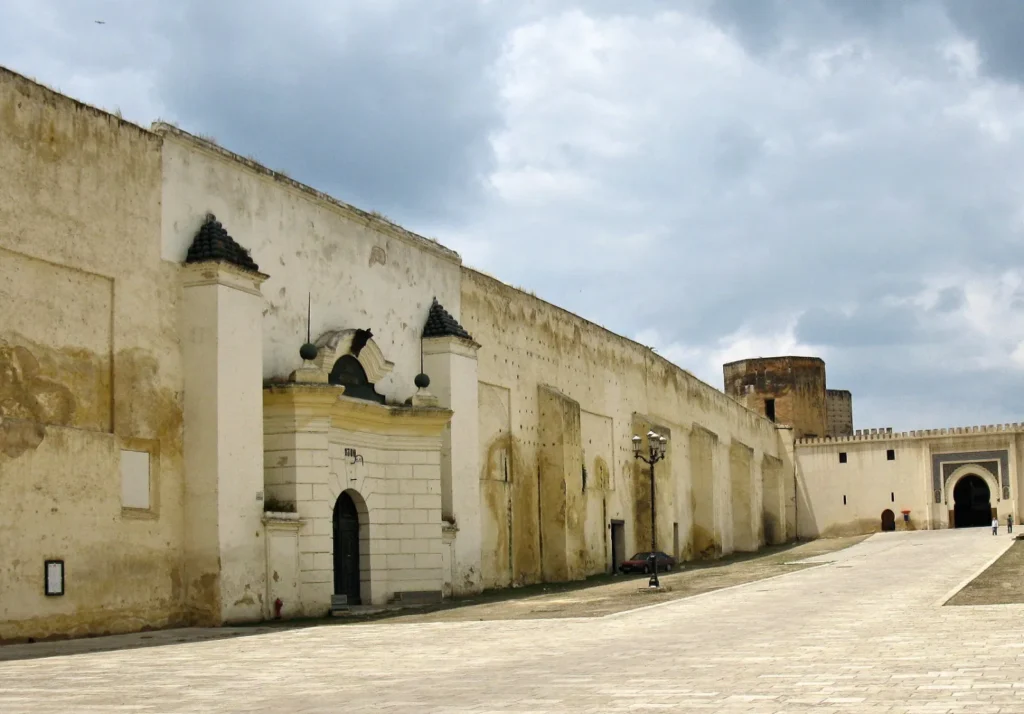
Bab al-Makina (باب الماكينة, sometimes written Bab Makina) is the entrance to Dar al-Makina, an arms factory founded in 1885-1886 by the Alaouite sultan Moulay Hassan I with the help of Italian officers, on the west side of the New Mechouar in Fes Jdid, next to the royal palace (Dar al-Makhzen). A mechouar is the large ceremonial square in front of a royal palace. The Italianate entrance facade hides a vast series of vaulted halls. According to ArchNet and the historical accounts of the site, production only began around 1889 and the factory, which never ran on a large scale, stopped when the French protectorate was imposed in 1912; the building is now disused.
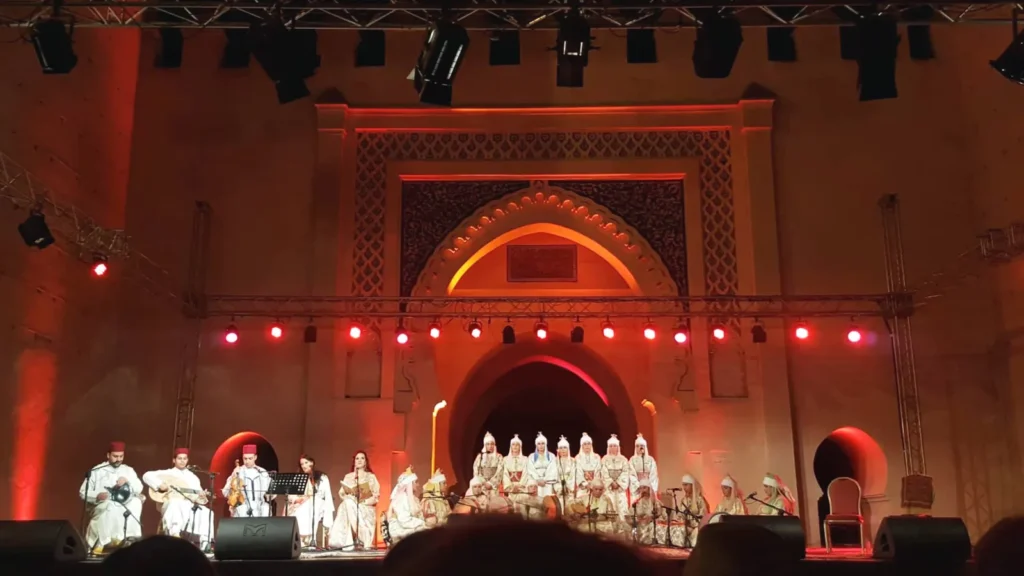
It is inside this enclosure, between high crenellated walls, that the festival sets up its main stage. The stage backs onto a monumental gate, lit at night, and the effect on the audience is real when the first choir begins. According to the review reported by the press, close to 5,000 spectators gathered there each evening during the 2026 edition. It is the venue for the opening and closing concerts and the headliners, at 9 pm.
Jnan Sbil garden, in the open air
The Jnan Sbil garden, also known as the Boujloud gardens, stretches between Bab Boujloud and Fes Jdid. During the festival it hosts the afternoon and late-night concerts, in a more relaxed atmosphere than Bab al-Makina: people settle in at the end of the day, when the heat drops. This is where the Master Musicians of Jajouka, from the Rif, played the festival for the first time in 2025. For the garden’s history, its pools and its noria, see our dedicated article on the Jnan Sbil garden.
Dar Adiyel, the morning concerts
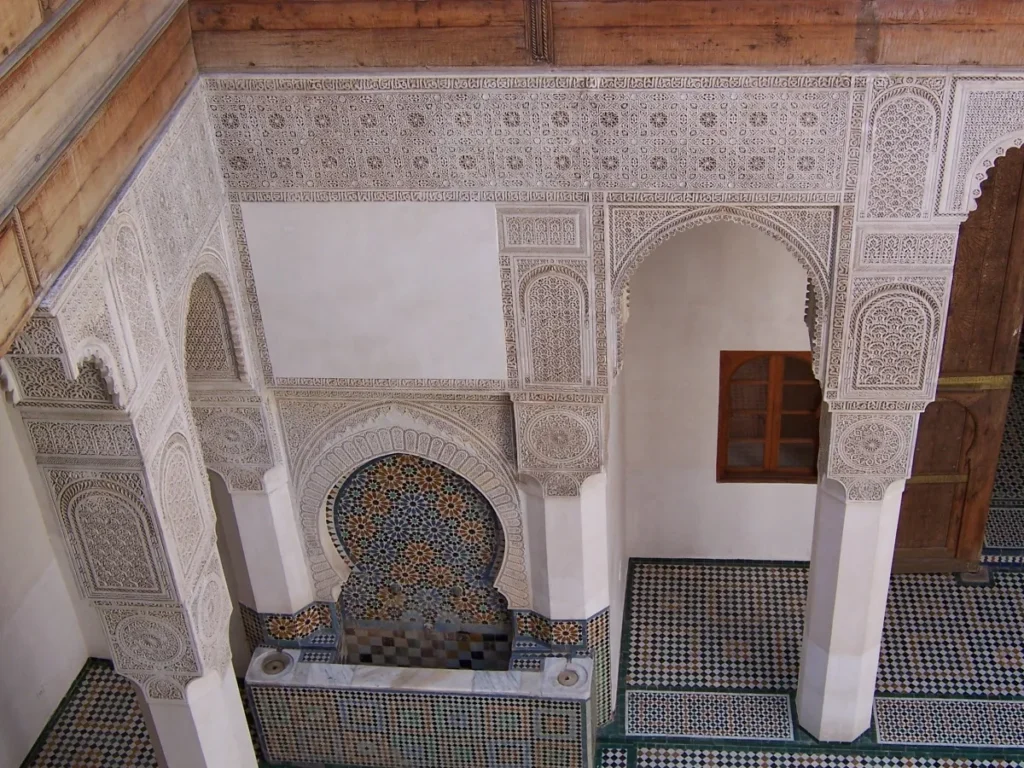
Dar Adiyel is a palace from the late 17th or early 18th century, located in Fes el-Bali, in the Zqaq el-Bghal quarter, south of Tala’a Seghira. It bears the name of Abd al-Khaliq Adiyel, a wealthy merchant who served as amin (guild magistrate) under Moulay Ismail before becoming governor of Fes under Sultan Moulay Abdallah. Restored with funding from the Italian government, in cooperation with UNESCO, it houses the conservatory of Andalusian music and malhoun.
In 2026 the palace hosted the morning concerts, a new feature of that edition: the Irish folk singer Niamh Bury, the Khmer dances “Incarnation”, ragas by Pandit Shyam Sundar Goswami, and a mystical tarab meeting with the Tunisian Jasser Haj Youssef. The capacity is far smaller than at Bab al-Makina and you hear the musicians without heavy amplification, around a patio with a zellige fountain (a mosaic of small hand-cut glazed terracotta tiles). For many regulars, it is the best moment of the day.
Batha, the conference centre and former venues
The prefecture hall in Batha, opposite the Batha museum, and the Palais des congrès et de l’artisanat de Fès complete the set-up. In recent editions the Moroccan press reported that the Sufi nights led by the brotherhoods of Fes were held from 11 pm in the prefecture hall. Other venues, such as the Dar Tazi palace, have been used in the past; they were not in the 2026 programme. The list of venues must therefore be checked every year in the official programme.
How much are tickets for the Fes Festival of World Sacred Music?
In 2026 the full pass for the Fes Festival of World Sacred Music cost 3,000 dirhams (MAD) according to the official programme published on fesfestival.com. Single tickets are available for the concerts, but their prices are only displayed on the festival’s online ticketing service: check them when you book.
The pass makes sense if you are staying all four days and plan to attend the big evenings at Bab al-Makina. For a two-night stay, it is better to buy single tickets for the two or three concerts that matter to you. Beware of touts at the gates and of sites offering “festival packages” with no verifiable link to the foundation: use the ticketing link given on the official website. Moroccan online ticketing platforms have sold festival tickets in the past; make sure the link starts from the official site.
A point that is often misunderstood: the festival is not free, unlike other major Moroccan events that offer public stages. If events open to the public are organised in some years, they are announced in the programme; do not assume there will be any. Keep your ticket on your phone and as a screenshot, as the mobile network is sometimes saturated at the entrance on big nights.
How do you get to the concerts from the medina, the station and the airport?
From Bab Boujloud, the blue gate of the Fes medina, you walk to the Jnan Sbil garden in a few minutes, then reach the Bab al-Makina enclosure by continuing towards Fes Jdid and the royal palace. Dar Adiyel lies in the other direction, down into the medina via Tala’a Seghira. Taxis run from the station and the airport.
On foot around the city
The Bab Boujloud – Jnan Sbil – Bab al-Makina route is the easiest in the city: an almost straight line on flat ground that runs along the garden and then enters Fes Jdid. You can do it without a guide. Dar Adiyel needs more attention, because you enter the derbs (narrow lanes of the medina, often dead ends); leave early for the 10 am concert to give yourself time to find your way. In the evening, after the Bab al-Makina concerts, the streets of Fes Jdid stay lively and everyone leaves as a crowd, which is reassuring.
By taxi, by train or from the airport
The red petits taxis of Fes drop off in front of Bab Boujloud or near the Mechouar; ask for the meter. Fes railway station, served by ONCF from Casablanca, Rabat, Meknes and Tangier, is in the new town, a few kilometres from the medina. Fes-Saïss airport is about fifteen kilometres to the south; during the festival, book your transfer in advance. Our guide to Fes-Saïss airport covers taxis, buses and timetables, and our comparison of airport transfers in Morocco helps you choose between an official taxi and a private driver.
Where to stay during the festival?
During the Fes Festival of World Sacred Music, the best area to stay is the upper medina, around Bab Boujloud and the Batha quarter: from there you can walk to Jnan Sbil and Bab al-Makina, and down to Dar Adiyel. Book early, with a cancellable option, because supply tightens during those few days.
A riad (a traditional house built around an inner courtyard, often converted into a guesthouse) near Batha offers the best compromise: quiet at night, within walking distance of every stage, with taxis available at Bab Boujloud. The riads of the lower medina, near Seffarine square or the tanneries, are superb but mean walking back uphill after the 11 pm concerts. The new town, with its conventional hotels, suits those who want a room with a lift and a taxi at the door. Our guide on where to stay in Fes compares the areas in detail.
Planning a typical festival day
A festival day in Fes can begin with a morning concert at Dar Adiyel, continue with a visit to the medina during the hot hours, pick up again at Jnan Sbil in the late afternoon and peak at Bab al-Makina at 9 pm. The example below follows the actual schedule of the 2026 edition.
| Time | Venue | What happened there in 2026 | Tip |
|---|---|---|---|
| 10 am | Dar Adiyel | Morning concert (Irish folk, ragas, mystical tarab) | Arrive 20 minutes early: capacity is small. |
| Noon – 3 pm | Medina | No concert scheduled on some days | Lunch and a walk in the medina, siesta at the riad. |
| 3 pm | Dar Adiyel or Jnan Sbil | Khmer dances, ensembles from Kazakhstan | Hat and water for open-air concerts. |
| 6 pm | Jnan Sbil | Late-afternoon concert | The light in the garden is at its best at this hour. |
| 9 pm | Bab al-Makina | Main evening concert | Eat early or afterwards; bring a warm layer. |
| 11 pm | Jnan Sbil | Late-night concert (Sufi songs from Pakistan, tarantella) | Head back in a group or by taxi if your riad is far. |
The pace is intense: four concerts in a day is possible, but you soon reach saturation. Pick two highlights per day and leave room for the city. To fill the free slots, dip into our guide to things to do in Fes, which links to a dedicated article for each monument.
Mistakes to avoid during the festival
The most common mistakes at the Fes Festival of World Sacred Music are booking before the official dates are announced, buying tickets outside the official channel, underestimating how cool the open-air nights get and trying to see everything. Here are the pitfalls specific to this festival and its venues.
- Trusting dates from travel sites. In 2026 several pages listed the festival in May when it actually took place from 4 to 7 June. Only fesfestival.com is authoritative.
- Confusing it with the Sufi culture festival. Fes also hosts a festival devoted to Sufi culture, which is a separate event with its own ticketing. Check the exact name before buying.
- Arriving right on time at Bab al-Makina. Ticket checks and security searches take time; allow 30 to 45 minutes for the opening and closing nights.
- Forgetting a warm layer. The 9 pm and 11 pm concerts finish late, in the open air; even in June, the night turns cool.
- Accepting a “guide” at Bab Boujloud to take you to the concert. The walk to Jnan Sbil and Bab al-Makina is direct and needs no one; decline politely.
- Using flash during ceremonies. The brotherhoods and ritual ensembles perform a repertoire of prayer: flash photography and chatting during a samâ are badly received.
- Booking a return flight on the evening of the closing concert. The last concert ends late; plan one more night.
Around the festival stages
Around the festival stages you can easily visit Fes Jdid and its mellah (the former Jewish quarter), the Jnan Sbil garden, the Bab Boujloud gate, the Bou Inania madrasa and Tala’a Kebira, the medina’s main shopping street, which leads towards the Al Quaraouiyine mosque and Seffarine square.
Leaving Bab al-Makina on the Fes Jdid side, the great gates of the royal palace on the Place des Alaouites are a few minutes’ walk away, with the mellah right next door: a good morning plan before an afternoon concert. From Dar Adiyel you quickly reach Tala’a Seghira, then Tala’a Kebira and its artisans, who take on their full meaning during an edition devoted to the mâalemine. Even closer to the main stage, Boujloud square and its cafés act as a meeting point before the evening shows: this is where people meet their friends before walking together to Bab al-Makina.
FAQ about the Fes Festival of World Sacred Music
Here are direct answers to the questions travellers ask most often when planning a stay at the Fes Festival of World Sacred Music: the dates of the next edition, the price of the pass, the official ticketing, access to the concerts for non-believers, the location of the main stage and how many days to allow.
What are the dates of the 2027 Fes festival?
The 2027 dates are not yet known: as of 13 September 2026, the Fondation Esprit de Fès had not announced the 30th edition. Recent editions took place between mid-May and early June (16-24 May 2025, 4-7 June 2026). Check fesfestival.com before booking a flight, and take cancellable options until then.
How much does the festival pass cost?
The full pass cost 3,000 dirhams in 2026, according to the official programme. It gave access to all four days. Single tickets are sold separately, at prices shown on the festival’s online ticketing site. The 2027 prices have not been published and may change; check them at the time of purchase.
Where can I buy festival tickets?
On the official website fesfestival.com, which links to its online ticketing. Moroccan ticketing platforms have sold the tickets in some years; always go through the link given on the official site. Avoid touts at the venue entrances and “festival packages” sold by intermediaries with no connection to the Fondation Esprit de Fès.
Do you have to be Muslim or religious to attend the concerts?
No. The festival is open to everyone, whatever their religion; that is its very purpose, since it was created to bring spiritual traditions into dialogue. The concerts take place in civil monuments, an esplanade and a garden, not in mosques. All that is expected is a respectful attitude, especially during the brotherhoods’ chants.
Who founded the Fes Festival of World Sacred Music?
Faouzi Skali, an anthropologist and specialist in Sufism born in Fes, founded it in 1994. He directed it from 1994 to 2007, then from 2010 to 2014, before taking back the post of general director in the early 2020s. The festival is now organised by the Fondation Esprit de Fès, chaired in 2026 by Abderrafie Zouiten, under the high patronage of King Mohammed VI.
Where is Bab al-Makina?
Bab al-Makina is in Fes Jdid, on the west side of the New Mechouar, near the royal palace. From Bab Boujloud you walk there along the Jnan Sbil garden, on a flat route that is easy to follow. Taxis can also drop you nearby, but the surroundings are very congested on big concert nights.
How many days should you plan for the festival?
Three to four days are enough if the festival keeps its 2026 format, condensed into four days. That lets you attend an opening or closing night at Bab al-Makina, one or two morning concerts at Dar Adiyel, and visit the medina between shows. Add one night after the closing concert.
Summary
The Fes Festival of World Sacred Music is one of Morocco’s most distinctive musical events: founded in 1994 and recognised by the UN in 2001, it presents spiritual music from around the world in places that belong to the city’s history, from Moulay Hassan I’s arms factory to the Dar Adiyel palace. Its 29th edition, from 4 to 7 June 2026, tightened the format to four days and added morning concerts. For 2027, wait for the official announcement before booking, stay in the upper medina, choose two highlights a day and keep time for the city itself.
Official sources
- Official website of the Fes Festival of World Sacred Music (Fondation Esprit de Fès)
- UNESCO – Medina of Fez, World Heritage
- ArchNet – Dar al-Makina, Fes
- Moroccan National Tourist Office – Visit Morocco
- ONCF – train timetables to Fes
- ONDA – Airports of Morocco
This article is for information only and does not commit the festival organisers. Dates, programmes, prices and times may change from one edition to the next: check them on the official website before any purchase. Last updated: September 2026.
Photo credits
Images: featured image « File:Bab makina.jpg » — Robert Prazeres (CC BY-SA 4.0); « File:مهرجان الموسيقى الروحية ، فاس.jpg » — Nassima Chahboun (CC BY-SA 4.0); « File:MoroccoFez, Dar Adiyel.jpg » — Csörföly Dániel (CC BY-SA 3.0), via Wikimedia Commons.