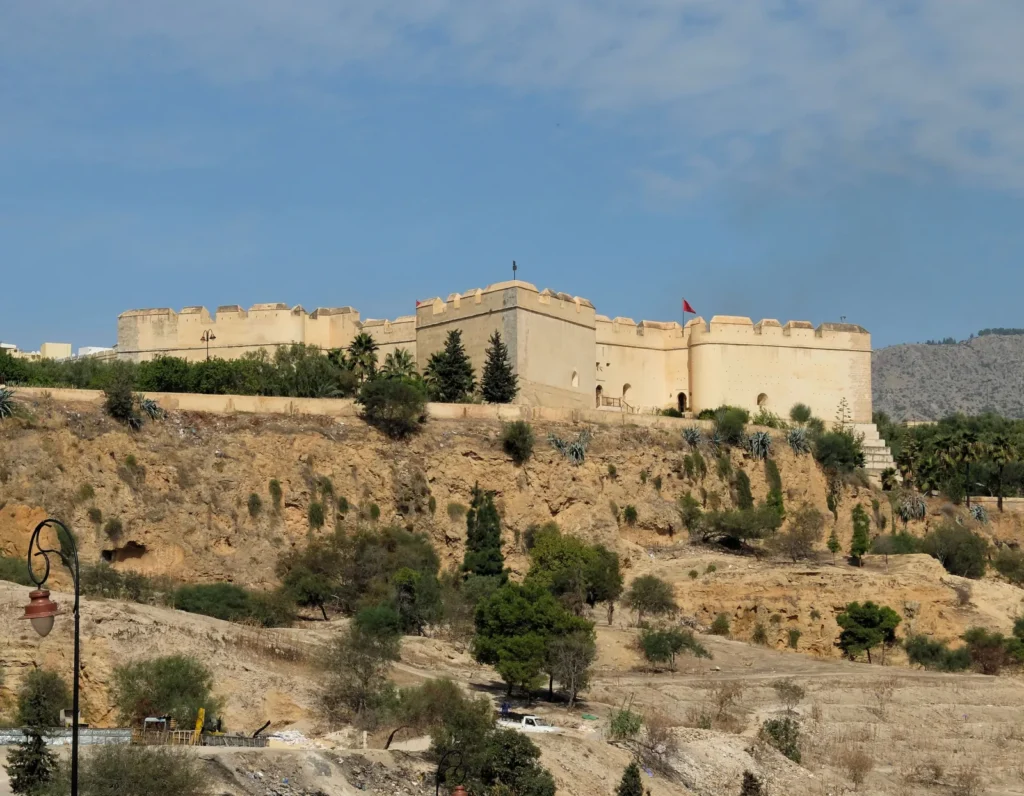
Borj Nord in Fes is a Saadian fortress founded in 1582 by Sultan Ahmad al-Mansur on the hill that overlooks Fes el-Bali from the north, and since 1963 it has housed the Museum of Arms, the first museum in Morocco devoted to the history of weapons. There are two equally good reasons to climb up: a collection of several thousand pieces assembled by a military curator, and one of the most complete views of the medina, framed from the very spot where the sultan’s cannons once kept it in line.
This guide tells the fort’s story from the available sources, explains what you see as you walk through its rooms and onto its terrace, gives an honest update on the museum’s opening status, then details how to get there from Bab Guissa, Bab Boujloud or the train station. The other monuments on the hill, starting with the neighbouring Marinid Tombs, each have their own article in our series on Fes (also spelled Fez): we link to them rather than repeat them.
At a glance
- Borj Nord was founded in 1582 by the Saadian sultan Ahmad al-Mansur; one scholarly entry gives 1588 (995 AH), a gap the sources do not settle.
- The fort belonged to a system of eleven forts that ringed the medina of Fes, according to its own curator.
- Its plan, a square core flanked by four very sharp-angled bastions, follows the sixteenth-century European “bastioned” model; the chronicles mention the help of Portuguese captives.
- The monument covers about 2,250 m² and its grounds about 4.5 hectares.
- The Museum of Arms, opened in 1963, has been under the Moroccan Commission for Military History since 22 March 2003; its collection held 4,898 pieces from Morocco and 35 other countries according to the inventory published in 2006, and 6,245 pieces according to a 2022 report.
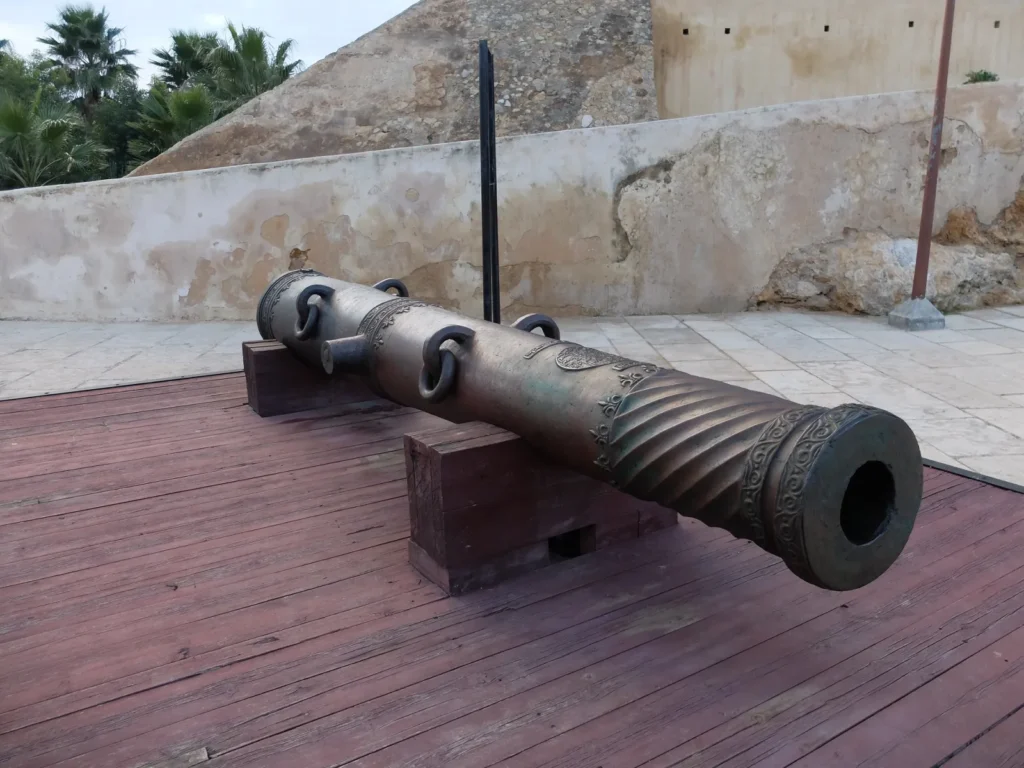
- Star exhibit: a sixteenth-century bronze cannon about 4.80 m long and weighing 12 tonnes, which tradition links to the Battle of the Three Kings (1578).
- The opening status has changed in recent years: check locally before making the trip specifically for the museum.
Why Borj Nord in Fes is worth the climb
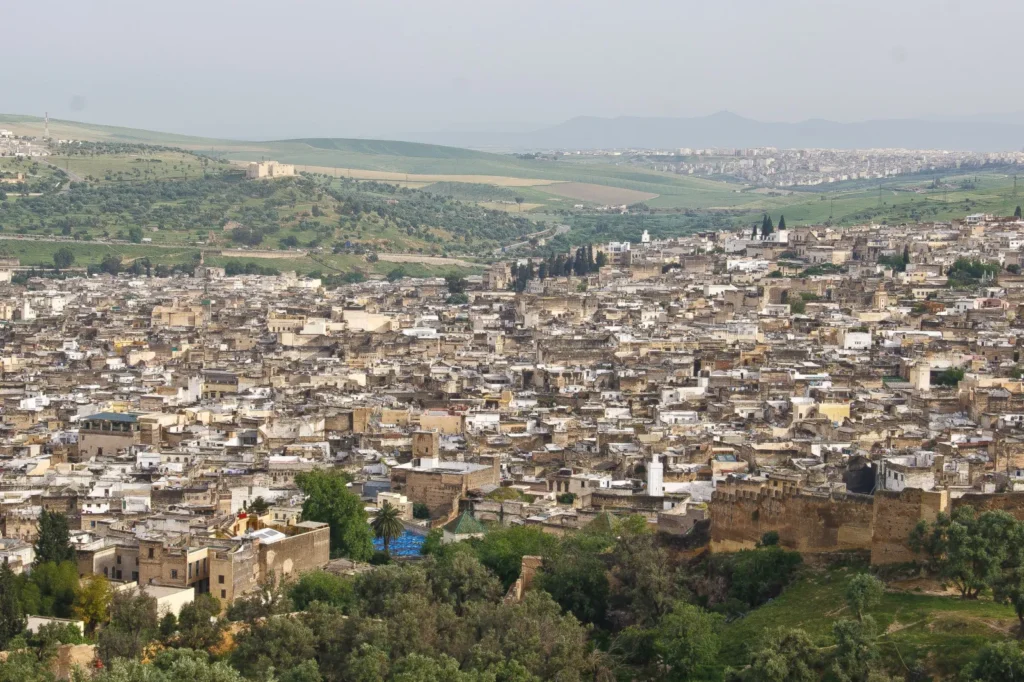
Most visitors discover Fes from below: through Bab Boujloud, along the Talaa Kebira, past the tanneries and down alleys where you never see more than three metres of sky. Borj Nord offers the opposite exercise. From its terrace the medina stops being a maze and becomes a readable shape, a bowl of white and ochre houses sloping down towards the river, bristling with minarets, and facing you on the far slope stands the silhouette of its twin, Borj Sud.
But the fort is more than a lookout. It is one of the rare witnesses in Fes to a military revolution: the arrival of gunpowder and cannon, which forced builders to invent walls able to absorb cannonballs and platforms strong enough to carry artillery. And it is a museum that tells the story of that revolution with its own objects, from the sabre to the repeating rifle. Few places see the building and the collection speak so precisely about the same subject.
Our view: if you only have half a day to get out of the souks, combine Borj Nord with the Marinid Tombs, a few minutes apart. The museum provides the substance, the tombs the evening light. To fit this stop into a full stay, our guide to things to do in Fes suggests itineraries of one to three days.
History of Borj Nord: a Saadian fortress aimed at the medina
1582 or 1588: what the sources say
The most frequently quoted date, 1582, is the one given by Hafid Mokadem, curator of Borj Nord and Borj Sud in Fes, in his presentation of the monument’s rehabilitation project, and by the MAP news agency dispatch published by Le Matin in 2006. The Discover Islamic Art database, whose entry is signed by the historian Mohamed Mezzine, gives 995 AH, that is 1588. French-language Wikipedia repeats both figures without deciding. The gap is small and easy to explain: a building site of this size can run over several years, and the founding date is not necessarily the completion date. Remember that Borj Nord is a work of the 1580s, from the reign of Ahmad al-Mansur (1578-1603).
This sultan, nicknamed ad-Dhahabi, “the Golden”, came to the throne in the aftermath of the Battle of the Three Kings, fought in August 1578 near Ksar el-Kebir, where the Moroccan army crushed the expedition of King Sebastian of Portugal. The victory brought him immense prestige, huge ransoms and thousands of prisoners. This context is not a detail: it sheds light both on the architecture of Borj Nord and on the presence in its museum of a cannon that tradition associates with that battle.
Portuguese captives and an architecture from Europe
According to the chronicles quoted by the site’s curator, Borj Nord was built with the help of Portuguese captives, which would explain the European character of its architecture. The art historian Xavier Salmon, in his book on Saadian splendours, also links these forts to the expertise of European prisoners captured in 1578. The plan does indeed imitate the fortresses the Portuguese had scattered along the Moroccan coast in the sixteenth century, from Azemmour to Mazagan: a compact body, projecting bastions, thick low walls designed to absorb fire rather than to impress.
There is an irony here that you appreciate more once you are on site: the sultan who had just defeated Portugal built, above his most rebellious city, a Portuguese-style fortress, perhaps raised by Portuguese hands. The fort belongs to the very first generation of fortifications in Fes designed for the age of gunpowder, and together with Borj Sud it remains the clearest demonstration of that turning point in the city.
Watching Fes more than defending it
Why a fort to the north and another to the south? The most honest answer has two parts. Officially, the aim was to protect Fes against sieges by tribes or pretenders to the throne, as the Discover Islamic Art entry points out. But the Saadians, whose capital was Marrakesh, had met stubborn resistance in Fes. The historian Roger Le Tourneau, in his reference study of Fes before the protectorate, stresses that these forts served as much to keep the population of Fes el-Bali in check as to repel an outside enemy. You only need to climb onto the terrace to understand: the gun openings do not face the countryside, they face the medina.
Borj Nord was not isolated. Hafid Mokadem describes it as one element in a defensive system of eleven forts ringing the medina. The best known today are Borj Nord and Borj Sud, which face each other across the valley, plus Saadian bastions along the walls of Fes el-Jdid. To place these works within the city’s whole defensive system, see our article on the gates and ramparts of Fes.
From the Alaouites to Morocco’s first arms museum
The fort has not come down through the centuries unchanged. Mohamed Métalsi, in his book on Fes, believes its original shape was more compact and cubic, close to that of Borj Sud, and that the large corner bastions which now give it its star-like look were probably added in the Alaouite period. The sources consulted give no precise date for this change; be wary of texts that offer one without a reference. The Discover Islamic Art entry also mentions “multiple restorations” over time.
Under the French protectorate the monument served as a military barracks, then as a prison, according to its curator. In 1963, a few years after independence, it received the first museum in Morocco specialising in the history of arms. On 22 March 2003 it was placed under the Moroccan Commission for Military History (CMHM), which launched a comprehensive rehabilitation project: consolidation and restoration of the building, landscaping of the surroundings, new museography and restoration of the collection. According to the project presentation, the work was planned over 24 months at a cost of about 11 million dirhams, with the architect Mohammed Bennani and the exhibition designer Philippe Delis. The MAP dispatch of May 2006 places the inauguration of the renovated museum within the celebrations of the fiftieth anniversary of the Royal Armed Forces.
| Date | Event | Main source |
|---|---|---|
| 1578 | Battle of the Three Kings; accession of Ahmad al-Mansur | General historiography |
| 1582 (or 1588 according to one entry) | Foundation of Borj Nord, within a system of eleven forts around the medina | Borj Nord curator; Discover Islamic Art |
| Alaouite period (date not established) | Probable addition of the large corner bastions | M. Métalsi, Fès, la ville essentielle |
| French protectorate (1912-1956) | Military barracks, then prison | Borj Nord curator |
| 1963 | Opening of Morocco’s first arms museum | Borj Nord curator; MAP |
| 22 March 2003 | Placed under the Moroccan Commission for Military History; start of rehabilitation | Borj Nord curator |
| May 2006 | Renovated museum presented during the Royal Armed Forces’ 50th anniversary | MAP dispatch, Le Matin |
| 2025 | Reopening reported by tourism websites after closure for works, no official statement found | To be checked on site |
The architecture of Borj Nord, read on the spot
A square core and four spearhead bastions
The principle is easier to grasp from the car park than from inside. The fort consists of a roughly square core, flanked at each corner by a bastion with very sharp points, which French Wikipedia compares to spearheads. The shape is not decorative: a pointed bastion eliminates blind spots, since each face can be swept by fire from the neighbouring bastion, and it offers enemy shot an oblique surface to glance off instead of taking the full impact. This is the logic of the “Italian trace” that took hold in Europe in the sixteenth century, and which the site’s curator explicitly cites.
The material surprises those who picture a dressed-stone fortress: the sources describe a fort built largely of pisé, the rammed earth packed in layers inside wooden formwork that also makes up the ramparts of Fes and Marrakesh. That is where the tawny colour of the walls comes from. The monument covers about 2,250 m², a large footprint for a fort, and the landscaped grounds around it, with gardens, a promenade and a car park, extend over about 4.5 hectares according to the rehabilitation project presentation.
Casemates, vaults and an underground cistern
Inside, you move through corridors covered with barrel vaults that lead to the museum rooms. The upper level housed casemates used as ammunition stores: these massive rooms, with thick walls and narrow openings, now lend themselves quite well to displaying fragile objects. The detail that catches the eye of architecture lovers lies beneath your feet: the fort has an underground cistern, essential for a garrison that had to withstand a siege. The rehabilitation project planned to open it to visitors, with access from the reception hall. If it is open on the day you visit, do not miss it: it is where you best grasp the fortress’s logic of self-sufficiency.
The terrace, its cannons and its sixty steps
To reach the terrace you climb a staircase of more than sixty steps, notes the Discover Islamic Art entry. The platform was designed to bear the weight and recoil of cannons, which is why it is so wide. Artillery pieces are displayed there facing the medina, in the very direction they once pointed. Médias24 counted 56 cannon openings there, supplemented by numerous paired loopholes pierced in the parapet for rifle fire. The renovation project also provided telescopes for visitors and a lifting platform for people with reduced mobility; we could not confirm that they are still in service, so ask at the reception desk.
The Borj Nord Museum of Arms: what the collections contain
The curator presents the site as a specialised national museum devoted to the history and evolution of arms in Morocco and around the world. The chronological range runs from prehistory to the automatic firearms of the first half of the twentieth century. The objects are not only of military interest: many are also works of goldsmithing, chasing or inlay, and speak of craftsmanship as much as of war.
The collection in figures
The figures published by the museum’s curatorial team and repeated in the 2006 MAP dispatch are precise: 4,898 pieces in total, of which 775 are on permanent display, 2,479 kept in storage and 128 lent to other Moroccan museums. Besides Morocco, the collection represents 35 countries in Africa, Europe, Asia and North America. These figures date from the 2003-2006 rehabilitation. In July 2022, a Médias24 report gave a higher total: 6,245 pieces, still with 775 on permanent display, not counting some 2,000 pieces then being restored, originating from around forty countries. The same report states that most of the weapons come from the former Makina of Fes. Inventories therefore change, and the display may have evolved since, particularly after more recent works.
The route, room by room
The museography designed during the rehabilitation follows a single, chronological and thematic visitor route. An article in Médias24 published in July 2022 describes an exhibition organised around three major themes spread over thirteen rooms, where the pieces are arranged to show the evolution of ignition, loading, defence and ceremonial systems. The plan of the rehabilitation project sets out the sequence as follows:
| Space | Theme | What to look at |
|---|---|---|
| Rooms 1 to 3 | Edged weapons of the world | Differences in the shapes of sabres, swords and daggers from region to region |
| Wing 4 | Armour: defence and display | Shields, helmets and protective gear, between function and prestige |
| Rooms 5 to 7 | Individual firearms, 15th to 18th century | The shift from matchlock to wheellock and then flintlock |
| Wing 8 | Artillery: origins and evolution | The great bronze cannon and the siege pieces |
| Rooms 9 to 11 | Individual firearms, 19th to early 20th century | Percussion, metal cartridges, repeating weapons |
| Moroccan section | Traditional Moroccan arms: prestige and glory | Inlaid long-barrelled muskets, daggers with chased scabbards |
| Makina section | The Makina of Fes | Weapons produced by the royal factory in Fes el-Jdid |
According to Médias24, the rooms devoted to weapons from around the world bring together an almost exhaustive collection: edged weapons (swords, sabres, daggers, knives), armour (shields, helmets, arm guards), individual firearms (rifles, carbines, pistols, machine guns), as well as ceremonial and hunting weapons. Our advice to a non-specialist visitor: do not try to read everything. Pick a thread, for example the evolution of the firing mechanism, and follow it from room to room. In an hour you will have understood how a sixteenth-century gun, which needed a lit match, became a cartridge weapon that could be reloaded in a few seconds.
The great bronze cannon
The most spectacular piece is a sixteenth-century bronze cannon, about 4.80 metres long and weighing some 12 tonnes according to the 2006 MAP dispatch. Local tradition links it to the Battle of the Three Kings in 1578, which would make it a direct souvenir of the victory that brought Ahmad al-Mansur to power. Take this attribution for what it is: a tradition, relayed by the museum’s official sources, for which we found no published archaeological proof. It takes nothing away from the visual shock of the object, whose length gives a very concrete idea of the firepower the fort could direct at the city.
The Makina of Fes, the other common thread
The most distinctively local section of the museum is devoted to the Makina. According to Médias24, Borj Nord holds hundreds of weapons from this factory created in the nineteenth century on the orders of Sultan Moulay Hassan I, which supplied the Moroccan army with rifles, cartridges and explosive devices. Dar al-Makina was founded in 1885-1886 with the help of Italian officers, as part of an effort to modernise the army in the face of the European powers. You sometimes read that the factory dates back to Moulay Rachid: that is a confusion the historical sources do not support.
For the visitor, the interest lies in connecting the museum with the city itself: the Makina building still stands in Fes el-Jdid, on the west side of the New Mechouar near the royal palace, with its Italianate gate, Bab al-Makina. If you pass by after the museum, you will see the factory that turned out the rifles you have just been looking at behind the glass.
Borj Nord Museum of Arms: open or closed?
This is the question everyone asks, and the answers found online contradict each other. Here is what is established and what is not. Established: the museum has existed since 1963, it comes under the Moroccan Commission for Military History, attached to the Royal Armed Forces, and it reopened after a complete rehabilitation carried out from 2003 onwards. Several tourist information websites then report a new closure for works lasting several years, followed by a reopening in March 2025. We found no official statement confirming that date, and as far as we know the museum has no website of its own publishing its opening hours.
Our recommendation is therefore pragmatic. Do not go up to Borj Nord just for the museum without checking that it is open: ask your riad, which regularly sends guests up the hill, or a taxi driver who makes the trip. On the other hand, the climb is worthwhile regardless: even with the door closed, the fort’s surroundings, the Marinid Tombs and the view over the medina justify the outing. That is exactly what we cover in our selection of the best viewpoints over Fes.
Visiting Borj Nord in Fes: practical information
Getting there from Bab Guissa, Bab Boujloud or the station
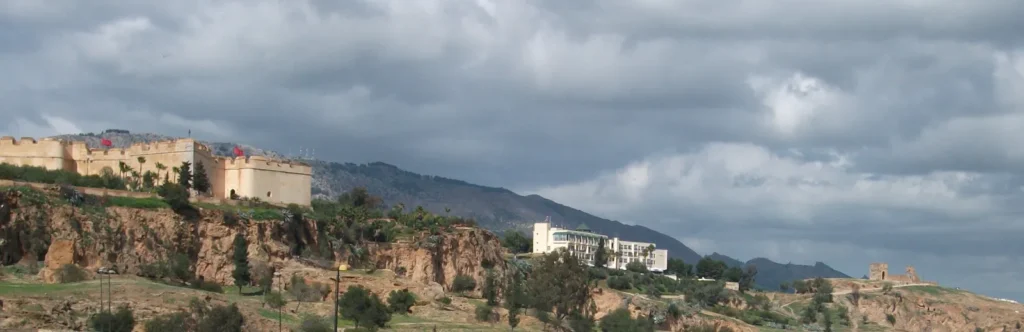
The fort stands outside the walls, on the hill north of Fes el-Bali, in the same area as the Marinid Tombs and the Hotel Les Mérinides. The site plan shows a promenade, called the Promenade des Saadiens, that leads down towards Bab Guissa, and a vehicle access road with a car park and a bus stop.
- On foot from Bab Guissa: this is the nearest northern gate of the medina. Allow about 15 to 25 minutes of uphill walking depending on your pace (estimate); the path is steep and has little shade.
- On foot from Bab Boujloud: possible, but long and unpleasant in full sun, as you have to skirt the medina to the north. We advise against it in summer.
- By petit taxi: the simplest option from Bab Boujloud or the new town. Ask for “Borj Nord” or “les Mérinides” and insist on the meter; the ride is short, and the fare depends on the time of day and traffic.
- From Fes ONCF railway station: the station is in the new town; a petit taxi drops you at the foot of the fort in a ride of about 15 to 20 minutes depending on traffic (to be checked).
- From Fes-Saïss airport: the airport lies south of the city; see our Fes-Saïss airport guide for taxis and shuttles, then our comparison of transfers from Morocco’s airports.
Opening hours, price and length of visit
The institution publishes no official opening hours. Information found on recent websites varies: some give opening from 9 am to 12 noon and then from 3 pm to 6 pm, closed on Tuesdays, others Tuesday to Sunday from 9 am to 12 noon and then from 2 pm to 5 pm. The midday break seems constant; do not count on visiting between noon and mid-afternoon. The reported admission fee is modest, generally around 10 to 20 dirhams, but a higher figure also circulates: bring change and check on site.
| Item | Information |
|---|---|
| Name | Borj Nord (Burj al-Shamal, برج الشمال), Museum of Arms |
| Location | Hill north of Fes el-Bali, near Bab Guissa and the Marinid Tombs |
| Managing body | Moroccan Commission for Military History (Royal Armed Forces) |
| Opening hours | Not officially published; sources mention 9 am-12 noon and 2/3 pm-5/6 pm, with one weekly closing day (to be checked) |
| Price | Modest, often quoted at 10 to 20 MAD (to be checked on site) |
| Recommended time | 1 hour for the museum, 30 minutes more for the terrace and grounds |
| Best time | Morning opening for the museum; late afternoon for the view, followed by the Marinid Tombs |
| Dress | No specific dress code reported; closed shoes for the climb, a hat in summer |
| Photos | Free outdoors; ask at reception for the rooms |
Best time and what to wear
As the fort faces south, the medina spreads out in front of you and catches slanting light in the morning and late in the day. For the museum, aim for the morning opening: the rooms are quiet and you avoid the heat of the climb. For photos, the ideal is to come back, or stay in the area, until evening: it is from this hill that you hear the call to prayer rising at the same moment from all the mosques of the old city, a moment that the Wikipedia page on the Marinid Tombs also mentions. In summer, between June and September, Fes gets very hot and the terrace has no shade at all: water, a hat and sunscreen are essential.
Borj Nord is a military and cultural site, not a place of worship: no particular dress code is reported. Clothing that covers shoulders and knees remains the most comfortable choice for moving on into the medina afterwards without drawing comments. As for paperwork, nothing specific applies to this monument; the only documents to carry are those required for your stay in Morocco.
Mistakes to avoid
- Arriving at 12.30 pm: that is the midday break, and you will wait in the sun.
- Following an improvised “guide” who offers to show you a shortcut from Bab Guissa: the route is simple, and the museum is visited without a guide.
- Confusing Borj Nord with the Marinid Tombs: they are two separate sites, a few minutes’ walk from each other.
- Climbing to Borj Sud expecting to find the museum there: Borj Sud is a viewpoint, not a museum.
- Walking back down after dark on poorly lit paths: take a taxi from outside the Hotel Les Mérinides instead.
Borj Nord, Borj Sud and the Marinid Tombs: reading the hill
These three sites are often confused in tour programmes, even though they tell the story of three different periods. The ruined Marinid Tombs date from the fourteenth century: Marinid sultans were buried there between 1361 and 1398, with a final burial in 1465. Borj Nord and Borj Sud, on the other hand, date from the 1580s and belong to the following dynasty, the Saadians. Borj Sud, on the hills south of Fes el-Bali, has kept the original cubic form that Borj Nord lost when its bastions were added; today it serves as a lookout and houses no museum.
| Site | Period | What you find | Best for |
|---|---|---|---|
| Borj Nord | Saadian, 1582; bastions probably Alaouite | Bastioned fort, Museum of Arms, cannon terrace | Military history enthusiasts, families, architecture buffs |
| Marinid Tombs | Marinid, 14th century | Ruined mausoleums, freely accessible panorama | Photographers, sunset |
| Borj Sud | Saadian, 1582 | Fort with original cubic form, lookout over the medina | Walkers, reverse view from the south |
The most rewarding thing, once on the terrace of Borj Nord, is to spot Borj Sud opposite: the two forts look at each other across the medina, and you grasp at a glance the crossfire principle they formed. For the history and a visit of the mausoleums, see our full article on the Marinid Tombs of Fes.
Around Borj Nord
The northern hill lends itself to a half-day loop. Starting from the fort, the Marinid Tombs are a few minutes’ walk to the east along the same ridge. The Hotel Les Mérinides, right next door, has a terrace from which many visitors watch the sunset; it is also the most convenient place to find a taxi for the way back. Heading down the Promenade des Saadiens, you reach Bab Guissa, the northern gate of the medina, next to which lies a cemetery; from there the alleys lead you back towards the heart of Fes el-Bali.
From the terrace, also look south-west, about a kilometre away, for the walls of the Kasbah Cherarda, a vast fortified complex whose present extent dates back to the Alaouite sultan Moulay Rachid in the seventeenth century. And if military history has whetted your appetite, the Makina and the New Mechouar in Fes el-Jdid are the logical next step.
FAQ about Borj Nord and the Museum of Arms in Fes
When was Borj Nord built?
Borj Nord was founded in 1582 by the Saadian sultan Ahmad al-Mansur, the date adopted by the monument’s curator. A Discover Islamic Art entry gives 1588 (995 AH); either way, it is a work of the 1580s.
Is the Borj Nord Museum of Arms open?
Several tourism websites report a reopening in March 2025 after years of works, but to our knowledge no official statement has confirmed it. Check with your accommodation or a taxi driver before going up specifically for the museum.
How much does it cost to enter Borj Nord?
The price is not officially published. Recent sources most often quote a modest admission fee of around 10 to 20 dirhams. Bring small change and treat this amount as a guide only.
How many pieces does the collection hold?
The inventory published by the curator in 2006 listed 4,898 pieces, 775 of them on permanent display, from Morocco and 35 other countries; a 2022 Médias24 report gives 6,245 pieces from around forty countries. It spans prehistory to the automatic weapons of the early twentieth century.
How do you get to Borj Nord from the medina?
The shortest way is to leave by Bab Guissa and walk up, about 15 to 25 minutes uphill. From Bab Boujloud or the new town, a metered petit taxi is simpler: ask for “Borj Nord” or “les Mérinides”.
What is the difference between Borj Nord and Borj Sud?
The two Saadian forts face each other on either side of the medina. Borj Nord houses the Museum of Arms and has large corner bastions added later; Borj Sud has kept its original cubic form and serves as a lookout, with no museum.
Can you combine Borj Nord and the Marinid Tombs?
Yes, and it is the best way to visit the hill. The two sites are on the same ridge, a few minutes’ walk apart. Do the museum first, then head to the tombs for the late-afternoon light.
In summary
Borj Nord is a Saadian fortress of the 1580s, inspired by Portuguese forts and probably built with the help of captives from the Battle of the Three Kings, whose cannons watched the medina itself more than any outside enemy. Turned into a barracks and then a prison under the protectorate, it has housed Morocco’s first arms museum since 1963, rehabilitated by the Moroccan Commission for Military History from 2003: several thousand pieces, a clear chronological route, a 12-tonne bronze cannon and a section devoted to the Makina of Fes. Check that it is open before going up, arrive in the morning for the museum, and stay on the hill until evening for the view and the call to prayer.
Official sources
- UNESCO World Heritage Centre: Medina of Fes
- Hafid Mokadem, curator of Borj Nord and Borj Sud: Borj Nord rehabilitation project (RehabiMed, in French)
- Discover Islamic Art (Museum With No Frontiers): Borj Nord entry
- ArchNet: Burj al-Shamali, Fes
- Le Matin (MAP dispatch, 2006): Borj Nord restored by the Royal Armed Forces (in French)
This article is for information purposes and was updated in September 2026. Opening hours, prices and access conditions at the Museum of Arms may change: check them on site before your visit.
Photo credits
Images: featured image « File:Borj Nord DSCF2747.jpg » — R Prazeres (Public domain); « File:Fès, Borj Nord etc.jpg » — ArnoldBetten (CC BY-SA 4.0); « File:Borj Nord cannon on display at the Musée des Armes.jpg » — Casual Builder (CC BY-SA 4.0), via Wikimedia Commons.