A day trip to Volubilis and Moulay Idriss Zerhoun from Fes takes a full day: roughly 65 to 70 km of road and 1 h 15 to 1 h 30 of driving each way, 2 hours in the UNESCO-listed Roman ruins and 1 h 30 to 2 hours in the holy town next door. Volubilis is written Walili or Oualili in Moroccan transliteration (وليلي in Arabic); Moulay Idriss Zerhoun also appears as Moulay Driss Zerhoun (مولاي إدريس زرهون) or simply Moulay Idriss, and the departure city is spelled Fes or Fez. This guide gives you the official ticket price, the opening hours, the four ways to get there, the visiting order that beats both crowds and heat, and what a non-Muslim can actually see in the town of Idris I.
Information verified in September 2026
At a glance
- Volubilis has been a UNESCO World Heritage Site since 1997; the property covers about 42 hectares at the foot of the Zerhoun massif, in the prefecture of Meknès.
- Admission costs 100 DH for a foreign adult and 30 DH for a Moroccan or resident adult, according to the Ministry of Culture’s online ticket office.
- The ministry lists visiting hours of 9 am to 5 pm; practical guides to the site mention longer seasonal hours, to be checked on the day.
- Moulay Idriss Zerhoun, burial place of Idris I, founder of the Idrisid dynasty who died in 791, lies 3 to 5 km from the ruins; its mausoleum remains closed to non-Muslims.
- From Fes, the easiest option is a car with driver; the cheapest combines the train to Meknès with a grand taxi.
- The site has almost no shade: in July and August, average highs exceed 34 °C in the Meknès area, with distinctly hotter peaks.
- A 4-million-dirham rehabilitation project, running from 2024 to 2026, is reorganising entrances and visitor routes.
Fact sheet: Volubilis and Moulay Idriss Zerhoun from Fes
Volubilis and Moulay Idriss Zerhoun are visited together on a day trip from Fes: the two places are 3 to 5 km apart and about 65 to 70 km from the medina by road. The table below gathers the data checked with the Ministry of Culture and UNESCO.
| Item | Volubilis (archaeological site) | Moulay Idriss Zerhoun (holy town) |
|---|---|---|
| Location | Plain at the foot of the Zerhoun, prefecture of Meknès, Fès-Meknès region | Town built on two hills, Khiber and Tasga, 3 to 5 km east of the ruins |
| Access from Fes (Bab Boujloud or ONCF station) | About 65 to 70 km, 1 h 15 to 1 h 30 by car; or train to Meknès, then about 30 km by road | About 60 to 65 km, just over 1 hour by car; about 30 km from Meknès |
| Opening hours | 9 am to 5 pm according to the Ministry of Culture; longer summer hours reported by practical guides to the site, to be checked on site | Town always open; mausoleum reserved for Muslims |
| Price | 100 DH foreign adult, 50 DH foreign child aged 7 to 13, 30 DH Moroccan or resident adult, 10 DH Moroccan or resident child | Free (town); local guide to be negotiated |
| Recommended time | 2 hours (3 hours with a guide and the interpretation centre) | 1 h 30 to 2 hours |
| Best time | At opening time, from March to May and in October-November | Late morning or late afternoon, avoiding Friday midday |
| Dress | Hat, closed shoes, water (the ground is uneven and unshaded) | Shoulders and knees covered, modest clothing |
| Accessibility | Uneven ground and slippery stones; adapted routes being laid out in the 2024-2026 project, to be checked on site | Steep streets and stairs, difficult in a wheelchair |
How to get to Volubilis and Moulay Idriss from Fes?
To get from Fes to Volubilis and Moulay Idriss, you have four options: a private car with driver for the day, a rental car, the ONCF train to Meknès followed by a grand taxi, or a group tour. No bus line serves the ruins directly; the last stretch is always done by car or on foot.
Two road routes link Fes to the Zerhoun. The first follows the motorway or the national road to Meknès, then heads north for about thirty kilometres: it is the most predictable, and the only one that lets you add a visit to Meknès. The second cuts more directly north-west along the regional roads of the Saïss plain and the Zerhoun hills: slightly shorter, it crosses villages and olive groves, but becomes slower when tractors and harvest trucks take over the road. Route planners give 1 h 05 to 1 h 15 to Moulay Idriss on this direct route; add a quarter of an hour to reach the ruins.
Car with driver: the most flexible option
A driver booked for the day picks you up at your riad door or at the car park closest to the medina (Bab Boujloud, Bab Ftouh or Bab Guissa depending on your area), waits during the visits and drops you back in the evening. It is the only solution that gets you to Volubilis at opening time, takes you up to Moulay Idriss without negotiating a second vehicle, then brings you back via Meknès if you wish. The price is not regulated: it depends on duration, number of stops and season. Ask for a firm written price stating whether the guide and fuel are included. To compare prices with other providers, our comparison of transfers in Morocco sets out the differences between taxi, private driver and shuttle.
Train to Meknès, then grand taxi: the budget option
ONCF trains link Fes and Meknès in about 30 to 40 minutes, with regular departures throughout the day; timetables are on the ONCF website and station details are in our guide to Fes train station and trains from Fes. In Meknès, grand taxis to Moulay Idriss leave from a rank in the new town. A grand taxi is a shared intercity taxi, often an old saloon car, which leaves once its six seats are sold; you can also buy all the seats to leave straight away, or hire it for the whole loop. No official fare is published: recent guidebooks quote around 400 DH for a whole taxi on a Meknès-Volubilis return trip with waiting time, an amount to negotiate before getting in.
One thing to plan for: shared grand taxis go to Moulay Idriss, not to the ruins. Between the town and the Volubilis entrance there are still 3 to 5 km depending on the path, an hour’s walk along the road and through the olive trees, or a few minutes in a taxi hired locally. On the way back, the Moulay Idriss rank fills up quickly in late afternoon; do not aim for the last departure.
Rental car: freedom, with two caveats
The road is good and well signposted; the Volubilis car park is right in front of the entrance. The two caveats concern Moulay Idriss, where the streets climb steeply and it is better to park at the bottom of town, and the drive back to Fes after dark, when unlit mopeds are common. If you arrive by plane, our guide to Fes-Saïss airport lists the rental companies at the terminal.
Organised tour: for those who want no logistics
Group tours from Fes most often combine Volubilis, Moulay Idriss and Meknès in one day. Three questions help sort the offers: is the site entrance included, is the official Volubilis guide included or only the driver, and how long do you actually spend in the ruins? A programme giving less than an hour and a half to Volubilis leaves no time to reach the mosaic houses in the north of the site.
| Option | One-way time from Fes | Cost | Strength | Weakness |
|---|---|---|---|---|
| Car with driver | 1 h 15 to 1 h 30 | Highest, negotiable | Arrival at opening, stop in Meknès possible | Unregulated price |
| Rental car | 1 h 15 to 1 h 30 | Rental and fuel | Free schedule | Difficult parking in Moulay Idriss |
| Train then grand taxi | 2 to 2 h 30 with connection | Lowest | Cheap, no driving | Waiting for the taxi to fill, last stretch to arrange |
| Group tour | Varies with programme | Package price | No logistics | Limited time in the ruins |
How much is the Volubilis entrance fee and what are the opening hours?
Entrance to Volubilis costs 100 DH for a foreign adult and 30 DH for a Moroccan or resident adult, according to the Ministry of Culture’s online ticket office, which lists visiting hours of 9 am to 5 pm. Moroccans get in free on Fridays and on the first day of national and religious holidays.
Many printed guidebooks and web pages still show 70 DH: that is an old price. The grid published by the ministry has four categories, and tickets can be bought in advance on its online services platform, which saves queuing at the counter on busy days. Practical guides to the site, for their part, mention opening from 8:30 am until one hour before sunset; these wider hours mainly apply to long summer days. Between the two sources, treat 9 am to 5 pm as the guaranteed slot and check the day before with your host or driver if you plan to arrive earlier or leave later.
| Visitor category | Price |
|---|---|
| Foreign adult | 100 DH |
| Foreign child aged 7 to 13 | 50 DH |
| Moroccan or resident adult | 30 DH |
| Moroccan or resident child aged 7 to 13 | 10 DH |
| Moroccans, on Fridays and the first day of national and religious holidays | Free |
Official guides are hired at the entrance. The website of the research project run by INSAP (Morocco’s National Institute of Archaeological Sciences and Heritage) and University College London mentions 120 DH for a guided tour; the ministry does not publish this figure, so confirm it at the counter. A licensed guide wears a badge: turn down offers made in the car park.
Volubilis: the history of the capital of Mauretania
Volubilis is a town founded in the 3rd century BC that became a capital of the kingdom of Mauretania, then a major city of the Roman province of Mauretania Tingitana after the Roman annexation of the mid-1st century; according to UNESCO, it is an exceptionally well-preserved example of a large Roman colonial town on the fringes of the Empire, later inhabited into early Islamic Morocco.
The earliest traces are Berber and Punic: a sanctuary to Baal and Phoenician inscriptions attest a Carthaginian presence from the 3rd century BC. After the fall of Carthage in 146 BC, the town entered the orbit of the kingdom of Mauretania, a client of Rome. Juba II, placed on the throne by Augustus in 25 BC, made it one of his capitals. Under Emperor Claudius, Rome annexed Mauretania in the 40s AD; Volubilis, which had stayed loyal to Rome during the revolt of Aedemon, received the status of municipium in 44, meaning a town whose free inhabitants were granted Roman citizenship, along with a tax exemption.
Its wealth came from olive oil and wheat from the plain. Excavations have uncovered 58 olive-press complexes and 121 shops, for a population estimated at around 20,000 at the end of the 2nd century. In 168-169, a date given by a coin sealed in the masonry, the town was enclosed by a 2.6 km wall with monumental gates and watchtowers (the exact counts vary between authors). Around 285, under Diocletian, Rome withdrew its administration to the north of the province; the town was not abandoned for all that.
The Awraba, a Berber tribe settled in the region, then occupied the site. It was among them that Idris ibn Abdallah, a descendant of the Prophet fleeing the Abbasids, arrived in 788-789: recognised as leader, he founded the Idrisid dynasty, the first Muslim dynasty of Morocco, before being assassinated in 791. His son Idris II moved power to Fes; Volubilis lost its political role and emptied out in the 11th century. Under the reign of the Alaouite sultan Moulay Ismail (1672-1727), stones and columns were taken from it for the building works in Meknès, and the earthquake that struck the Meknès region in 1755 made the destruction worse.
| Date | Event |
|---|---|
| 3rd century BC | First Berber and Punic occupation |
| 25 BC | Juba II, king of Mauretania, makes Volubilis a capital |
| AD 44 | Municipium status under Emperor Claudius |
| 168-169 | Construction of the town wall and the Tangier Gate |
| 217 | Erection of the Arch of Caracalla |
| Around 285 | Withdrawal of the Roman administration |
| 788-791 | Idris I among the Awraba; founding of the Idrisid dynasty |
| 11th century | Town abandoned |
| 1755 | Earthquake worsens the destruction |
| From 1887, then 1915 | First French explorations, then systematic excavations |
| 1930-1934 | Restoration of the Arch of Caracalla |
| 1997 | Inscription on the UNESCO World Heritage List |
| 2024-2026 | Rehabilitation of entrances and visitor routes |
Modern excavations began from 1887 with Henri de La Martinière, then became systematic from 1915, under Lyautey’s protectorate. They are still going on: more than 20 hectares have been uncovered, less than half the town. The finest bronzes, including the dog, the bust identified as Cato the Younger found in 1918 and a portrait of Juba II, are not on site: they are kept in Rabat, at the Museum of History and Civilisations.
What to see in Volubilis: a route through the ruins
In Volubilis, the highlights are the interpretation centre at the entrance, the olive presses, the basilica and the capitol around the forum, the Arch of Caracalla, the decumanus maximus lined with mosaic houses, and the Tangier Gate. A two-hour loop links these points in order, from south to north.
The interpretation centre and the olive presses
The visitor building, set against a retaining wall near the ticket office, displays ceramics, lamps, stelae, capitals and reconstructions that help you read the ruins. Ten minutes are enough, but do not skip it: you will then better grasp the scale of a Roman house. Walking down towards the wadi ravine, the path passes an olive press where you can make out the settling basins and the position of the press; this is where the town’s economy becomes tangible.
The basilica, the capitol and the forum
A Roman basilica is not a church: it is the civic building where justice and business were conducted. The one at Volubilis, completed under Emperor Macrinus in the early 3rd century, measures 42.2 m by 22.3 m; its arches and front columns form the most photographed silhouette on the site, and storks often nest on top of the shafts. Just behind, the capitol, a temple dedicated to Jupiter, Juno and Minerva, was rebuilt in 218; its re-erected columns tower over a flight of steps. Between the two, the forum, a paved public square, held honorific statues whose inscribed bases can still be seen.
The Arch of Caracalla
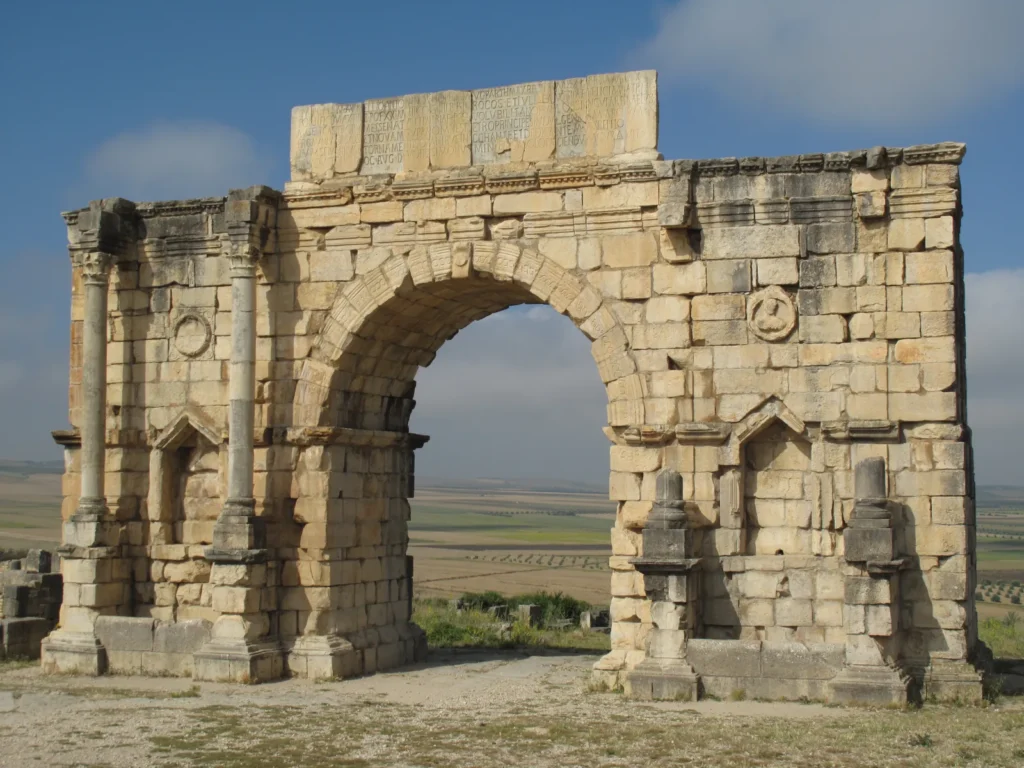
The triumphal arch was erected in 217 by the procurator Marcus Aurelius Sebastenus in honour of Emperor Caracalla and his mother Julia Domna; the inscription on the attic records this dedication. The medallions and side niches once held busts and fountains. The arch was restored between 1930 and 1934, which explains the paler colour of some blocks. Stand on the town side, facing the plain: the arch frames the farmland of the Saïss, the view that made the site famous.
The decumanus maximus and the mosaic houses
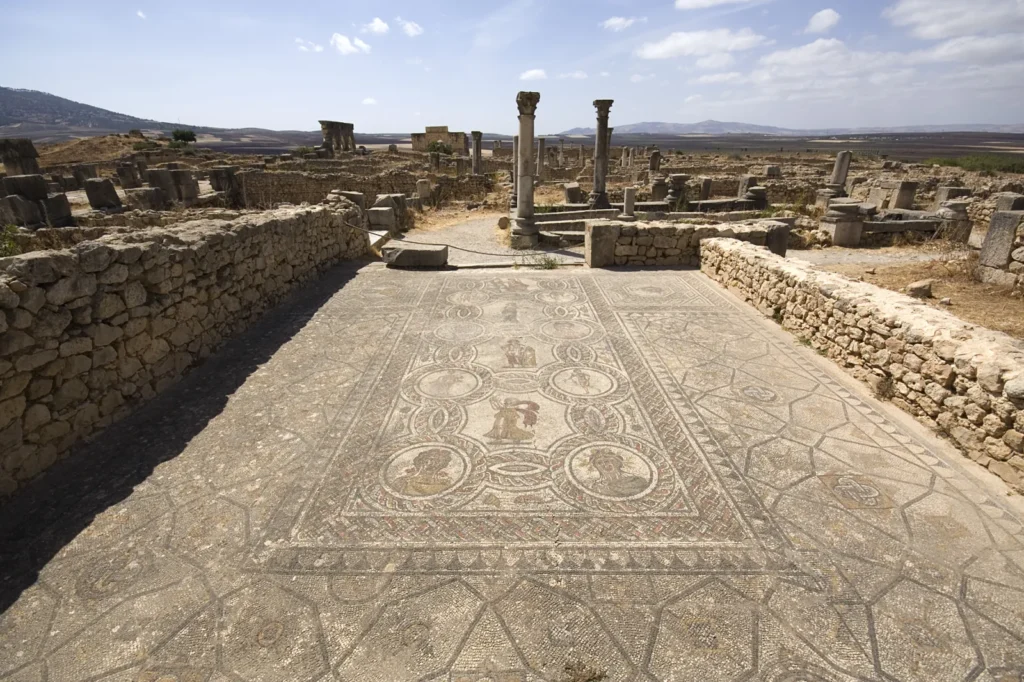
The decumanus maximus, the main street of a Roman town, starts at the arch and climbs north-east to the Tangier Gate. It was lined with porticoes sheltering shops, and behind those shops stretch the grand houses of the north-eastern quarter. This is the main reason for the visit: mosaics left in place, dated from the mid-1st century to the mid-3rd century. Look for the House of Orpheus, with its musician surrounded by animals and its dolphin pavement; the House of Dionysus and the Four Seasons; the House of the Procession of Venus, where the bust of Cato was found; the House of the Labours of Hercules, with 41 rooms over about 2,000 m², where the hero’s twelve labours appear in medallions; and the House of the Knight and the House of the Ephebe. The most fragile mosaics are roped off: stay on the paths.
The Tangier Gate and the so-called Palace of Gordian
At the end of the decumanus, the Tangier Gate, dated 168-169 like the wall, marks the exit towards Tingis, today’s Tangier. Heading back towards the arch, a vast colonnaded complex, traditionally called the Palace of Gordian and identified as the governor’s residence, lines the street. The return to the entrance along the top of the site gives a last view of Moulay Idriss, white on its hill, to the east.
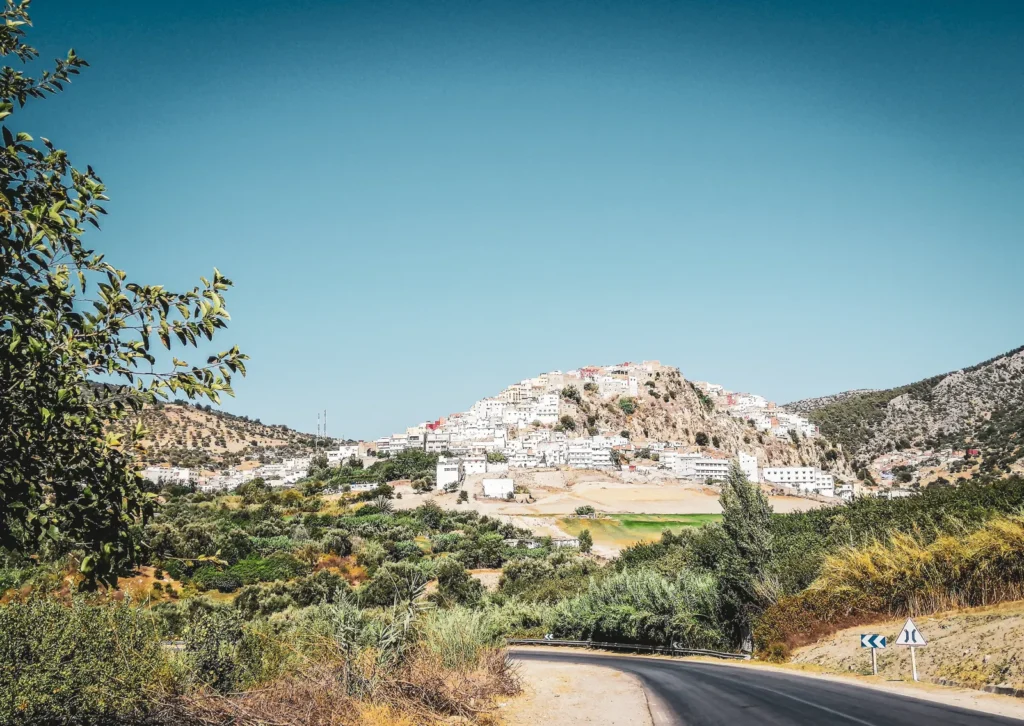
Moulay Idriss Zerhoun, the holy town of Idris I
Moulay Idriss Zerhoun is the town that grew up around the tomb of Idris I, who died in 791 and founded the Idrisid dynasty; it had 11,615 inhabitants at the 2014 census and remains one of Morocco’s main pilgrimage sites. Its mausoleum is closed to non-Muslims, but the town itself can be visited freely.
A town born from a tomb
Idris I died in 791, possibly poisoned on the orders of the Abbasid caliph Harun al-Rashid; he was buried at the foot of the Zerhoun and a qubba, a small domed structure built over a saint’s tomb, marked his grave. In 1318, under the Marinids, his remains were said to have been rediscovered. The present mausoleum owes much to Moulay Ismail, who had it demolished and rebuilt on a grand scale between 1719 and 1721; Sultan Moulay Abderrahmane enlarged it in 1822, and Sidi Mohammed had zellige added between 1859 and 1873, zellige being glazed ceramic tiles cut into small pieces. Kings Mohammed V and Hassan II had it redecorated after independence.
The town was closed to non-Muslims until 1912, and they were only allowed to stay overnight from 2005. A popular belief holds that several pilgrimages to Moulay Idriss are worth one pilgrimage to Mecca; the number five is often quoted. In 1995, Morocco placed the town on its tentative list for World Heritage.
What non-Muslims can see
The mausoleum complex occupies the saddle between the two hills. A wooden bar marks the threshold beyond which only Muslims may enter; non-Muslim visitors can look into the courtyard from the doorway, without photographing worshippers. Around it spreads a busy square selling candles, nougat and devotional objects, as well as grill stalls. For a non-Muslim, the real visit means climbing the lanes of the Khiber or Tasga quarter to the terraces from which you look down on the green-tiled roofs of the sanctuary.
The cylindrical minaret of the Sentissi mosque
Built in 1939 by a local man returning from pilgrimage, the minaret of the Sentissi mosque is the only cylindrical minaret in Morocco, where square towers are the rule. It is covered with green tiles bearing a Quranic verse in white Kufic script. It stands in the upper lanes; ask your way rather than following a hustler.
The moussem, an annual religious festival held around a saint’s tomb, draws thousands of pilgrims to Moulay Idriss, usually in late summer; its dates change every year. During those days the town is packed, the access roads are busy and taxis are scarce: a spectacle if you are looking for it, a constraint if you just want to visit.
What itinerary for a day at Volubilis and Moulay Idriss from Fes?
The most efficient plan is to leave Fes around 8 am, visit Volubilis from opening until 11 am, have lunch in Moulay Idriss and explore the town in the early afternoon, then head straight back or return via Meknès. In this order, you see the ruins before the heat and before the tour groups arrive.
- 8 am: leave Fes, from the Bab Boujloud car park or the station.
- 9:15-9:30 am: arrive at Volubilis, ticket, interpretation centre.
- 9:30-11:30 am: olive presses, forum, basilica, Arch of Caracalla, mosaic houses, Tangier Gate.
- 12 noon: a few minutes’ drive to Moulay Idriss; lunch on the mausoleum square.
- 1-2:30 pm: climb to the terraces and the minaret of the Sentissi mosque.
- 3 pm: drive back to Fes, or detour via Meknès for a late afternoon in the imperial city.
- 4:30-6 pm: arrive in Fes depending on the option chosen.
The Meknès option turns the day into a 9 to 10-hour loop. It makes sense if you had not planned to give the city a day of its own; otherwise, keep Meknès for another outing, described in our guide Meknès from Fes. If you are short of time, our 3-day Fes itinerary shows where to fit the trip without sacrificing the medina.
Heat, guide, dress: tips for visiting Volubilis
To visit Volubilis in good conditions, arrive at opening time, carry at least one litre of water per person, a hat and closed shoes, hire an official guide if you want to understand the mosaics, and wear clothing that covers shoulders and knees for the stop in Moulay Idriss.
Heat is the first thing to manage. Climate normals for Meknès give average highs above 34 °C in July and August, with considerably hotter days, and the site, on an open plateau, offers only the shade of a few olive trees and the basilica walls. Guides to the site warn of sometimes scorching summer heat. In spring, on the other hand, the plain is green, flowers grow between the paving stones and the light is ideal; it is the best season, along with October and November. In winter, the ground becomes slippery after rain.
Do you need a guide? The on-site signs are basic. On your own, you will see the monuments; with a guide, you will know which mosaic shows what and why the olive presses matter so much. A reasonable compromise: do the forum and the arch alone, then negotiate a guide for the northern houses. In Moulay Idriss, young men offer to show you around; if you accept, agree the price and duration before setting off.
Toilets are at the Volubilis entrance, and a food outlet operates near the ticket office, with no guaranteed hours. Bring cash in dirhams: the counter and the small shops of Moulay Idriss do not always accept cards.
Mistakes to avoid at Volubilis and Moulay Idriss
The most common mistakes are arriving at midday in summer, assuming the grand taxi drops you at the ruins, paying a fake guide in the car park, trying to enter the mausoleum of Idris I, and confusing the old price of 70 DH with the current price of 100 DH.
- Arriving between 12 noon and 3 pm from June to September. The ground reflects the heat; this is when people feel unwell.
- Assuming the shared taxi goes to the ruins. It stops in Moulay Idriss; plan for the walk or an extra ride.
- Walking on the mosaics. Some are open to the sky and unprotected; the ropes are not decorative.
- Photographing worshippers in Moulay Idriss. Photograph the roofs from the terraces, not the people at the sanctuary door.
- Coming on a Friday around midday. Prayer gathers the faithful around the mausoleum, and the square is less accessible to visitors.
- Attempting a half-day round trip. With 2 h 30 to 3 hours of driving, almost nothing is left for Moulay Idriss.
- Looking for the bronzes on site. The dog, Cato and Juba II are in Rabat.
Around Volubilis and Moulay Idriss Zerhoun
Around Volubilis and Moulay Idriss, the logical next stop is Meknès, Moulay Ismail’s imperial city about thirty kilometres to the south; the olive-covered hills of the Zerhoun massif are also good for walking, and the trip combines easily with the return to Fes or a departure towards northern Morocco.
Meknès gives meaning to what you saw at Volubilis: some of the Roman columns ended up in the sultan’s building works. The Zerhoun massif can be explored on foot along the tracks linking its villages; ask in Moulay Idriss which trails are passable before setting off, as there are no waymarks. For those continuing to the Rif, Volubilis already lies north-west of Fes, but the road to Chefchaouen in practice goes back through Fes or through Ouezzane: better to make it a separate stage. Finally, to plan the rest of your stay, our guide to things to do in Fes covers the medina’s sights.
FAQ about Volubilis and Moulay Idriss from Fes
How long does it take to get from Fes to Volubilis?
Allow 1 h 15 to 1 h 30 by car for about 65 to 70 km. By train, count 30 to 40 minutes to Meknès, then about 40 minutes by grand taxi to Moulay Idriss, plus the time spent waiting for the taxi to fill and the final leg to the ruins. For a comfortable day, leave Fes around 8 am and plan to be back in late afternoon.
What is the Volubilis entrance fee in 2026?
A ticket costs 100 DH for a foreign adult, according to the Ministry of Culture’s online ticket office. Foreign children aged 7 to 13 pay 50 DH, Moroccan or resident adults 30 DH and their children 10 DH. The 70 DH price still shown in many guidebooks is out of date. The official guide is paid separately, at the entrance.
Can you visit Volubilis and Moulay Idriss in half a day?
No, not comfortably from Fes. The round trip alone takes 2 h 30 to 3 hours; with 2 hours for the ruins and 1 h 30 for Moulay Idriss, the outing takes 6 to 7 hours at the very least. Half a day only works if you are staying in Meknès or in Moulay Idriss itself, thirty kilometres or less from the site.
Can non-Muslims enter Moulay Idriss?
Yes, the town is open to everyone and non-Muslims have even been allowed to stay overnight since 2005. The mausoleum of Idris I, however, remains reserved for Muslims: a wooden bar marks the threshold. Visitors look into the courtyard from the doorway, wander the lanes, see the cylindrical minaret of the Sentissi mosque and admire the green roofs from the terraces.
Do you need a guide at Volubilis?
It is not compulsory, but it helps with the mosaics. The signs on site are basic, and an official guide explains the scenes, the olive presses and how the town was organised. The INSAP-UCL project website quotes 120 DH for a guided tour; confirm the price at the counter and choose a guide wearing a badge rather than a tout in the car park.
What is the best season to visit Volubilis?
Spring, from March to May, is the best season: the plain is green, temperatures stay mild and the light flatters the stone. October and November are a good second choice. In July and August, average highs in the region exceed 34 °C on a site with no shade; if you come in summer, arrive at opening time.
Can you combine Volubilis, Moulay Idriss and Meknès in one day?
Yes, it is the programme most drivers offer from Fes. Allow 9 to 10 hours: Volubilis in the morning, lunch in Moulay Idriss, then two or three hours in Meknès before heading back. The day is packed; if you like to take your time, give Meknès a separate outing instead.
Are the finds from Volubilis displayed on site?
Only in part. The interpretation centre at the entrance displays ceramics, lamps, stelae and capitals, and most mosaics have stayed in place. The most famous bronzes, including the dog, the bust identified as Cato the Younger and the portrait of Juba II, are kept in Rabat, at the Museum of History and Civilisations.
Summary
The Volubilis and Moulay Idriss Zerhoun day trip from Fes fills a whole day: 1 h 15 to 1 h 30 of driving, 100 DH admission for a foreign adult, 2 hours in the ruins and 1 h 30 to 2 hours in the holy town. Leave early, start with the ruins, keep the afternoon for the lanes of Moulay Idriss and respect the threshold of the mausoleum. For the rest of your stay, our guide to sightseeing in Fes takes over.
Official sources
- UNESCO World Heritage Centre: Archaeological Site of Volubilis
- Moroccan Ministry of Culture: Volubilis archaeological site ticket office
- Volubilis Project by INSAP and University College London
- Moroccan National Tourist Office: archaeological treasures of Morocco
- ONCF: Fes-Meknès train timetables
This article is for information only. Prices, opening hours and access conditions at Volubilis and Moulay Idriss Zerhoun may change, particularly during the rehabilitation works: check them with the official sources before your visit.
Photo credits
Images: featured image « File:Arc de Caracalla à Volubilis (Maroc).jpg » — Mikolalain (CC BY-SA 4.0); « File:Volubilis mosaic Four Seasons.jpg » — Prioryman (CC BY-SA 3.0); « File:Moulay Idriss Zerhoun 1.jpg » — ZAINEB HACHAMI (CC BY-SA 4.0), via Wikimedia Commons.