Entry rules for Morocco are simpler than most travellers assume, but two misunderstandings persist among those departing the Benelux: believing an identity card will do, and expecting a form to fill in on board. The first is wrong, the second has not been true since 2019. This article covers specifically the case of Belgian and Dutch passports and departures from a Benelux airport; for the general question see our guide to Morocco visa and entry requirements.
In short: what you need to know
- No visa for stays of up to ninety days on a Belgian or Dutch passport.
- A passport is mandatory. An identity card is not accepted, even for a short break.
- No landing card any more. The paper form was abolished on 16 September 2019.
- Officers may still ask verbally where you are staying. Keep the address to hand.
- The dirham is a closed currency: import and export are capped at 2,000 MAD in banknotes.
- Foreign currency enters freely, but above the equivalent of 100,000 MAD a declaration is required if you want to take it out again.
- Morocco keeps GMT all year: one hour earlier than the Benelux in winter, two hours in summer.
Passport or identity card?
A passport. This is the most common reason for denied boarding on these routes: Morocco sits outside the European Union and outside the Schengen area, so the rules that apply within Europe do not apply here. A Belgian or Dutch identity card is not enough, however short your stay.
Check your passport well before departure, therefore, and not the evening before. If it has expired or is close to expiry, allow for your local authority’s processing time. The Dutch government publishes travel advice for Morocco, including document requirements, at nederlandwereldwijd.nl; Belgian travellers will find theirs at diplomatie.belgium.be. Always consult those sources shortly before departure, because document requirements can change.
Do I need a visa?
Not for stays of up to ninety days. Belgian and Dutch nationals fall under the exempted-nationalities regime and can enter Morocco on their passport alone. That covers tourism as well as family visits.
Two situations fall outside that exemption and need preparation. If you want to stay longer than ninety days, you must apply for an extension locally with the competent authorities; that is not a formality handled at the border. And if you are travelling to work or to study, a different regime applies from the tourist exemption. In both cases the Moroccan embassy or consulate in your country is the right point of contact, not your airline.
The landing card: abolished, yet still quoted
This is the point on which most travel guides lag behind. The paper embarkation and disembarkation card that had to be filled in on board for years was abolished on 16 September 2019. You are therefore no longer handed a form, and you do not need to ask for one.
What has remained: the border police may ask you verbally where you are staying. Keep the address of your hotel, riad or family to hand, on paper or on your phone. That is not a check to prepare for, but it saves time if you do not have to look up the answer while the queue waits behind you.
What happens on arrival
The arrival procedure at a Moroccan airport follows a fixed order. Knowing it tells you where the time goes.
| Step | What you need | Where the time goes |
|---|---|---|
| 1. Passport control | Passport, address of your stay | The longest wait, especially at peak hours |
| 2. Baggage reclaim | Baggage tag | Varies with the size of the airport |
| 3. Customs | Nothing, unless you carry declarable goods | Usually quick |
| 4. Transport into town | Cash or a pre-booked transfer | Varies with the airport |
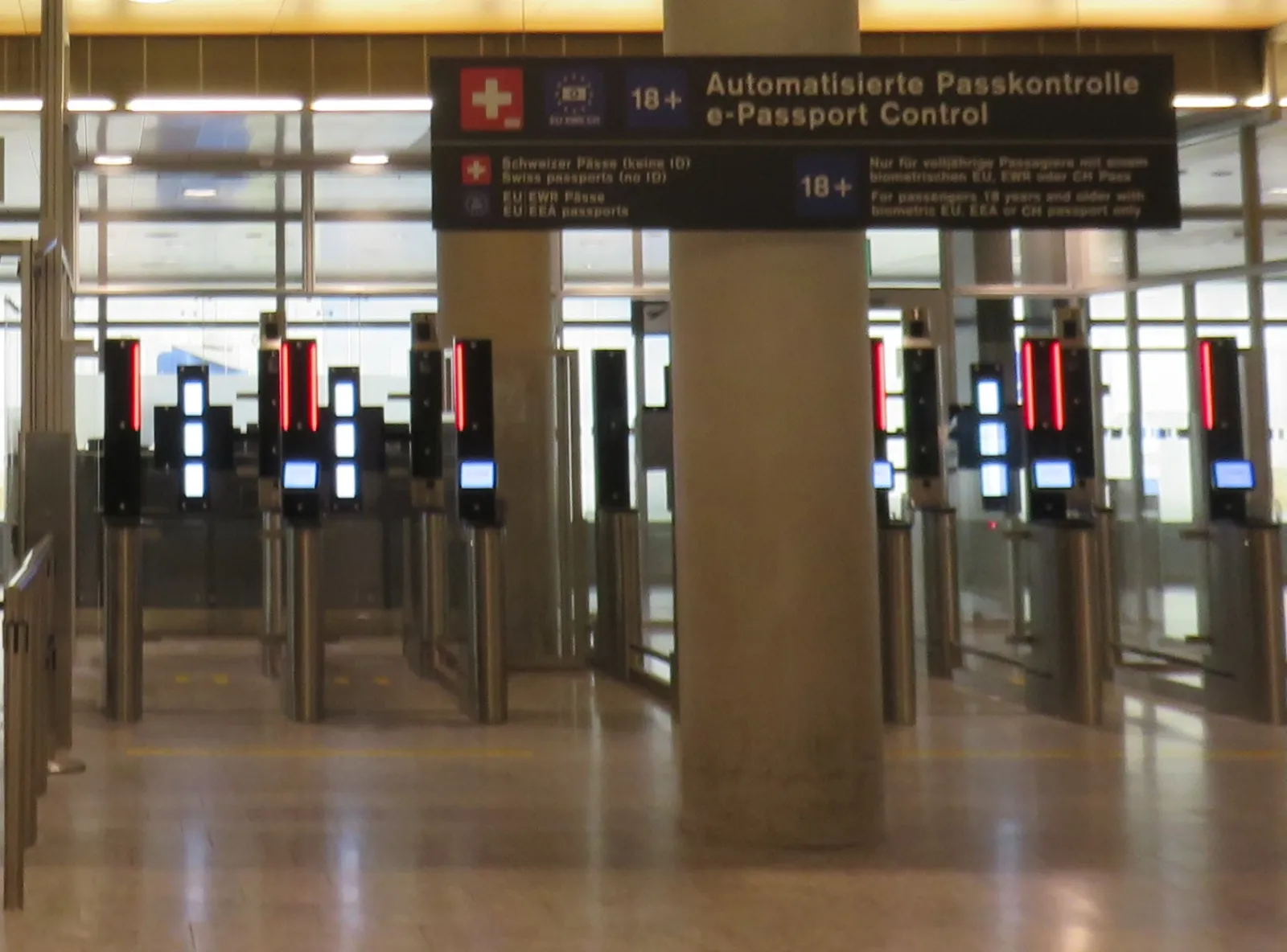
A growing number of Moroccan airports have automated gates. How they work, who may use them and what happens to the stamp in your passport is set out in our article on the biometric e-gates at Moroccan airports. Anyone wanting to shorten the wait at the border police will find the paid options in our guide to fast track at Moroccan airports.
Money: the dirham is a closed currency
This is the rule that surprises travellers most often, and it applies in both directions. The Moroccan dirham is a closed currency: you may carry no more than 2,000 MAD in banknotes into or out of the country. Buying dirhams in the Benelux before departure is therefore not a good plan, and at the end of your trip it is wise to spend your remaining notes or change them back.
- The dirham — import and export capped at 2,000 MAD in banknotes.
- Foreign currency — free to import, but above the equivalent of 100,000 MAD a declaration is required if you want to take the sum out again.
- Changing locally — at the airport, at a bank or at an authorised exchange office; keep your exchange receipt for changing back.
- Withdrawing — cash machines are widely available at the major airports and in the cities.
How paying works in practice, with withdrawals, exchange, card acceptance and the use of cash in the souks, is in our guide to money in Morocco.
What you may bring, and what you may not
Customs rules mainly matter to two groups of travellers: those bringing gifts for family, and those carrying medication. For gifts and new souvenirs a tolerance applies up to a total value of 2,000 MAD, with no commercial character. Above that, customs may levy import duty.
The full overview, with the categories and the borderline cases, is in what you can bring into Morocco. If you travel with medication, the rule is to carry it in its original packaging and preferably with a prescription or a letter from your doctor; the detail is in travelling with medication in Morocco. What belongs in your case by season is set out in our Morocco packing list.
Which documents for which situation?
The ninety-day exemption covers most trips, but not all. Below is what you need and where to arrange it, by situation. The principle: anything outside the tourist framework is arranged before departure with the Moroccan embassy or consulate, neither with your airline nor at the border.
| Situation | What you need | Where to arrange it |
|---|---|---|
| Holiday up to 90 days | Valid passport | Nothing to arrange |
| Family visit up to 90 days | Valid passport, address of your stay | Nothing to arrange |
| Longer than 90 days | Extension applied for locally | With the competent Moroccan authorities |
| Work or study | A regime separate from the tourist exemption | Moroccan embassy or consulate, before departure |
| Minor with both parents | The child’s own passport | With your local authority |
| Minor without both parents | Own passport plus a signed consent letter | Drawn up yourself, with a copy of the identity document |
One warning on the extension: this is not something you settle at an airport desk on your way out. Anyone exceeding ninety days without an extension runs into a procedure that can delay the trip considerably. Note your date of entry, therefore.
Travelling with children
A child needs its own passport; being listed on a parent’s passport no longer exists. If a minor travels without both parents, it is advisable to carry a signed consent letter from the non-travelling parent, together with a copy of their identity document. That is not a Moroccan requirement but a practical precaution: airlines and border authorities ask for it in practice, and without it a discussion can start that you do not want at the airport.
Check the current requirements for your situation with the official sources above, since they depend on your nationality and on parental responsibility. This is precisely the point on which you should not rely on a travel guide.
Health: what to arrange and what not
For a trip from the Benelux to Morocco no vaccinations are mandatory. That does not mean there is nothing to prepare: two points are worth checking before you book.
- Travel insurance — check that your policy covers outside the European Union, because many standard policies do not do so automatically. Morocco falls outside the European coverage area.
- Medication — carry it in its original packaging, preferably with a prescription or a medical letter. That avoids any discussion at customs and helps if you need a pharmacy locally.
- Vaccination advice — not mandatory, but personal. Ask your doctor or a travel clinic, particularly for a long stay or travel outside the cities.
- Your European health insurance card does not work — it applies within the European Union and therefore not in Morocco.
This article gives travel information and not medical advice: for your personal situation your doctor is the right source.
Time difference and planning
Morocco keeps GMT all year. Belgium and the Netherlands are on UTC+1 in winter and UTC+2 in summer. It is therefore one hour earlier in Morocco in winter and two hours in summer, and that does not change when European summer time begins.
In practice a morning departure gives you a full first day, because you land locally earlier than the clock on your phone in the Benelux would suggest. On the way back the effect reverses and the flight looks longer than it is — worth factoring in if you still have an appointment on the day you land.
Leaving Morocco
Exit formalities get less attention than arrival, but three points catch travellers out.
- Your remaining dirhams — you may carry no more than 2,000 MAD in banknotes. Spend the rest or change it back before you head to the airport, and keep your exchange receipt, which may be requested.
- Your purchases — rugs, ceramics and copperware may travel, but watch size and weight against your baggage conditions. For antiques an export certificate may be required.
- Time at the airport — during the holiday peaks the queues at passport control and security are longer on departure than on arrival, because all the European services leave within a short window.
Which airport has which facilities, and how much time to allow, is on our page covering the airports in Morocco.
Five mistakes to avoid
- Turning up at the airport with an identity card. The most common reason for denied boarding on these routes.
- Buying dirhams in the Benelux. The dirham is a closed currency; only 2,000 MAD may enter or leave.
- Waiting for a landing card. It has not existed since 16 September 2019.
- Not having the address of your stay to hand. Officers may ask for it verbally.
- Taking medication out of its packaging to save space. Carry it in the original packaging, with a prescription.
FAQ — Morocco entry requirements from the Benelux
Do I need a visa for Morocco on a Belgian or Dutch passport?
No, not for stays of up to ninety days. For a longer stay, work or study, a different regime applies.
Can I travel to Morocco on my identity card?
No. Morocco sits outside the European Union and outside Schengen; a passport is mandatory, even for a stay of a few days.
Do I still have to fill in a landing card?
No, the paper form was abolished on 16 September 2019. The border police may still ask verbally where you are staying.
How much money may I bring into Morocco?
Foreign currency enters freely, but above the equivalent of 100,000 MAD a declaration is required if you want to take the sum out again. Of the dirham itself you may bring in or take out no more than 2,000 MAD in banknotes.
Does my child need its own passport?
Yes. Being listed on a parent’s passport no longer exists. If the child travels without both parents, carry a signed consent letter.
What is the time difference with Morocco?
Morocco keeps GMT all year. It is therefore one hour earlier than the Benelux in winter and two hours earlier in summer.
Are vaccinations required for Morocco?
None are mandatory for a trip from the Benelux. Vaccination advice is personal, though, so ask your doctor or a travel clinic, particularly for a long stay or travel outside the cities.
In summary
Three things to remember: a passport, no visa up to ninety days, and no landing card. Carry the address of your stay, do not buy dirhams in advance, and check your document requirements shortly before departure with the official sources. Which airport to choose for your departure is set out in flights from the Netherlands to Morocco and in flights from Belgium to Morocco.
Image credits
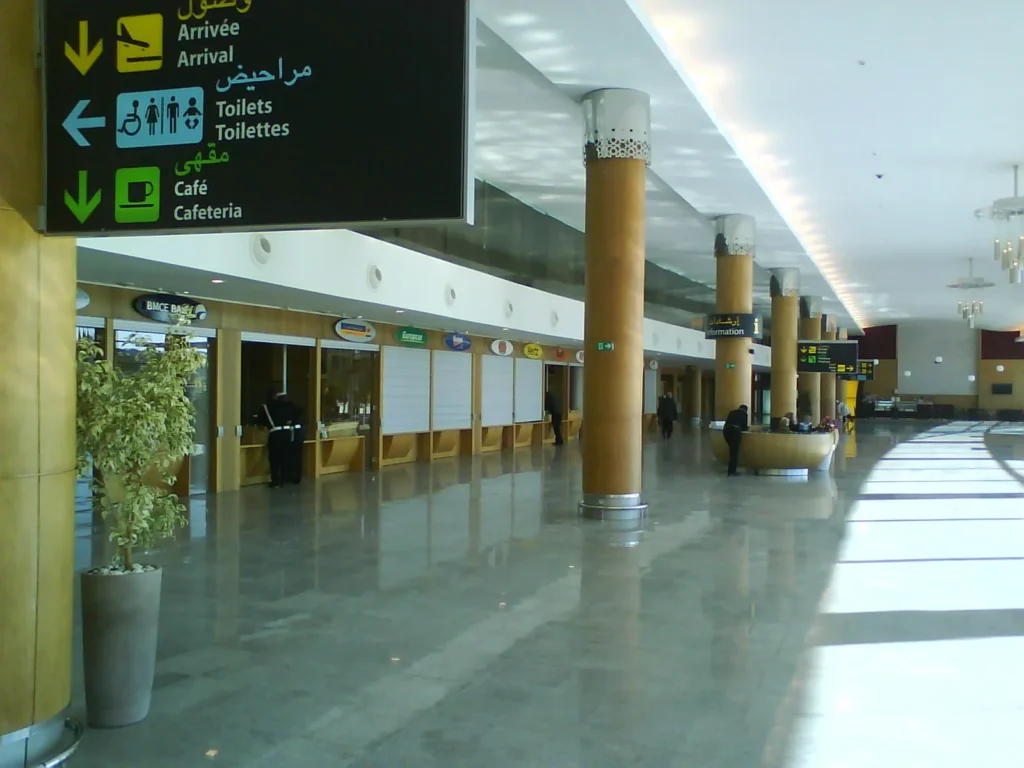
Images: featured image « MA Airport Rabat Sale New Terminal Hall » — Froik (CC BY-SA 3.0) ; « Zurich International Airport e-Passport control gates » — Zurich International Airport (CC BY-SA 4.0), via Wikimedia Commons.