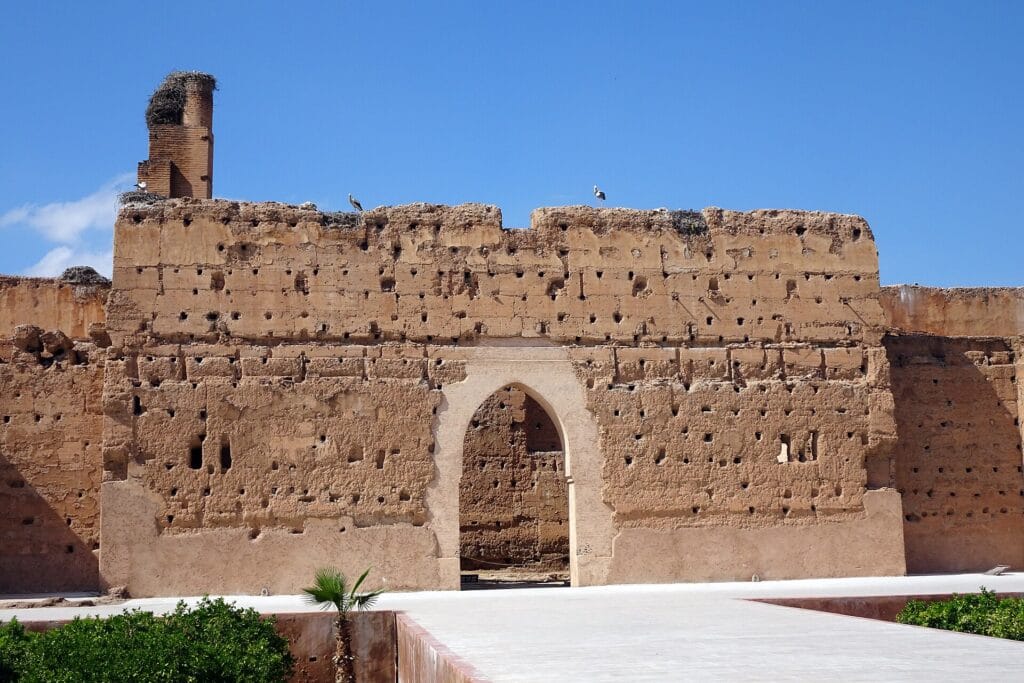
The El Badi Palace is one of Marrakech’s most spectacular monuments: vast open-air ruins, the remains of a 16th-century Saadian palace built by Sultan Ahmad al-Mansur to be “the Incomparable.” Today, you wander through a giant rectangular courtyard, a central pool, sunken orange groves and high ramparts crowned with stork nests. You can also admire the famous minbar of the Koutoubia, a medieval masterpiece. Allow about an hour for the visit, at a modest entrance fee. Here is everything you need to know before discovering this jewel of Moroccan heritage.
In brief: the essentials about the El Badi Palace
- Era: Saadian dynasty, late 16th century (construction launched in 1578).
- Patron: Sultan Ahmad al-Mansur ad-Dhahbi, to celebrate his victory of 1578.
- Current state: majestic open-air ruins, dismantled around 1696 by Moulay Ismail.
- Must-see: the minbar of the Koutoubia, a 12th-century masterpiece displayed on site.
- Visit duration: about 1 hour (1.5 hours if you linger on the ramparts).
- Indicative price: modest entrance ticket; a possible surcharge for the minbar pavilion.
History of the El Badi Palace and the Saadian context
To understand the El Badi Palace, you have to go back to the golden age of the Saadian dynasty, which ruled Morocco from the 16th to the 17th century and made Marrakech its radiant capital. On 4 August 1578, at the so-called Battle of the Three Kings (or Battle of the Oued el-Makhazen, near Ksar el-Kebir), the Moroccan army crushed the Portuguese forces of King Sebastian I, who died there along with two other sovereigns. This resounding victory marked a turning point: it asserted Morocco’s independence and filled the state coffers thanks to the considerable ransoms paid to free the high-ranking Portuguese captives.
It was in this context of triumph that the new sultan, Ahmad al-Mansur — nicknamed “ad-Dhahbi,” the Golden — launched the construction of a palace intended to dazzle the world as early as 1578. The works spread over nearly sixteen years and were completed around 1593–1594. Al-Mansur, a lavish sovereign and skilful diplomat, maintained relations with Europe and the Ottoman Empire; his palace was meant to embody the power and prestige of a Morocco restored to greatness. The complex was part of the royal Kasbah, the district of power located to the south of the medina, away from the bustle of Jemaa el-Fna square.
The El Badi Palace was not an everyday residence but a ceremonial palace, a theatre of power. There the sultan held grand receptions and welcomed foreign ambassadors in a setting designed to take the breath away and to remind them, without a word, of the wealth and legitimacy of Saadian Morocco. It is said that the splendour of the place — water features, marbles, gold and perfumes — served diplomacy as much as piety: the palace was part of a staging of dynastic prestige. This representative function explains the vast scale of the whole and the extraordinary care given to the smallest decorative detail.
Why “the Incomparable”? The meaning of the name El Badi
The name “El Badi” (or El Badii Palace) is anything but trivial. “Al-Badi,” translated as “the Incomparable” or “the Marvellous,” is one of the 99 names of God in Islamic tradition: it designates the Creator who brings forth unprecedented wonders. Giving this name to a palace was a declaration of boundless ambition: this place aspired to be without equal in the world, a manifesto of refinement intended to impress the ambassadors and dignitaries received by the sultan.
A famous anecdote, often told by guides, illustrates the fate of the monument. On the day of the inauguration, Sultan al-Mansur is said to have asked the opinion of a jester or a mystic of the court; the latter reportedly replied that the palace would make “a fine heap of ruins.” The prophecy, whether unintentional or not, came true a century later. Even today, contemplating these bare walls conveys the measure of the original extravagance: the very emptiness of the site tells of its lost splendour.
Original architecture and materials of the El Badi Palace
At its height, the El Badi Palace displayed a luxury that the chroniclers of the time struggled to describe. The whole was organised around an immense rectangular courtyard about 135 metres long and 110 metres wide — colossal dimensions that still strike visitors today. At its centre stretched a vast ceremonial pool of about 90 by 20 metres, framed by four sunken beds planted with orange trees and several secondary basins. According to the sources, the palace is said to have had up to around 360 rooms arranged around the courtyard.
The sultan had the most precious materials brought from around the Mediterranean basin and beyond. Records mention the use of Italian marble — notably the famous white Carrara marble — of onyx in many shades, of chiselled stucco, of zellige (faience mosaics), of cedar-wood ceilings enhanced with gold, as well as imported columns and facings. Tradition holds that the marble was paid for by weight: an equal quantity of Moroccan sugar, then a commodity of great value, exchanged for the Italian marble. Around the courtyard stood sumptuous pavilions, including the Koubba el-Khamsiniya (“pavilion of the fifty”), so named in reference to its fifty columns or its proportions. The result blended Andalusian, Moorish and Eastern influences in a dazzling synthesis.
The dismantling by Moulay Ismail
The splendour of the El Badi Palace barely outlived the dynasty that had built it. After the decline of the Saadians, it was the Alaouite dynasty that took power. Around 1696, Sultan Moulay Ismail, founder of a new imperial capital at Meknes, ordered the methodical dismantling of the palace. For about a decade, workers and craftsmen removed, transported and reused marble, onyx, doors, columns and precious woodwork to adorn the monuments of his own city.
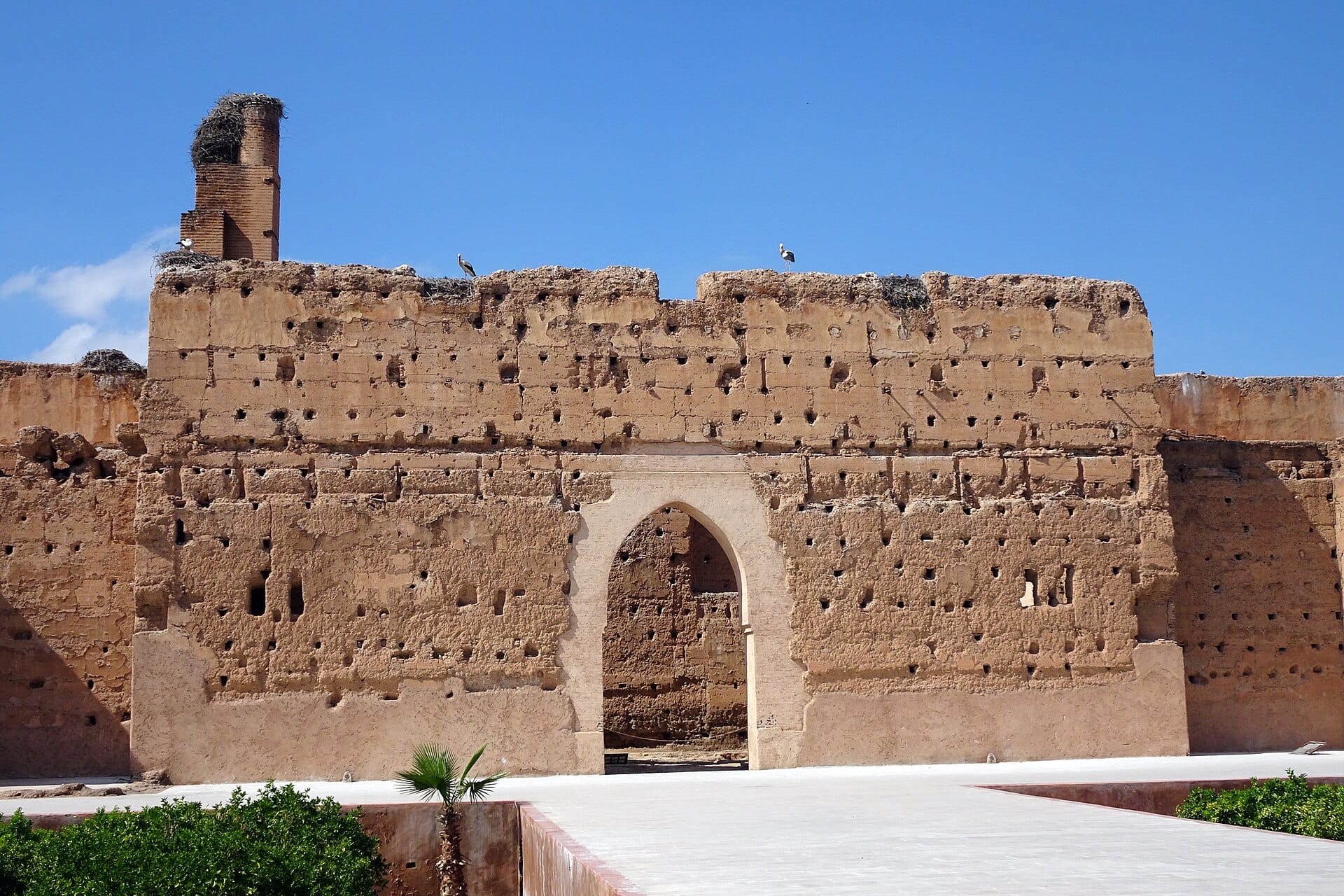
This stripping, as political as it was practical, was also intended to symbolically turn the Saadian page. Of the “Incomparable,” soon only the thick rammed-earth walls, the foundations and the framework of the great courtyard remained. Far from erasing the memory of the place, this deliberate ruin paradoxically created the striking landscape that visitors see today: bare ramparts bathed in light, where the imagination reconstructs the vanished pomp. Archaeological excavations, notably carried out in the 1950s, made it possible to reveal the general plan and to better understand the layout of the palace.
Timeline of the El Badi Palace
To grasp at a glance the major stages in the history of the El Badii Palace, here is a concise timeline of the key dates, from the founding victory to the modern excavations.
| Date | Event |
|---|---|
| 1578 | Battle of the Three Kings (Oued el-Makhazen); launch of construction |
| 1578–1594 | Palace construction site under the reign of Ahmad al-Mansur |
| around 1593–1594 | Completion of the “Incomparable” palace |
| around 1696 | Dismantling ordered by Moulay Ismail for Meknes |
| 1950s | Archaeological excavations revealing the general plan |
| Today | Historic site open to visitors and a cultural venue |
What can you see at the El Badi Palace today?
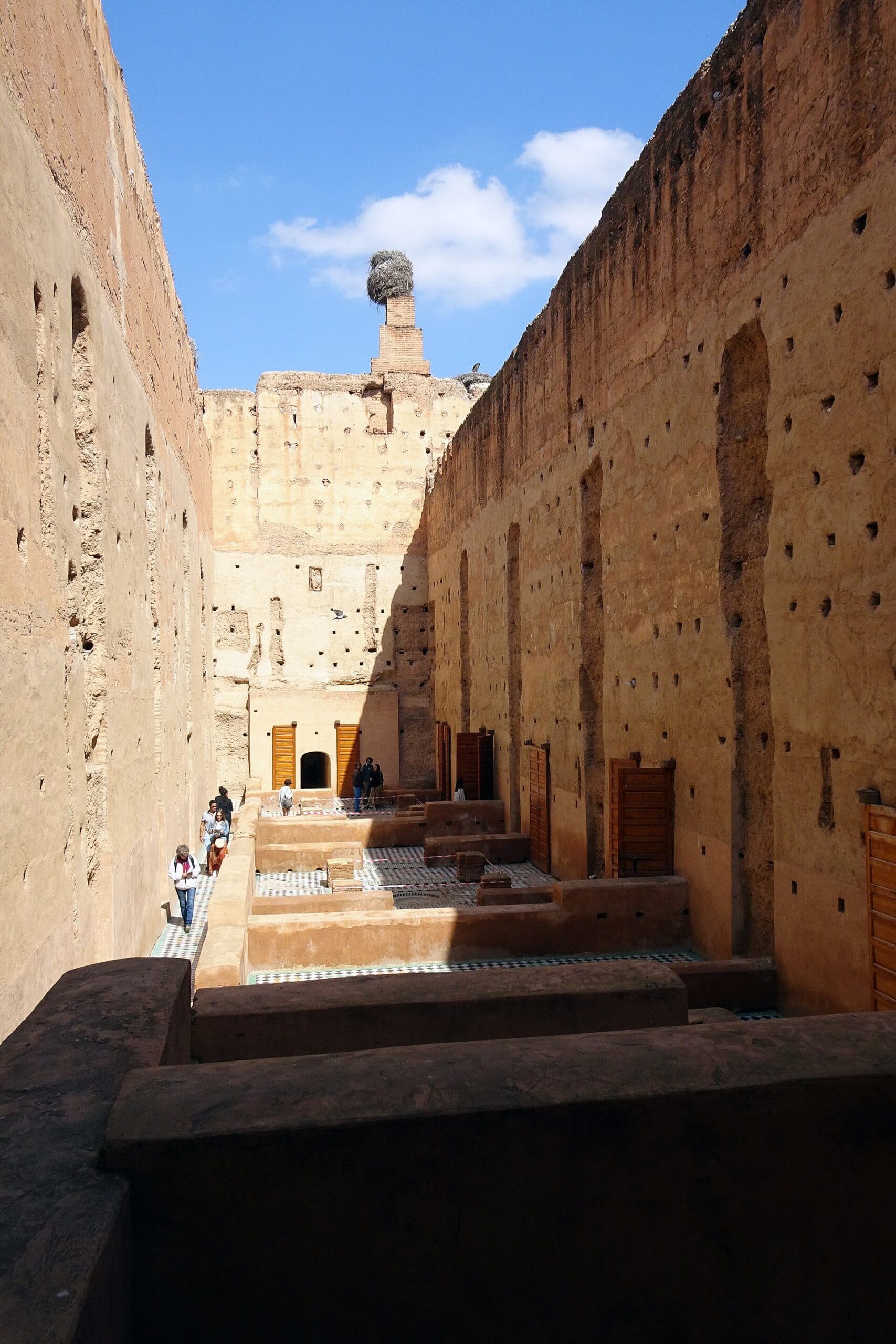
Visiting the El Badi Palace in Marrakech is above all an experience of space and scale. Once past the entrance, you emerge onto the immense central esplanade, whose proportions take your breath away. Here are the elements not to be missed:
- The great courtyard: the rectangular esplanade, framed by ochre rammed-earth walls, gives a sense of the sheer scale of the Saadian project.
- The central pool: the immense body of water, often partly filled, reflects the sky and the ramparts, offering superb perspectives.
- The sunken groves: beds planted with orange trees, set below the level of the courtyard, recall the palace’s former landscaped layout.
- The pavilions and remains: the sites of the former ceremonial pavilions, including the Koubba el-Khamsiniya, and secondary basins.
- The underground passages and old stables: in places, you can glimpse galleries and basement spaces that structured life in the complex.
- The minbar pavilion: a hall houses the precious minbar of the Koutoubia (see below).
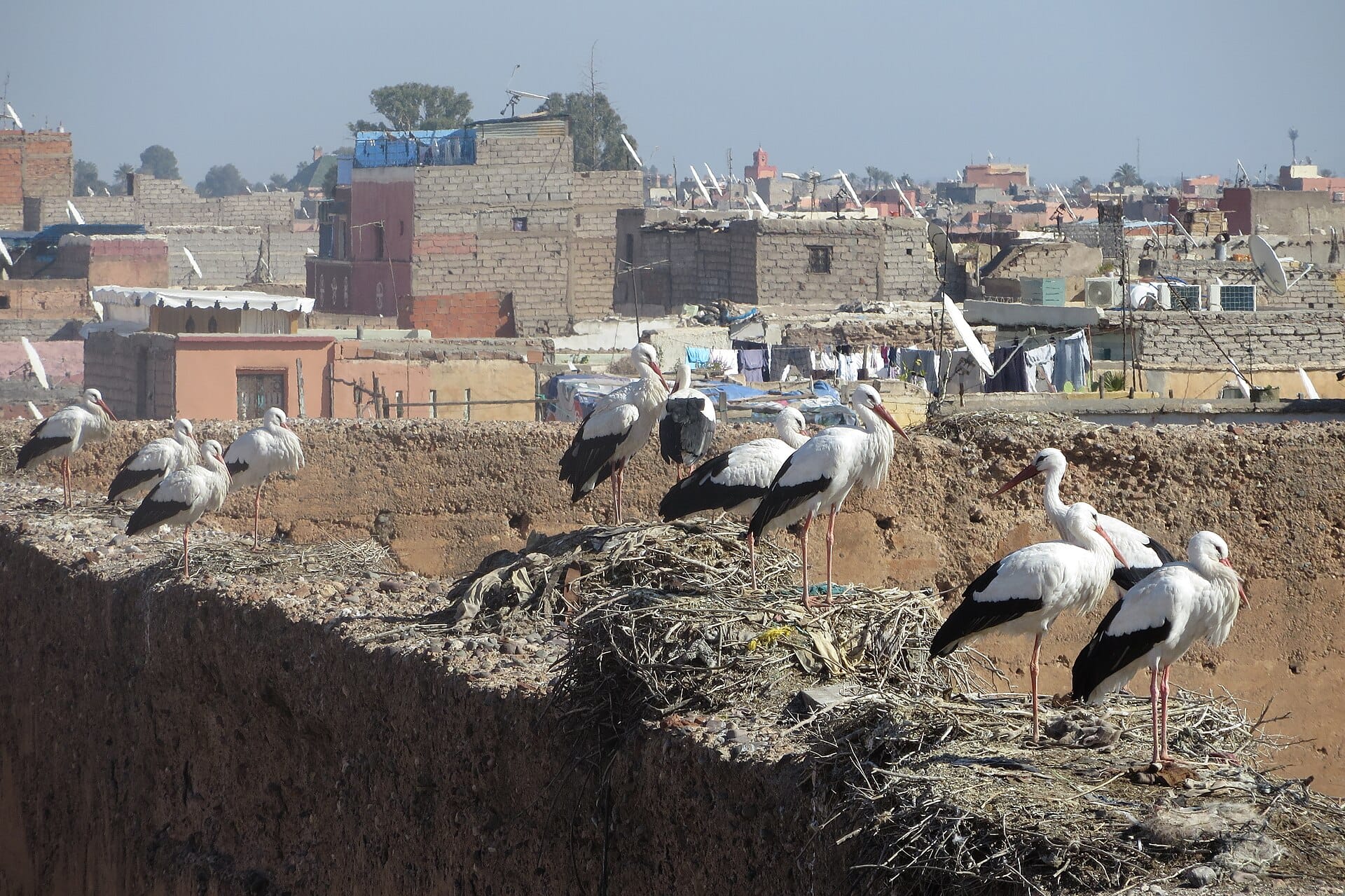
The contrast between the bare, mineral walls and the blue sky, punctuated by the flight of storks, gives the place an atmosphere at once grand and serene, very different from richly decorated palaces such as the Bahia Palace. It is precisely this austerity that gives El Badi its emotional power: where other monuments show everything, this one invites you to imagine. Here you feel the passage of time, greatness and its fall, in a silence disturbed only by the clatter of storks’ bills and the footsteps of visitors on the packed earth.
The minbar of the Koutoubia, a masterpiece displayed at the El Badi Palace
One of the most precious treasures on view at the El Badi Palace is not Saadian at all: it is the minbar (the preaching pulpit) of the Koutoubia mosque. This 12th-century masterpiece, commissioned in the Almoravid period and made by Andalusian craftsmen (tradition links it to workshops in Cordoba), is considered one of the pinnacles of woodworking art in the medieval Islamic world.
This stepped structure, long used in the great Koutoubia mosque, is a marvel of marquetry: thousands of finely assembled pieces of precious wood and bone compose geometric patterns and arabesques of dizzying complexity. Restored and then placed in safekeeping, the minbar is today presented in a dedicated pavilion of the palace, often for a small surcharge on the entrance ticket. Taking the time to examine it closely is to grasp the extreme refinement that Moroccan craftsmanship could reach more than eight centuries ago.
The presence of this minbar at the El Badi Palace is no accident: it links two great eras of Marrakech, the Almoravid peak that saw the birth of the Koutoubia and the Saadian golden age that built the palace. For the curious traveller, discovering the pulpit here and then looking up towards the minaret of the Koutoubia, a few hundred metres away, weaves a tangible thread between the dynasties that shaped the city. It is also a chance to appreciate how well Moroccan heritage has, across the centuries, preserved and passed on its masterpieces.
Climbing the ramparts and watching the storks
One of the great pleasures of the visit is to take the ramps and stairs leading to the top of the ramparts. From up there, you take in the whole great courtyard, the pool and the groves in a single glance, and you suddenly grasp the scale of the El Badii Palace. The view extends beyond the walls: you can make out the rooftops of the Kasbah, the neighbouring minarets and, on a clear day, the silhouette of the snow-capped Atlas on the horizon.
The ramparts are also the kingdom of the storks. These large wading birds have taken up residence atop the walls, where they build imposing nests of branches. Watching them clatter their bills, take off and glide over the ruins is part of the place’s unique charm. In Morocco, the stork enjoys an affectionate status in popular imagination, and its presence adds to the peaceful, timeless atmosphere of the site. Remember to look up and to have your camera ready: it is one of the most photogenic scenes in Marrakech.
Opening hours, prices and tickets for the El Badi Palace
The El Badi Palace can be visited every day of the week. The most commonly indicated hours are continuous opening from morning until late afternoon (generally around 9 a.m. to 5 p.m.), with a last admission shortly before closing. The entrance fee remains modest given the interest of the site, with the usual reductions for children as well as specific rates for Moroccan citizens and residents. Visiting the pavilion housing the minbar of the Koutoubia may require a separate ticket or surcharge.
| Practical information | Indicative detail |
|---|---|
| Opening days | Every day |
| Hours (indicative) | Approx. 9 a.m. – 5 p.m. (last entry before closing) |
| Entrance fee | Modest ticket; reduced rates for children and residents |
| Minbar of the Koutoubia | Surcharge or separate ticket possible |
| Recommended visit duration | About 1 hour (1.5 hours with the ramparts) |
| Location | Kasbah district, south of the medina |
As hours and prices can change (public holidays, festival periods, administrative changes), we recommend checking the up-to-date information before your visit. Bring some change and, in high season, arrive early to enjoy the calm.
How to get to the El Badi Palace and where it is located
The El Badi Palace is located in the historic Kasbah district, to the south of the Marrakech medina, about 900 metres south-east of Jemaa el-Fna square. From this iconic square, allow about fifteen minutes’ walk through the lively alleyways, heading towards the royal quarter. The site is close to the current royal palace and to the Kasbah mosque, whose minaret is easy to spot.
- On foot: about 15 minutes from Jemaa el-Fna, following the direction of the Kasbah.
- By taxi: the petits taxis drop you off near Place des Ferblantiers, a stone’s throw from the entrance.
- Landmarks: the palace adjoins the Kasbah district and lies not far from the famous Saadian Tombs.
The Marrakech medina, of which this district is part, is a UNESCO World Heritage Site, a testament to the exceptional value of its monumental ensemble.
El Badi today: a living, cultural place
While the El Badi Palace no longer has a residential function, it is far from a frozen site. Its vast open-air spaces make it a remarkable setting for cultural events. Over the years, the venue has notably hosted gatherings linked to Morocco’s heritage and popular arts, the immense courtyard offering a natural stage of rare power. This contemporary role extends, in a way, the ceremonial vocation intended by al-Mansur: the palace remains a showcase for celebrating Moroccan prestige and culture.
For the visitor, this means that El Badi is not merely a ruin to contemplate: it is a space that breathes, where light, vegetation, birds and sometimes music bring the old stones to life. Depending on the period, access to certain areas may be temporarily adjusted because of events; ask locally if you visit during a particular happening.
Combining the visit: Saadian Tombs, Bahia and Kasbah
The great advantage of the El Badi Palace is its position at the heart of a district rich in monuments, which lets you string together several visits in half a day. Just a few hundred metres away are the Saadian Tombs, the necropolis of the same dynasty and an ideal historical complement: after seeing where Sultan al-Mansur held his receptions, you discover where he rests.
Continuing north, you easily reach the Bahia Palace, whose richly decorated interiors offer a striking contrast with the bare ruins of El Badi. Architecture lovers can also plan the superb Ben Youssef Madrasa, a little further north in the medina. To organise your whole stay, our Marrakech in 3 days itinerary weaves these essentials into a coherent route, and our complete guide to things to do in Marrakech places the palace within the full range of the city’s sights.
Photo tips and the best time to visit
To make the most of the El Badi Palace, the choice of time of day is decisive. Early morning offers soft light, active storks and, above all, fewer visitors: ideal for photographing the great courtyard without the crowds. Late afternoon, meanwhile, bathes the rammed-earth walls in a warm, particularly flattering golden light, while the pool can reflect the sky in fine conditions.
- Best light: early morning or late afternoon (raking, golden light on the rammed earth).
- Vantage point: climb the ramparts for an overall view of the courtyard and the pool, with the Atlas in the background on a clear day.
- Storks: frame the nests on the walls and watch for take-offs for lively shots.
- Reflections: get close to the pool when it is filled to capture the symmetries.
- Comfort: bring a hat, water and sunglasses; the site is very exposed and offers little shade.
As for the season, spring (March to May) and autumn (September to November) offer the most pleasant conditions, with mild temperatures and beautiful light. Summer can be very hot on this shadeless site: in that case, favour the first hours after opening.
Frequently asked questions about the El Badi Palace
Who built the El Badi Palace?
The El Badi Palace was built by the Saadian sultan Ahmad al-Mansur ad-Dhahbi, starting in 1578, to celebrate his victory at the Battle of the Three Kings (Oued el-Makhazen) against the Portuguese. The works were completed around 1593–1594.
Why is the El Badi Palace in ruins?
Around 1696, the Alaouite sultan Moulay Ismail had the palace dismantled over about a decade to recover its precious materials (marble, onyx, gilded woodwork) and build his new capital at Meknes. Only the walls and the framework remain, forming today’s ruins.
What does the name “El Badi” mean?
“Al-Badi” means “the Incomparable” or “the Marvellous.” It is one of the 99 names of God in Islamic tradition. The name reflected the sultan’s ambition to build a palace without equal in the world.
How long does it take to visit the El Badi Palace?
Allow about an hour for a leisurely tour of the courtyard, the pool and the groves, and up to 1.5 hours if you climb the ramparts and go to see the minbar of the Koutoubia.
Can you see the minbar of the Koutoubia at the El Badi Palace?
Yes. The minbar (pulpit) of the Koutoubia mosque, a 12th-century marquetry masterpiece from the Almoravid period, is displayed in a pavilion of the palace. Access to it may require a small surcharge on the entrance ticket.
Is the El Badi Palace worth visiting?
Absolutely. Despite its ruined state, El Badi impresses with its monumental proportions, its rampart-dwelling storks, its panoramic views and its exceptional minbar. It combines perfectly with the nearby Saadian Tombs and Bahia Palace.
Conclusion
The El Badi Palace in Marrakech is far more than a field of ruins: it is an open-air history book, where the power of the Saadian dynasty and its builder-sultan still resonates. From the great courtyard to the central pool, from the orange groves to the stork-crowned ramparts, by way of the minbar of the Koutoubia, every corner tells of the rise of an empire and the fragility of human glory. Easy to combine with the other jewels of the Kasbah, El Badi fully deserves its place in any stay in Marrakech.
Editorial independence: this article is purely informative and independent. The hours, prices and access arrangements are given for indication only and may change; we invite you to check the up-to-date official information before your visit.
Images under free licence via Wikimedia Commons: © Alacoolwiki (CC BY-SA 4.0); © aconcagua (talk) (CC BY-SA 3.0); © Alacoolwiki (CC BY-SA 4.0). Sources: UNESCO and Wikipedia.