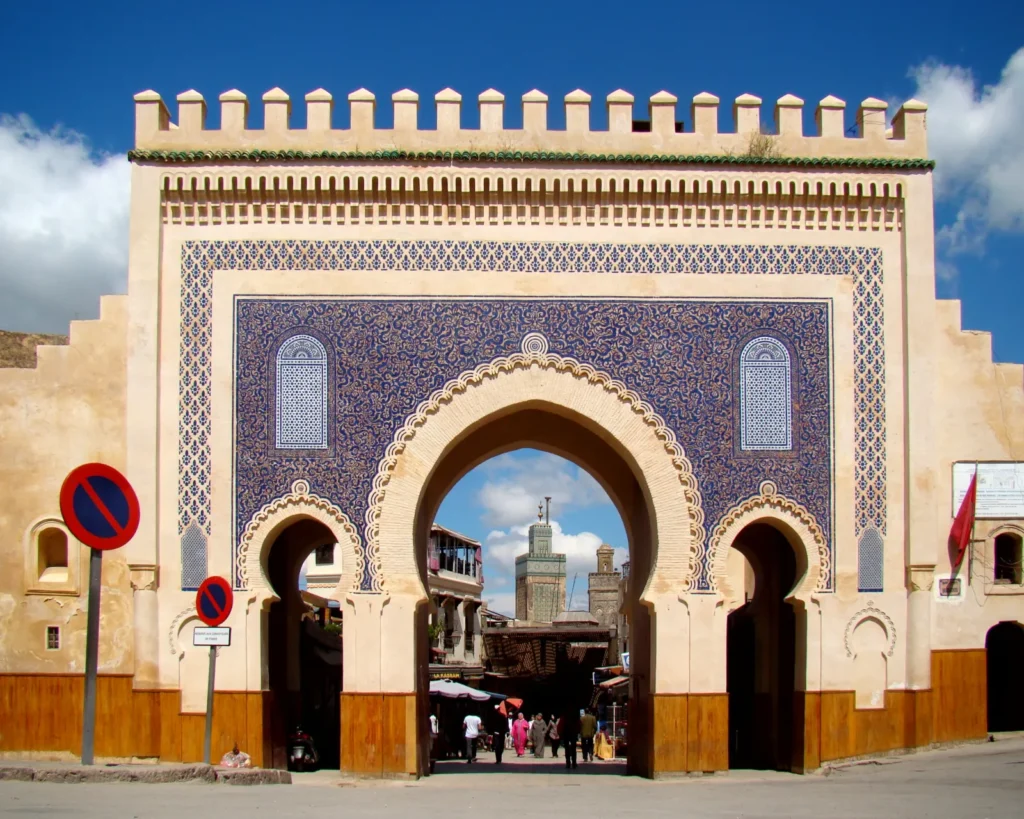
Bab Boujloud, the Blue Gate of Fes, is the monumental western entrance to the Fes el-Bali medina: a triple horseshoe arch built in 1913, at the very start of the French protectorate, faced with blue ceramic tiles on the outside and green tiles on the medina side, opening straight onto the two main streets of the old city, Talaa Kebira and Talaa Seghira. You can walk through it free of charge, day or night, and it is the easiest starting point for a first visit to Fes (also spelled Fez).
This page is only about the gate and its immediate surroundings: its real history, more recent than most visitors think, how to read its facade, the square in front of it, the two streets that start behind it, the classic traps around it and the best times to photograph it. To plan the rest of your stay, our guide to things to do in Fes brings together all the city’s highlights.
At a glance
- The current Bab Boujloud gate dates from 1913: it was commissioned by the administration of the French protectorate, established in 1912, to give the medina a grander entrance.
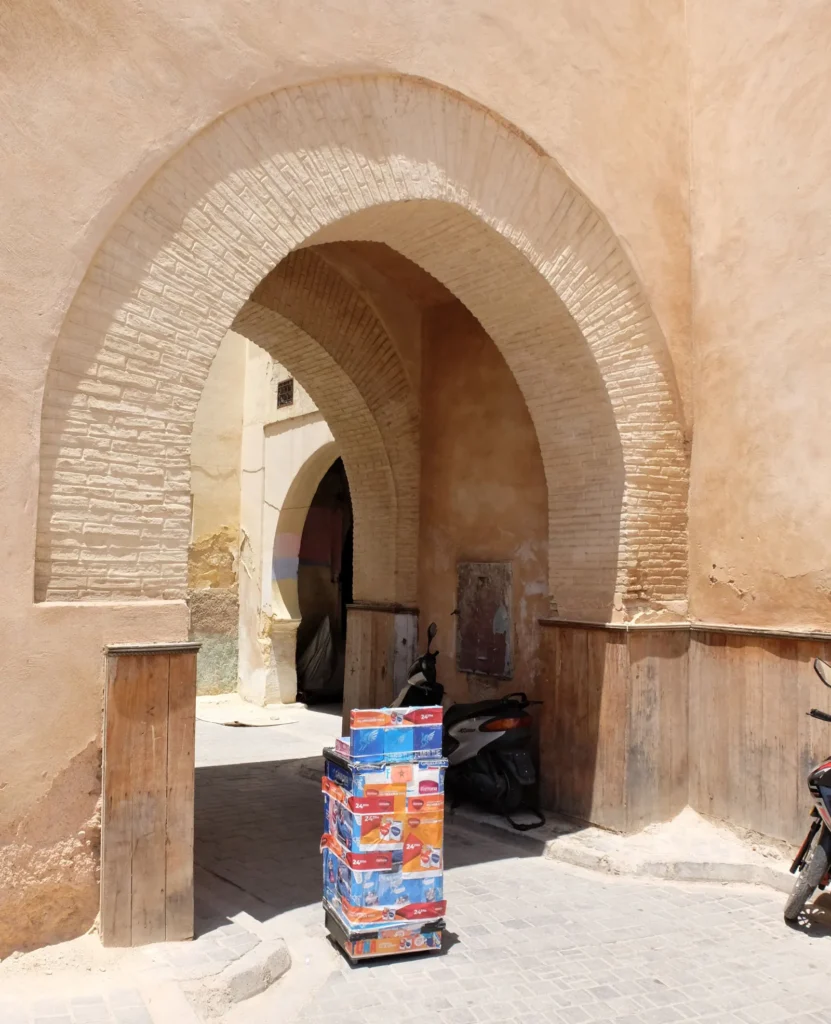
- An older and far more modest gate, thought to date essentially from the 12th century, still stands just to the left when you face the gate from the square; it is closed off today.
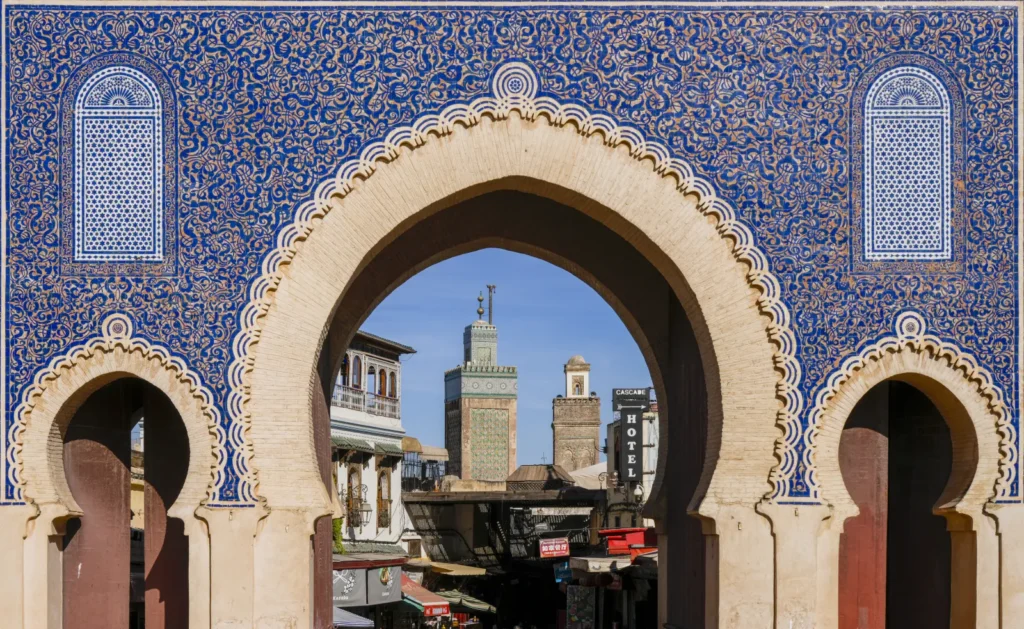
- The facade facing outwards is dominated by blue, the one facing the medina by green; both are covered in glazed tiles with geometric and floral patterns.
- The name is thought to come from Abu al-Junud, “father of the troops”, a reference to the former military parade ground now occupied by Place Boujloud, also called Place Pacha el-Baghdadi.
- Through the central arch you can see the minarets of the Bou Inania Madrasa and the Sidi Lazzaz Mosque, a two-minute walk away.
- Behind the gate begin Talaa Kebira and Talaa Seghira, which run downhill towards the Qarawiyyin quarter; beyond the square, cars can go no further.
- Access is free at any hour; the gate is part of the Medina of Fez, a UNESCO World Heritage Site since 1981.
History of Bab Boujloud: a 1913 gate on a medieval threshold
Many visitors leave convinced they have walked through a thousand-year-old gate. They have not, and that is precisely what makes Bab Boujloud interesting. The gate that circulates on social media is just over a century old. The spot itself, however, has been a threshold of the city since the Middle Ages, and you can still see, side by side, the medieval entrance and its 20th-century replacement.
The name: from “father of the troops” to Boujloud
The name is much older than the current gate. The explanation most often accepted by the city’s historians sees it as a popular corruption of Abu al-Junud, “father of the troops”. It would refer to the vast open space in front of the gate, long used as a parade and military mustering ground. Spellings vary a great deal: Boujloud, Bou Jeloud, Bou Jloud, Bab Bou Jeloud; in Arabic you will also read “Bab Abi al-Junud”. All refer to the same gate and, by extension, to the surrounding neighbourhood, which is also home to the Bou Inania Madrasa.
The old gate, bent and defensive
Before 1913, people came in through a simple gate that may date essentially from the 12th century, when the Almohads reshaped the fortifications of Fes. It did not open in line with the street: its passage ran parallel to the wall, so that you emerged sideways, on the south side, into Talaa Kebira. This bent layout, common in Morocco’s old gates, slowed down attackers and made it easier to control who came in. The old gate is still there, to the left of the Blue Gate as you arrive from the square. It is closed, but its large brick arch, with no tilework at all, shows what the medina’s entrances looked like before the protectorate. Take a minute to look at it: comparing it with its neighbour tells you everything about the intentions of 1913.
The building works of 1912-1913
The French protectorate was established in 1912. The new administration took over the running of Fes and wanted a grander entrance to the old city. In December 1912, the head of municipal services, Captain Mellier, drew up plans for a new opening in the walls. This meant buying and then demolishing a stable and three shops. Those shops, however, belonged to a religious endowment (habous, or waqf) whose revenues they provided, so the operation required delicate negotiations before work could proceed. The gate was completed in 1913. Its architect is not known for certain; he was probably French, and the ceramic decoration reflects Moroccan craftsmanship.
There is a paradox here that should not be glossed over. The most photographed gate in Fes, which has become the symbol of the medina, is a creation of the colonial era. Yet it was executed in a perfectly mastered Moroccan vocabulary, and the people of Fes adopted it long ago. It does not betray the medina: it has become its shop window. As proof of its fame, the Morocco pavilion at Epcot, in Florida, reproduces a version of it to mark the passage between its “new town” and its “medina”.
| Period | Event linked to Bab Boujloud and its surroundings |
|---|---|
| 12th century (probable) | A simple gate with a bent entrance opens the west side of Fes el-Bali onto Talaa Kebira. |
| 1203-1204 | Under the Almohad ruler Muhammad al-Nasir, the fortifications are rebuilt; Bab Mahrouk, on the north-west corner of the square, dates from this campaign. |
| 1350-1355 | The Marinid sultan Abu Inan Faris builds the Bou Inania Madrasa, whose minaret is now seen through the arch. |
| 1873-1894 | Reign of Moulay Hassan I: a wall links the two cities for the first time, and the Jnan Sbil gardens take on their royal form. |
| 1912 | The French protectorate is established; in December, Captain Mellier designs a new entrance. |
| 1913 | Completion of the current three-arched gate, blue outside, green on the medina side. |
| 1914-1917 | Opening of the Collège Musulman, later the Collège Moulay Idriss, then construction of its current buildings begins south of the square. |
| 1981 | The Medina of Fez, gate included, is inscribed on the UNESCO World Heritage List. |
| 2018-2022 | A car park project for the medina is launched on the square, with expropriations, followed by an architectural competition to redesign the surface. |
Bab Boujloud architecture: how to read the facade
People often walk under the gate while looking at their phone. It is better to stop in the middle of the square, about thirty paces away, and take in the whole thing before moving on. The composition is simple, almost textbook, and that is what makes it so easy to read.
Three arches, a Moroccan-style triumphal arch
The gate has three passages: a large central arch and two lower side arches, arranged symmetrically. All are pointed horseshoe arches, the characteristic profile of western Islamic architecture. The overall scheme, one large passage flanked by two small ones, recalls a triumphal arch: this is one of the keys to reading the monument, which combines a classical European composition with Hispano-Moorish forms. The top is crowned with merlons, the tooth-shaped crenellations that evoke a fortress, and a rectangular frame, the alfiz, encloses the decoration above the arches. The plain lower sections contrast with the field of ceramics covering the upper wall. Look at the edges of the arches too: a scalloped moulding in relief outlines each opening and softens the mass of the masonry.
Blue outside, green inside
On the square side, the decoration is dominated by blue; on the medina side, by green. Both faces are covered with glazed tiles in which arabesques and geometric patterns intertwine, with two blind windows filled with denser mosaic above the side passages. The most widespread explanation, repeated by most guides and by the people of Fes themselves, holds that blue is the colour of Fes, the colour of its famous pottery, and that green is the colour of Islam, which you discover as you enter the holy city. No text from 1913 published to date confirms that the builder intended this symbolism, so it should be taken as a traditional interpretation rather than an archival fact. It does at least remind us that “Fes blue” refers to a real pottery tradition, whose blue-decorated pieces made the city’s workshops famous.
A practical tip that follows from this double face: do not photograph only the blue side. Once you have passed under the arch, turn around. The green face, more discreet and often backlit, is the one residents see as they leave the medina, and it marks the transition from the merchant city to the modern one.
The two minarets framed in the arch
The real show at Bab Boujloud is what you see through it. From the square, the central arch frames two minarets. The taller one, decorated with green ceramics, belongs to the Bou Inania Madrasa, built in the 14th century on Talaa Kebira. The other, plainer and more recent, belongs to the Sidi Lazzaz Mosque. The framing is so perfect that many people assume it was intentional; no source allows us to say so, but the result is there, and it is the image that made the gate famous. To get the shot, stand exactly in line with the central arch, slightly back, and wait for a gap between two waves of passers-by. A short telephoto lens tightens the two towers inside the arch; a wide-angle lens, on the contrary, shrinks them and drowns them in the decoration.
Place Boujloud and the monuments around it
You cannot understand the gate without the open space in front of it. Place Boujloud officially bears the name Place Pacha el-Baghdadi, in honour of Si Mohammed ben Bouchta el-Baghdadi, who governed Fes during the first twenty years of the protectorate, until his death in 1932. The square probably dates from the Almohad period, in the early 13th century, when most of the neighbouring fortifications were built. Parade ground, caravan camping area, promenade and evening entertainment venue: it has always been the antechamber of the medina. In the Marinid period, a large stable building, the Herri Bou Jloud, even stood in its centre.
Around it, several monuments can be read like the successive layers of the city:
- Kasbah Bou Jeloud, to the south: this former citadel, Almoravid and then Almohad in origin, housed the authorities and the governor of Fes until the 20th century. It is no longer fortified and is now a residential neighbourhood whose layout still follows the old enclosure.
- Bou Jeloud Mosque, to the south, founded in the Almohad period at the end of the 12th century; its minaret, built by the Marinid Abu Yahya after he took Fes in 1248, bears the earliest known Marinid foundation inscription. An active place of worship, reserved for Muslims.
- Bab Mahrouk, on the north-west corner: the “Gate of the Burnt One”, built under Muhammad al-Nasir in 1204, was long the main western gate of Fes el-Bali. Its name recalls the body of a rebel, al-Ubaydi, burnt on this spot in 1203-1204.
- Bab Chorfa and Kasbah en-Nouar, to the north: the “Gate of the Chorfa”, in its Alawite form, leads into Kasbah en-Nouar, a citadel of Almohad origin that later housed followers of the Alawites from the Tafilalt region.
- Collège Moulay Idriss, to the south: opened in 1914 as the Collège Musulman, it moved into buildings whose construction began in 1917, arranged around a large garden courtyard decorated with zellige.
- Bab Chems, at the western end of the square: it opens onto the walled corridor linking Fes el-Bali to Fes el-Jdid, where the Jnan Sbil gardens lie.
The northern part of the square has long hosted an open-air market selling cheap goods to local residents, far from the tourist shops. On lively evenings you may come across halqa circles, the traditional street performances where storytellers, musicians and comedians gather a standing audience. The square has also served as a free stage during some editions of the Fes Festival of World Sacred Music; the programme changes every year, so check the official schedule before counting on it.
In urban planning terms, the square has been changing for several years. A car park project intended to relieve congestion in the medina was launched in 2018, with the expropriation of 46 properties; in 2022, an architectural competition was opened to redesign the surface, with an announced budget of 8.5 million dirhams, new lighting and illumination of the walls and gates. Depending on when you visit, expect hoardings or a refreshed layout: check the exact state of the site on the spot.
Bab Boujloud is, in any case, only one of the city’s many entrances. If you are interested in the history of the fortifications, our feature on the gates and ramparts of Fes covers Bab Mahrouk, Bab Guissa, Bab Ftouh and the others, with a route to walk around them.
After Bab Boujloud: Talaa Kebira or Talaa Seghira?
As soon as you pass through the gate, the street splits. This is the first decision of your visit, and it matters, because both streets slope down towards the heart of the medina and they are more pleasant to walk in that direction. They run roughly parallel, from west to east, and meet in the Ain Allou quarter, below the Chrabliyine Mosque.
Talaa Kebira (“the great ascent”) is the main street of Fes el-Bali. Today you reach it through a passage on the north side of the small space behind the gate. It passes the Sidi Lazzaz Mosque, then the Bou Inania Madrasa and, opposite, Dar al-Magana, the water clock house whose bronze bowls once marked the hours. Next come the fondouks, old caravanserais, the Chrabliyine quarter, historically linked to babouche slippers, then the steep descent of Ras Tiyyalin before the spice souk and the Attarine Madrasa. Talaa Seghira (“the small ascent”) leaves from the same gate, a little further south, and offers a descent that is often less crowded, lined with everyday shops.
| Criterion | Talaa Kebira | Talaa Seghira |
|---|---|---|
| Start from Bab Boujloud | To the left after the gate, through the passage on the north side | Further south, straight on from the gate |
| End point | Spice souk and Attarine Madrasa, near the Qarawiyyin | Joins Talaa Kebira at Ain Allou |
| Monuments along the way | Sidi Lazzaz, Bou Inania Madrasa, Dar al-Magana, fondouks, Chrabliyine Mosque | Fewer major monuments, more neighbourhood life |
| Atmosphere | Very busy, fresh produce stalls at the start | Generally a little quieter |
| Best for | First visit, easy landmarks | Returning to the gate or a second walk |
Our advice: go down Talaa Kebira for the monuments and come back up Talaa Seghira. You will make a loop without passing the same stalls twice and you will naturally end up back at Bab Boujloud. For the rest of the old city, our guide to the Fes el-Bali medina covers the quarters, the souks and how to find your way.
Visiting Bab Boujloud: access, hours, dress and best time
Getting there from the airport, the station and the new town
Bab Boujloud is one of the few points in the medina that any driver finds without hesitation: it is where vehicles have to stop. Simply say “Bab Boujloud” or “Place Boujloud” to any taxi.
- From Fes-Saïss airport, about fifteen kilometres south of the city: allow 20 to 35 minutes by road depending on traffic. Grand taxis wait outside arrivals; the fare per vehicle to a medina gate varies with the time of day and between recent reports (most often 150 to 250 dirhams, more at night), so confirm it before you get in. Many riads also offer a transfer to the gate, where a porter walks you to your door. All the details are in our guide to Fes-Saïss airport, and our comparison of airport transfers in Morocco helps you choose between taxi, shuttle and private driver.
- From Fes ONCF station, in the new town: a petit taxi (red in Fes) drops you off in 10 to 20 minutes depending on traffic, for roughly 10 to 20 dirhams on the meter, more at night. Insist on the meter.
- From the new town: same solution, a metered petit taxi. Walking is possible but long and unpleasant, along very busy avenues.
- By car: you cannot go beyond the square. Parking spots nearby are often watched by attendants who ask for a small coin; ask about the car parks built for the medina, whose capacity is changing with the works.
Hours, price and dress
There is no ticket office and no opening hours: Bab Boujloud is a city gate open at all times, and walking through it is free. No particular dress is required to pass through, but you are entering a traditional and devout city: covered shoulders and knees will make for more relaxed exchanges in the medina, and they will be expected anyway if you go on to the Bou Inania Madrasa. Above all, wear shoes with good grip: both Talaa streets are paved, sloping and slippery after rain.
| Information | Details |
|---|---|
| Name | Bab Boujloud (Bab Bou Jeloud), the “Blue Gate” |
| Location | Western entrance to Fes el-Bali, between Place Boujloud (Place Pacha el-Baghdadi) and the start of Talaa Kebira and Talaa Seghira |
| Construction date | 1913 (current gate); neighbouring old gate probably 12th century |
| Hours | Open access 24/7 |
| Price | Free |
| Suggested time | 15 to 30 minutes for the gate and square, longer if you have tea on a terrace |
| Best light | Afternoon for the blue facade; evening for the atmosphere |
| Accessibility | Flat square; the medina streets beyond are sloping and paved |
| Status | Part of the Medina of Fez, UNESCO World Heritage Site (1981) |
Best time and photography
The blue facade faces the square, on the western side of the medina: it catches the afternoon light, which makes the ceramics glow. In the morning it is more often in shade, but the square is almost empty early on, which allows a clear shot. On Fridays around the main midday prayer and on holidays, crowds change a lot; on summer evenings and during Ramadan, after the fast is broken, the square becomes the neighbourhood’s open-air living room.
Evening is, in fact, our favourite time. The café terraces just behind the gate, on the medina side, look down on the arches and the comings and goings of families, street vendors and porters pushing their carts back uphill. Order a mint tea, sit upstairs and watch the medina fill up: no photo can capture the scene. Prices on these terraces are generally modest, but ask if the menu is not displayed. Finally, be aware that photographing people’s faces without permission is frowned upon; ask, and accept a refusal.
Bab Boujloud as a meeting point: tips and mistakes to avoid
If you are staying in the medina, Bab Boujloud quickly becomes your main landmark: it is where the taxi drops you off, where your riad sends someone to fetch you, where you meet a guide or friends. This position has a downside: it is also the place in Fes where you will be approached the most.
- Unofficial guides. Young men will immediately offer to show you “the way” or “the tanneries”. A polite, firm no is enough. Licensed guides carry an official badge; if you want to be accompanied, have one booked through your accommodation.
- The “it’s closed today” line. If someone tells you the street, the madrasa or your riad is closed and that you should follow them, keep walking. The Bou Inania Madrasa is two minutes away: check for yourself.
- Porters. The porters with carts waiting near the gate are invaluable with luggage, since cars are not allowed in the lanes. Agree on the price before setting off, and ask your riad what the usual rate is.
- The vague meeting point. “At Bab Boujloud” is vague: the square is large and the gate has two sides. Say “blue side, on the square” or “green side, at the start of Talaa Kebira”.
- GPS. It quickly gets lost in the lanes. Save the location of the gate and of your accommodation before setting out: if in doubt, head uphill and you will almost always come back to one of the Talaa streets, then to the gate.
- Going back at night. The square stays lively late, but side lanes empty quickly. Walk back along the main streets.
One tip that avoids plenty of misunderstandings: if your riad is further down in the medina, ask whether it is better to drop you at Bab Boujloud or at another gate. Many travellers arrive at the Blue Gate out of habit, then drag their suitcases downhill for twenty minutes when another entrance would have left them a few steps from their door.
Around Bab Boujloud
The gate is an excellent base: everything below can be reached on foot in under twenty minutes.
The Bou Inania Madrasa, two minutes away
The minaret you see through the arch is your logical first stop. Founded by the Marinid sultan Abu Inan Faris and built between 1350 and 1355, it is the only madrasa in Morocco that also served as a Friday mosque. Its courtyard, cedarwood carvings and stucco can be visited; the prayer hall is reserved for Muslims but can be seen from the courtyard. Everything is covered in our article on the Bou Inania Madrasa. Directly opposite, look up at the facade of Dar al-Magana and the brackets that once held the bowls of the water clock.
The Al Batha Museum of Islamic Arts
A few minutes’ walk south of the gate, on Place Batha, the former Batha palace, begun in 1886 under Moulay Hassan I and completed in 1907 under Moulay Abdelaziz, reopened on 26 February 2025 after restoration as a museum of Islamic arts run by the National Museums Foundation. It displays Quranic manuscripts, textiles, ceramics and chased metalwork, around a large Andalusian garden that takes up more than half the site. According to the Foundation, it is open from 10 am to 6 pm every day except Tuesday; admission is listed at 60 dirhams for foreign visitors, 30 dirhams for Moroccans and 15 dirhams for children. Check prices and hours before your visit.
The Jnan Sbil gardens
Between Fes el-Bali and Fes el-Jdid, the Jnan Sbil gardens cover about 7.5 hectares. Their origin is debated: the Mohammed VI Foundation for Environmental Protection dates them to the 18th century and Sultan Moulay Abdallah, while other historians associate them mainly with the reign of Moulay Hassan I in the 19th century. Restored in the late 2000s together with their old water systems (fountains, seguias, a noria) and some 3,000 plant species, they were inaugurated in June 2010 and then fully reopened to the public. Entry is free according to recent reports; the gardens open during the day and are often reported closed on Mondays, so check on the spot. Allow about ten minutes on foot from the gate, through Bab Chems and the walled corridor.
Bab Mahrouk, Bab Chorfa and the ramparts
Walking along the square to the north-west, you reach Bab Mahrouk, much older than the Blue Gate, then Bab Chorfa, which marks the entrance to Kasbah en-Nouar. The contrast between these massive rammed-earth gates, with almost no decoration, and the tilework of Bab Boujloud is the best free history lesson in Fes: on one side, gates built for defence; on the other, a gate built to be seen.
FAQ about Bab Boujloud
When was Bab Boujloud built?
The current gate was completed in 1913, on the initiative of the French protectorate administration. The project was drawn up in December 1912 by Captain Mellier, head of municipal services. An older gate, probably from the 12th century, survives right next to it, closed off.
Why is Bab Boujloud blue on one side and green on the other?
According to the traditional explanation, the blue on the outside is the colour of Fes and its pottery, and the green on the medina side is the colour of Islam. No published document from the time confirms this intention, but the interpretation is widely accepted locally.
Do you have to pay to enter Bab Boujloud?
No. It is a city gate open to everyone, day and night, with no ticket. Only the nearby monuments, such as the Bou Inania Madrasa or the Al Batha Museum, charge admission.
What does the name Boujloud mean?
The most widespread theory sees it as a corruption of Abu al-Junud, “father of the troops”, referring to the military parade ground that occupied the square in front of the gate.
Can you drive or take a taxi to Bab Boujloud?
Yes, as far as the square, but no further: the Fes el-Bali medina is closed to cars. Taxis drop you on the square and you continue on foot, with a porter if you have luggage.
What is the best time to photograph Bab Boujloud?
In the afternoon, when the sun lights up the blue facade; early in the morning for an almost empty square; in the evening for the atmosphere, from the café terraces overlooking the entrance.
Which street should you take after Bab Boujloud?
Talaa Kebira for a first visit: it passes the Bou Inania Madrasa and Dar al-Magana and runs down towards the Qarawiyyin. Talaa Seghira, which runs parallel, joins it at Ain Allou and makes a good return route.
Is Bab Boujloud safe in the evening?
The square and the start of the Talaa streets stay lively late, especially in summer. The usual precautions are enough: keep your belongings close, turn down self-appointed guides and walk back along the main streets rather than through deserted lanes.
Summary
Bab Boujloud is not a medieval gate but a 1913 creation set on a threshold that does go back to the Middle Ages, and whose closed-off predecessor can still be seen next to it. Its blue and green triple arch, the two minarets framed in the arch and its lively square make it the most practical and photogenic entrance to Fes el-Bali. Come in the afternoon for the light or in the evening for the atmosphere, take Talaa Kebira towards Bou Inania, stay calm when approached and use it as your landmark: in a medina where you will inevitably get lost, it is the point you always come back to.
Official sources
- UNESCO: Medina of Fez, World Heritage
- Moroccan National Tourist Office: Fez
- National Museums Foundation: Al Batha Museum of Islamic Arts
- Mohammed VI Foundation for Environmental Protection: Jnane Sbil garden
- ONDA: Airports of Morocco
- ONCF: trains to Fes
This article is for information purposes and was updated in September 2026. Prices, opening hours and access conditions for the monuments mentioned may change: check them with official sources or on site before your visit.
Photo credits
Images: featured image « File:Fes Bab Bou Jeloud 2011.jpg » — Bjørn Christian Tørrissen (CC BY-SA 3.0); « File:Bab Bou Jeloud old gate DSCF3337.jpg » — R Prazeres (CC BY-SA 4.0); « File:Bab Bou Jeloud Frame Minaret Fes Nov25 A7CR 09127-8 HDR3.jpg » — Timothy A. Gonsalves (CC BY-SA 4.0), via Wikimedia Commons.