The Dar Batha Museum in Fes is a late 19th-century royal palace on the western edge of the medina, a short walk from Bab Boujloud, which reopened on 26 February 2025 under a new name: the Al Batha Museum of Islamic Arts. One of Morocco’s oldest museums (founded in 1915), it was until 2019 the folk arts and crafts museum that travellers remember, with its slightly tired cases of blue pottery. After six years of work, it is a different visit: a collection of more than 6,500 objects reframed as a history of Islamic art in Morocco, redesigned galleries, a replanted Andalusian garden, and a few objects you will not see anywhere else, starting with the minbar of the Andalusians Mosque, carved in 980.
This page is for anyone who wants to know, before going, what the museum really shows since reopening, what it costs, when it is open, how to get there without getting lost, and what deserves your time. For the rest of the city (also spelled Fez in many English sources), our complete guide to things to do in Fes gives the big picture.
At a glance
- Official name since 2025: Al Batha Museum of Islamic Arts, run by the Fondation Nationale des Musées (FNM), Morocco’s national museums foundation.
- Address: 5, Place Batha, Oued Fejjaline, a few minutes’ walk from Bab Boujloud, the western gateway to Fes el-Bali.
- Opening hours published by the FNM: daily from 10 am to 6 pm, except Tuesday (closed).
- Prices published by the FNM: 60 MAD for foreign visitors, 30 MAD for Moroccan residents, 15 MAD for children.
- The palace was begun under Sultan Moulay Hassan I and completed under Moulay Abdelaziz; it became a museum in 1915 and a listed monument in 1924.
- Highlights: the minbar of the Andalusians Mosque (980-985), the 14th-century minbar of the Bou Inania madrasa, astrolabes, early Qur’ans and Fes blue pottery.
- Allow 1.5 to 2 hours including the garden; the Andalusian garden covers more than half of the site.
Dar Batha Museum or Al Batha Museum: what exactly are we talking about?
The names overlap, which causes confusion both on the ground and online. “Dar Batha” means the palace (dar means house or residence), named after the Batha district, the fairly open area that separates the old city of Fes el-Bali from the 19th-century gardens and palaces built between the medina and Fes el-Jdid. For a century, the building housed the “Batha Museum”, called the museum of folk arts and traditions in everyday speech and an ethnographic museum in publications. Since February 2025, the official name used by the national museums foundation has been the “Al Batha Museum of Islamic Arts”.
The change of name is not cosmetic. The old museum presented Fes crafts by material: wood, copper, embroidery, pottery. The new one tells the story of Islamic art in Morocco, from the earliest centuries to the Alaouite period, with a section dedicated to Fes as a city of learning. The local pieces are still there, but now they serve a narrative. If you visited before 2019, do not rely on your memories: the display, the labels (in Arabic, French and English) and part of the collection have changed.
Nor should it be confused with Dar el-Beida, the twin palace built in the same complex right next door. It has remained a royal residence used for official receptions and is not open to visitors. A wall and a gate separate it from the museum: if a guard waves you away, you are probably in front of the wrong building.
History of the Dar Batha palace, from Moulay Hassan I to 2025
A summer palace between the medina and the royal city
In the late 19th century, the Alaouite sultan Moulay Hassan I (reigned 1873-1894) set out to link Fes el-Bali, the medieval medina, physically with Fes el-Jdid, the royal city founded by the Marinids. In the space between them he laid out gardens and began building a palace for summer stays and for receiving distinguished guests. Reference works give 1886 as the start of construction. Completion fell to his son and successor Moulay Abdelaziz (reigned 1894-1908); the exact date varies between sources, 1897 in some references and 1907 in others, which probably reflects several building campaigns rather than a mistake. The neighbouring palace, Dar el-Beida, was finished later under Sultan Moulay Abdelhafid.
The style is the one described as Hispano-Moorish or Arab-Andalusian: a large paved courtyard surrounded by galleries, long narrow reception rooms closed by heavy cedar doors, and an enclosed garden laid out in a cross. Nothing of a fortress: this is holiday architecture, designed for shade, water and coolness during the scorching summers of the Saïss plain.
From palace to museum of local arts (1912-1924)
In 1912, at the start of the French protectorate, Dar Batha and Dar el-Beida housed the offices of the Resident-General. Three years later, in 1915, the two palaces were separated: Dar Batha became a museum of local arts, one of the very first in the country, while Dar el-Beida kept a reception role. The same year, the French landscape architect Jean-Claude Nicolas Forestier, known for his gardens in Seville and Paris, redesigned the garden. In 1924, the palace was listed as a national monument.
This origin deserves a clear-eyed view: the museum was born of a colonial policy of “safeguarding” Moroccan arts, which also froze a certain image of craftsmanship. But it had a lasting, positive consequence: objects that might have disappeared, wooden fragments from mosques, zellige panels, old ceramics, were gathered and kept in Fes rather than scattered. Over the 20th century the collection grew to more than 6,500 objects.
The 2019-2025 restoration and the museum’s rebirth
In April 2019, the museum closed for a restoration launched on royal initiative, with a projected budget of 15.6 million dirhams according to figures published at the time. The project, overseen by the national museums foundation, chaired by Mehdi Qotbi, and the Agency for the Development and Rehabilitation of Fes, took far longer than planned. The walls regained their original whiteness, the painted decoration was restored using natural pigments, the cedar ceilings and carved plaster were repaired by maâlems, the city’s master craftsmen, and the garden was replanted.
The museum reopened on Wednesday 26 February 2025. According to the report by the official MAP news agency carried by the Moroccan press, the site covers about 7,500 m². The FNM describes a diverse collection of archaeological and ethnographic objects, from the pre-Islamic era to modern times; the exact number of pieces on display has not been officially published. Success was immediate: a total of 10,000 visitors between the reopening and the end of April 2025, according to the official portal maroc.ma.
| Date | Event |
|---|---|
| 1886 (according to most references) | Construction begins under Sultan Moulay Hassan I |
| 1894-1908 | Reign of Moulay Abdelaziz, who completes the palace (1897 or 1907 depending on the source) |
| 1908-1912 | Reign of Moulay Abdelhafid, who finishes the neighbouring Dar el-Beida palace |
| 1912 | Both palaces house the offices of the protectorate’s Resident-General |
| 1915 | Dar Batha becomes a museum of local arts; garden redesigned by J.-C. N. Forestier |
| 1924 | Listed as a national monument |
| 1981 | The Medina of Fes is inscribed on the UNESCO World Heritage List |
| April 2019 | Closure for restoration (announced budget: 15.6 million dirhams) |
| 26 February 2025 | Reopening as the Al Batha Museum of Islamic Arts |
The palace architecture: what to look at
The great courtyard and its two kinds of gallery
On entering, you step into a vast rectangular courtyard paved with marble and zellige, dotted with basins and fountains. The detail that gives away the attentive observer: the galleries are not identical. On the east and west sides, large horseshoe arches in rendered brick punctuate the façades; on the north and south sides, the galleries rest on painted wooden structures. Stand in the middle of the courtyard and turn slowly: the contrast between the pale mass of the arches and the delicacy of the woodwork is the best architecture lesson of the visit.
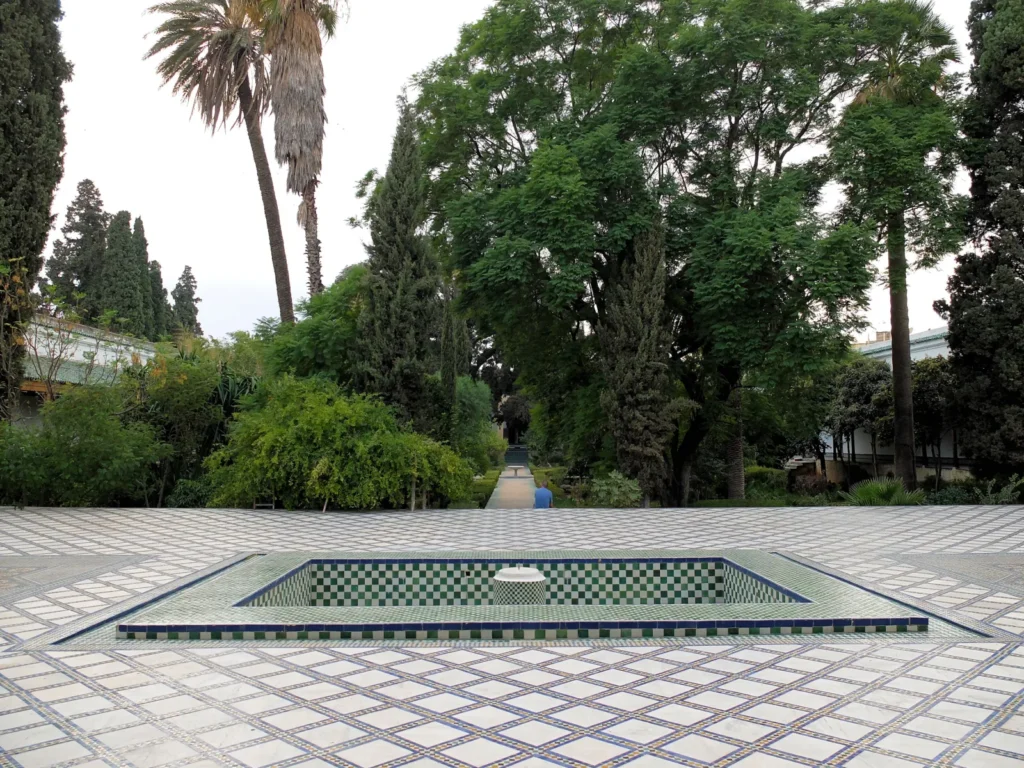
On the ground, the zellige carpets around the fountains are worth looking down for. Around the central basin, the pattern forms a geometric star in which every tessera was hand-cut from glazed tiles. Note the colours: white, black, green, ochre and cobalt blue, the classic Fes palette. In one corner of the courtyard, an immense tree whose trunk and crown tower over the arcades provides welcome shade in the afternoon.
Cedar ceilings and reception rooms
The exhibition galleries are the palace’s former state rooms. Look up as you enter each one: several keep painted cedar ceilings where sixteen- or twenty-four-pointed stars radiate around a central motif. The restoration revived these decorations without repainting them as new, and you can still make out the worn areas. The large double doors, often with a smaller wicket door set into them, are typical of Moroccan palaces: the wicket was used every day and the full doors opened for receptions.
Also look out for the carved plaster (gebs) of the upper friezes and the zellige dados, which sometimes rise to shoulder height. This is the decorative grammar of the 14th-century Marinid madrasas, taken up here five hundred years later by Alaouite craftsmen. Seeing these 19th-century decorations just before or after the Bou Inania madrasa lets you measure the continuity, and also the difference in finesse.
The Andalusian garden of the Dar Batha Museum
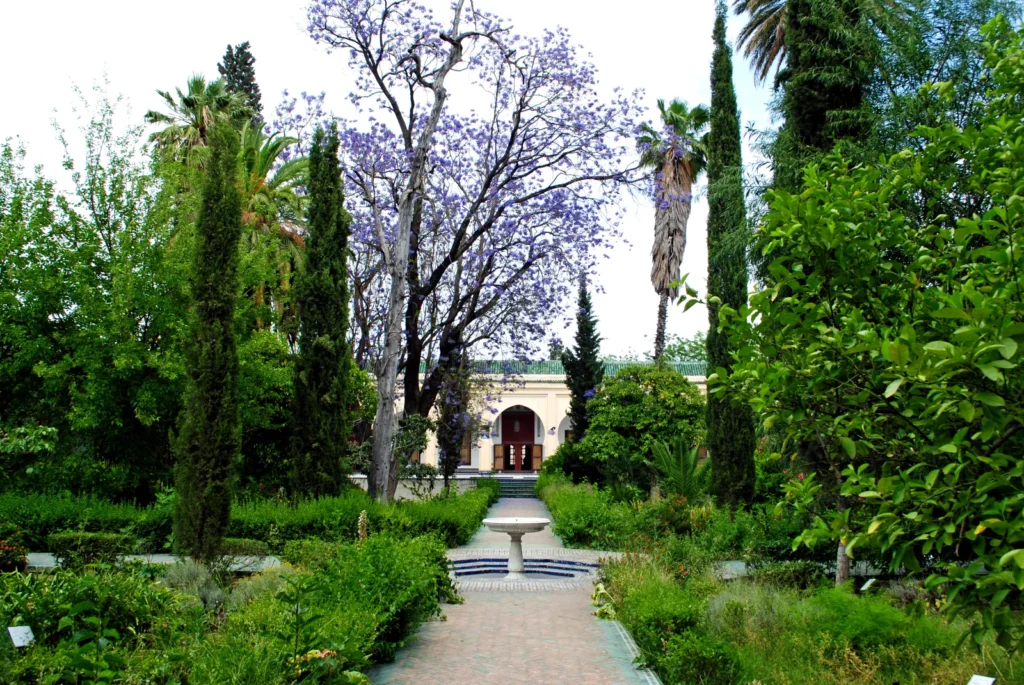
The garden is often what visitors remember most. It follows the plan of the Andalusian riad: a rectangle divided into four beds by two perpendicular paths, with a fountain where they cross. According to published data, it takes up more than half of the palace area (58% according to the Discover Islamic Art virtual museum). On the north and south sides, it is lined by galleries carried on 28 painted wooden columns. The paths are paved with green and blue zellige, slightly raised above the beds, as in Hispano-Muslim gardens where people walked at the level of the flowers.
The planting mixes palms, cypresses, orange trees, jacarandas and hibiscus. If you are in Fes towards the end of spring, the jacarandas cover the paths with mauve blossom: the most photogenic moment of the year. The rest of the time, the garden remains the quietest corner of this part of the medina. There are benches, and it is a good idea to keep it for the end of your visit, when the galleries have tired your eyes.
This garden has another, musical life. Since the Fes Festival of World Sacred Music was founded in 1994, its late-afternoon concerts were long held under the great Batha tree, in a far more intimate atmosphere than on the Bab Makina stage. Venues vary from one edition to the next, however: for the 29th edition (4-7 June 2026), official announcements named in particular Bab Makina, which hosted the opening night, and the Jnan Sbil gardens. Check the festival’s official website before counting on a concert in the museum garden.
The museum garden is not a public park: you can only enter with a ticket and during museum hours. If you are looking for a large free green space to rest, the Jnan Sbil garden, ten minutes’ walk away, fills that role.
What to see at the Dar Batha Museum: the unmissable pieces
The route is both chronological and thematic: it starts with the pre-Islamic era and the first dynasties, passes through the major periods (Idrisids, Almoravids, Almohads, Marinids, Saadians, Alaouites), pauses on Arabic writing and calligraphy, then devotes a space to Fes as a capital of learning. These are the objects that justify the trip on their own.
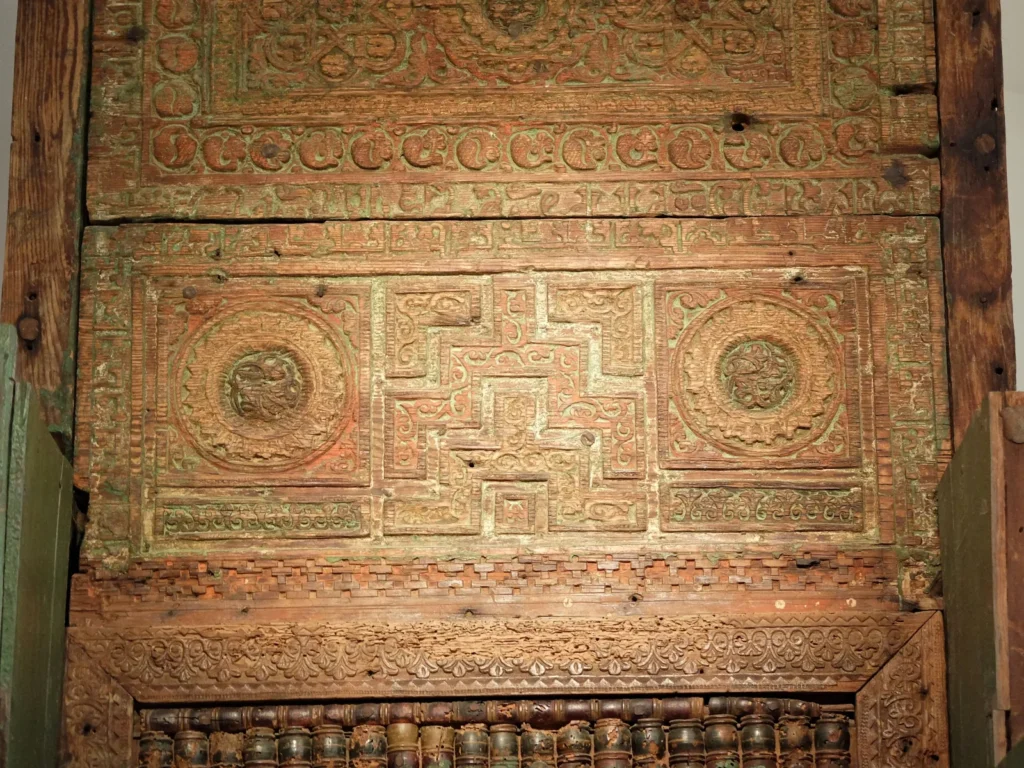
The minbar of the Andalusians Mosque (980-985)
This is the centrepiece, and one of the oldest wooden pulpits preserved in Morocco. Its history reads like a summary of 10th-century rivalries. In 980, Buluggin ibn Ziri, a Zirid emir ruling on behalf of the Fatimid caliphs, took Fes and had a new minbar made for the Andalusians Mosque. In 985, the Umayyads of Córdoba recaptured the city; the strongman of al-Andalus, Ibn Abi Amir (al-Mansur), had some of the Fatimid panels removed and added an inscription in his own name, dated 375 AH. At the beginning of the 13th century, the Almohads covered almost the whole minbar with new panels.
The old minbar was only truly rediscovered in the 20th century, thanks to the study by the art historian Henri Terrasse, published in 1942, which brought the original inscription to light. The 10th-century elements, from the Fatimid and Umayyad periods, are now displayed in the Batha Museum. Get close to the uprights: the plant scrolls, arches and rosettes carved into the wood are astonishingly crisp for their age. The gaps left visible are part of the object’s story, so do not mistake them for a display flaw.
The Bou Inania water clock and minbar (14th century)
Opposite the Bou Inania madrasa, on Talaa Kebira, the façade of the 14th-century Marinid water clock known as Dar al-Magana still shows twelve windows above thirteen wooden consoles, each of which once held a bronze bowl. Every hour, a lead ball or weight dropped into one of the bowls and made it ring; the mechanism has disappeared and its exact workings are unknown. The bowls were removed in the later 20th century for study. Several presentations of the museum list elements of this clock among the Batha’s pieces, alongside the 14th-century minbar of the same madrasa. The FNM does not specify which elements are shown in the new display: ask at the desk, then go and look at the façade in the medina, one of the most telling connections you can make in Fes.
Astrolabes, Qur’ans and manuscripts
One gallery brings together brass planispheric astrolabes, instruments used to observe the stars, calculate prayer times and determine the direction of Mecca. Read the dates on the labels: astrolabe dates, converted from the Hijri calendar, are often garbled in publications. You will also find Qur’ans and rare manuscripts, which the FNM highlights among the key pieces, and a section on the history of writing and Arabic calligraphy in Morocco, from Kufic to Maghrebi scripts.
Fes blue pottery
The museum holds one of the great collections of so-called “Fes blue” ceramics: dishes, bowls, butter jars and storage jars glazed in white and painted with cobalt blue. The designs combine floral motifs, geometric stars, interlacing and sometimes stylised Kufic letters. A trained eye spots the differences in shade, from the pale, slightly greyish blue of older pieces to the deep blue of more recent production, linked to the composition of the cobalt ore used. If you plan to buy pottery in town afterwards, this room is the best school: you will be able to tell a hand-painted piece from mass production.
Do not miss the zellige and architectural ceramic panels either, which show how much the glazed terracotta mosaic of the madrasas and palaces relied on sophisticated geometry.
Textiles, carpets, jewellery and everyday objects
The FNM lists textiles and carpets among the strengths of the collection, alongside chiselled metal objects. Then come embroidery, carved wood, jewellery and Andalusian and Oriental musical instruments, a reminder that Fes was above all a city of guilds, where each trade had its own street and its own maâlems. To go further into woodworking, its tools and its roof structures, the Nejjarine Museum of Wooden Arts and Crafts is the natural complement to this visit.
| Piece | Period | Why stop |
|---|---|---|
| Minbar of the Andalusians Mosque | 980, altered in 985 | Direct witness to the Fatimid-Umayyad struggle for Fes |
| Bou Inania water clock and minbar | 14th century (Marinids) | The direct link between the museum and the nearby madrasa |
| Planispheric astrolabes | Medieval and modern periods (see labels) | Science, astronomy and the timing of prayers |
| Qur’ans and rare manuscripts | Several periods | Maghrebi calligraphy and gold illumination |
| Zellige and ceramic panels | Several periods | The geometry of glazed mosaic, seen up close |
| “Fes blue” ceramics | Mainly 18th-20th centuries | The city’s visual signature, useful before any purchase |
A suggested 90-minute route
The museum is not huge, but it wears you out quickly if you read every label. Here is the order that works best, tried to combine the galleries, the courtyard and the garden without doubling back.
- Ten minutes in the courtyard before any gallery: spot the two kinds of gallery, the zellige floors and the layout of the rooms.
- The historical galleries in chronological order, stopping mainly at the first dynasties and the Andalusians minbar (allow a quarter of an hour for it alone).
- The room on writing and science: Qur’ans, manuscripts, astrolabes, the Bou Inania clock.
- The arts of fire and fabric: blue pottery, zellige, carpets, textiles, jewellery.
- The section on Fes as a city of learning, which links to the Qarawiyyin and the madrasas you will see in the medina.
- The garden to finish, along the central path to the fountain, then a full loop of the beds.
With children, reverse it: garden first, then two or three chosen galleries (the minbar, the musical instruments, the astrolabes), and leave before boredom sets in. The children’s ticket is modest, and the open courtyard makes breaks easy.
Visiting the Dar Batha Museum: practical information
| Information | Details |
|---|---|
| Official name | Al Batha Museum of Islamic Arts (FNM) |
| Address | 5, Place Batha, Oued Fejjaline, Fes |
| Opening hours | 10 am – 6 pm, daily except Tuesday |
| Foreign visitors | 60 MAD |
| Moroccan residents | 30 MAD |
| Children | 15 MAD |
| Free entry and discounts | Not published by the FNM to date, ask at the ticket desk |
| Telephone | +212 (0)5 30 67 60 81 |
| Suggested length | 1.5 to 2 hours |
| Best time | At opening (10 am) or after 4 pm; late spring for the jacarandas |
How to get there
From Bab Boujloud, the blue gate of Fes, this is the easiest walk in the medina: with your back to the gate on the outer side, head towards Place Batha along the walls, and the museum is a few hundred metres away, about five minutes on foot. Place Batha is also one of the main drop-off points for the red petits taxis: just say “Batha”, every driver knows it. From the ONCF railway station in the new town, a petit taxi usually takes ten to fifteen minutes depending on traffic; insist on the meter.
If you arrive by air, Fes-Saïss Airport is about fifteen kilometres south of the city; grands taxis and transfers will drop you at Place Batha or Bab Boujloud, points drivers accept without difficulty, whereas the medina lanes are closed to cars. Leaving your luggage at the riad before the visit is more comfortable: no left-luggage service is advertised at the museum.
Dress, photography and accessibility
The museum is a cultural venue, not a place of worship: it is open to all visitors regardless of religion, and there is no specific dress code. Clothing that covers the shoulders is still best for walking around the surrounding medina. Photography rules are not detailed publicly by the FNM: flash-free photos are generally tolerated in the courtyard and garden, but ask at the desk about the galleries and respect the signs. The palace is mostly on one level, though with thresholds and a few steps; wheelchair access conditions are not officially published, so call the museum before coming.
When to come
Avoid Tuesday, the closing day, which many visitors discover at the door. Weekend mornings and school holidays attract Moroccan families and school groups: it is lively, but the narrow galleries fill quickly. The 10 am opening on weekdays remains the quietest slot; in summer, late afternoon, when the courtyard falls into shade, is more pleasant. During Ramadan, opening hours at Moroccan cultural sites are often adjusted: check by phone the day before.
Mistakes to avoid at the Dar Batha Museum
- Trusting an old guidebook: pre-2019 hours, prices and content are no longer valid, and some websites still say “closed for renovation”.
- Coming on a Tuesday.
- Following a tout who claims “the museum is closed today” to take you elsewhere: go and see for yourself, the entrance is five minutes from Bab Boujloud.
- Rushing through the galleries in twenty minutes just to enjoy the garden: the Andalusians minbar is unique in the world.
- Confusing the museum with Dar el-Beida, the neighbouring palace that is not open to the public.
- Forgetting to carry some cash: card payment is not guaranteed at every site in the medina.
Around the Dar Batha Museum
The museum is ideally placed to start or end a day in the western part of the medina. Here is what lies within a quarter of an hour’s walk.
- Bab Boujloud: the monumental gate with blue zellige, five minutes away, framing the minarets of Bou Inania and Sidi Lazzaz through its arches.
- The Bou Inania madrasa: at the top of Talaa Kebira, about ten minutes away; opposite it, the façade of the water clock presented in the museum.
- Jnan Sbil garden: a large restored public garden, free, between the medina and Fes el-Jdid, perfect after the visit.
- Talaa Kebira and Talaa Seghira: the two main streets running down to the heart of the medina, the Qarawiyyin and the souks.
- The Nejjarine Museum: further down in the medina, on the square of the same name, for wooden arts; allow twenty to thirty minutes on foot down Talaa Kebira.
| Criterion | Al Batha Museum (Dar Batha) | Nejjarine Museum |
|---|---|---|
| Building | Late 19th-century royal palace with garden | 18th-century fondouk (caravanserai) |
| Theme | Islamic arts in Morocco, from early history to the Alaouite period | Wooden arts and crafts |
| Highlight | Andalusians minbar, blue pottery, Andalusian garden | Roof structures, doors, tools, terrace |
| Location | Western edge of the medina, near Bab Boujloud | Heart of the medina, Place Nejjarine |
| Ideal for | A first visit to Fes, to understand the city | Craft and woodworking enthusiasts |
Still undecided between the two imperial cities for your stay? Our comparison Marrakech or Fes: which to choose will help; note that in Fes, the Batha plays a role similar to that of a palace-museum such as Dar Si Saïd in Marrakech, but with an older collection.
FAQ about the Dar Batha Museum
Is the Dar Batha Museum open in 2026?
Yes. Closed for restoration from April 2019 to early 2025, it reopened on 26 February 2025 as the Al Batha Museum of Islamic Arts. According to the national museums foundation, it is open daily from 10 am to 6 pm, except Tuesday.
How much is the entrance fee to the Dar Batha Museum?
The FNM lists 60 MAD for foreign visitors, 30 MAD for Moroccan residents and 15 MAD for children. The FNM does not publish any free-entry scheme: for student or group discounts, ask at the ticket desk.
What is the difference between Dar Batha and the Al Batha Museum?
They are the same place. Dar Batha is the name of the palace; the museum inside was commonly called the Batha Museum or the museum of folk arts and traditions, and since 2025 its official name has been the Al Batha Museum of Islamic Arts.
Who built the Dar Batha palace?
The palace was commissioned by the Alaouite sultan Moulay Hassan I, who began construction in the 1880s, and completed under his son Moulay Abdelaziz. It served as a summer palace and a residence for distinguished guests.
How much time should I allow for the visit?
Allow 1.5 to 2 hours to see the galleries without rushing and enjoy the garden. A one-hour express visit is possible if you focus on the Andalusians minbar, the science room and the blue pottery.
Can non-Muslims visit the Dar Batha Museum?
Yes. It is a public museum, not a place of worship: it is open to all visitors. The religious objects on display, such as the minbar and the Qur’ans, should be viewed respectfully, with no special rules beyond those posted in the galleries.
How do I get to the Dar Batha Museum from Bab Boujloud?
On foot, in about five minutes: from the outer side of Bab Boujloud, head for Place Batha, where the museum entrance is, at 5 Place Batha. Petits taxis also drop off directly on Place Batha.
Does the museum garden still host the Sacred Music Festival?
The Batha garden long hosted the festival’s afternoon concerts, but venues change from one edition to the next. In 2026, official announcements named in particular Bab Makina and Jnan Sbil: check the festival website for the year of your trip.
Summary
The Dar Batha Museum is the first stop to recommend to anyone discovering Fes: a late 19th-century summer palace and one of the country’s oldest museums, which since February 2025 has told the story of Islamic art in Morocco from a collection of more than 6,500 objects. You come for the minbar of the Andalusians Mosque, the manuscripts and astrolabes, the blue pottery and an Andalusian garden of rare serenity. Avoid Tuesdays, come at opening time, allow two hours and continue to Bab Boujloud, Bou Inania and Jnan Sbil, all a few minutes away on foot.
Official sources
- Fondation Nationale des Musées: Al Batha Museum of Islamic Arts
- UNESCO: Medina of Fez, World Heritage
- Discover Islamic Art (Museum With No Frontiers): Batha Palace
- Fes Festival of World Sacred Music (official website)
- Maroc.ma, official portal of the Kingdom of Morocco: the Al Batha Museum’s first months (in French)
Informational article, updated in September 2026. Prices, opening hours, free-entry days and the display of the Al Batha Museum collections may change: check with the Fondation Nationale des Musées or on site before your visit.
Photo credits
Images: featured image « File:Dar Batha DSCF2832.jpg » — R Prazeres (CC BY-SA 4.0); « File:Dar Batha Museum, Fes (8958254162).jpg » — just_a_cheeseburger (Flickr) (CC BY 2.0); « File:Andalusians Mosque minbar DSCF6270.jpg » — R Prazeres (CC BY-SA 4.0), via Wikimedia Commons.