The Nejjarine Museum of Wooden Arts and Crafts occupies a former funduq in Fes built in 1711 under Sultan Moulay Ismail, on the carpenters’ square in the heart of the Fes el-Bali medina; in about an hour you see monumental doors, chests, musical instruments and craftsmen’s tools, before climbing to a rooftop terrace that looks out over the old city. The building is as much a reason to come as the collections, and it is one of the few places in the medina where you can sit quietly with a glass of tea two minutes from the busiest lanes.
This page is for travellers who want to understand what they are looking at: why a caravanserai became a museum, what the fountain beside the door tells you, how to read the decoration of the portal, what there really is to see inside and how to get there without spending twenty minutes going round in circles. The other monuments of Fes (often spelled Fez) have their own articles in our series; here we stay on Nejjarine Square and its immediate surroundings.
At a glance
- The Nejjarine funduq was built in 1711 (1123 AH) during the reign of Moulay Ismail, to house merchants and their goods.
- The building was listed as a historic monument in 1916 and is part of the Fes medina, inscribed on the UNESCO World Heritage List in 1981.
- Restored in the 1990s with funding from the Mohammed Karim Lamrani Foundation, it has housed the Nejjarine Museum of Wooden Arts and Crafts since 23 May 1998.
- The collections are organised around three uses of wood: architecture, the home, and religious and scholarly life.
- The zellige-covered fountain on the square is later: it is attributed to Sultan Moulay Abderrahmane (reigned 1822-1859).
- A rooftop terrace with a tea room looks out over the medina roofs; allow 45 minutes to 1 hour 30 for the visit.
- Admission is charged (roughly 20 to 30 dirhams according to recent reports), daytime opening hours, to be checked on site.
Nejjarine Museum: a museum of wood inside a caravanserai
In Fes, wood is no secondary material. It covers the ceilings of the madrasas, it closes off the houses, it holds up the canopies above the fountains, it is used for low tables, looms and the boards on which children learned the Quran. The Nejjarine Museum was designed to keep the memory of these skills alive at a time when traditional workshops were seeing machines and imported timber arrive.
The choice of location is no accident. “Nejjarine” comes from the Arabic word najjar, carpenter: the square and the neighbourhood have been occupied by woodworkers for centuries, and you can still hear planes and saws in the nearby workshops. Putting a museum of wood in the carpenters’ funduq means showing the objects a few metres from where some of them may have been made.
It is also worth being clear about what this museum is and what it is not. It is not a state institution: it is a private museum run by the Mohammed Karim Lamrani Foundation, which is recognised as being of public utility. Nor is it a huge museum: the rooms go by quickly, and the building itself makes up half of the interest. If you want a large collection of Moroccan arts across every discipline, head to the Dar Batha Museum, devoted to the traditional arts of Fes; the two visits complement each other well.
History of the Nejjarine funduq, from 1711 to today
A funduq built under Moulay Ismail
The funduq was built in 1711, or 1123 in the Hijri calendar, during the reign of the Alaouite sultan Moulay Ismail. Reference sources name as its commissioner an amin, an official in charge of management on behalf of the ruling power, called ʿAdiyil. The Makhzen, the royal administration, had interests in it: the building served both as a warehouse and as lodging for passing traders, especially those arriving from the interior of the country with valuable goods.
The principle of a funduq is simple and effective. On the ground floor, around the courtyard, pack animals were stabled and bales were stored; on the upper floors, rooms opened onto galleries and housed travellers. The Nejjarine funduq has fifty-one of them according to the foundation that restored it. Before the protectorate, some of the rooms belonged to merchants, including Jewish traders of Fes, and in the 19th century a post office operated from a small shop between the building and the fountain.
For architectural historians, the funduq’s interest lies in its date. It illustrates the decorative trends of the early Alaouite period, at a time when Moulay Ismail was concentrating most of his great building projects in Meknes. Seeing a civil building of this quality in Fes, and this well preserved, is not that common.
Historic monument, then police station
The funduq was listed as a historic monument in 1916, in the early years of the French protectorate. The listing did not stop it from changing use: during the 20th century it served as a police station under the protectorate, then as a boarding house for students. Without maintenance it deteriorated badly and was abandoned in the 1970s. Looking today at the immaculate woodwork of the galleries, it is hard to imagine the partly ruined state the building was in some twenty years before the museum opened.
The restoration funded by Mohammed Karim Lamrani
The rescue came from a son of Fes. Mohammed Karim Lamrani, born in the city in 1919 and who died in 2018, was three times Prime Minister of Morocco under Hassan II and a leading businessman. The initiative to save the Nejjarine ensemble came from the Fès-Saïss association, the Ministry of the Interior and the city’s local authorities; Karim Lamrani agreed to fund the restoration, and his foundation then took charge of the museum.
Work began in 1990 and was completed in October 1996, according to the presentation published by CEMA, one of the patron’s companies. It was not limited to the funduq: a multidisciplinary committee oversaw the restoration of the square, the fountain, the neighbouring mosque and the craft quarter. The announced cost was 18 million dirhams. The museum was inaugurated on 23 May 1998. The result is very clean, almost new in places: bear in mind, as you look at the galleries, that part of the woodwork was redone in the 1990s by present-day craftsmen, which is in itself a living demonstration of the skills the museum exhibits.
| Date | Event |
|---|---|
| 1711 (1123 AH) | Construction of the funduq under Moulay Ismail, commissioned by the amin ʿAdiyil |
| 1822-1859 | Reign of Moulay Abderrahmane, to whom the fountain on the square is attributed |
| 19th century | Post office in a small shop between the funduq and the fountain |
| 1916 | Listing as a historic monument |
| 20th century | Successive uses: police station, student boarding house |
| 1970s | Building abandoned, badly deteriorated |
| 1981 | Fes medina inscribed on the UNESCO World Heritage List |
| 1990-1996 | Restoration of the ensemble (funduq, square, fountain, mosque, quarter) |
| 23 May 1998 | Inauguration of the Nejjarine Museum of Wooden Arts and Crafts |
Nejjarine Square, its fountain and the carpenters’ souk
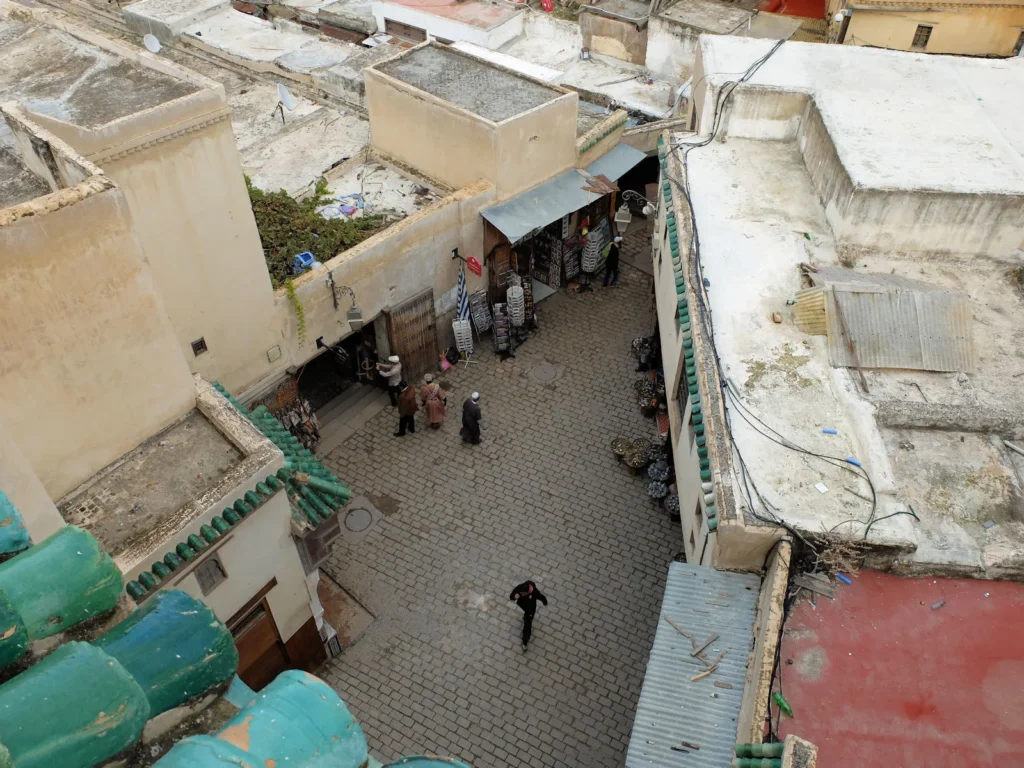
The square itself is small, slightly irregular, and you often come out onto it unexpectedly at the turn of a lane. Three elements make it up: the facade of the funduq, the fountain set beside its portal, and the carpentry workshops lining the surrounding streets. It is this ensemble, more than any single element, that makes it one of the most photographed squares in Fes.
The fountain of Moulay Abderrahmane
The fountain, or saqqaya, is not contemporary with the funduq: it is attributed to Sultan Moulay Abderrahmane, who reigned from 1822 to 1859, more than a century after the caravanserai was built. Yet today the funduq and the fountain form a single ensemble, and that is how people photograph them: the eye no longer separates one from the other.
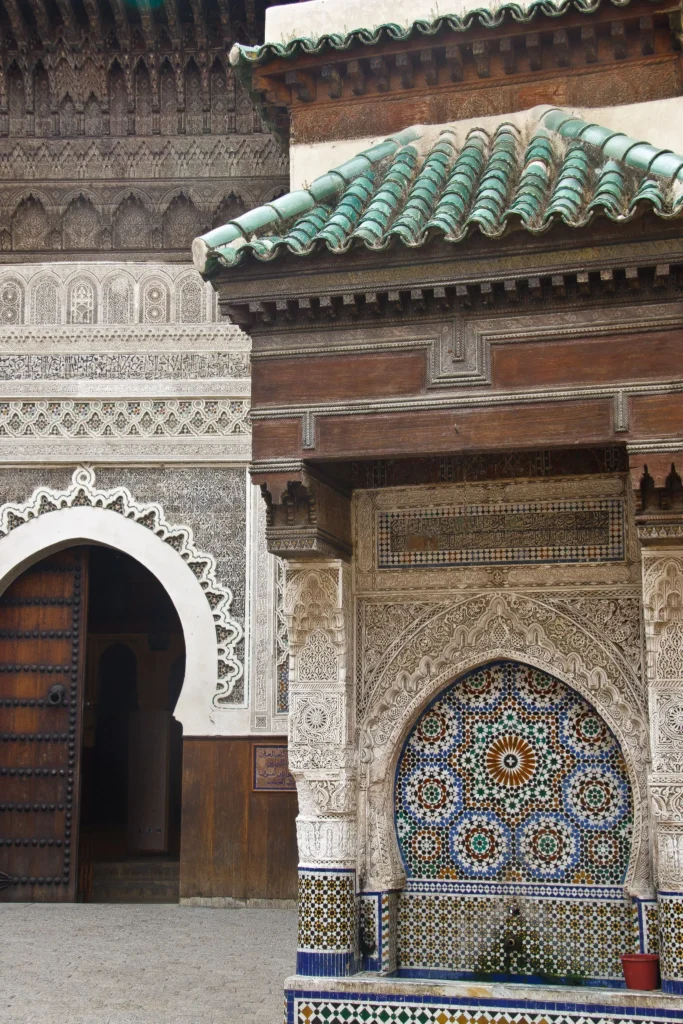
Look at it closely. A rectangular basin, which also served as a trough for horses, topped by a large panel of zellige dominated by blues, yellows and reds, with geometric and floral patterns. Above it, a blind arch, carved stucco, half-columns supporting wooden lintels and finally a cedar canopy that protects the decoration from the rain. It is a good summary, in two square metres, of the three materials of Fassi decoration: ceramic, plaster and wood.
The carpenters’ souk, still at work
The museum would make less sense without the neighbourhood. In the lanes leading off the square, carpenters still make doors, frames, tables, wedding chests and roof timbers. The smell of freshly cut cedar warns you before you even see the shavings. Take five minutes before or after the visit to watch a craftsman at work: you will then better understand the tools in the display cases, which are not relics but the direct ancestors of what is still used three doors away. To place this souk among the city’s specialised markets, see our guide to the souks of Fes.
A matter of courtesy: ask before photographing a craftsman at work. Most gladly agree, some expect a gesture or a purchase, a few refuse, and that is their right.
Reading the architecture of the funduq
The portal, the museum’s first exhibit
Before buying your ticket, stop in front of the entrance. The portal is about 5 metres high and 3 metres wide. It combines a horseshoe arch set on brick pillars, a polylobed arch in carved plaster, zellige panels with floral and epigraphic decoration, and a corbelled wooden canopy with its arches and beams. Look up under that canopy: the wood carving there is finer than it seems from the square. The heavy double door completes the composition.
The courtyard and the galleries
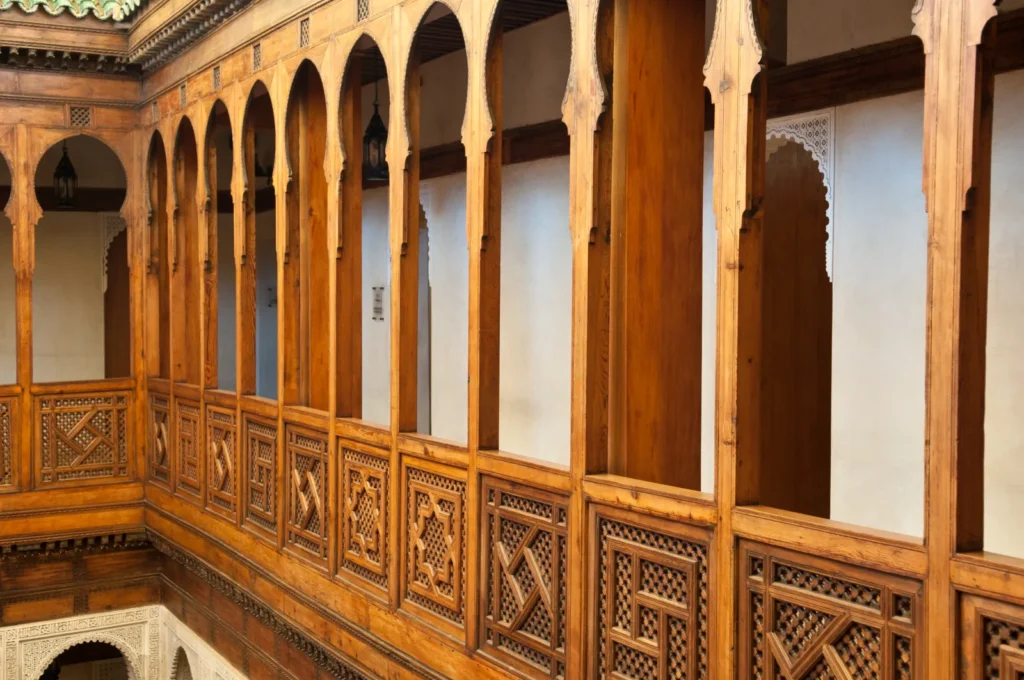
Once through the door, the noise of the medina drops away almost at once. The plan is rectangular, arranged around a central courtyard lined on all four sides by superimposed galleries. There is a ground floor and upper levels, then the terrace. The balustrades, arches and mashrabiya screens of the galleries are made of wood; the light falling from the open sky of the courtyard cuts across these lattices and changes a great deal with the time of day. In the courtyard, a large metal merchant’s scale, once used to weigh goods, is a reminder of the building’s commercial function.
The rooms, now exhibition spaces
The former travellers’ rooms, of varying sizes, open onto the galleries. They now hold the display cases. They are narrow and fairly dark, which means going in one at a time and gives the tour a particular rhythm: you alternate between the half-light of a room and the brightness of the gallery. That is also why the visit feels longer than it really is.
The Nejjarine Museum collections, theme by theme
The tour is organised around three themes, as presented by the Fes regional tourism council: wood in architecture, wood in domestic life and liturgical wood. Craftsmen’s tools and pieces of furniture, both old and contemporary, complete the whole. The exact number of objects on display is not officially published.
Wood in architecture
This is the most spectacular part. You see monumental doors, carved door leaves, fragments of ceilings, lintels and brackets, mashrabiya panels. Seeing these elements at eye level changes everything: in a madrasa, a carved ceiling is viewed from ten metres away and against the light; here you can make out the stroke of the gouge, the interlacing, the inscriptions, sometimes traces of paint. If you plan to visit the city’s great madrasas afterwards, come here first: you will look at their woodwork differently.
Wood in the home
The second register is everyday objects. Carved or painted chests that held the trousseau and linen, low tables, shelves, furniture and household utensils. The museum also displays musical instruments, which show that a woodworker could also be an instrument maker. This is often the part children prefer, because the objects have a purpose you can guess.
Wood for faith and learning
The third register is liturgical and school woodwork. Here you find Quranic boards, the wooden tablets on which pupils of traditional schools wrote in ink the verses to be memorised before washing them off, mosque objects and prayer beads. These modest pieces tell the story of Fes as much as the monumental doors do: the city of al-Qarawiyyin is first and foremost a city of scholars and schools.
Tools, timbers and techniques
Part of the collection is devoted to the tools of carpenters and carvers: instruments for sawing, planing, hollowing and measuring wood. It is the most underrated section of the museum. The panels also explain the species used, first among them Atlas cedar, whose forests in the Middle Atlas are less than two hours’ drive from Fes. Remember three techniques you will then see everywhere in the city:
- carving in intaglio and relief, which produces the interlacing and inscriptions of doors and ceilings;
- painted wood, called zouaq, with colourful floral patterns, especially on chests and domestic ceilings;
- mashrabiya, an assembly of small turned pieces that lets air and light through while shielding from view.
| Theme | What you see | Look closely at |
|---|---|---|
| Architectural wood | Doors, door leaves, ceiling fragments, brackets, mashrabiya | The carved inscriptions and traces of old paint |
| Domestic wood | Chests, low tables, utensils, musical instruments | The zouaq-painted chests and the joints made without nails |
| Liturgical and school wood | Quranic boards, mosque objects, prayer beads | The wear on the boards, polished by generations of pupils |
| Tools | Carpenters’ and wood carvers’ tools | Compare them with the tools in the workshops on the square |
| Building | Portal, courtyard, galleries, merchant’s scale, terrace | The cedar canopy of the portal and the light on the galleries |
The panoramic terrace and its tea room
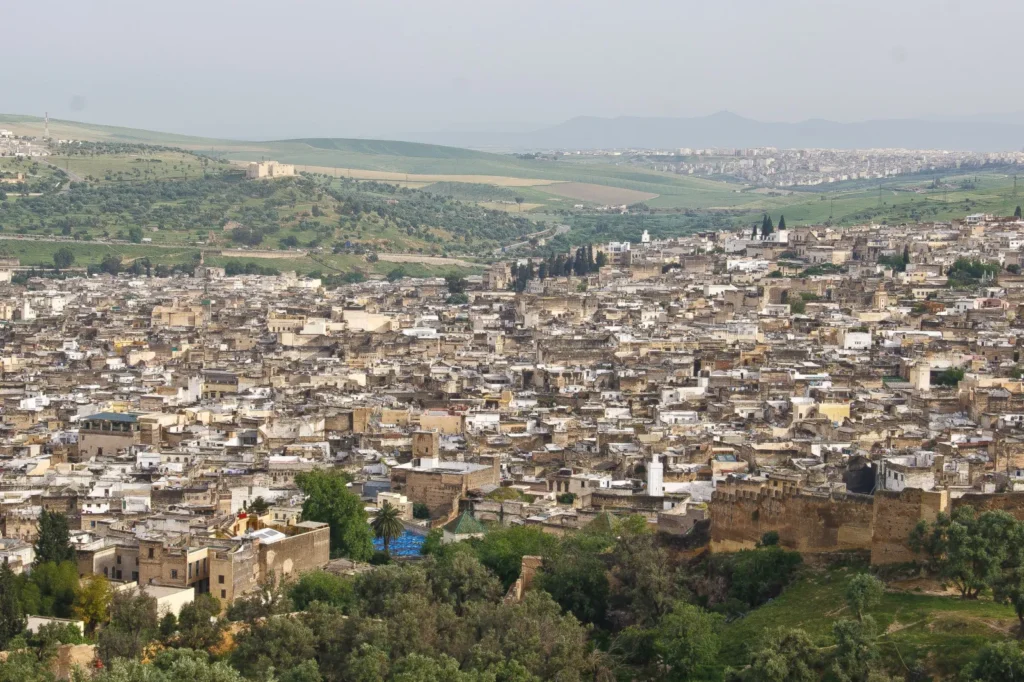
The terrace is the pleasant surprise of the visit. You reach it by the stairs after the last level of galleries, and there is a tea room. The view takes in the flat roofs of the medina, the minarets and, on clear days, the hills around the city. Even if you do not have time to see every room, go up: it is one of the few easily accessible high viewpoints in the centre of Fes el-Bali, and the ideal place for a break.
Two practical points. The tea room may close earlier than the museum or not operate on some days: do not count on it for lunch. And the terrace is exposed: in summer, between 1 pm and 4 pm, the sun is overwhelming, whereas in the late afternoon the low light on the roofs is at its most beautiful.
Visiting the Nejjarine Museum: practical information
| Item | Information |
|---|---|
| Address | Place Nejjarine, Fes el-Bali medina |
| Status | Private museum run by the Mohammed Karim Lamrani Foundation |
| Opening hours | Daily from 10 am to 5.30 pm according to the Fes regional tourism council (some sources give a later closing time); check on site, especially during Ramadan and on public holidays |
| Admission | Paid, roughly 20 to 30 dirhams per adult according to recent reports; price not officially published online |
| Duration | 45 minutes for the essentials, 1 hour 30 with the terrace and the souk |
| Photos | The rule has varied over time and may be stricter in the rooms than in the courtyard or on the terrace; follow the posted notices and the staff’s instructions |
| Accessibility | Stairs to the upper floors and terrace; no lift reported |
| Best time | At opening time or in the late afternoon, on a weekday |
Walking there from Bab Boujloud
From the blue gate of Bab Boujloud, the easiest route to follow is down the Talaa Kebira, the main street that crosses the medina on a slope. Follow it to the end, where it comes out into the central souks, towards Souk Attarine and the approaches to the shrine of Moulay Idriss II. Nejjarine Square lies a few dozen metres from this area. Allow 15 to 25 minutes on foot depending on the crowds and your stops. The museum is generally marked on the medina’s tourist signs; if in doubt, ask shopkeepers rather than the young men who spontaneously offer to guide you.
To find your way around the medina beyond this route, our guide to the Fes el-Bali medina explains the gates, the main thoroughfares and the logic of the quarters.
From the airport, the station or by taxi
No cars enter the medina. A petit taxi will drop you at one of the gates (Bab Boujloud is the most convenient for the route above), and you finish on foot. If you arrive by air, Fes-Saïss airport lies south of the city: our guide to Fes-Saïss airport explains the options for reaching the centre, and the comparison of airport transfers in Morocco helps you choose between taxi, shuttle and private transfer. Many riads also offer to have guests accompanied to the gate on arrival, which saves hunting for the address with your luggage.
Dress, duration and best time
The museum is a cultural venue open to everyone, with no religious restriction. No particular dress is required, but the surrounding area is one of the most religious in the medina, a stone’s throw from the shrine of Moulay Idriss II: covered shoulders and knees are simply the most respectful way to walk around. Wear shoes with a good grip, as the inside stairs are steep and the lanes slippery in wet weather.
On Fridays in the late morning and early afternoon, the neighbouring sacred quarter is very busy at the time of the main prayer, and many shops close: not a good moment to combine the museum with the souks. On weekdays, arriving at opening time lets you enjoy an almost empty courtyard before the guided groups, which often pass through in the late morning.
Mistakes to avoid
- Settling for a photo of the fountain. Most groups stop for five minutes in front of the facade and move on: the interior is well worth the ticket.
- Skipping the tools. The tool cases look austere; yet they hold the key to everything else.
- Photographing in the rooms without checking. Look at the signs or ask the staff; in any case the courtyard and terrace offer plenty of good pictures.
- Following a fake guide. Touts who offer to “show you the museum” will usually also lead you to a shop. The route is short and signposted.
- Arriving just before closing. With less than an hour left, you will have to choose between the rooms and the terrace, which closes with the museum.
- Forgetting to look up on the square. The cedar canopies of the portal and the fountain are two free exhibits.
Around Nejjarine Square
The square is at the medina’s centre of gravity, and almost everything Fes is most famous for lies less than ten minutes’ walk away. A few ideas for what to do next, each covered in our guide to things to do in Fes:
- The shrine of Moulay Idriss II, very close by: the interior is reserved for Muslims, but you can look through the doors and walk along the sacred quarter, whose entrances are marked by horizontal wooden bars.
- Souk Attarine, the old spice and perfume market, and the kissaria, where fabrics and clothing are sold.
- The Attarine Madrasa, a 14th-century college famous for its stucco and woodwork, a few minutes away, to see in place what the museum shows in cases.
- The Qarawiyyin Mosque, whose courtyard can be glimpsed from the doors (entry reserved for Muslims).
- Place Seffarine and its coppersmiths, hammering copper in the open air, a little further east.
A logical half-day circuit: the Nejjarine Museum at opening time, a break on the terrace, the shrine of Moulay Idriss seen from outside, Souk Attarine, the Attarine Madrasa, then down to Place Seffarine. You will have seen the essentials of the heart of Fes el-Bali without ever walking more than a kilometre.
FAQ about the Nejjarine Museum
How much does the Nejjarine Museum cost?
Admission is charged and costs roughly 20 to 30 dirhams per adult according to recent reports. The price is not officially published online: bring change in dirhams and check the price displayed at the ticket desk.
What are the Nejjarine Museum’s opening hours?
The Fes regional tourism council gives daily opening from 10 am to 5.30 pm; some sources mention a later closing time. Hours may be reduced during Ramadan and on some public holidays: check on site or with your accommodation.
When was the Nejjarine funduq built?
The funduq was built in 1711, or 1123 in the Hijri calendar, during the reign of Sultan Moulay Ismail. The fountain on the square is later and attributed to Moulay Abderrahmane, who reigned from 1822 to 1859.
Who runs the Nejjarine Museum?
It is a private museum run by the Mohammed Karim Lamrani Foundation, recognised as being of public utility. The patron, a former Prime Minister from Fes, funded the restoration of the Nejjarine ensemble in the 1990s; the museum was inaugurated on 23 May 1998.
Can you take photos in the Nejjarine Museum?
The courtyard, galleries and terrace can be photographed without difficulty in most cases; the rule in the exhibition rooms has varied over time. No official rule is published online: follow the posted signs and the staff’s instructions.
How long does it take to visit the Nejjarine Museum?
Allow 45 minutes for the rooms and the building, and up to 1 hour 30 if you have tea on the terrace and take a walk through the neighbouring carpenters’ souk.
Is the Nejjarine Museum open to non-Muslims?
Yes. It is a museum, open to all visitors without distinction. Only the neighbouring places of worship, such as the shrine of Moulay Idriss II and the Qarawiyyin Mosque, are reserved for Muslims.
Is the Nejjarine Museum worth it if you are short on time?
Yes, because it is central and quick to visit. With a single day in Fes, it fits in easily between the Moulay Idriss quarter and Souk Attarine, and its terrace offers one of the few easily reached high views over the medina.
Summary
The Nejjarine Museum brings together three good reasons to stop: a funduq from 1711 that is among the best restored in Fes, a 19th-century fountain that sums up Fassi decoration on its own, and collections that teach you to look at the wood of the whole city, from house doors to madrasa ceilings. Come early, go up to the terrace, spend five minutes with the carpenters on the square, and keep the rest of the morning for the Moulay Idriss quarter and Souk Attarine, a few steps away. It is a short, inexpensive visit, and one of those that make the rest of your stay more interesting.
Official sources
- UNESCO, Medina of Fez (World Heritage)
- ArchNet, Funduq al-Najjariyyin
- Discover Islamic Art (Museum With No Frontiers), Nejjarin Funduq
- Fes Regional Tourism Council, Nejjarine Museum
- Karim Lamrani Foundation, cultural patronage of the Nejjarine Museum
Informational article, updated in September 2026. Prices, opening hours and visiting rules at the Nejjarine Museum may change: check them on site before your visit.
Photo credits
Images: featured image « File:Fondouk el-Nejjarine (Old name- Fes (5364129707)).jpg » — Michal Osmenda from Brussels, Belgium (CC BY-SA 2.0); « File:Place nejjarine from above.jpg » — Robert Prazeres (CC BY-SA 4.0); « File:Place-an-Nejjarine (4783710686).jpg » — Mike Prince from Bangalore, India (CC BY 2.0), via Wikimedia Commons.