You only have a single day ahead of you and you’re wondering whether it’s really possible to see Marrakech in one day? The answer is yes, provided you focus on the essentials and accept that you won’t see everything. In one well-organised day, you can discover the Koutoubia Mosque, the Bahia Palace, the Ben Youssef Madrasa, the buzz of the souks, a Saadian monument, a rooftop sunset and the legendary Jemaa el-Fna square as night falls. It’s concentrated, it’s dense, but it’s doable, because the historic heart of the city fits into an area you can cover on foot.
This Marrakech one-day itinerary is aimed above all at three types of traveller: those on a layover with a few hours between two flights, those doing an express weekend, and the curious who add Marrakech to a wider Moroccan trip. The aim of this article is not to detail every monument in the smallest corner — dedicated guides exist for that — but to give you a realistic, hour-by-hour game plan so that Marrakech in one day stays a pleasure and not a race against the clock. Follow the thread, adapt it to your own pace, and keep some energy for the magic of the evening.
In short: what to see in Marrakech in one day?
- Ideal time on site: 8 to 10 active hours (early arrival, departure after dinner).
- The 3 absolute must-sees: Jemaa el-Fna, the souks of the medina and one historic monument (Bahia or Ben Youssef).
- Getting around: everything on foot within the medina; petit taxi only to reach or leave the centre.
- Indicative budget for the day: around 250 to 450 MAD (25 to 45 €) per person, entry fees and meals included.
- What to wear: comfortable walking shoes, shoulders and knees covered for places of worship, water and a hat.
- What to avoid: trying to cram everything in, taking a car into the medina, underestimating the midday heat.
Independent guide: this website is neither affiliated with nor managed by ONDA or any tourist office; the information and prices are given as an indication only and may change.
The hour-by-hour plan for Marrakech in one day
Here is the backbone of the day. This table sums up the ideal itinerary: you can follow it to the letter or pick out the stops that appeal to you most. The order is designed to limit back-and-forth and to enjoy the monuments before the crowds and the heat.
| Time slot | Stop | Why now |
|---|---|---|
| 8:00 – 8:30 | Koutoubia and its gardens | Soft light, coolness, few people |
| 8:30 – 10:00 | Bahia Palace | Quiet opening, sumptuous decor |
| 10:00 – 12:00 | Ben Youssef Madrasa and northern medina | Masterpiece before the midday crowds |
| 12:00 – 1:30 pm | Quick lunch in the medina | A break out of the sun |
| 1:30 – 3:30 pm | Souks of the medina | Wandering, crafts, shopping |
| 3:30 – 5:00 pm | El Badi Palace or Saadian Tombs | Saadian history, gardens |
| 5:30 – 6:30 pm | Sunset on a rooftop | Panoramic view, mint tea |
| 6:30 – 9:00 pm | Jemaa el-Fna and dinner | The peak of the night-time atmosphere |
If you want a broader overview of things to do before or after your day, take a look at our complete guide to activities in Marrakech. Now let’s move on to the detail of each moment of the day.
The morning: Koutoubia, Bahia and Ben Youssef
The secret to a successful day in Marrakech can be summed up in one word: start early. Between 8am and noon, the light is magnificent, the temperature bearable and the monuments still peaceful. It’s the best time to slot in the visits that call for attention and beautiful photos. Have a light breakfast at your riad or hotel, then head for the Koutoubia, a landmark that is impossible to miss.
8:00 am – Koutoubia, the city’s landmark
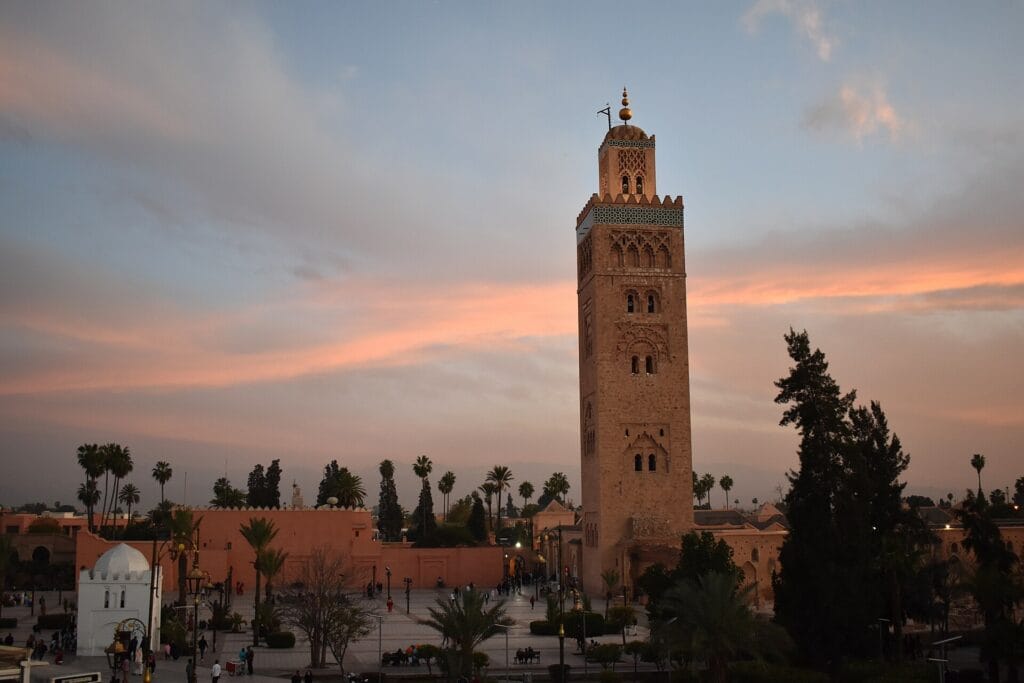
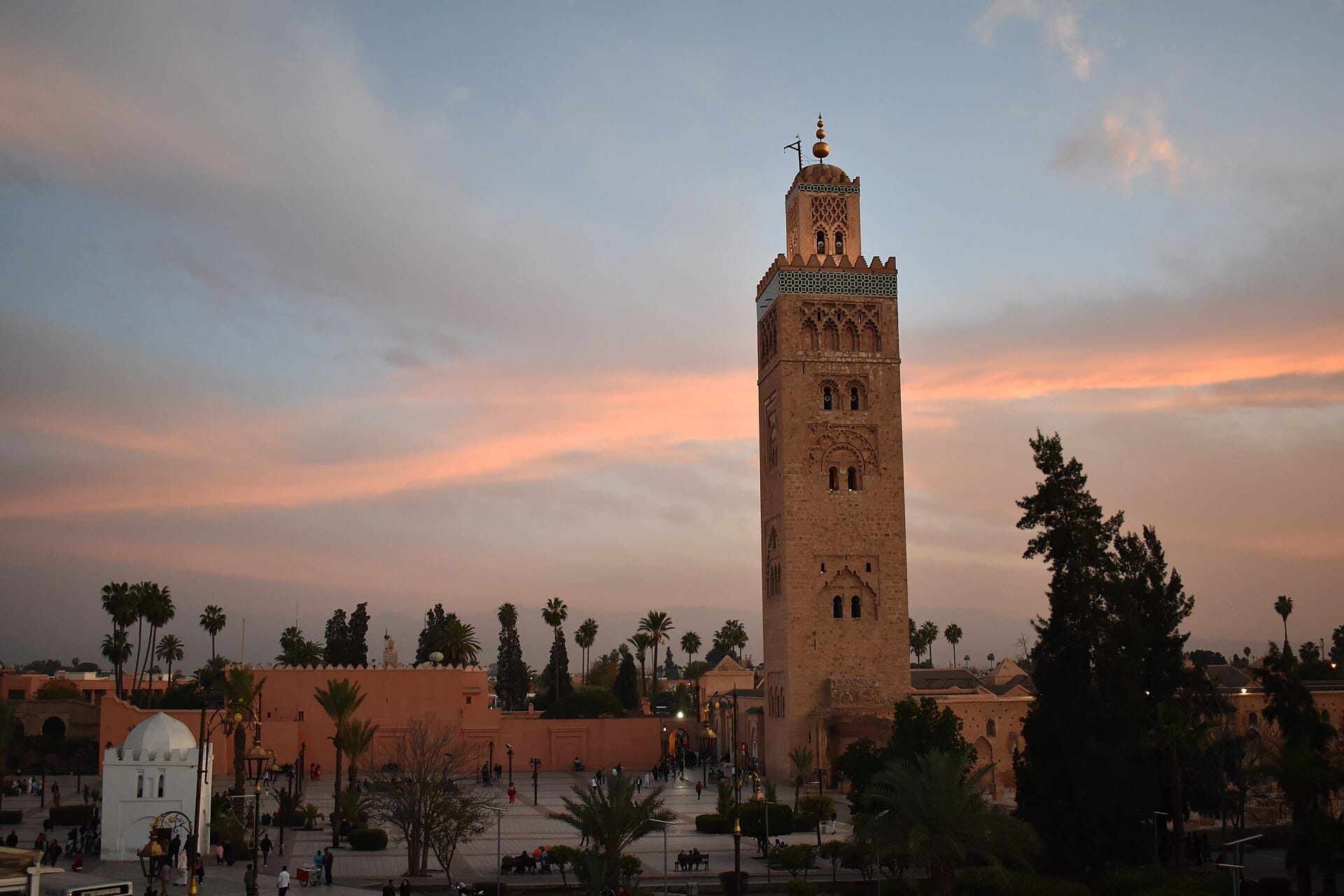
The Koutoubia Mosque is the most emblematic monument in Marrakech. Its 77-metre minaret, built in the 12th century under the Almohads, dominates the city and acts as a natural compass: wherever you are, a glance towards this ochre silhouette will reorient you. The inside of the mosque is not accessible to non-Muslims, but the essential part plays out outdoors: the gardens that surround it offer a soothing and free introduction, ideal in the early morning. Allow about twenty minutes to walk around it, photograph the minaret in the low-angled light and soak up the atmosphere. For the full history and visiting tips, see our dedicated article on the Koutoubia Mosque.
8:30 am – The Bahia Palace, a festival of decor
About a ten-minute walk south-east of the Koutoubia stands the Bahia Palace, built at the end of the 19th century. It’s one of the most rewarding visits for the time it takes: open-air courtyards, painted cedar ceilings, multicoloured zellige tiles, chiselled stucco and shaded gardens follow one another in a refined maze. Arriving right at opening time (usually 9am) lets you enjoy the rooms before the tour groups. Entry costs around 100 MAD (about 10 €). Allow 45 minutes to an hour for a relaxed visit. Our detailed guide to the Bahia Palace gives you the layout of the rooms and the best photo angles.
10:00 am – The Ben Youssef Madrasa, a jewel of Andalusian-Moroccan art
Next, head to the north of the medina for the Ben Youssef Madrasa, a former Quranic school and arguably the most beautiful interior monument in the city. Recently restored, it dazzles with its central courtyard, its pool, its carved woodwork and its mosaics of rare finesse. The walk from Bahia crosses the heart of the medina: take advantage of it to feel the pulse of the city, but keep heading north. Entry is around 50 MAD (5 €). Half an hour to three quarters of an hour is enough to appreciate every detail. Everything is explained in our article on the Ben Youssef Madrasa. On the way out, you’re ideally placed to carry on to the souks, but your stomach may be calling: time for lunch.
Midday: where to eat quickly and well in the medina
At midday, the heat rises and your legs have already put in some work. This is the moment to take a real break, in the shade, to recharge. There’s no need to waste an hour searching: in the Ben Youssef district and around the square, options are plentiful. The idea on a one-day trip is to eat properly without spending the whole afternoon on it.
- Terrace near Ben Youssef: several café-restaurants with a view offer tagines and Moroccan salads for 60 to 120 MAD (6 to 12 €).
- Medina snack: a sandwich, skewers or msemen to take away for 20 to 40 MAD (2 to 4 €), perfect if you’re in a hurry.
- Rooftop around Jemaa el-Fna: to combine a meal and a panorama, count on 80 to 150 MAD (8 to 15 €).
- Fresh orange juice: a must and inexpensive, around 5 to 10 MAD at the stalls.
Drink plenty of water, avoid weighing yourself down and save room for the evening dinner, often the best culinary moment of the day. For a full selection of addresses by district and by budget, browse our guide to where to eat in Marrakech. Once fed and a little rested, the afternoon can begin.
The afternoon: souks, El Badi and the Saadian Tombs
The afternoon is the beating heart of Marrakech in one day. You alternate between the sensory wandering of the souks and a final historic visit in the south of the medina. It’s also the moment when you willingly let yourself be surprised: don’t worry about getting a little lost, that’s part of the experience.
1:30 pm – Getting lost in the souks
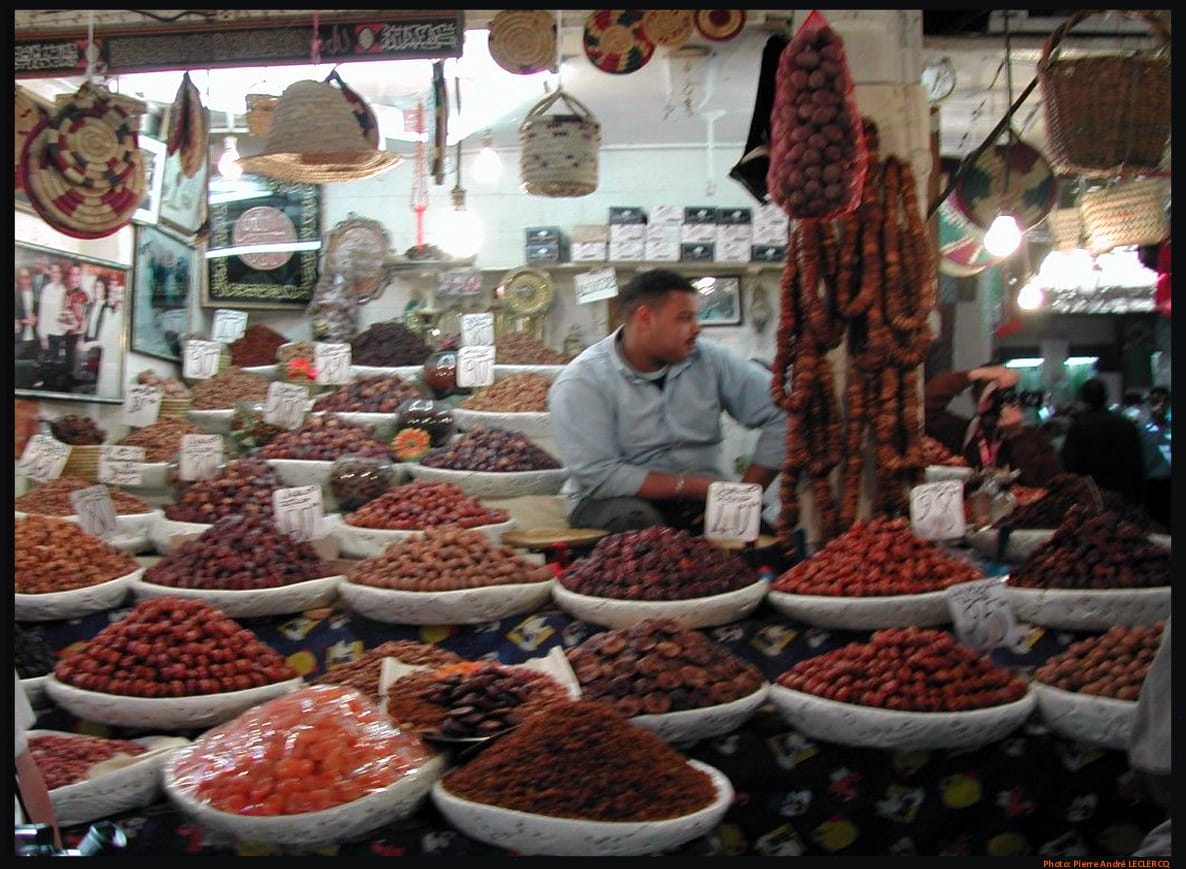
The souks of the medina form a maze of alleys where the artisan quarters follow one another: coppersmiths, dyers, leather workers, sellers of spices, carpets and babouches. It’s a festival of colours, smells and sounds. So you don’t wander too far off, keep a mental landmark: from Jemaa el-Fna square, the souks climb northward; you just have to head back south to find the square again. Don’t be afraid to haggle, with a smile: a quoted price can often be divided by two or three. Allow 1.5 to 2 hours of wandering. Our guide to the souks of Marrakech details the quarters, fair prices and the art of negotiation.
3:30 pm – El Badi or the Saadian Tombs, your choice
In a single day, you have to decide. Two gems of the Saadian era, very close to each other in the south of the medina, are worth the detour, but you’ll only have time for one if you want to enjoy the rest. The El Badi Palace is a grandiose ruin, with vast courtyards and pools where storks nest; you can feel the megalomania of a palace that was once sumptuous (entry around 100 MAD / 10 €). The Saadian Tombs, more intimate, house richly decorated mausoleums including the famous hall of twelve marble columns (entry around 100 MAD / 10 €, queues sometimes long). Our pick for a one-day trip: the Saadian Tombs if you love refined decor, El Badi if you prefer wide-open spaces and elevated viewpoints.
Both sites are in the Kasbah district, away from the bustle of the souks. After the visit, make your way calmly back north: it’s time to think about the highlight of the show, the sunset.
The evening: sunset and Jemaa el-Fna
The evening is, for many, the best moment of Marrakech in one day. The light turns golden, the air cools and the city changes face. Two highlights follow one another: a panorama from up high, then immersion in the most famous square in Morocco.
5:30 pm – Sunset on a rooftop
Nothing beats a rooftop terrace to capture the magic of the golden hour. Around Jemaa el-Fna, many cafés and restaurants offer rooftops overlooking the square, the minarets and, on a clear day, the snow-capped peaks of the Atlas in the distance. Settle in about thirty minutes before sunset, order a mint tea or a fresh juice, and watch the square come alive beneath your feet as the lights switch on. It’s the moment to catch your breath after an intense day. To spot the best terraces and the evening atmosphere, take a look at our guide to Marrakech nightlife and rooftops.
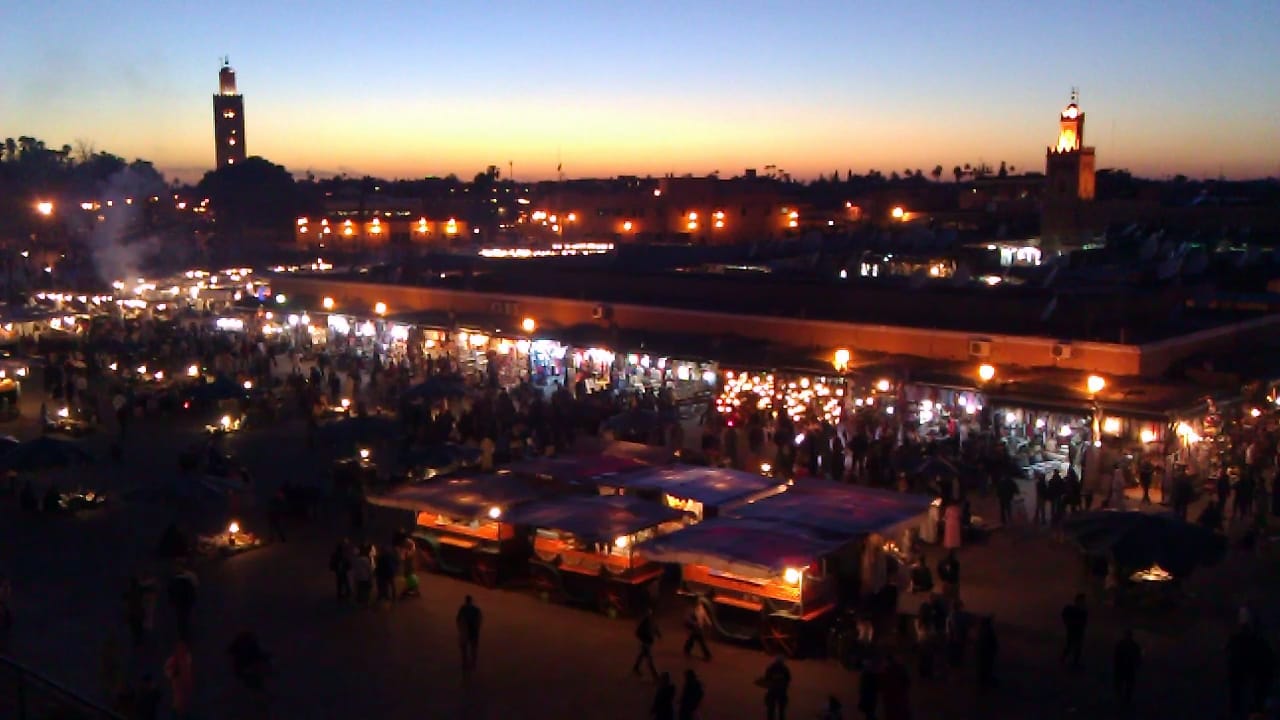
6:30 pm – Jemaa el-Fna, the grand finale
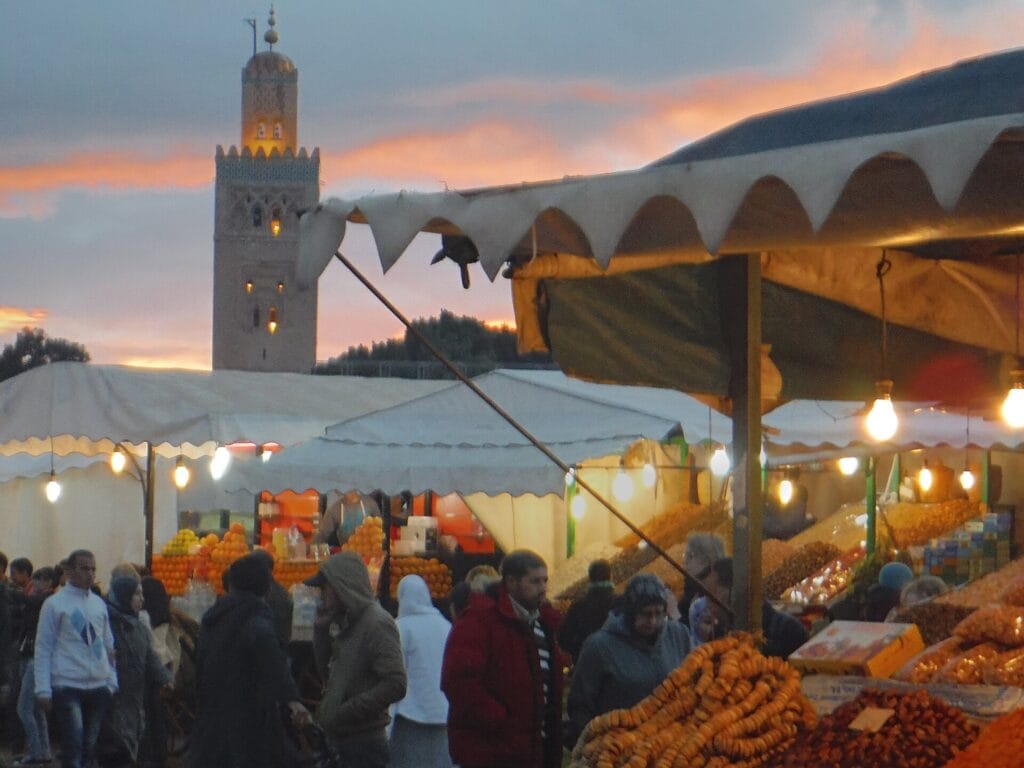
Finally, head down to Jemaa el-Fna square, the beating heart of the medina and a masterpiece of oral and intangible heritage recognised by UNESCO. As night falls, the square is transformed: steaming food stalls, storytellers, Gnaoua musicians, snake charmers, juice sellers and a cosmopolitan crowd. It’s the ideal setting for your dinner. Sit down at one of the numbered grill stalls, or opt for a restaurant on the edge of the square if you prefer some quiet. Count on 60 to 120 MAD (6 to 12 €) for a full dinner at the stalls. Stay alert with your belongings, politely decline persistent approaches, and let yourself be carried by the unique energy of the place: it’s the perfect final note for a day in Marrakech.
The walking itinerary: mental map and distances
The good news is that this whole programme can be done on foot. The Marrakech medina, listed as a UNESCO World Heritage Site, is compact: the distances between the major sites are measured in hundreds of metres, rarely more. Here is the mental map to keep in mind so you don’t go round in circles.
- Koutoubia → Bahia: about 900 m, 12 minutes on foot heading east.
- Bahia → Ben Youssef: about 1.3 km, 18 minutes crossing the medina to the north.
- Ben Youssef → souks → Jemaa el-Fna: about 800 m, 10 to 15 minutes heading south.
- Jemaa el-Fna → El Badi / Saadian Tombs: about 900 m, 12 minutes to the south (Kasbah).
- Return Kasbah → Jemaa el-Fna: the same route, 12 minutes to the north.
In total, you’ll walk between 6 and 9 km over the day, counting the detours in the souks. Wear good shoes, hydrate regularly and don’t hesitate to ask for directions: in the medina, GPS sometimes struggles between the high walls. Above all, remember that Jemaa el-Fna square is your anchor point: as long as you know how to find it again, you’ll never really be lost.
A practical tip: download an offline map of the medina before you set off, because the network and geolocation are unreliable between the walls. Mark your key points in advance — Koutoubia, Bahia, Ben Youssef, Kasbah and Jemaa el-Fna — to picture the logical order of the day. If tiredness catches up with you in the late afternoon, know that a petit taxi can always take you back to the entrance of the medina: negotiate the fare before getting in, count on 20 to 50 MAD depending on distance and time. Finally, don’t try to optimise every minute to the point of never looking up: part of Marrakech’s beauty lies in the details you stumble upon in a random alley.
Airport layover version: seeing Marrakech in a few hours
You’re on a Marrakech layover and only have 4 to 6 hours between two flights? It’s short, but far from impossible: Marrakech-Menara airport is just 6 km from the centre, or 15 to 20 minutes by taxi. Here’s how to make the most of a layover.
- Check the visa and the timings: make sure you can leave the airport zone and keep a comfortable margin for the return and check-in.
- Direct taxi to Jemaa el-Fna: negotiate the price before getting in, count on around 100 to 150 MAD (10 to 15 €) for the trip from the airport.
- The express trio (2 to 3 hours on site): Jemaa el-Fna, a quick dive into the souks, then the Bahia Palace or the Koutoubia depending on your location.
- Lunch or tea on a rooftop overlooking the square to condense atmosphere and panorama.
- Head back with 1.5 hours to spare before your flight to absorb any traffic surprises.
To organise the airport-to-centre trip with peace of mind and compare transfer options, take a look at our comparison of airport transfers in Morocco. On a layover, it’s better to aim for two or three strong experiences than to chase a list: an hour on Jemaa el-Fna is worth more than ten monuments glossed over.
Mistakes to avoid when you visit Marrakech in one day
A well-lived day depends as much on what you do as on what you avoid. Here are the classic traps that spoil a Marrakech one-day itinerary, and how to sidestep them.
- Wanting to see everything: in one day, three visits savoured are better than eight rushed. Accept that you’ll have to make choices.
- Setting off too late: every hour lost in the morning is paid for in crowds and heat in the afternoon. Be out by 8am.
- Taking a car into the medina: the alleys are pedestrian or narrow; a car is a source of stress. Walk.
- Underestimating the heat: in summer, midday can exceed 40 °C. Bring water, a hat and breaks in the shade.
- Not haggling: in the souks, the first price is rarely the right one. Negotiating is part of the game.
- Following a tout: beware of spontaneous “guides” who steer you towards a friend’s shop. A polite no is enough.
- Forgetting to cover shoulders and knees near places of worship, out of respect for local customs.
Also keep some cash on you: many small stalls, taxis and shops don’t accept cards. An ATM near Jemaa el-Fna will help you out if needed.
And if you have more time?
One day gives a fantastic overview, but Marrakech deserves that you linger. If your schedule allows, extend your stay: the pace becomes gentler and you discover facets that the express format doesn’t let you explore, such as the Majorelle Garden, the palm grove, a traditional hammam or an excursion into the Atlas.
- Two days: you add the gardens, a moment of relaxation and a more thorough exploration of the souks. Follow our Marrakech in 2 days itinerary.
- Three days: you fit in an excursion (Ourika valley, waterfalls, Agafay desert) and some real downtime. Everything is detailed in our Marrakech in 3 days itinerary.
Whatever time you have, the important thing is to leave with a few strong memories rather than a long list hastily ticked off. Marrakech is to be savoured: even in one day, leave yourself room for the unexpected, an encounter, a shared tea or an alley that draws you in.
FAQ: Marrakech in one day
Can you really see Marrakech in one day?
Yes, provided you focus on the essentials. In one well-organised day, you can see the Koutoubia, one or two historic monuments (Bahia, Ben Youssef, El Badi or the Saadian Tombs), the souks and Jemaa el-Fna square. You won’t see everything, but you’ll leave with a faithful and powerful image of the city.
How much does a day in Marrakech cost?
Count on around 250 to 450 MAD (25 to 45 €) per person for a day, including two to three monument entries (around 50 to 100 MAD each), a quick lunch, a dinner on the square and a few drinks. Shopping in the souks and taxis come on top depending on your wishes.
What is the best starting point for the itinerary?
Jemaa el-Fna square and the nearby Koutoubia make the ideal starting point. The whole historic heart is organised around this axis, and it’s also where you’ll return in the evening. If you’re staying in the medina, you’re already on the doorstep; otherwise, ask your taxi to drop you near the Koutoubia.
What to see in Marrakech in one day if I only have the morning?
Focus on three stops: the Koutoubia for the landmark and the gardens, the Bahia Palace for the decor, then an express dive into the souks up to Jemaa el-Fna. That way you cover a monument, crafts and atmosphere in three to four hours, the essentials of a Marrakech layover.
Do you need a guide for a day in Marrakech?
It’s not essential: this itinerary is very easy to follow independently. An official guide can nonetheless enrich the visit of the monuments and save you from getting lost in the souks, over half a day. If you hire one, choose a licensed guide and agree on the fee in advance.
What is the best time to visit Marrakech in one day?
Spring (March to May) and autumn (September to November) offer the most pleasant temperatures for walking all day. Summer is hot: favour the morning and the evening then, and reserve midday for breaks in the shade. Winter stays mild and bright, perfect for a short stay or a layover.
To go further, the city has a rich thousand-year history that you can explore on the Marrakech Wikipedia page. Have a great day in the ochre city!
Images under free licence via Wikimedia Commons: © Misa.stefanovic.07 (CC BY-SA 4.0); © Pierre André Leclercq (CC BY-SA 4.0); © YoTuT (CC BY 2.0). Sources: Wikimedia Commons.Photo credits: royalty-free illustrative images. Prices and opening hours are indicative and subject to change; check the official information before your visit.