You dream of wandering the colourful souks, sipping mint tea on a rooftop terrace and feeling the energy of Jemaa el-Fna square, but one question holds you back: is it sensible to go on your own? The answer is yes. Every year, thousands of women visit Marrakech solo and come home with bright memories. The city isn’t dangerous in the way that word is often meant: serious physical assaults targeting tourists remain rare. What you should prepare for, on the other hand, is verbal street harassment — remarks, whistles, pushy pitches from vendors and “fake guides” — especially in the medina. This is what Marrakech solo female travel is really about.
This article tackles the subject of Marrakech solo female travel honestly, without playing down the nuisance but without dramatising it either. We’ll draw one essential distinction throughout the guide: the one between annoyance (frequent, irritating, but harmless) and real danger (rare). You’ll find concrete tips, tested by female travellers, for getting around calmly, choosing reassuring accommodation, reacting to an awkward situation and, above all, fully enjoying this magnificent city. Travelling alone in Marrakech isn’t just possible: it’s an experience many women would happily repeat without hesitation.
In brief
- Is it safe? Yes, on the whole. Marrakech welcomes many solo female travellers; serious violence against tourists is rare.
- The real nuisance: verbal street harassment (remarks, whistles, pushy vendors, fake guides), especially in the medina.
- The right attitude: walk with confidence, ignore without replying, keep your distance, don’t let yourself be followed.
- Dress: covering shoulders and knees noticeably reduces unwanted attention.
- At night: avoid the deserted alleys of the medina; favour taxis ordered by your riad.
- Accommodation: a well-rated riad in the medina, or a hotel in Guéliz, with an arrival transfer arranged in advance.
Is Marrakech safe for a woman travelling alone? (an honest reality check)
Let’s start with the most important point, straight up. In terms of physical safety, Marrakech ranks among the relatively safe destinations for female travellers. Morocco is one of the most stable countries in the region, tourism is an economic pillar, and local authorities keep an active watch over areas frequented by visitors. Marrakech even has a dedicated tourist police brigade. Snatch thefts (phone, bag) happen, as in every major tourist city in the world, but violent assaults specifically targeting solo women remain infrequent and are not the norm.
So why do you sometimes read anxious accounts? Because the daily reality of a woman alone in Marrakech isn’t the fear of assault: it’s the fatigue of verbal harassment and constant pitching. In the alleys of the medina and around Jemaa el-Fna square, you’ll hear remarks, people will try to sell you something, to “guide” you, to catch your attention. It’s annoying, it can make you uncomfortable, and it would be dishonest to gloss over it. But we need to name things accurately: in the vast majority of cases, this is a nuisance, not a threat.
It’s this distinction — frequent nuisance versus rare danger — that should guide your mindset. A prepared traveller knows she’ll cross paths with pushy vendors and that a firm “no” is enough in 99% of cases. She doesn’t confuse an irritating tout with an attacker. This mental clarity changes everything: it lets you stay relaxed, keep control and savour the city rather than endure it. The great majority of women who visit Marrakech solo come back saying they’d return — which is the best underlying indicator there is.
For more on the tourist traps that aren’t specific to women (money changing, inflated prices, classic scams), see our dedicated guide: safety and scams in Marrakech. It perfectly complements what we cover here from the angle of Marrakech solo female travel.
Street harassment: what to expect and how to react
Best to know before you go: street harassment is the first thing female travellers mention when it comes to safety in Marrakech. It takes various forms, almost always verbal. It’s better to be aware of them so you’re not caught off guard and, above all, so you don’t over-read them.
The most common forms
- Remarks and compliments: “gazelle”, “hello beautiful”, words in several languages tossed out as you pass. Often they stop the moment you don’t react.
- Whistles and lingering stares: unpleasant, but with no follow-up in almost every case.
- Pushy vendors and touts: they follow you a few metres, repeat their spiel, try to draw you into their shop.
- “Fake guides”: they offer to show you the way, a square, a tannery, then demand money. We devote a whole section to them below.
- Forced henna: on Jemaa el-Fna square, some women grab your hand to apply henna, then demand payment. Keep your hands close to you and decline firmly.
The strategy that works
The golden rule comes down to three words: ignore, keep moving, don’t engage. Street harassment feeds on attention. The more you reply, argue or justify yourself, the more you fuel the exchange. Here are the effective reflexes recommended by experienced travellers:
- Walk with confidence, at a purposeful pace, as if you knew exactly where you’re going — even when you don’t. A confident manner discourages most approaches.
- Don’t make eye contact with people calling out to you. Looking straight ahead isn’t rudeness, it’s a clear boundary.
- Don’t answer, or give a firm “no, thank you” without smiling and without slowing down. Silence is often the most powerful tool.
- Earphones (with or without music) send the signal that you’re not available for conversation.
- Keep your physical distance: don’t let anyone take your hand, “guide” you by the arm, or crowd you.
- Don’t feel obliged to be excessively polite. Western courtesy (smiling, explaining, thanking) can be read as encouragement. A clear “la, choukran” (no, thank you) is enough.
One last, essential point for your morale: don’t take these approaches personally. They’re aimed at “the tourist”, not at you specifically. Many travellers say that after a day or two of adjustment they found their rhythm, the harassment became background noise they filtered out effortlessly, and the joy of discovery took over again.
How to dress to feel comfortable
Dress isn’t a legal requirement in Marrakech — you’ll see tourists dressed in a thousand ways — but it’s a concrete lever for reducing unwanted attention and travelling more calmly. The principle: cover the shoulders and knees. It’s not a matter of morality or submitting to a norm, simply an adaptation to the local cultural context that will make your life easier, especially in the medina and working-class neighbourhoods.
- Favour loose, lightweight clothing: flowing trousers, a long dress, a tunic. They also protect against the sun.
- A light scarf in your bag is versatile: shoulders, head for visiting a religious site, sun protection.
- Plunging necklines, short shorts and thin tank tops draw more attention in traditional areas. Save them for the riad poolside instead.
- A veil is not required for non-Muslim women in the street.
We’ve written a complete, illustrated guide on this subject, with outfit examples by season and location: read what to wear in Marrakech. You’ll find all the useful detail there to pack your case without any missteps.
Getting around alone: taxis, on foot, at night
Getting around well is half of the peace of mind when it comes to Marrakech solo female travel. The city is mostly explored on foot in the medina and by petit taxi elsewhere, and organisation counts for more than luck.
On foot
The medina is a labyrinth: get lost by day, with pleasure, but keep an offline map (Google Maps downloaded, or Maps.me) and the name of your riad noted down. Getting lost is the surest way to attract fake guides. Walk preferably where there are people. The medina is at its liveliest and safest between roughly 9am and 6pm; that’s the best window to explore the souks.
Petits taxis
- These are the beige/local-colour taxis for trips within the city. Insist on the meter (“compteur, s’il vous plaît”) or negotiate the fare before getting in.
- As a rough guide, an urban daytime ride is often around 20 to 50 dirhams; at night a surcharge applies. Ask your riad about the usual fare for your route.
- Have the taxi ordered by your accommodation in the evening: it’s safer and the price is set in advance.
- Ride-hailing apps may be available depending on the period; failing that, the petit taxi remains the simple, affordable solution.
At night
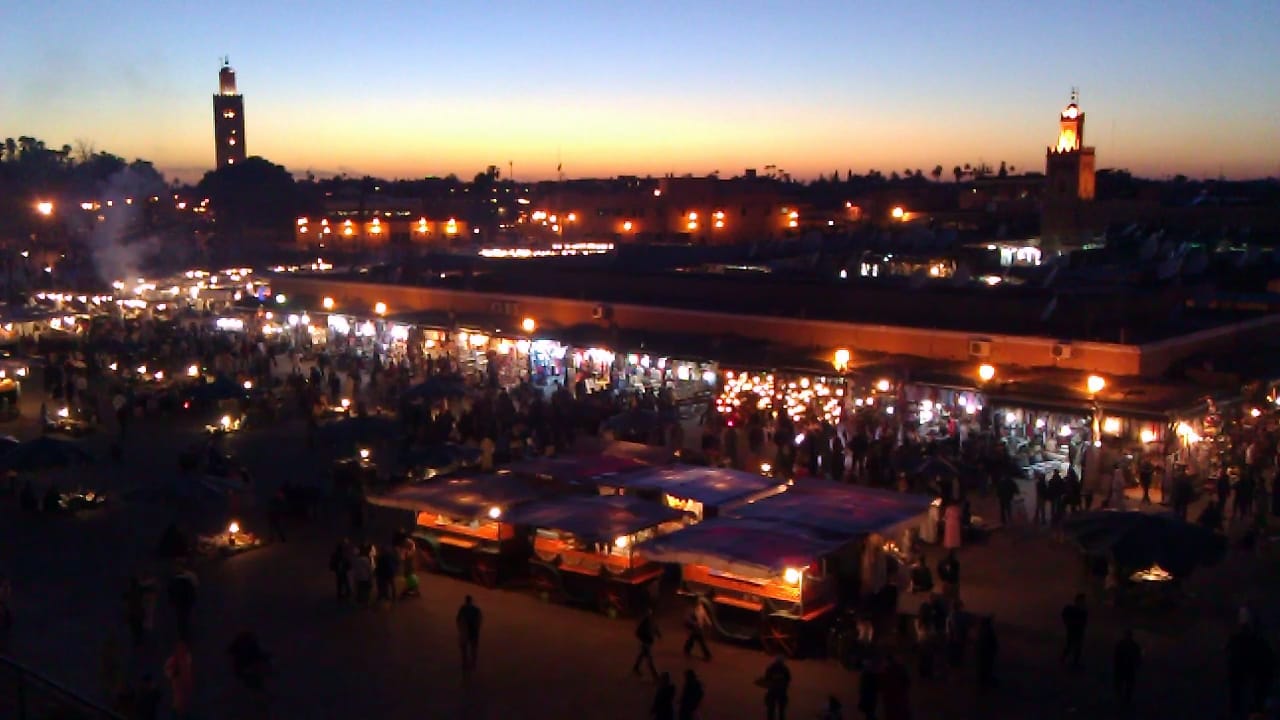
This is when caution matters most. Avoid the deserted, poorly lit alleys of the medina after dark, particularly after 9pm. That doesn’t mean staying shut indoors: Jemaa el-Fna square in the evening is a spectacle not to be missed, very lively and busy. The smart move is to take a taxi back as close as possible to your riad rather than crossing dark, empty passages alone. Let your accommodation know your return time if you’re out late.
For everything about the modes of transport, fares and local tips, our detailed guide will be useful: getting around Marrakech. And for airport arrival, the most stress-free option remains a private transfer booked in advance — compare the solutions in our comparison of airport transfers in Morocco. Avoiding a haggle with an unknown taxi at midnight, after a flight, is well worth the price.
Where to stay: safe riads and good neighbourhoods
The choice of accommodation weighs enormously on your comfort. For a woman alone, a good riad or hotel isn’t just a bed: it’s a refuge, a reliable source of information and a logistical ally (taxis, recommended guides, advice).
- The riad in the medina: the authentic experience par excellence, with patio, terrace and a carefully prepared breakfast. Choose one that’s very well rated, with recent reviews from solo female travellers, and ask to be met at the edge of the neighbourhood (the alleys aren’t accessible by car — a staff member guides you in).
- Guéliz (the new town): more modern, with wide avenues, cafés, restaurants and Western-style hotels. Some travellers feel more at ease here, especially for a first trip; harassment is less present than in the heart of the medina.
- Hivernage: a district of hotels and residences, quiet and secure, a little more upmarket.
Whatever the neighbourhood, check the ease of access (how to reach the entrance from a taxi), the existence of a responsive reception, and read the reviews filtering for solo stays. Our selection by neighbourhood and budget is here: where to stay in Marrakech. An attentive host often makes all the difference between a stressful stay and a wonderful one.
Fake guides and touts
This is probably the most recurring approach. “Fake guides” spot visitors who look lost or hesitant and spontaneously offer help: “the square is that way”, “the souk is closed, come, I’ll show you”, “the tannery, follow me”. The scenario almost always ends with a demand for money, sometimes forceful, or a forced detour to a shop where you’ll be pressured to buy.
- Decline outright any spontaneous offer to guide you, however friendly: “no thanks, I know the way”, and keep walking.
- Be wary of the classic “it’s closed” or “the action’s over there”: it’s often a pretext to divert you.
- If you’re lost, ask for directions instead from a shopkeeper in their shop, from a woman, or in a café — not from someone who approaches you in the street.
- To visit with a companion, go through an official guide booked via your riad or a reputable agency. You’ll then know exactly what you’re paying for.
So do you actually need an official guide to visit Marrakech? It’s not compulsory, but it has real advantages — including cutting off fake guides at the source. We lay out the pros and cons in do you need a guide in Marrakech. And to understand the layout of the historic heart where these approaches are concentrated, see our guide to the Marrakech medina.
What to do when a situation gets awkward
Most of the time, ignoring is enough. But if someone insists to the point of making you uncomfortable, or refuses to leave you alone, here’s a graduated set of simple, effective responses.
- Don’t engage: pick up the pace, with no comment or glance. Often the person gives up after a few metres.
- Set a firm boundary: a clear, loud “la!” (no!), hand raised, in a tone that brooks no argument. Firmness surprises and ends most persistence.
- Head to a busy place: step into a shop, a café, a hotel. The presence of other people defuses the pressure.
- Ask for help: turn to a shopkeeper, a family, an employee. Moroccans are, in the vast majority, welcoming and quick to help a visitor who’s being bothered.
- Call on the authorities: Marrakech has a tourist police brigade and officers present in busy areas. In the event of theft or threatening behaviour, don’t hesitate to approach them.
Keep the underlying distinction in mind: an irritating vendor isn’t a threat, it’s a nuisance you handle with a “no” and your legs. Real danger — someone who touches you, blocks your path, follows you insistently in an isolated spot — is rare, but if it happens, don’t stay alone: head towards the crowd, the light, an open shop, and ask for help without hesitation. Making noise and drawing attention is your best asset.
Enjoying the city solo: what makes Marrakech magical
We’ve talked a lot about vigilance; now for the pleasure, because that’s exactly why you’re going. Travelling alone offers total freedom: your rhythm, your desires, your encounters. And Marrakech is brimming with experiences perfectly suited to solo travel, where you feel good and surrounded by others.
- The hammam: a must, both cultural and restorative. The spaces are separated men/women, the atmosphere is caring, and it’s one of the most soothing moments of the trip. Choose according to your budget between a local hammam and an upmarket spa: see our guide to hammam and spa in Marrakech.
- A cooking class: ideal for a solo traveller. You learn to make tagine or pastilla, share a meal, and meet other travellers in a warm, safe setting. Details and addresses in our article on cooking classes in Marrakech.
- Gardens and museums: the Majorelle Garden, the Secret Garden, the palaces and museums offer calm interludes, far from the bustle of the souks.
- Café terraces: settling in up high with a mint tea to watch Jemaa el-Fna square is a simple, pressure-free pleasure.
- Organised excursions: a day in the Atlas, the Ourika Valley or towards a nearby desert works very well in a supervised group, a reassuring format for a woman alone.
To build your programme without missing anything, lean on our complete guide to things to do in Marrakech. A tip from solo travellers: book one or two supervised activities early in your stay. They give you bearings, let you meet people and build a confidence that carries over into the rest of the trip.
Tips from women who’ve done it
Beyond the general rules, here are the tips that come up most often among women who’ve experienced Marrakech solo female travel and recommend the experience.
- The first two days are the most intense. You absorb the culture shock, the noise, the constant approaches. After that, you find your rhythm and everything flows more easily. Don’t judge your stay on the first few hours.
- Wear a wedding ring or mention a husband “joining later”. Many travellers find that mentioning a partner cuts off certain advances, rightly or wrongly.
- Keep small change and a little cross-body bag worn in front of you in crowds; leave your passport and most of your cash in the riad safe.
- Learn three words: “salam” (hello), “la, choukran” (no, thank you), “choukran” (thank you). It disarms people, and a confident “la, choukran” sends touts packing.
- Trust your instinct. If a situation, an alley or a person makes you uncomfortable, turn around. You owe no one an explanation.
- Connect with others. Riads, cooking classes, excursions and cafés are natural places to meet people. You travel alone without being isolated.
- Photograph with respect. Ask before photographing people, especially women and market traders; some ask for money for a photo.
The common thread through all these accounts is the same: preparation and confidence radically transform the experience. Travellers who arrive informed, know what to expect and set their boundaries live Marrakech as an exhilarating adventure — not as an ordeal.
Useful numbers and what to do if there’s a problem
Best to have these details saved in your phone before you leave. You hope never to use them, but their presence is reassuring.
- Police (emergency): 19 — the number to dial in the city in an emergency.
- Ambulance / SAMU: 15 — medical emergencies.
- Royal Gendarmerie: 177 — mainly outside cities (roads, outskirts).
- Marrakech tourist police brigade: present around busy areas (Jemaa el-Fna, medina); approach an officer in the event of a dispute or persistent harassment.
- Your embassy or consulate: note their contact details, useful in the event of a lost passport or a serious problem.
- Your riad’s contact: keep it accessible; the staff are often your fastest and most effective help.
In practice, the course of action is simple: in the event of theft, go to the nearest police station to file a report (essential for insurance); in the event of persistent harassment, head to a busy place and report the situation to an officer; in a medical emergency, call 15 or ask your accommodation to organise help. Taking out travel insurance before departure remains the best protection to cover care, theft and repatriation.
To place Marrakech in context, its history and setting, you can consult its encyclopaedic entry on Wikipedia.
FAQ — Marrakech for a woman travelling alone
Is it really safe to travel alone in Marrakech?
Yes, on the whole. Serious physical assaults targeting tourists are rare and a great many women visit Marrakech solo every year. The main nuisance is verbal street harassment, annoying but rarely dangerous. With a minimum of preparation and vigilance, the experience is most often positive.
Is street harassment really frequent?
Yes, especially in the medina and around Jemaa el-Fna: remarks, whistles, pushy vendors and fake guides. It’s common but almost always verbal. The best response is to ignore it, walk on with a confident stride and not engage in conversation. Most approaches stop as soon as you don’t react.
How should I dress as a woman travelling alone?
Nothing is compulsory, but covering shoulders and knees with loose clothing noticeably reduces unwanted attention and eases interactions, particularly in the medina. A light scarf is handy. Very revealing outfits are best kept for the riad pool. See our dedicated guide for the details.
Can I go out alone in the evening in Marrakech?
Yes, Jemaa el-Fna square is very lively and busy in the evening, a real must. Do avoid, however, the deserted, poorly lit alleys of the medina after 9pm. The smart move is to have your riad order a taxi to bring you back as close as possible to your accommodation rather than crossing dark passages alone.
How do I react to a man who’s too insistent?
Start by ignoring him and picking up your pace. If the insistence continues, set a firm boundary with a clear “la!” (no!), without smiling. Head to a busy place — shop, café, hotel — and ask for help if needed. Shopkeepers and families willingly lend assistance. In the event of a real threat, head towards the crowd and call on the police or tourist police brigade.
Which neighbourhood should I choose to stay in when travelling alone?
A well-rated riad in the medina offers the most authentic experience and a real cocoon, provided you choose recent reviews and easy access. For a first trip, Guéliz or Hivernage, more modern and quiet, often feel more reassuring. In all cases, favour responsive accommodation that arranges your arrival transfer.
Independent tourist information guide, not affiliated with ONDA or any official body.
Images under free licence via Wikimedia Commons: © Omalihy (CC BY-SA 4.0); © Arnaud 25 (CC BY-SA 3.0); © YoTuT (CC BY 2.0). Sources: Wikimedia Commons.Photo credits: illustrative images of Marrakech (medina, riad, Jemaa el-Fna square). Please credit the authors according to the image bank used at the time of publication.