The Al Attarine Madrasa is a Quranic college built between 1323 and 1325 by the Marinid sultan Abu Said Uthman II in the heart of the Fes medina (also spelled Fez), a few steps from the Al Qarawiyyin Mosque: it is one of the most finely decorated madrasas in Morocco, and it is open to visitors today for a modest fee, usually quoted at 20 dirhams. Its courtyard is tiny, but every square centimetre is worked, from the zellij floor to the carved cedar eaves.
Many visitors stumble on it by chance as they come out of the spice souk, and walk out twenty minutes later wondering why nobody had told them about it. This page gives you what you need before going in: who built it and why, how to read its decoration, where to look, how to get there without getting lost, and how to choose between it and its great rival, Bou Inania.
At a glance
- Foundation: commissioned by the Marinid sultan Abu Said Uthman II (reigned 1310-1331), built from 1323 to 1325.
- Name: it takes its name from the Souk al-Attarine, the market of spice sellers and perfumers that surrounds it.
- Original purpose: to house and feed students attending lessons at the neighbouring Qarawiyyin, around fifty to sixty boarders.
- Architecture: a two-storey courtyard, a prayer hall to the east and about thirty rooms upstairs, on a very narrow plot.
- Decoration: zellij on the floor and lower walls, carved stucco, chiselled cedar, marble columns and bronze-plated doors.
- Status: listed as a historic monument since 1915, inside the Medina of Fes, a UNESCO World Heritage Site since 1981.
- Visiting: paid entry (20 MAD is the figure most often quoted), allow 30 to 45 minutes, opening hours to be checked on site.
Why the Al Attarine Madrasa is seen as the peak of Marinid decoration
The Marinids, a Berber dynasty that ruled Morocco from the 13th to the 15th century, made Fes their capital and filled it with madrasas. Several are larger than this one. Bou Inania, built a generation later, is more monumental, more ambitious and has a minaret. Yet art historians and attentive visitors often reach the same verdict: it is at Al Attarine that the balance between materials is most accomplished.
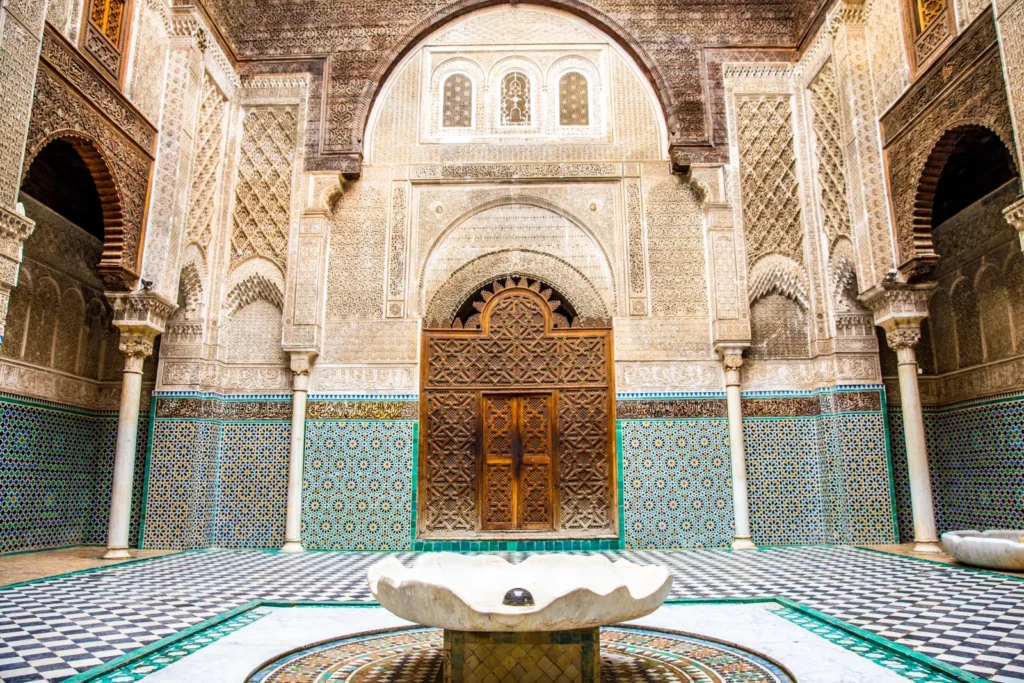
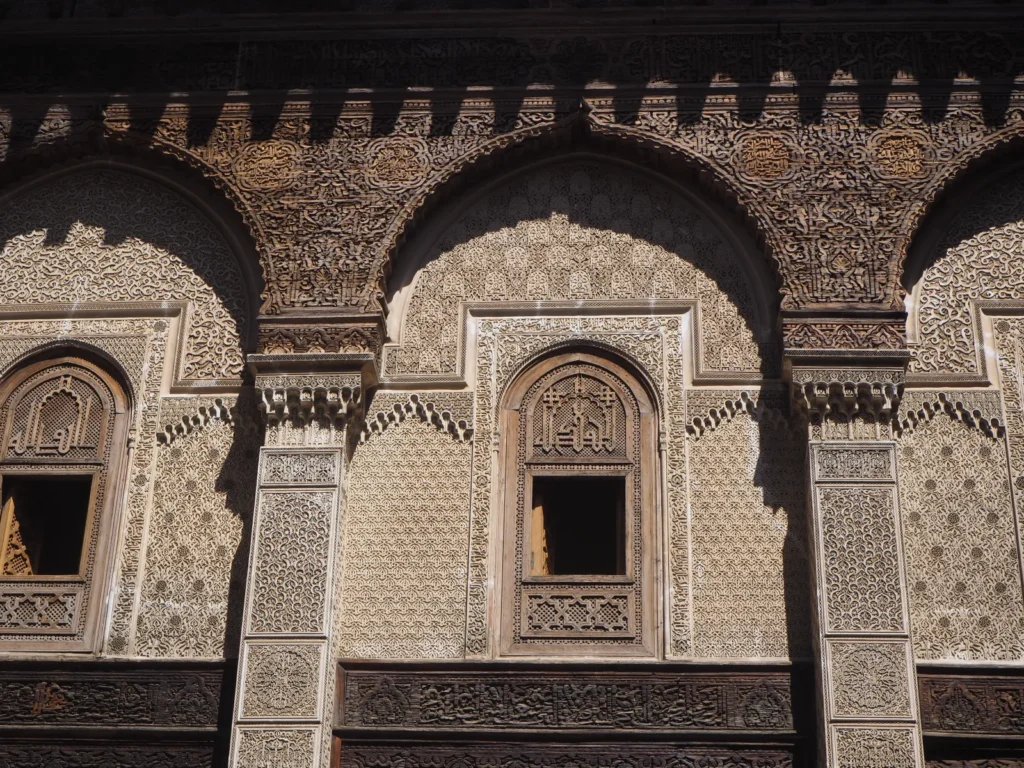
The reason lies in a constraint. The available land, squeezed between the souk’s shops and the flank of the Qarawiyyin, was minute. The builders had no room to play with volumes, so they put everything into the surfaces. The result is a courtyard where the eye never meets a bare wall. Zellij covers the floor and the lower walls, a calligraphic band runs at eye level, stucco takes over up to the upper-floor windows, and cedar closes everything off beneath the roofs. Each material keeps to its own band without spilling into the next. That discipline, more than sheer profusion, is what built the building’s reputation.
Another distinguishing point is its clever use of space. The reference article on the building in the collaborative encyclopedia, drawing on the work of Georges Marçais and Jonathan Bloom, highlights exactly this efficient use of a limited space. You can check it on the spot: the bent entrance, the off-axis prayer hall and the staircase slipped into a corner are all solutions devised to fit a complete programme into an awkward plot.
History of the Al Attarine Madrasa
Abu Said Uthman II, a builder rather than a warrior
Abu Said Uthman II was the ninth Marinid sultan. Born in Fes in 1276, he reigned from November 1310 to August 1331 and died in Taza. The chronicles describe him as pious and not fond of military campaigns; in 1313 he even returned Algeciras and Ronda to the ruler of Granada to reduce Moroccan commitments in the Iberian Peninsula. His reign is marked above all by the revolts of his son Abu Ali and by sustained building activity in Fes.
Three madrasas in the city are attributed to him: Fes el-Jdid in 1320, Es-Sahrij, begun in 1321 by his son and heir Abu al-Hasan, and then Al Attarine from 1323 to 1325. The sources report that the sultan attended the laying of the foundations in person and that the works were entrusted to Sheikh Abu Muhammad Abdallah ibn Qasim al-Mizwar. Al Attarine therefore comes at the end of a short series: the teams working on it had already honed their techniques at Sahrij, whose zellij is among the oldest preserved in any Moroccan madrasa.
A name taken from the souk of spice sellers and perfumers
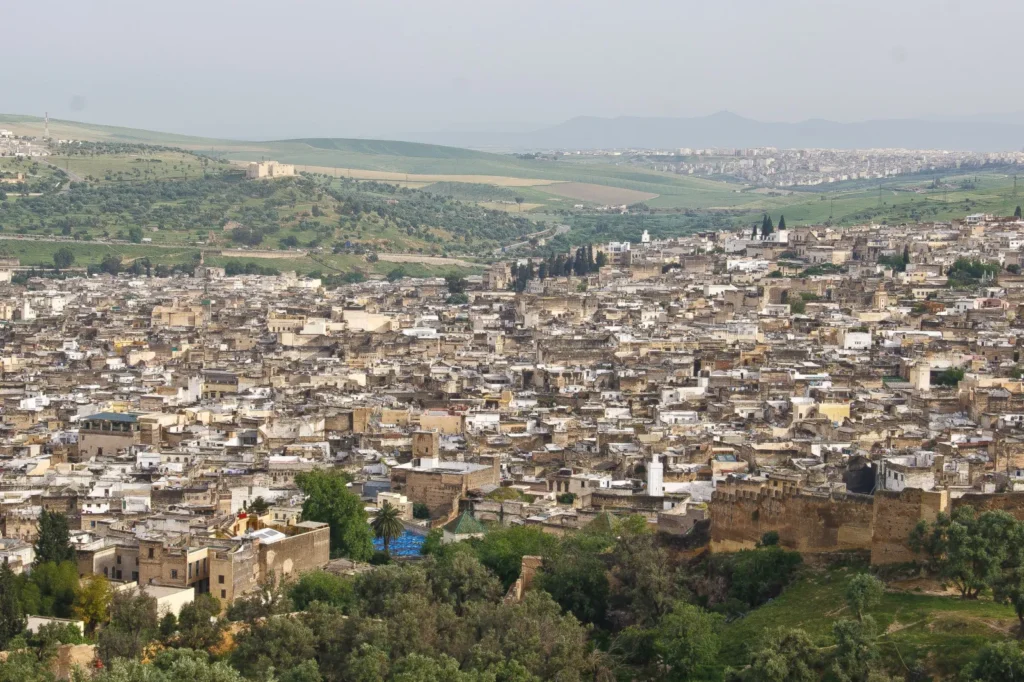
The Arabic word attar refers to a dealer in spices, medicinal drugs and perfumes; attarine is its plural. The Souk al-Attarine was one of the most prestigious markets in the medina, placed as close as possible to the great mosque, where the valuable trades were concentrated. Giving the madrasa this name anchored it in the most central and busiest quarter of Fes el-Bali. Even today, the route that leads to it passes stalls of spices, henna and traditional apothecary goods, although souvenir shops have gained ground.
A residence for Qarawiyyin students
A Marinid madrasa is not a university in the modern sense. The main teaching took place at the nearby Al Qarawiyyin mosque-university; the madrasa housed the students, gave them bread and hosted additional classes. Al Attarine was funded by habous endowments, meaning inalienable properties whose income maintained the building and paid an imam, muezzins and teachers. It could take fifty to sixty students, many of them from towns in the north-west of the country such as Tangier, Larache or Ksar el-Kebir, trained mainly in Islamic law and jurisprudence.
The choice was not purely pious. By multiplying madrasas, the Marinid sultans trained Maliki jurists loyal to their rule and asserted their legitimacy in the face of traditional religious authorities. Each foundation carried the ruler’s name in its inscriptions; at Al Attarine, the bronze chandelier in the prayer hall still bears an inscription praising its founder.
From its 1915 listing to recent restorations
The madrasa has been a listed historic monument since 1915, among the very first protected buildings in Morocco. It has gone through several restoration campaigns carried out in keeping with its original style. The most recent was part of the programme to rehabilitate the historic madrasas of the Fes medina, launched on 4 March 2013 under the patronage of King Mohammed VI and carried out with the agency for the de-densification and rehabilitation of the Fes medina (ADER-Fès). A ceremony marked the completion of the programme on 23 May 2017. Several accounts from visitors and guides indicate that Al Attarine was closed to the public during part of the works; it is open to visitors today, but an occasional closure for maintenance is always possible, so it is worth checking with your accommodation the day before.
| Date | Event |
|---|---|
| 1276 | Birth in Fes of the future sultan Abu Said Uthman II |
| 1310 | Start of his reign |
| 1320 | Foundation of the Fes el-Jdid madrasa |
| 1321-1323 | Es-Sahrij Madrasa, launched by crown prince Abu al-Hasan |
| 1323-1325 | Construction of the Al Attarine Madrasa |
| 1331 | Death of the sultan in Taza |
| 1350-1355 | Construction of the Bou Inania Madrasa by Abu Inan Faris |
| 1915 | Al Attarine listed as a historic monument |
| 1981 | Medina of Fes inscribed on the UNESCO World Heritage List |
| 2013-2017 | Royal programme to restore the historic madrasas of Fes |
What you see inside the Al Attarine Madrasa, from the entrance to the upper floor
The bent entrance and the bronze doors
You do not walk into the courtyard in a straight line. From the street, an L-shaped vestibule turns the visitor, which once protected the students’ privacy and stopped passers-by in the souk from seeing inside. A pierced wooden screen of the mashrabiya type still filters the view. On the north side of this vestibule was the ablutions hall, the mida’a, essential to any building that contains a prayer hall.
Stop before crossing the threshold and look at the door leaves. They are made of cedar covered with bronze plates forming a network of geometric interlacing; Kufic inscriptions appear at the centre of eight-pointed stars. This kind of metal cladding continues an older tradition, already present in the Almoravid period. Published studies indicate that the original leaves were moved for safekeeping to the Batha museum; what you see at the entrance may therefore be a faithful replacement, which takes nothing away from the geometry lesson.
The courtyard: three registers, three materials
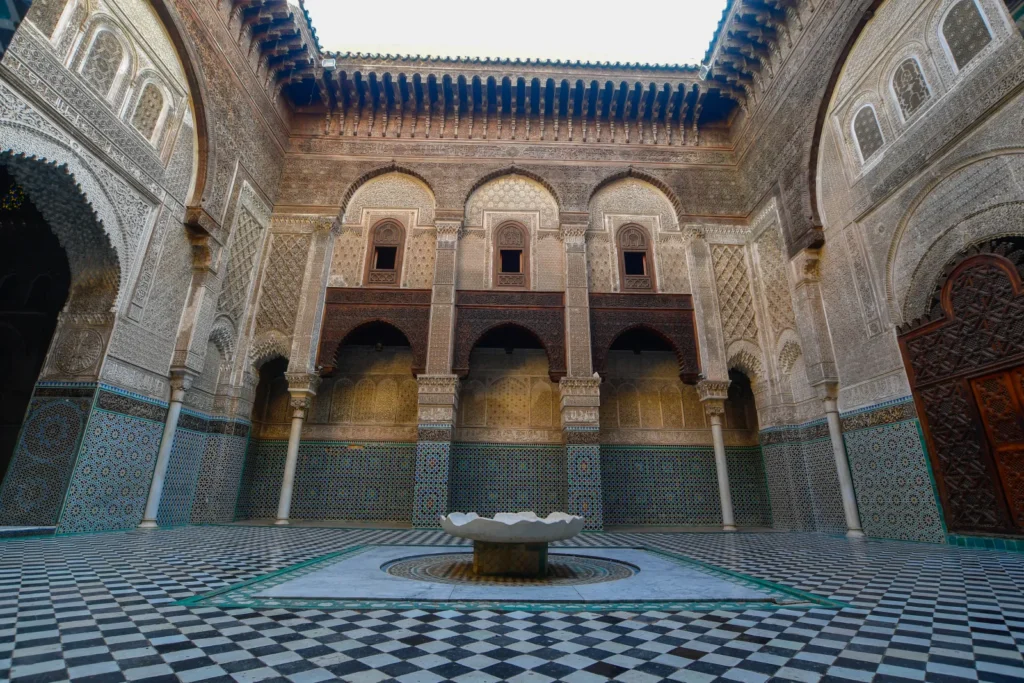
The courtyard is rectangular and runs west to east. In the centre, a marble basin stands in the middle of a chequerboard floor. Then raise your eyes and follow the three levels of decoration.
- At the bottom, zellij: thousands of small pieces of glazed terracotta, cut one by one and assembled into compositions of stars and polygons. The dado rises to shoulder height.
- At eye level, a ceramic epigraphic band: this is the line to read, carrying texts in praise of God and of the founder.
- Above, carved stucco: arabesques, plant motifs, muqarnas cells and lozenge networks known as sebka, covering the pillars and walls up to the upper-floor windows.
- At the very top, cedar: carved lintels, brackets and eaves, which protect the stucco from rain and cast shifting shadows over it.
The cedar arches and marble columns
Along the sides of the courtyard, galleries open through arches of an original design: two square pillars and marble columns support three carved wooden arches, framed by small stucco arches with muqarnas. The dark, warm wood contrasts with the creamy white of the stucco. The column capitals deserve a closer look: they are of rare finesse, carved with stylised foliage that reflects know-how inherited from al-Andalus.
The prayer hall, its off-axis mihrab and its Marinid chandelier
At the far, eastern end of the courtyard, a large cedar door topped by a lambrequin arch with a muqarnas intrados leads into the prayer hall. This rectangular room holds a surprise: its mihrab, the niche indicating the direction of Mecca, is not on the axis of the courtyard but on a side wall, perpendicular to the main axis of the building. Once again, the plot imposed this solution. A three-arched gallery on the north side frees a square space in the centre, covered by a wooden cupola decorated with geometric stars.
Two details are worth a look. The high windows are fitted with coloured glass set in lead grilles, rather than the simple stucco screens often found elsewhere, which tints the light. And a Marinid-era bronze chandelier still hangs in the hall, with its inscription praising the founder. Visitor access to the hall is generally limited to the threshold or a marked area; respect the ropes and look from the entrance if access is closed.
The students’ rooms upstairs
A staircase off the south side of the entrance vestibule leads upstairs, where about thirty rooms line the central void. They are small and plain, lit by windows overlooking the courtyard: you feel the contrast between the luxury of the shared spaces and the austerity of the boarders’ daily life. When the upper floor is open, which is not always the case, go up: the view down onto the courtyard zellij completely changes your perception of the decoration, and some openings give a glimpse of the green-tiled roofs of the Qarawiyyin.
Reading the decoration: four things to spot
At first glance, the decoration of Al Attarine can seem overwhelming. It follows a precise grammar, though, and a few pointers are enough to move from dazzlement to understanding.
- The geometry of the zellij. Pick a star on the floor or a wall and follow the lines that leave it: they continue endlessly and join other stars. This idea of a pattern with no beginning or end lies at the heart of western Islamic art.
- The script. Notice the difference between Kufic, angular and vertical, and cursive, more supple. Kufic often appears in panels or on the doors, cursive in the running bands.
- The muqarnas. These small stacked cells, which look like stalactites or a honeycomb, act as a transition between a flat surface and a curve: look for them inside the arches and under the brackets.
- The woodwork. Under the eaves, the cedar beams and brackets carry carved motifs of great precision, shown off particularly well by the raking light of late morning.
A tip on method: first walk round the courtyard without a camera, looking only at eye level, then do it again looking only upwards. This two-step visit takes ten extra minutes and saves you from leaving with two hundred photos and no clear memory.
Al Attarine Madrasa or Bou Inania: which one to visit?
Almost every traveller short on time asks this question. Our answer is clear: if you have time, visit both, because they do not tell the same story. If you can only see one and you love detail, choose Al Attarine; if you prefer scale and monumental impact, choose Bou Inania. Our article on the Bou Inania Madrasa covers that visit in detail; here is the core of the comparison.
| Criterion | Al Attarine | Bou Inania |
|---|---|---|
| Founder | Abu Said Uthman II | Abu Inan Faris |
| Dates | 1323-1325 | 1350-1355 |
| Location | At the end of Tala’a Kebira, against the Qarawiyyin | On Tala’a Kebira, near Bab Boujloud |
| Size | Small, very constrained plot | Much larger (main building of about 35 x 39 m) |
| Religious function | Madrasa with a prayer hall | The only madrasa in Morocco that also served as a Friday mosque, with a minaret |
| Highlight | Density and harmony of the decoration | Monumental scale, minaret, water clock opposite |
| Prayer hall | Usually viewed from the threshold | Closed to non-Muslims |
| Crowds | Variable, peaks around midday | Often busier, as it is close to the medina entrance |
A logical route is to start with Bou Inania, near Bab Boujloud, then walk down Tala’a Kebira to Al Attarine: you go from the most imposing madrasa to the most refined, and the contrast helps you appreciate each one. Enthusiasts can add the Cherratine Madrasa, founded much later under the Alaouite dynasty in a far more restrained style, just a short walk away.
Visiting the Al Attarine Madrasa: access, opening hours, fee and tips
| Information | Details |
|---|---|
| Address | Souk al-Attarine, end of Tala’a Kebira, Fes el-Bali, next to the Qarawiyyin |
| Opening hours | Daytime, every day, generally from about 9 am to 6 pm; some sources give 8.30 am-12.30 pm and 2.30 pm-6.30 pm. Possible closures at prayer times, to be checked on site |
| Fee | 20 MAD per adult most often displayed; a reduced rate is sometimes quoted for groups, to be checked at the ticket desk |
| Payment | Bring cash in dirhams and small change |
| Duration | 30 to 45 minutes, an hour if the upper floor is open and you take time to read the decoration |
| Dress | Shoulders and knees covered recommended |
| Photography | Generally allowed without flash in the courtyard; avoid tripods |
| Accessibility | Steps at the entrance and stairs to the upper floor; difficult access by wheelchair |
Getting there from Bab Boujloud, step by step
Bab Boujloud, the blue-tiled gate on the west side of the medina, remains the easiest starting point. Of the two main streets heading down towards the centre, take Tala’a Kebira, the one that passes the Bou Inania Madrasa. Follow it downhill without leaving it: it crosses quarters of butchers, shoemakers and slipper sellers, passes near the Cherabliyine mosque, then narrows as it approaches the commercial heart. When the spice and apothecary shops multiply, you are in the Souk al-Attarine. The madrasa stands where the street runs up against the Qarawiyyin; if in doubt, ask a shopkeeper for “Medersa Attarine” rather than a tout. Count on a little over a kilometre of walking, or 20 to 30 minutes with stops.
Another option, shorter on foot: take a taxi to Bab Rcif, on the south-east side of the medina, then walk up via Place Seffarine and along the Qarawiyyin. This route works well if you are staying in the new town. If you have just flown in, our page on Fes-Saiss Airport explains the options for reaching the medina.
Opening hours, fee and closures
Published opening hours vary from one source to another, and to our knowledge no official website keeps them up to date online. Expect daytime opening, every day, with possible interruptions at prayer times, especially at midday on Fridays. The fee most commonly seen is 20 dirhams, payable in cash at the ticket desk. During Ramadan and on religious holidays, hours are often shortened: in that case, aim for late morning.
Dress and behaviour
Even though the madrasa no longer operates as a student residence open to the public, it remains a religious place with a prayer hall. Cover shoulders and knees, speak quietly, do not sit on the edge of the basin and do not touch the stucco: the material is fragile and every hand leaves a greasy mark. If people are praying in the hall, step back and wait.
Best time and photography tips
Come at opening time or in the late afternoon. Around midday, guided groups follow one another and the sun beats straight down into the narrow courtyard: it flattens the relief of the stucco and creates harsh contrasts between lit and shaded areas. In the morning, light enters at an angle, glides over the carvings and brings out the muqarnas.
- For the overall view, stand at the west end of the courtyard, with your back to the entrance, and frame the basin with the prayer hall door behind it: this is the classic, symmetrical composition.
- A wide-angle lens or a smartphone’s 0.5x mode is almost essential, the courtyard is so narrow.
- For details, aim for the capitals, the calligraphic band and the cedar brackets rather than trying to fit everything into a single image.
- Photograph the zellij from above, from the upper floor, if it is accessible.
- Do not photograph people at prayer, and ask before photographing the guard.
Mistakes to avoid
- Following an improvised “guide” who approaches you on Tala’a Kebira claiming the madrasa is closed: it is a classic trick to take you elsewhere. Go and check for yourself.
- Confusing Al Attarine with the Qarawiyyin: the great mosque is closed to non-Muslims, who can only look through the doors; the madrasa, on the other hand, can be visited.
- Arriving without change: the ticket desk does not always have change for a large note.
- Cramming five madrasas into the same morning: after the third, your eye is saturated and you stop seeing anything. Better two well observed.
Around the Al Attarine Madrasa
The madrasa sits at the densest point of the medina. Within less than ten minutes’ walk you can reach several major sites, which makes it an ideal stop in the middle of a day of sightseeing.
- The Qarawiyyin: its doors open a few metres away; from one of them you can see the courtyard and its fountains. Its history, from the 9th century to today, is covered in our dedicated article.
- Place Seffarine: on the other side of the Qarawiyyin, the coppersmiths’ square rings with hammer blows on copper; it is also home to the Seffarine Madrasa, founded in 1271, the first of the Marinid madrasas of Fes.
- The Zaouia of Moulay Idriss II: the shrine of the founder of Fes, very close by, is closed to non-Muslims inside, but its surroundings and decorated doors can be seen from the street.
- Fondouk Nejjarine: a former caravanserai that now houses a museum of wooden arts and crafts, ideal for extending your study of carved cedar.
- The souks: spices, copper, slippers, fabrics… Our guide to the Fes souks helps you find your way and haggle without stress.
- The Al Batha Museum of Islamic Arts: reopened in February 2025 by the National Museums Foundation after restoration, it is near Bab Boujloud, so combine it with the start or end of your route.
To plan the rest of your stay, our guide to things to do in Fes suggests itineraries for one, two or three days.
FAQ about the Al Attarine Madrasa
Who built the Al Attarine Madrasa?
The Marinid sultan Abu Said Uthman II, who reigned from 1310 to 1331. The works took place between 1323 and 1325, supervised by Sheikh Abu Muhammad Abdallah ibn Qasim al-Mizwar.
What does “Attarine” mean?
It is the plural of attar, a dealer in spices and perfumes. The madrasa is named after the Souk al-Attarine, the market of spice sellers and perfumers that still surrounds it today.
How much is the entrance fee to the Al Attarine Madrasa?
The fee usually displayed is 20 dirhams per adult, payable in cash. This amount is not published on an official website and may change: check at the ticket desk.
Can non-Muslims visit the Al Attarine Madrasa?
Yes, the courtyard and, depending on the period, the upper floor can be visited regardless of religion. The prayer hall is generally viewed from its threshold. That is the big difference from the neighbouring Qarawiyyin, which is closed to non-Muslims.
How much time should I allow?
Between 30 and 45 minutes is enough for a careful visit. Allow an hour if you take a lot of photos or if the upper floor is open.
Do I need a guide to visit the madrasa?
No, you can easily visit on your own once you are there. An official guide, recognisable by a badge, can however save you time in the alleys and enrich your reading of the decoration. Turn down unofficial guides who approach you in the street.
Al Attarine or Bou Inania: which is more beautiful?
Bou Inania impresses with its size and minaret, Al Attarine with the density and harmony of its decoration. For detail and finesse, Al Attarine wins in our view; ideally, see both on the same day by walking down Tala’a Kebira.
Do students still live there?
The madrasa now operates as a monument open to visitors. The upper-floor rooms are not presented as occupied by students; the restoration programme for the Fes madrasas did, however, seek to give some of them back a teaching role, and this may change.
In summary
The Al Attarine Madrasa is a small building that concentrates, on an awkward plot, the most accomplished work of Marinid art: flawless geometric zellij, a calligraphic band at eye level, chiselled stucco and a crown of cedar, arranged in registers without confusion. Built from 1323 to 1325 to house Qarawiyyin students, listed as early as 1915 and restored under the royal programme of 2013-2017, it can be visited in under an hour for around twenty dirhams. Come early, look at eye level before raising your head, and pair it with Bou Inania to grasp the full ambition of the Marinids.
Official sources
- UNESCO: Medina of Fes, World Heritage
- ArchNet: Madrasa al-‘Attarin, Fes
- National Museums Foundation: Al Batha Museum of Islamic Arts
- Wikipedia: Al-Attarine Madrasa, with scholarly bibliography
This article is for information only and was updated in September 2026. Fees, opening hours and access conditions at the Al Attarine Madrasa may change: check them on site before your visit.
Photo credits
Images: featured image « File:Médersa Attarine.jpg » — Houssain tork (CC BY-SA 4.0); « File:Al-Attarine Madrasa YAC 2017.jpg » — Alina Chan (Public domain); « File:Attarine – courtyard arch.jpg » — Ariel Gera (CC BY-SA 4.0), via Wikimedia Commons.