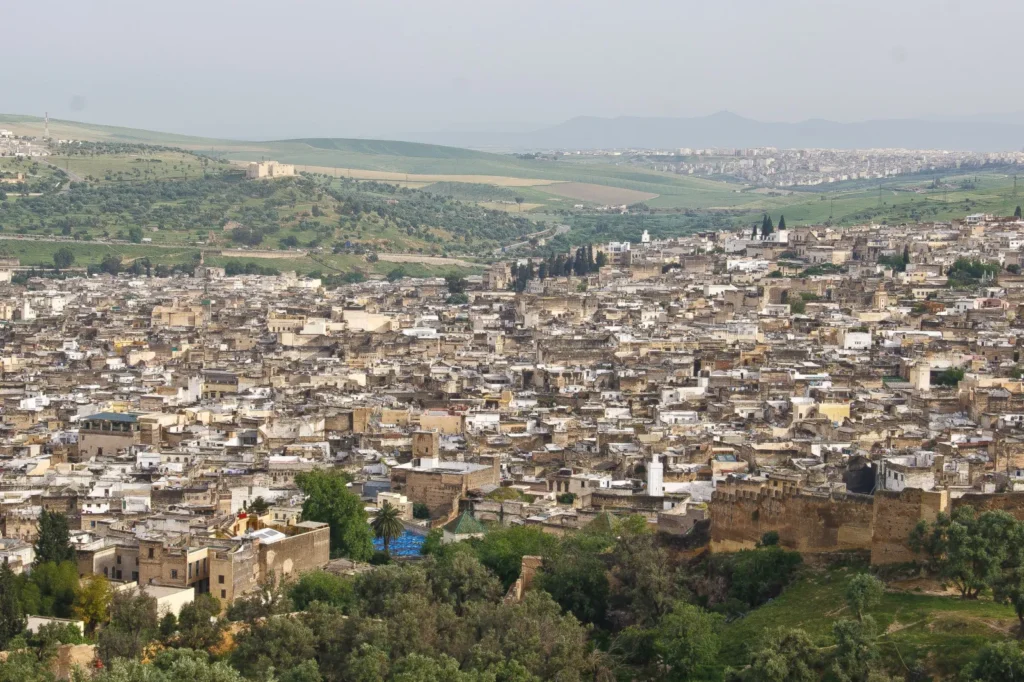
The Mellah of Fes is the city’s former Jewish quarter, created in the mid-15th century inside Fes el-Jdid, right against the Royal Palace, and described by the Fes Regional Tourism Council as the first organised Jewish quarter in Morocco. Today you walk along a street lined with open balconies, visit two restored synagogues, Ibn Danan (late 17th century) and Slat al-Fassiyine, and end in a vast whitewashed cemetery. In Arabic it is written ملاح فاس; you will also see “Mellah of Fez”, and the synagogue appears as “Aben Danan” or “Slat Rabbi Shlomo Ibn Danan” (صلاة ابن دنان).
Information verified in September 2026
Key facts
- The Mellah of Fes occupies the southern part of Fes el-Jdid, between the walls, at the foot of the Royal Palace (Dar el-Makhzen); its streets are open to walk freely at any time of day.
- It was created in the mid-15th century under the last Marinid sultans; many historians link it to the rediscovery of the tomb of Idris II in 1437-1438.
- The Ibn Danan Synagogue, built around 1680, was restored with the World Monuments Fund and the Moroccan Ministry of Culture and reopened in 1999; it has been a listed historic monument since 2002.
- The Slat al-Fassiyine Synagogue, considered the oldest in the quarter, reopened in February 2013 after two years of restoration.
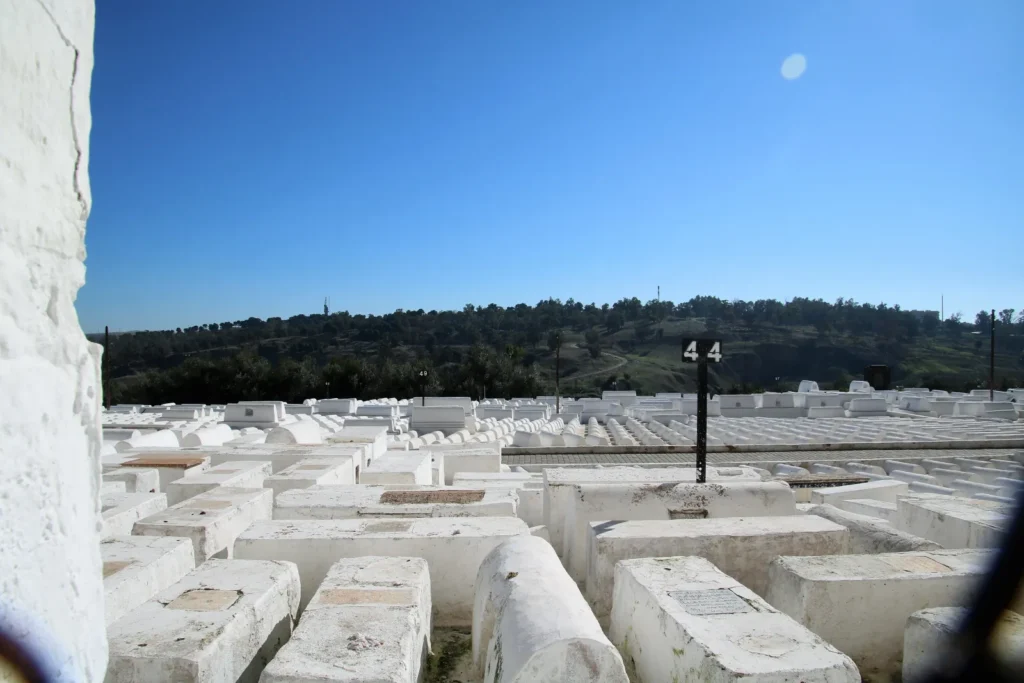
- The Jewish cemetery, in the south-eastern corner of the Mellah, holds about 22,000 graves according to those in charge of its restoration, including that of Solica Hachuel, executed in 1834.
- No official admission fee is published: the synagogues and the cemetery ask for a small contribution or donation at the door, to be checked on site.
Practical information
The Mellah of Fes can be explored freely and at no cost on foot, starting from Place des Alaouites or Bab Semmarine; only the Ibn Danan and Slat al-Fassiyine synagogues and the Jewish cemetery ask for a small contribution. The table below gathers the useful details, marked “to be checked” wherever no official source publishes them.
| Item | Details |
|---|---|
| District | Fes el-Jdid, southern part, between Place des Alaouites (Royal Palace gates) and Bab Semmarine |
| Access from a landmark | From Bab Boujloud: about 25 to 35 minutes on foot via the Jnan Sbil garden and the Grande Rue of Fes el-Jdid to Bab Semmarine (time to be checked depending on your pace); a few minutes by petit taxi to Place des Alaouites |
| Opening hours | Streets: open access. Synagogues and cemetery: no officially published hours, generally open during the day; possible closures on Saturdays and Jewish holidays, to be checked on site |
| Price | The quarter is free. Synagogues and cemetery: small contribution or donation, around 20 to 25 dirhams per site according to recent traveller reports, not officially published |
| Recommended time | 1.5 to 2.5 hours for the main street, both synagogues and the cemetery |
| Best time | Weekday mornings, before the heat and while the caretakers are present |
| Dress | Shoulders and knees covered; men may be asked to cover their heads in a synagogue |
| Accessibility | Main street manageable; steps inside the synagogues, a staircase down to the Ibn Danan ritual bath and sloping paths in the cemetery: difficult in a wheelchair, to be checked on site |
What is the Mellah of Fes and why is it Morocco’s first?
The Mellah of Fes is the quarter where the city’s Jewish community was gathered from the mid-15th century onwards, inside Fes el-Jdid, the royal city founded in 1276 by the Marinid sultan Abu Yusuf Yaqub. It is the country’s first mellah: those of Marrakesh and Meknes only appeared later, from the 16th century onwards.
In Morocco, a mellah is an enclosed Jewish quarter placed under the protection of the ruler. The origin of the word is debated: according to the most widely quoted explanation, the site in Fes already bore that name before the Jews settled there, either because of a salty water source or because a salt store (melh in Arabic) stood there. The quarter was also known as Hims. The term then travelled: every Moroccan city came to have “its” mellah, but the word was born in Fes.
Before the move, the Jews of Fes lived in Fes el-Bali, the old city founded by the Idrisids. The exact reasons for the transfer and its precise date are not firmly established. Many authors link it to 1437-1438, when the tomb of Idris II, founder of Fes, was “rediscovered” under the reign of Abd al-Haqq II: the heart of the old city was becoming a place of pilgrimage, and a Jewish presence there was judged incompatible. Other historians see it as a protective measure, placing the community against the palace, under the eye of the sultan’s guard.
That closeness to power is the key to the place. The Mellah is not an outlying ghetto: it is pressed against the Dar el-Makhzen, the royal palace, whose walls still run along its northern side. Jewish craftsmen practised many trades here, and the Regional Tourism Council points out that some activities, such as goldsmithing, jewellery-making and coin minting, were reserved for them. To place the quarter within the royal city, read our guide to Fes el-Jdid, the Marinid city.
Toshavim and megorashim: two communities in one quarter
From 1492, the edict of the Catholic Monarchs expelled the Jews from Spain, and then from Portugal; many reached Fes. Two groups were then distinguished. The toshavim (“residents”) were the indigenous Jews of the Maghreb, speaking Judeo-Arabic or Judeo-Berber and settled for centuries. The megorashim (“the expelled”) arrived from Andalusia with their own language, Judeo-Spanish, and their own prayer rites. For generations the two communities kept separate synagogues and customs, before the Sephardic rite prevailed almost everywhere. That is what makes Slat al-Fassiyine so special, as explained further down.
History of the Mellah of Fes: key dates
The history of the Mellah of Fes spans almost six centuries, from a Marinid foundation around 1437-1438 to a quarter now almost entirely inhabited by Muslim families. In between came a massacre in 1465, the arrival of exiles from Spain, a population of more than 15,000 in the late 1940s, and then mass emigration to Israel, France and Canada.
| Date | Event |
|---|---|
| 1276 | The Marinid sultan Abu Yusuf Yaqub founds Fes el-Jdid, a new administrative and military city |
| 1437-1438 | Rediscovery of the tomb of Idris II in Fes el-Bali; the Jews are moved to the future Mellah, according to many historians |
| 1465 | Revolt in Fes against Sultan Abd al-Haqq II and his Jewish vizier Harun ibn Battash; the Mellah is attacked and the sultan killed in May |
| 1492 | Expulsion of the Jews from Spain; the megorashim arrive in Fes |
| 1540-1541 | Population of the Mellah estimated at 4,000 |
| Around 1680 | The merchant Mimoun Boussidan builds the synagogue now called Ibn Danan |
| 1790-1792 | Under Sultan Moulay Yazid the Jews are driven out of the Mellah; the al-Fassiyine synagogue becomes a prison, and the community returns after his death |
| 1834 | Solica Hachuel, aged 17, is executed in Fes and buried in the Jewish cemetery |
| 1894 (or after 1912) | The Jewish cemetery is moved to the south-eastern corner of the Mellah, depending on the source |
| April 1912 | Fes riots; part of the quarter is destroyed, notably by French artillery |
| 1924 | The French administration cuts Rue Boukhessissat, later Rue des Mérinides |
| Late 1940s | About 15,150 Jews in the Mellah, 22,000 in the whole city |
| 1950s-1970s | Mass emigration to Israel, France and Canada; Slat al-Fassiyine closes around 1970-1971 |
| 1996-1999 | Ibn Danan is placed on the first World Monuments Watch (1996), restored and reopened in 1999 |
| 2002 | Ibn Danan is listed as a historic monument by the Ministry of Culture |
| 2011-2013 | Restoration of Slat al-Fassiyine, reinaugurated in February 2013 |
| From 2015 | Donor-funded restoration campaign in the Jewish cemetery |
1465: the revolt that ended the Marinids
Sultan Abd al-Haqq II had entrusted the treasury, and in practice the vizierate, to Harun ibn Battash, a Jewish banker, after eliminating the Wattasids who had been ruling in his place. The appointment of the vizier’s relatives to important posts angered part of the city. According to traditional accounts, an incident involving a relative of the vizier and a woman from a sharifian family was the spark; the sharifs called for an uprising, the crowd stormed the Mellah and the sultan was lynched in May 1465 (on the 18th or the 23rd, depending on the source), ending two centuries of Marinid rule. The chronicles speak of thousands of deaths in the Mellah. The historian Mercedes García-Arenal has, however, questioned the scale of the massacre, noting that a thriving Jewish community existed again in Fes by the 1470s.
1912 and the years after independence
In April 1912, a few weeks after the protectorate treaty was signed, Moroccan soldiers mutinied against their French instructors and the city erupted. The Mellah was looted; residents took refuge inside the neighbouring Royal Palace, and French artillery, while crushing the riot, destroyed part of the houses. The protectorate administration then redrew the surroundings: streets were widened, a Place du Commerce was laid out and, in 1924, Rue Boukhessissat was cut along the palace. After independence in 1956, departures accelerated. Only about 150 Jews remained in the whole city in 1997, and in 2017 Jeune Afrique put the community at fifty to one hundred people, most of them living in the new town around the Maimonides community centre.
Architecture of the Mellah of Fes: why the open balconies?
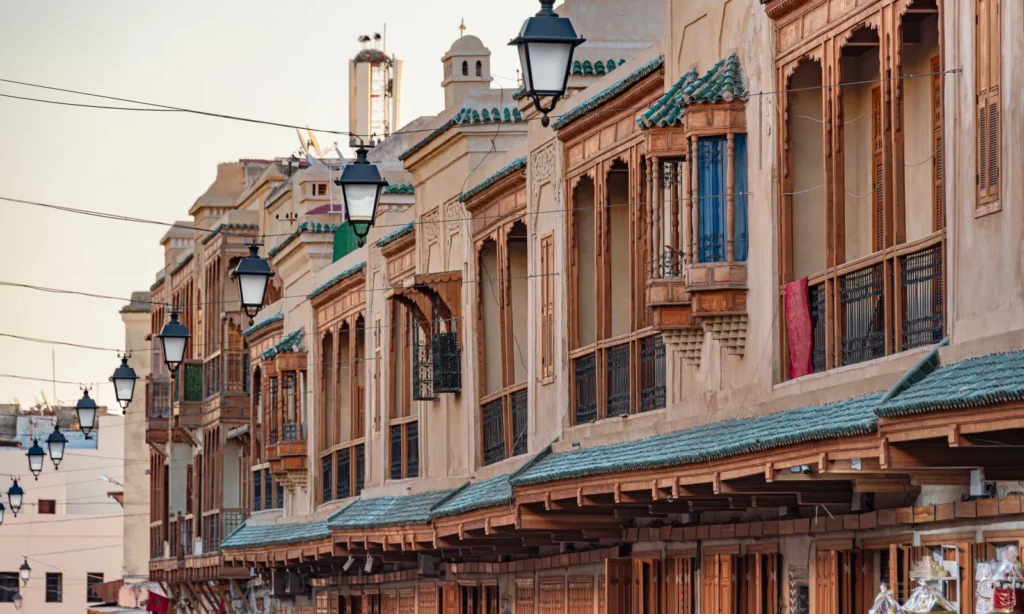
The Mellah of Fes is instantly recognisable by its street-facing houses: wooden and wrought-iron balconies, many windows, and overhanging galleries above shops sheltered by green-tiled awnings. It is the opposite of the traditional Muslim house in the medina, closed to the outside and opening onto an inner courtyard.
To measure the difference, you need to know what a riad is: a house built around an inner garden, whose rooms take their light only from the courtyard. A dar follows the same principle around a courtyard without a garden. In Fes el-Bali, façades are almost blind, pierced by a door and a few high openings; family privacy, especially that of women, is shielded from the street. In the Mellah, density, limited space and different social customs produced taller houses with balconies and windows overlooking the public street. The contrast strikes even a visitor who has just spent a morning in the medina: you feel you have changed cities within a few hundred metres.
The most photographed façade is on Rue des Mérinides, also called Rue Boukhessissat or Bou Khsisat, cut in 1924 between the northern edge of the Mellah and the southern walls of the palace. The buildings here were rebuilt or remodelled in the 20th century, which explains their plaster mouldings, regular balconies and ground-floor shops. Deeper in the quarter, the old commercial artery, Derb al-Souq (“market street”), and the lanes branching off it give an older idea of the urban fabric. In Fes, a derb is a neighbourhood lane or cul-de-sac, often closed by a gate in the past. The historic entrance to the quarter was Bab el-Mellah, flanked by a watchtower.
Many houses are tired today: cracked façades, propped-up balconies, peeling render. As most Jewish families left between the 1950s and 1970s, their homes were taken over by Muslim families. This is a lived-in neighbourhood, not a museum: look at the balconies, but do not photograph residents at their windows without their consent.
What you see along the main street
- Jewellers and shops on the ground floor, heirs to a gold and jewellery trade that was long a Jewish speciality of the quarter.
- Balconies closed with turned-wood lattice screens, others in wrought iron, sometimes filled with plants.
- Carved plaster frames and friezes on the façades remodelled in the 20th century.
- The monumental gates of the Royal Palace at the end of the street, on Place des Alaouites.
Ibn Danan Synagogue: history and what you see inside
The Ibn Danan Synagogue is a Jewish place of worship built around 1680 in the lower Mellah by the wealthy merchant Mimoun Boussidan, later owned by the Danan family of rabbis. Restored with the World Monuments Fund and reopened in 1999, it has been a listed historic monument since 2002 and can be visited on weekdays for a small contribution.
Its current name honours the Danan family, whose lineage in Fes goes back, according to the Regional Tourism Council, to the late 14th century, and more specifically Rabbi Shelomo Danan (1847-1928), who officiated there in the early 20th century according to the entry of the Discover Islamic Art virtual museum. The date “around 1680” is that of the historian Hicham Rguig; it is also given more broadly as “late 17th century”.
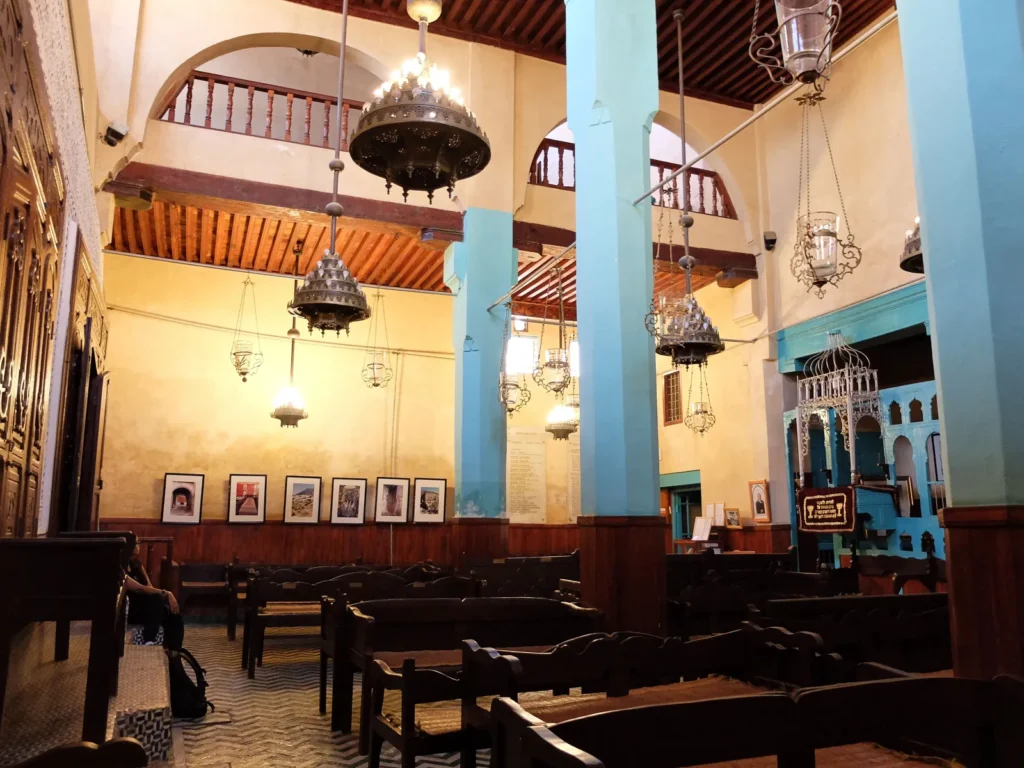
From the outside the building is plain: a door in a lane, nothing that announces the interior. You enter a rectangular prayer hall divided into aisles by octagonal brick pillars carrying arches. According to the Discover Islamic Art entry, the building first had three aisles set against the Mellah wall; a fourth, with a lower ceiling, was added later, with a women’s gallery, the azara, above it. The walls are rendered, the small windows set high, and the floor is covered with green and white faience tiles laid in a zigzag pattern.
Three elements catch the eye. First the hekhal, the holy ark where the Torah scrolls are kept, set into the eastern wall, made of carved wood and topped with chiselled plaster decoration. Then the teba, the reading platform raised by a few steps, crowned by a wrought-iron canopy with Islamic-style arches and floral motifs, ending in a crown. Finally the lamps and chandeliers hanging above the benches. The combination speaks for itself: the plan of a synagogue, the decorative vocabulary of a Fes palace, faience, carved wood and chiselled plaster included.
The mikveh found during restoration
In 1997, the works uncovered a mikveh against the eastern wall, that is, a Jewish ritual bath fed by spring water, where purification is done by immersion. It is reached through a vaulted chamber beneath the prayer hall. According to the Discover Islamic Art entry, the bath was originally outside the building and was enclosed when the fourth aisle was built. If the caretaker offers to take you down, be careful: the staircase is narrow and can be slippery.
A model restoration, 1996 to 1999
In the 1990s the synagogue was a ruin: peeling plaster, collapsed roofs, waterlogged beams rotting, broken windows. In May 1996 the World Monuments Fund placed it on the first list of its World Monuments Watch, which identified one hundred endangered monuments. In June 1997, American Express announced a 30,000-dollar grant to start the work, carried out with the Moroccan Ministry of Culture and the Foundation for Judeo-Moroccan Cultural Heritage. The synagogue reopened in 1999, and the Ministry of Culture listed it as a historic monument in 2002.
Slat al-Fassiyine, the oldest synagogue in the Mellah of Fes
Slat al-Fassiyine, “the synagogue of the people of Fes”, is considered the oldest in the Mellah of Fes. It served the toshavim, the indigenous Jews, and kept a non-Sephardic prayer rite until the 20th century. Closed around 1970-1971, then turned into a workshop and later a gym, it was restored between 2011 and 2013.
Its founding date is still debated. Several sources place it in the Marinid period (13th to 15th centuries), while the present building is generally dated to the 17th century; some historians put it before 1492, precisely because it preserved customs older than the arrival of the exiles from Spain. The daily Le Matin links its rite to the ancient tradition known as “Ahabat ha-qadmonim”. According to Hespress, it stands in the oldest lane of the Mellah.
The hall is small: about 7.3 by 11.5 metres, on a basilical plan with three aisles separated by pillars carrying pointed arches. The decoration combines zellige, a mosaic of small hand-cut glazed terracotta tiles, with carved plaster in plant and geometric patterns. A women’s gallery overlooks the hall, and the teba stands in the centre. You also see wooden benches, oil lamps and the original prayer furnishings.
Its recent history sums up that of the quarter. In 1790, under Moulay Yazid, the community was expelled and the building used as a prison; it was handed back to the community after the Jews returned in 1792. After the departures of the 1950s and 1960s, the synagogue closed and became a carpet-making workshop, then a boxing gym. Hespress reports that a Muslim caretaker kept lighting a candle there every Friday. The restoration, funded by the Jewish community of Fes, the Foundation for Judeo-Moroccan Cultural Heritage, the German government and the Moroccan state, ended with a reinauguration in February 2013 under the high patronage of King Mohammed VI, whose message was read by the head of government Abdelilah Benkirane, in the presence of the President of the Bundestag, Norbert Lammert.
The other synagogues of the quarter
At the end of the 19th century the Mellah had about fifteen synagogues, and the Regional Tourism Council counts seventeen in Fes at the start of the 20th century. Most were private prayer rooms set up in a house. Among the known names: Mansano, Ibn Attar, Rabbi Yehuda ben Attar, Rabbi Haim Cohen, Haham Abensur, Saba and Gozlan in the upper Mellah; Bar Yochai, Obayd, Dbaba and Rabbi Raphael Abensur in the lower Mellah; Aharon Cohen, Danan, Hachuel and Rabbi El Baz in the En-Nowawel quarter. Many cannot be visited or survive only as walls. Ibn Danan and al-Fassiyine remain the two essential stops.
Jewish cemetery of the Mellah of Fes and its museum
The Jewish cemetery of Fes spreads over the south-eastern corner of the Mellah, on a slope descending towards the valley. It gathers about 22,000 whitewashed graves, including those of many rabbis and of Solica Hachuel, and contains former synagogues that have been restored, one of which serves as a small museum. It is the most moving part of the visit.
The cemetery has not always been here. It used to lie at the foot of the Royal Palace; its move to the present site dates from 1894, by order of the sultan, according to some historians, or from the protectorate period, after 1912, according to others. The figure of 22,000 graves is the one given by the architect Henri Cohen, quoted by Bladi.net in January 2022, about a restoration launched in 2015 on the initiative of Sylviane and Elie Devico and funded by donors, for about 300,000 dollars at that date.
The landscape is unique in Morocco: tight rows of half-cylinder or chest-shaped graves, entirely white, numbered by alley, with the hills south of the city as a backdrop. Inscriptions are in Hebrew, sometimes in French or Spanish. Several graves of saints (tzaddikim) are marked, and according to the Visiting Jewish Morocco association the cemetery holds more tombs of Jewish saints than any other in Morocco.
The grave of Solica Hachuel
Solica Hachuel, born in Tangier in 1817, was accused of having embraced Islam and then renouncing it, which she denied; having refused to convert, she was beheaded in Fes on 5 June 1834, aged 17. Revered by Jews as Sol ha-Tzaddikah and by Muslims as Lalla Suleika, she inspired, among others, the painter Alfred Dehodencq. Her grave, with an inscription in Hebrew and French, is one of the most visited; ask the caretaker to show it to you.
The museum and the cemetery synagogues
At the bottom of the cemetery, a former synagogue has been turned into a small museum: ritual objects, photographs and books left behind by the families who departed. Visitors often know it as the Habarim synagogue. Bladi.net, quoting those in charge of the restoration, describes three synagogues from the late 19th and early 20th centuries on the site: Vidal ha-Serfaty, returned to prayer and visits, Raphael Abensour, now a museum, and Haim Cohen, fully restored. Names vary from one source to another: ask on site which one houses the museum.
The three sites not to miss: comparison
To plan the visit, remember that the Ibn Danan Synagogue has the finest interior, that Slat al-Fassiyine best tells the story of Jewish life before 1492, and that the cemetery shows the true size of the former community. All three are a few minutes’ walk from each other, in the southern half of the quarter.
| Site | Date | Current status | Must-see | Tip |
|---|---|---|---|---|
| Ibn Danan Synagogue | Around 1680 | Historic monument (2002), synagogue-museum | Carved wooden ark, wrought-iron canopy, underground mikveh | Come on a weekday morning; bring change for the contribution |
| Slat al-Fassiyine | Marinid period according to several sources, present building 17th century | Restored 2011-2013, reopened February 2013 | Zellige, carved plaster, women’s gallery | Less regular opening: ask for the caretaker in the lane |
| Jewish cemetery | Present site since 1894 or after 1912 | Restoration under way since 2015 | Grave of Solica Hachuel, rows of white graves, museum | Slope and sun: closed shoes and water |
How to visit the Mellah of Fes: access, hours, price and dress
The Mellah of Fes is about 25 to 35 minutes on foot from Bab Boujloud, or a short petit taxi ride to Place des Alaouites. The streets are open access; the synagogues and cemetery open during the day, with no officially published hours, for a small contribution. Allow two hours and wear clothes that cover shoulders and knees.
How to get to the Mellah from Bab Boujloud or the station?
From Bab Boujloud, the blue gate of Fes el-Bali, walk west and south along the Jnan Sbil garden, then follow the Grande Rue of Fes el-Jdid, lined with shops, to Bab Semmarine, the southern gate of the royal city. Rue des Mérinides starts from this area and runs along the Mellah to Place des Alaouites. Allow 25 to 35 minutes depending on stops, on flat ground. From Fes railway station, in the new town, the easiest option is a petit taxi (the petits taxis in Fes are red); insist on the meter. The official “Mellah and Fes el-Jdid” walking circuit offered by the Regional Tourism Council takes about two hours, from the Royal Palace gate to Place Moulay Hassan.
If you arrive by plane, Fes-Saiss airport lies about fifteen kilometres south of the city: our guide to Fes-Saiss airport covers the options, and our comparison of airport transfers in Morocco helps you choose between taxi, shuttle and private driver.
What are the opening hours and how much is the entrance fee?
No public body publishes official hours or prices for the synagogues or the cemetery, which are run by the community and caretakers. Travellers report daytime opening, roughly 9 am to 6 pm for Ibn Danan, and a contribution of about 20 to 25 dirhams per site. Treat these figures as indicative: they vary, and the sites may close on Saturdays, the Sabbath, and during Jewish holidays. Keep small change; the donation or ticket pays for upkeep.
What to wear and how to behave?
The synagogues are places of worship, the cemetery a place of remembrance. Cover shoulders and knees, speak quietly and follow the caretaker’s instructions: men may be asked to cover their heads in the synagogues. In the cemetery, do not sit on the graves and stay on the paths. For photos, ask permission, especially inside the synagogues.
Do you need a guide?
No, the quarter is easy to visit alone: the main street is straight and the sites are close together. An official guide, recognisable by a badge, is however a real plus for finding synagogues closed to the public, notable houses and the graves of saints. Politely decline unofficial companions who approach visitors at Bab Semmarine or outside the synagogues.
Mistakes to avoid in the Mellah
Disappointments in the Mellah almost always come down to the calendar and fake guides: arriving on a Saturday or a Jewish holiday and finding the synagogues shut, following a tout who leads you to a shop, or underestimating the slope and sun in the cemetery. Here are the pitfalls specific to this quarter.
- Coming on a Saturday without checking. The Sabbath can mean the synagogues are closed; aim for a morning from Sunday to Thursday.
- Thinking Rue des Mérinides is “the” Mellah. That façade largely dates from the 20th century; the old quarter lies behind it, in the lanes to the south.
- Following a “guide” who claims the synagogue is closed. It is a classic way to steer visitors to a shop; go and check for yourself, the sites are close by.
- Going down to the mikveh in sandals. The staircase is narrow; closed shoes are enough to avoid slipping.
- Visiting the cemetery at midday in summer. There is hardly any shade; come early and bring water.
- Paying without asking what the amount covers. Ask whether the contribution includes the gallery, the mikveh or the museum, to avoid successive requests.
- Photographing residents on their balconies. The quarter is lived in; always ask first.
What to see around the Mellah of Fes?
Everything around the Mellah of Fes can be done on foot: the brass gates of the Royal Palace on Place des Alaouites, the Grande Rue and Bab Semmarine in Fes el-Jdid, the Jnan Sbil garden, then Bab Boujloud and the entrance to Fes el-Bali. Half a day is enough to combine the Mellah and the royal city.
- The Royal Palace and Place des Alaouites: the monumental brass gates and zellige decoration of the façade are at the end of Rue des Mérinides. The palace cannot be visited; everything is explained in our article on the Royal Palace of Fes (Dar el-Makhzen).
- Bab Semmarine and the Grande Rue of Fes el-Jdid: the southern gate of the Marinid city opens onto a lively shopping street, less touristy than the medina.
- Jnan Sbil garden: a public park between Fes el-Jdid and Fes el-Bali, ideal for a shady break on the way to Bab Boujloud.
- Fes el-Bali: the Idrisid medina, with its madrasas and souks, presented in our guide to the Fes el-Bali medina. A madrasa is a religious college with lodgings for students.
To fit the Mellah into a two- or three-day stay, see our guide to things to do in Fes, which suggests itineraries by district.
FAQ about the Mellah of Fes and the Ibn Danan Synagogue
Is the Mellah of Fes the oldest in Morocco?
Yes. The Mellah of Fes, created in the mid-15th century, around 1437-1438 according to many historians, is the first organised Jewish quarter in Morocco according to the Fes Regional Tourism Council. The word mellah was in fact born here, before it came to describe the Jewish quarters of other cities, such as Marrakesh or Meknes, created from the 16th century onwards.
How much does it cost to enter the Ibn Danan Synagogue?
No official price is published. Travellers report a contribution of about 20 to 25 dirhams, paid to the caretaker for the upkeep of the building. The amount may change, and a separate sum is sometimes requested for the cemetery or the other synagogue. Bring small change and ask what the amount covers before paying.
Is the Ibn Danan Synagogue still used for prayer?
Rarely. It mainly works as a synagogue-museum open to visitors, and the entry of the Discover Islamic Art virtual museum describes it as deconsecrated. According to Jeune Afrique, the synagogues of the Mellah are used for prayer only on major occasions or pilgrimages, as today’s small community prays in the new town.
Can you visit the Mellah on a Saturday?
Yes for the streets, but the synagogues and cemetery may be closed. Saturday is the Sabbath, and sites run by the community may also close during Jewish holidays. To see the inside of Ibn Danan, Slat al-Fassiyine and the museum, choose a morning from Sunday to Thursday and, if possible, check on site the day before.
Where is the grave of Solica Hachuel?
It is in the Jewish cemetery of Fes, in the south-eastern corner of the Mellah. Solica Hachuel, born in Tangier in 1817 and executed in Fes in 1834 for refusing to convert to Islam, is revered there as a saint. Her grave bears an inscription in Hebrew and French; the caretaker will gladly point it out to you.
How long does it take to visit the Mellah?
Allow an hour and a half to two and a half hours. That is enough to walk Rue des Mérinides and the lanes of Derb al-Souq, go inside the Ibn Danan and Slat al-Fassiyine synagogues, then explore the cemetery and its museum. The official “Mellah and Fes el-Jdid” circuit of the Regional Tourism Council takes about two hours.
How do you get from Fes airport to the Mellah?
The simplest way is a grand taxi or a pre-booked transfer from Fes-Saiss airport, about fifteen kilometres south of the city. Ask for Place des Alaouites or Bab Semmarine, the two landmarks closest to the Mellah. Fares are agreed at departure or when booking, and should be confirmed before you get in.
Summary
The Mellah of Fes is where the word mellah was born, in the mid-15th century, against the walls of the Royal Palace. Its appeal lies in three things: the street of open balconies, which contrasts with the blind façades of the medina; the Ibn Danan Synagogue, from around 1680, saved by the 1996-1999 restoration; and the cemetery with its 22,000 white graves, where Solica Hachuel rests. Come on a weekday morning, bring change for donations and carry on to Fes el-Jdid and Bab Boujloud.
Official sources
- UNESCO World Heritage Centre: the Fes medina listing
- Fes Regional Tourism Council: the Mellah
- Fes Regional Tourism Council: the Ibn Danan Synagogue
- Museum With No Frontiers, Discover Islamic Art: Danan Synagogue
- World Monuments Fund: Rabbi Shlomo Ibn Danan Synagogue
This article is for information only. Opening hours, requested contributions and access conditions for the synagogues and cemetery may change: check them on site before your visit. Last updated: September 2026.
Photo credits
Images: featured image « File:Fez Rue Bou Ksissat (54242292936).jpg » — Jorge Franganillo (CC BY 2.0); « File:Ibn Danan Synagogue DSCF5062.jpg » — R Prazeres (CC BY-SA 4.0); « File:Fez Mellah 04.jpg » — Werner100359 (CC BY-SA 4.0), via Wikimedia Commons.