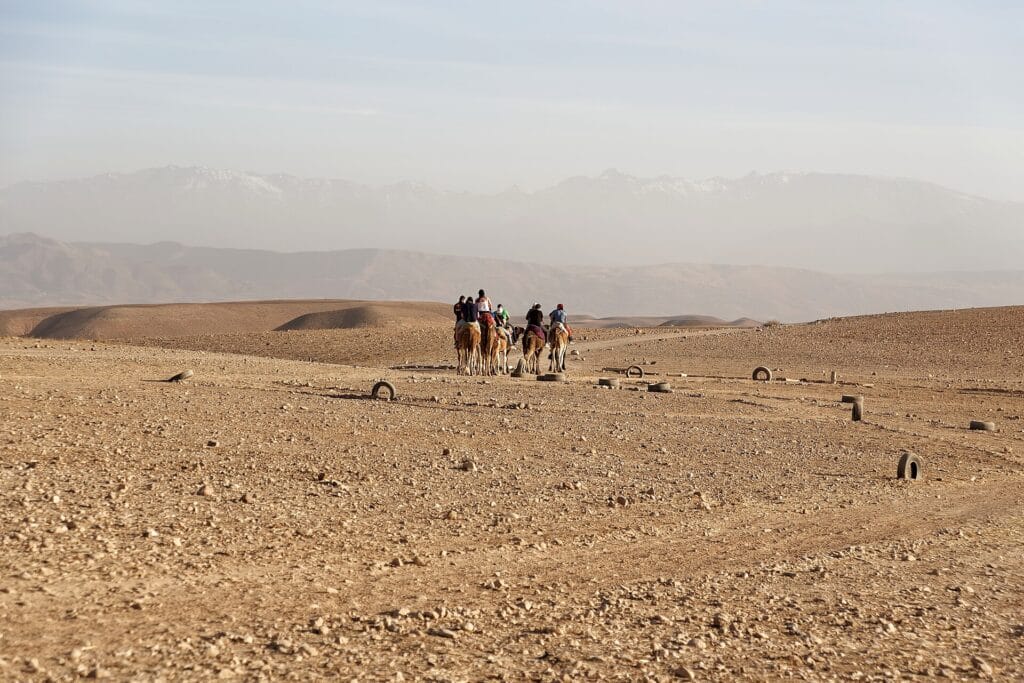
The Agafay Desert is a stretch of stony, arid hills located just 30 to 40 km (about 19 to 25 miles) southwest of Marrakesh, roughly 45 minutes to an hour by road. Contrary to what many people picture, it is not a sand desert like the Sahara: it is a lunar, mineral landscape of stones and rolling terrain, set against the sometimes snow-capped peaks of the High Atlas. For anyone short on time to reach Merzouga or Zagora, the Agafay Desert is the ideal nearby alternative: you can enjoy it for a half-day, an evening or a full night under the stars, between a camel ride, a quad-bike outing, a sunset dinner and a night in a camp. Here is everything you need to know before you go.
In brief: the Agafay Desert in 6 points
- Distance: ~30 to 40 km (19 to 25 miles) southwest of Marrakesh, i.e. 45 min to 1 hr by road.
- Landscape: a stony desert of arid hills (no sand dunes).
- Setting: sweeping views of the High Atlas peaks.
- Accommodation: numerous camps and bivouacs, from the most basic to the ultra-luxurious.
- Activities: camel rides, quad bikes and buggies, hiking, dinner and sunset under the stars, hot-air balloon take-offs.
- Ideal length: a half-day, an evening or an overnight stay.
What is the Agafay Desert and where is it?
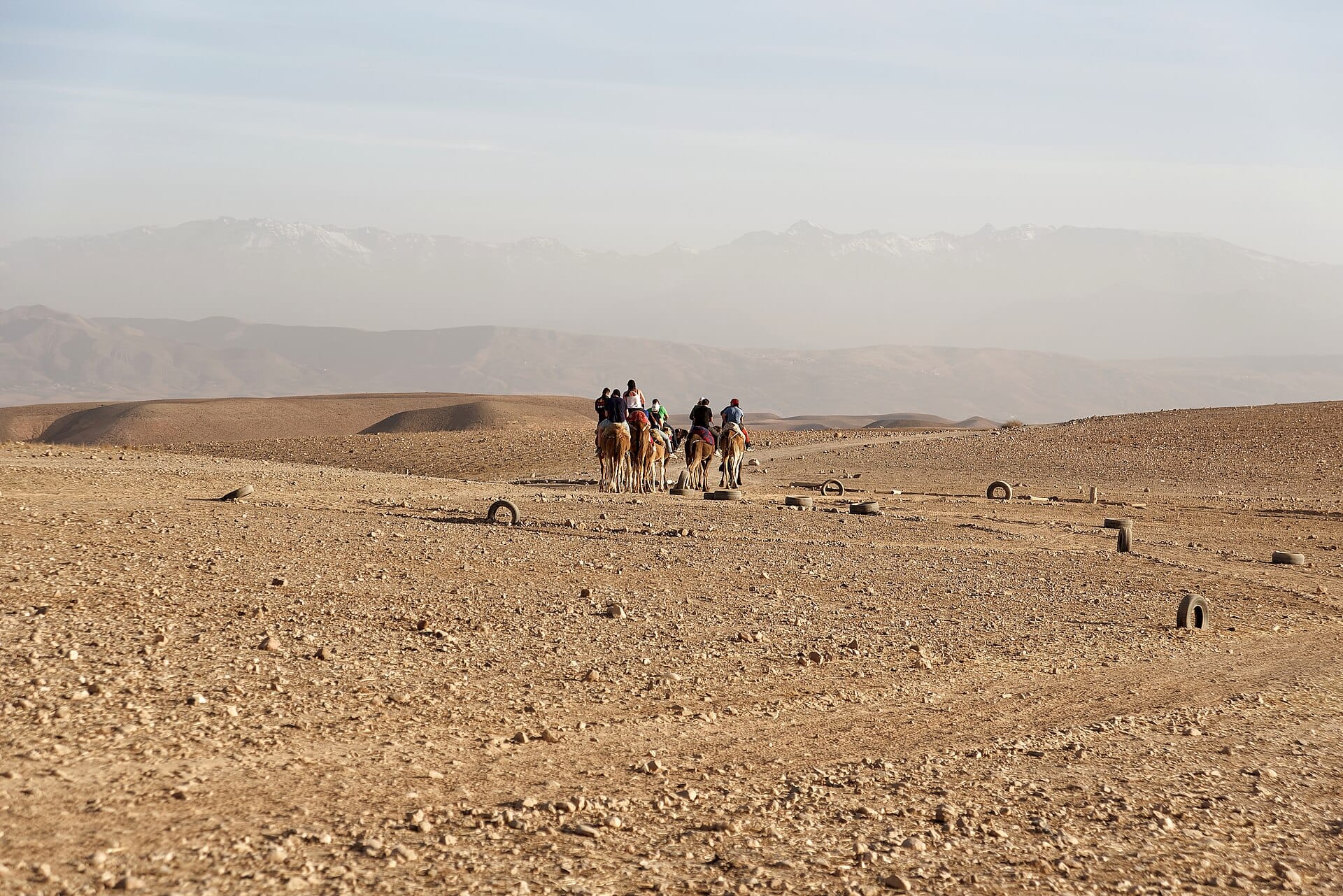
The Agafay Desert is a semi-desert plateau that stretches southwest of Marrakesh, along the road heading toward Amizmiz, between the Haouz plain and the Lalla Takerkoust reservoir. It is reached in 45 minutes to an hour by car from the medina, which makes it one of the easiest getaways to arrange from the Red City. Geographically, Agafay is not a true desert in the Saharan sense: it is an arid zone of clay and stone hills, sculpted by erosion, where the vegetation is limited to a few scattered bushes and to cereal crops in spring.
What makes the Agafay Desert so photogenic is the contrast between its beige and golden terrain and the wall of the High Atlas that closes off the horizon to the south. In winter and early spring, the peaks are cloaked in snow, creating a striking picture: a mineral, desert foreground and, in the background, snow-covered mountains. It is this meeting of desert and mountain that has built the reputation of Agafay near Marrakesh among travellers and photographers.
The name “Agafay” refers to both the plateau and the area surrounding it. It is not a fenced-off space or a paid park with an entrance fee: it is a vast semi-desert territory where, over the years, many camps and bivouacs have settled. This spread explains why the distance from Marrakesh can vary by a few kilometres depending on the establishment you choose. The area remains home to rural communities and is dotted with seasonal cereal crops, which gives the landscape a living character, somewhere between desert and countryside. This authenticity is part of Agafay’s charm: you are not in an artificial set, but in a genuine corner of Moroccan nature, shaped by the climate and by subsistence farming.
Sand or stone? Setting the right expectations
This is the most important thing to understand before you set off: the Agafay Desert is not a desert of sand dunes. Many visitors arrive picturing the great golden dunes seen on Sahara postcards, and sometimes leave disappointed for not having been warned. Agafay is a “stone” desert: a rocky, rolling landscape with a lunar feel, but no sea of sand.
This takes nothing away from its beauty, quite the opposite. The low, raking light of morning and evening creates dramatic plays of shadow across the hills, and the silence of the place, just a few kilometres from the bustle of Marrakesh, has something soothing about it. You simply have to go for what it is: a natural, mineral escape, an immersion in calm and wide-open spaces, and not to find the dunes of Merzouga. Once that expectation is adjusted, the Agafay Desert delivers on every promise.
Note that some camps build up a few mounds of trucked-in sand around their grounds, for atmosphere and photos. But these are localised touches, not real natural dunes stretching as far as the eye can see. The bulk of the plateau remains stony and clay-covered. If great golden dunes are your absolute priority, only the Sahara can offer them. On the other hand, if you are looking above all for calm, open spaces and proximity to Marrakesh, Agafay is hard to beat.
How to get to the Agafay Desert from Marrakesh
Reaching the Agafay Desert from Marrakesh is easy. The road runs southwest toward Amizmiz and Lalla Takerkoust, along paved and straightforward routes, before branching off onto tracks that lead to the various camps. Generally allow 45 minutes to an hour depending on your starting point and the exact location of the camp.
- On an organised excursion: the most common option. Most camps include round-trip transfers in their packages (dinner, sunset, overnight stay), with pick-up at your hotel or riad.
- By private taxi or driver: handy for a tailor-made half-day; agree on the price and the waiting time in advance.
- By rental car: possible, but the final kilometres are sometimes on unpaved track. A raised vehicle is more comfortable, and it is best to have the camp spell out the route for you.
Agafay combines very well with other outings in the region. To broaden your itinerary, consider a nature day in the Ourika Valley, another easy getaway at the foot of the Atlas.
Things to do in the Agafay Desert
One of Agafay’s great strengths is the variety of activities on offer, suited to families and thrill-seekers alike. Here are the must-dos.
Camel ride
This is the signature activity of the Agafay Desert. A ride on camelback, often at sunset, lets you cross the hills at a peaceful pace and take in the scenery effortlessly. Outings usually last 30 minutes to an hour. It is an ideal experience for families and for first-timers. If you are looking for an option closer to the city, the Marrakesh Palm Grove also offers camel rides amid a setting of palm trees.
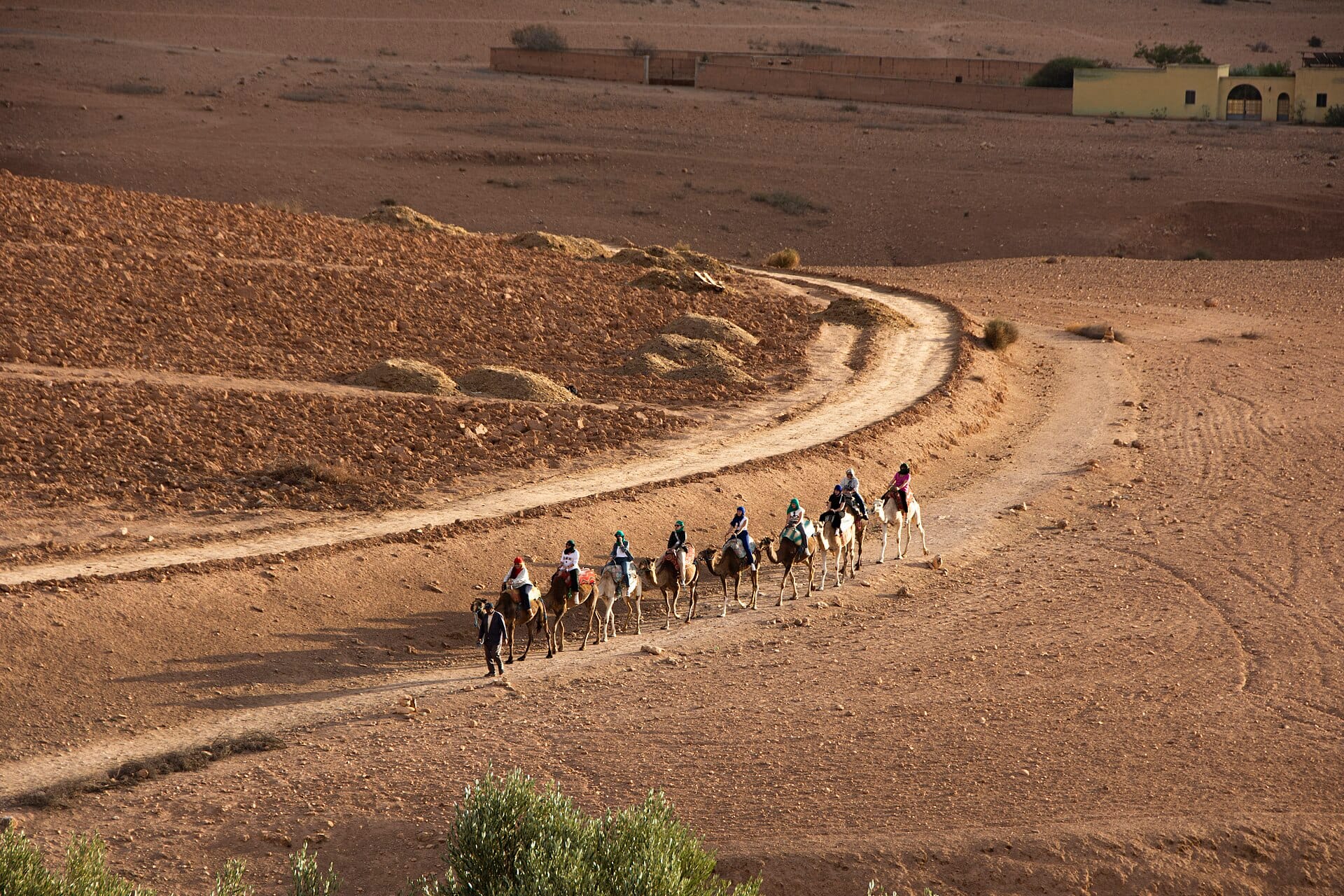
Quad bikes and buggies
For thrill-seekers, quad bikes and buggies rule at Agafay. The rocky, rolling tracks are perfectly suited to these machines, led by guides. Circuits range from an hour to a half-day. A helmet and safety briefing are provided; bring goggles and a scarf, as the dust is very much present. A quad bike is driven solo after a short introduction, whereas the two-seater buggy lets you share the experience as a pair, which often appeals to couples and families with teenagers. Always ask about the minimum age required and the insurance included before booking.
Hiking and walking
The Agafay Desert also lends itself to gentle hiking. Short walks between the hills lead to viewpoints over the Atlas or over Lalla Takerkoust lake. It is a quiet way to soak up the silence of the place, best done early in the morning or at the end of the day to avoid the heat.
Hot-air balloon
The Agafay region is one of the main take-off points for hot-air balloon flights around Marrakesh. Rising at dawn above the hills and the plain, with the Atlas on the horizon, offers an unforgettable perspective on this mineral landscape. Flights leave very early in the morning, when the wind conditions are most favourable.
Dinner and sunset under the stars
If the Agafay Desert has become so popular, it is largely thanks to its evenings. Sunset here is one of the finest moments of the day: the golden light sets the hills ablaze and reflects off the snows of the Atlas. Many camps organise dinners under the stars, with Moroccan cuisine served under a tent or in the open air, often accompanied by traditional music around a fire.
Far from the city lights, Agafay’s night sky opens up magnificently in clear weather, and you can watch the stars with the naked eye. The “dinner + sunset” package is one of the most requested for those who do not wish to stay overnight: you leave Marrakesh in the late afternoon and return in the evening, for a change of scenery in just a few hours.
To make the most of this moment, aim to arrive a good hour before sunset. That leaves time to settle in, take a short walk or do an activity, then admire the light fading over the hills and the Atlas. After dinner, take a few minutes to move a little away from the camp lights: that is where the starry sky truly reveals itself. Many travellers describe that moment of silence, beneath a star-studded vault, as the highlight of their time in the Agafay Desert.
Among the local agencies that run this format privately, Excursions Maroc offers a Berber dinner at sunset in the Agafay desert, half an hour from Marrakech, with a written itinerary and a firm quote before anything is confirmed.
Sleeping in an Agafay camp: types and budgets
Spending the night in the Agafay Desert is an experience in its own right. The range of accommodation here is very broad, from a simple bivouac to a luxury camp. Broadly speaking, there are three main categories.
- Simple bivouacs: comfortable but no-frills Berber tents, shared or basic facilities, an authentic atmosphere. The best value for money for a night under canvas.
- Mid-range camps (glamping): well-equipped tents with a real bed, a private bathroom, sometimes a pool and a carefully designed dining area. A good balance between comfort and budget.
- Luxury camps: spacious tent-suites, infinity pools, a spa, fine dining and top-end service. The Agafay Desert has several well-known addresses in this category.
Many camps have a swimming pool, very welcome for cooling off during the day, especially in fine weather. Rates vary enormously by category and season; they are given as indicative figures by the establishments and should always be confirmed at the time of booking. If you are hesitating between staying overnight on site or remaining in Marrakesh, our guide on where to stay in Marrakesh will help you compare the options.
Sleeping in Agafay is not just about the night: most camps offer packages including the previous evening’s dinner, breakfast and sometimes one or two activities. Early morning in the desert is a special time, often calmer and cooler than the evening, ideal for a walk at daybreak or simply for savouring a coffee facing the mountains. Before booking, remember to check several practical points: whether there is electricity and how it works (some remote camps run on a generator or on solar power), the availability of hot water, the type of facilities, and how well the camp is suited to families with children. These details make a real difference to the comfort of a night out in the open desert.
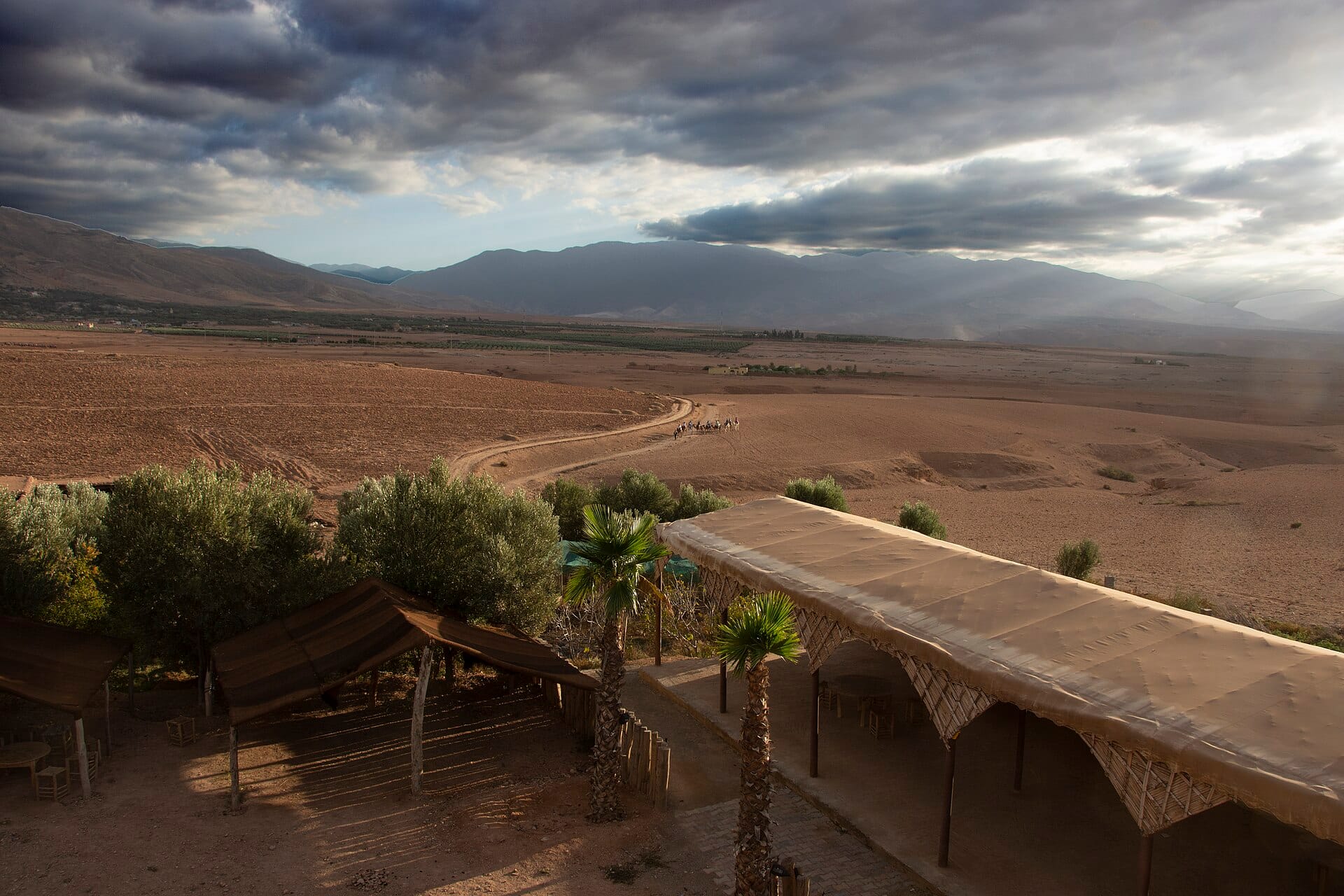
Lalla Takerkoust lake, a stone’s throw from Agafay
Right next to the Agafay Desert lies the Lalla Takerkoust reservoir, itself also about forty kilometres from Marrakesh. This large man-made body of water, backed by the dam of the same name, offers a refreshing contrast with the aridity of Agafay: calm waters, lakeside restaurants, water sports and views of the Atlas.
The lake combines very naturally with a visit to the desert: you can, for example, spend a morning at Agafay then have lunch on a terrace by the water, or reverse the order. This proximity lets you put together a lovely day blending stone desert, mountains and lakeside relaxation, without ever straying far from Marrakesh.
Depending on the season, the lake’s level varies considerably: in spring, after the snowmelt and the rains, it is generally at its highest, whereas by late summer it can recede noticeably. The shores host a few outdoor activities and restaurants that make Lalla Takerkoust a pleasant stop for families. It is also an excellent vantage point over the High Atlas, complementing the one Agafay offers. By combining the two sites, you get a very complete overview of the landscapes south of Marrakesh in a single outing.
Agafay or the Sahara: which to choose?
This is the big question for many travellers. The Agafay Desert and the true Sahara (Merzouga or Zagora) offer two very different experiences, and the choice depends above all on the time you have and on what you are looking for.
| Criterion | Agafay Desert | Sahara (Merzouga / Zagora) |
|---|---|---|
| Distance from Marrakesh | ~30-40 km (45 min to 1 hr) | ~350-560 km (7 to 10 hrs by road) |
| Landscape | Stone desert and arid hills | Real golden sand dunes |
| Recommended length | Half-day, evening or 1 night | 2 to 3 days minimum |
| Ideal for | Short on time, a quick getaway, families | Experiencing the great dunes, Saharan immersion |
In short: if you only have an evening or a day, Agafay is the obvious choice. If you dream of the great dunes and can devote several days to them, head for Merzouga or Zagora. Many travellers actually choose to do both, depending on the length of their stay. Other more distant excursions are also well worth the trip, such as Aït Benhaddou from Marrakesh or the coast at Essaouira from Marrakesh.
Best time and when to go to Agafay
The Agafay Desert can be visited all year round, but not every season is equal. The best periods are spring (March to May) and autumn (September to November): temperatures are mild during the day, nights are pleasant, and the hills may even turn green in spring.
- Summer (June to August): the heat can be overwhelming in the middle of the day. Favour outings early in the morning or in the late afternoon, and a camp with a pool.
- Winter (December to February): mild, sunny days, but cold nights. It is also the season when the snow-capped Atlas offers the finest views.
Whatever the season, bear in mind that the desert has large temperature swings between day and night. To fine-tune your travel calendar, see our guide to the best time to visit Marrakesh.
What to pack for an Agafay outing
Good preparation makes all the difference in the Agafay Desert, where the climate can be demanding. Here are the essentials to bring depending on when you visit.
- Against the sun: a hat or cap, sunglasses, sunscreen and a bottle of water, essential even outside summer.
- For the night: a jacket or a warm jumper, as the nights are cool, including after hot days.
- On your feet: closed, comfortable shoes suited to stones and dust.
- For the activities: a scarf to protect against dust on a quad bike or buggy, and clothes you don’t mind getting dusty.
- Miscellaneous: a camera or a charged phone, some cash, and a head torch if you are staying overnight.
Practical tips for a successful visit
A few recommendations to make the most of the Agafay Desert:
- Book ahead, especially for dinners and overnight stays in high season and at weekends, as the best camps fill up quickly.
- Aim for sunset: it is the most magical and most photogenic moment of the day.
- Check what is included in your package (transfer, meals, activities, drinks) to avoid unpleasant surprises.
- Confirm the transfer and the exact location of the camp, as some sit at the end of unpaved tracks.
- Adapt to the heat in summer: stay hydrated and favour the morning and evening slots.
- Respect the site: leave no litter and preserve the calm and natural beauty of the place.
The Agafay Desert fits perfectly into a stay in Marrakesh. To build a complete programme, rely on our complete guide to things to do in Marrakesh, which lists the must-sees of the city and its surroundings.
Frequently asked questions
Is the Agafay Desert a sand desert?
No. Agafay is a desert of stones and arid hills, with a lunar landscape, and not a desert of sand dunes like the Sahara. This is an important point to know before you go so you are not disappointed.
How far is Agafay from Marrakesh?
The Agafay Desert lies about 30 to 40 km (19 to 25 miles) southwest of Marrakesh, i.e. 45 minutes to an hour by road depending on your starting point and the location of the camp.
Can you visit Agafay in a half-day?
Yes. Thanks to its proximity, Agafay is perfectly suited to a half-day or an evening (sunset and dinner), without having to spend the night. This is one of its great advantages over the Sahara.
What activities can you do in the Agafay Desert?
The most popular are the camel ride, quad bikes and buggies, hiking, dinner under the stars with sunset, swimming in the camps’ pools and, early in the morning, a hot-air balloon flight over the region.
What is the best time to go to Agafay?
Spring (March to May) and autumn (September to November) offer the best conditions, with mild temperatures. Summer is very hot during the day and winter has cold nights, but with lovely views of the snow-capped Atlas.
Agafay or the Sahara: which to choose?
If you are short on time, choose Agafay, reachable in under an hour. If you dream of the great sand dunes and have several days, opt for the Sahara (Merzouga or Zagora), 7 to 10 hours by road from Marrakesh.
Conclusion
The Agafay Desert is much more than a simple nearby alternative to the Sahara: it is a destination in its own right, where the mineral landscape meets the peaks of the Atlas in rare silence, less than an hour from Marrakesh. Provided you go for what it is — a desert of stone rather than dunes — you will experience powerful moments: a golden sunset, dinner under the stars, a camel ride or a night in a camp facing the mountains. Whether you have only an evening or a whole night, Agafay offers an instant change of scenery and one of the finest nature escapes in the surroundings of Marrakesh.
Editorial independence: this article is informative and independent. It does not promote any particular camp or provider. The rates and services mentioned are given for indicative purposes only and may vary by season and establishment; always check the up-to-date information at the time of your booking.
Images under free licence via Wikimedia Commons: © Jakub Hałun (CC BY 4.0); © Anual (CC BY-SA 4.0); © Anual (CC BY-SA 4.0). Sources: UNESCO and Wikipedia.