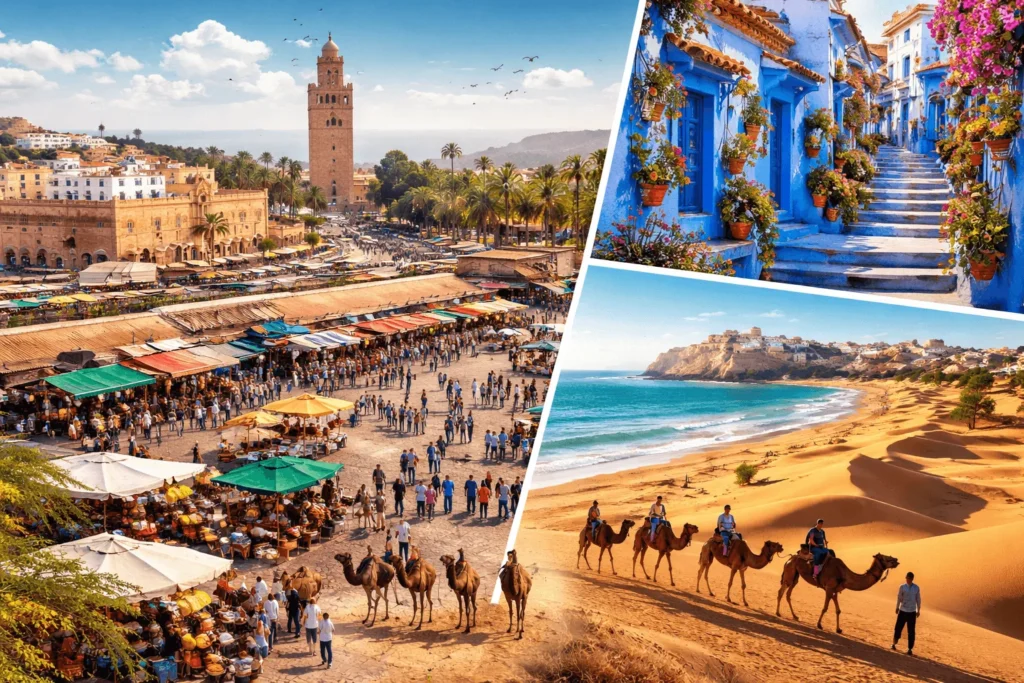
Morocco is not a country you simply visit. From the labyrinthine lanes of thousand-year-old medinas to the silence of the Sahara, from the snow on the Atlas peaks to beaches rocked by the Atlantic, the kingdom offers a range of experiences so wide that the real question is not whether there is anything to do, but where to begin. This guide sorts that abundance into four decisions: which cities, which wild spaces, which stretch of coast, and how to string them together in the time you actually have.
In brief
- If you have one week and it is your first trip: Marrakech, one day in the Atlas, and either the desert or Essaouira. Trying to add Fes as well turns the week into a driving holiday.
- The four imperial cities — Marrakech, Fes, Meknes and Rabat — each served as a capital, and each shows a different face of the country. Marrakech is the loudest, Fes the oldest and most intact.
- The single most memorable night for most travellers is a camp in the Sahara, at Erg Chebbi near Merzouga or Erg Chigaga near M’Hamid.
- The best months are April to May and September to October. Summer is punishing inland and perfect on the Atlantic coast; winter is mild in the cities and genuinely cold at night in the desert and the mountains.
- Trains are excellent between the northern and western cities, and useless for the south. For the mountains, the valleys and the coast, you want a car or a driver.
- Dress modestly outside the beach resorts, shoulders and knees covered, and expect to bargain in the souks as a matter of ordinary courtesy rather than conflict.
- Carry cash. Cards work in city hotels and restaurants; souks, small shops and taxis do not take them.
Which region suits which traveller
Before picking places, it helps to pick a register. Morocco rewards travellers who choose a dominant note and let the rest be seasoning, because the distances are real: Marrakech to Merzouga is a long day on the road, and Marrakech to Fes is another.
| If you want | Go to | Minimum time | Watch out for |
|---|---|---|---|
| Cultural immersion and craft | Fes, then Marrakech | 3 days each | Fes is harder to navigate; a licensed guide pays for itself |
| A first taste of everything | Marrakech plus one day trip | 4 days | Resist adding a second city |
| Desert and big landscapes | Ouarzazate, the gorges, Merzouga | 3 days from Marrakech | Cold nights; book the camp, not just the transport |
| Hiking and mountain villages | Imlil, Ait Bougmez, the M’Goun | 2 to 4 days | Altitude; a local guide is the norm, not a luxury |
| Surf and a slower pace | Taghazout, Imsouane, Essaouira | 4 days | The Atlantic is cold year round |
| Family beach holiday | Agadir | 5 days | Modern resort, little historic depth |
| Photography and quiet | Chefchaouen | 2 days | Remote from the main airports |
The imperial cities: the soul of the kingdom
Morocco’s great cities are the keepers of its history. Each was a capital at some point, and each reveals a different face of the culture, between creative energy, deep spirituality and living tradition.
Marrakech, the electric red city
Marrakech is often the emotional gateway to the country: a city that never sleeps, where past and present intertwine in the most spectacular way. Its beating heart is Jemaa el-Fna, a square that transforms twice a day. By day it is a busy market of orange-juice stalls and snake charmers; after dark it becomes an enormous open-air restaurant, filled with the smoke of grills and the noise of storytellers and musicians. Experience it at least once at sunset, when the Koutoubia minaret stands against an orange sky.
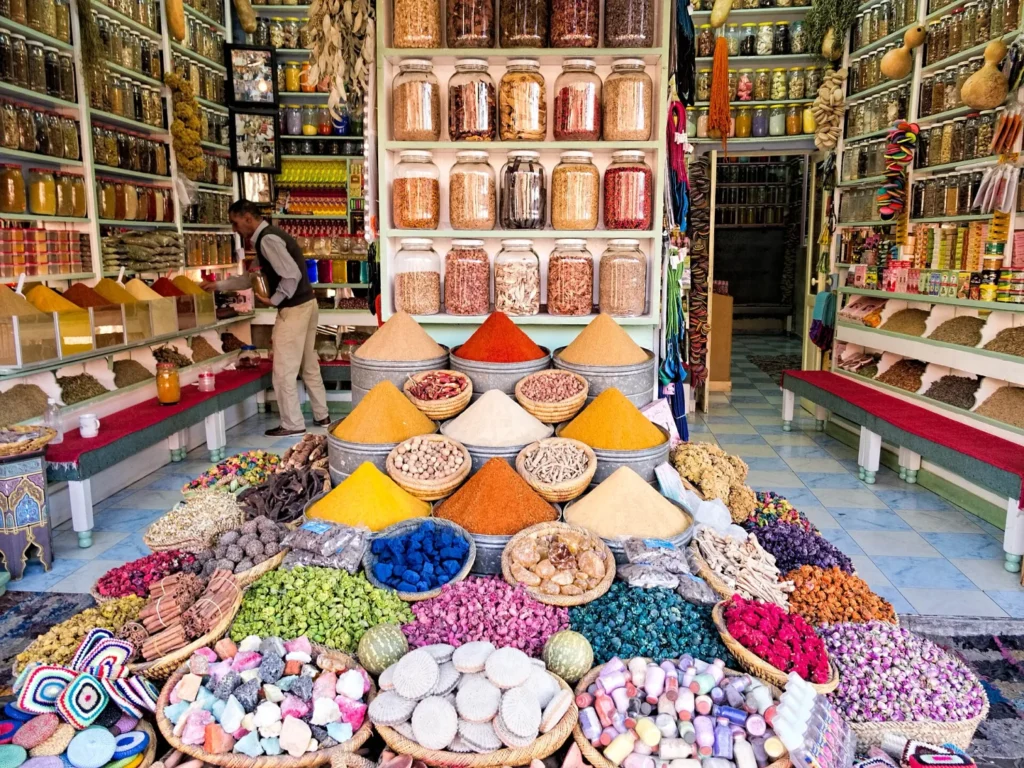
Then get lost in the souks, a warren of covered lanes where the air carries leather, spice and sandalwood. For a pause, the Majorelle Garden offers cobalt blue and dense planting as an oasis of calm, while the Bahia Palace and the Saadian Tombs testify to the splendour of Islamic art. To escape the crowds, explore the Kasbah quarter at dawn, and end the day in a traditional hammam followed by mint tea on a riad terrace. Our full list is in our guide to things to do in Marrakech, and the old city itself is mapped in our guide to the Marrakech medina.
Fes, a journey back in time
If Marrakech is the heart, Fes is the spiritual and intellectual soul. Its medina, Fes el-Bali, is the largest in the world and a UNESCO World Heritage site: a preserved medieval city where you move on foot or by donkey and craft still rules. Here getting lost is the point. The souks are organised by trade — dyers, weavers, blacksmiths — and the most striking discovery remains the Chouara tanneries, whose dye pits are viewed from the terraces of the surrounding leather shops, an intense and fascinating sight that illustrates methods unchanged for centuries.
Do not miss the Bou Inania madrasa, a fourteenth-century Koranic school and a masterpiece of Marinid architecture with finely carved stucco, zellige mosaic and sculpted cedar. Fes is also home to the Al Quaraouiyine university, founded in 859 and recognised as the oldest continuously operating university in the world. One piece of advice carries more weight here than anywhere else in Morocco: hiring a licensed local guide for a few hours will not only keep you from losing hours in the maze, it will open workshop doors you would never find. See our guides to things to do in Fes and to the Fes el-Bali medina.
Chefchaouen, the blue pearl of the Rif
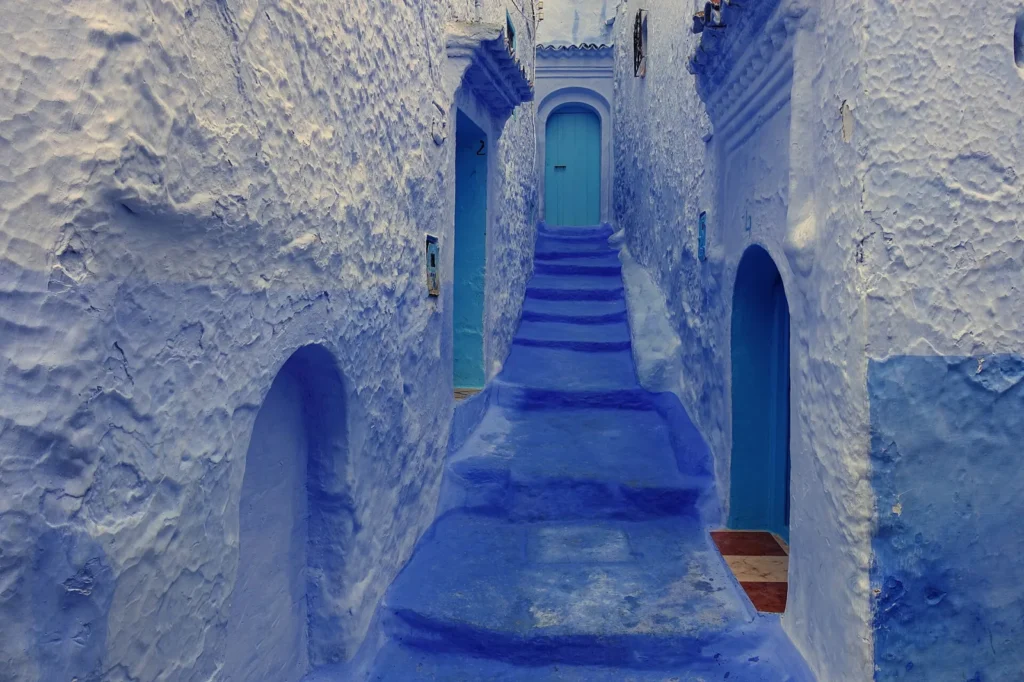
Tucked into the Rif mountains, Chefchaouen is a haven of calm that looks like a living postcard: every house, door and lane in its medina is painted in some shade of blue. The main activity is to drift. Wander the blue lanes with no destination, find small squares, and take time over a coffee or a mint tea on one of the terraces looking out at the mountains. It is a paradise for photographers, above all early in the morning when the light is soft and the crowds have not yet arrived.
Chefchaouen is also a good base for walking. A short taxi ride reaches Akchour, a spectacular hiking area with cool waterfalls and a natural rock arch known as the Bridge of God, while Talassemtane National Park offers trails through cedar forest and mountain scenery. Our guide to things to do in Chefchaouen covers both the town and the walks, and getting there from Fes airport is a separate practical question worth reading first.
Casablanca, Essaouira and Rabat
Casablanca is the economic capital, modern and busy, and its undisputed jewel is the Hassan II mosque, an architectural masterpiece with the tallest minaret in the world, built partly over the ocean. Essaouira is a fortified citadel on the Atlantic with a bohemian, unhurried air; its white and blue medina is UNESCO-listed and the trade winds have made the town Morocco’s kitesurfing and windsurfing capital. Rabat, the administrative capital, offers a gentle and elegant introduction to the country, between the blue-walled Kasbah of the Udayas, lush gardens and wide avenues.
The Atlas mountains: the roof of North Africa
Crossing the country like a spine, the Atlas is a paradise for walkers. It divides into the High Atlas, the Middle Atlas and the Anti-Atlas, each with its own character. For experienced hikers, the ascent of Mount Toubkal at 4,167 metres, the highest summit in North Africa, is the prize, usually done over two or three days with a guide; our guide to Imlil and Toubkal from Marrakech sets out the logistics. Gentler but equally fine treks are possible in the Ait Bougmez valley, known as the Happy Valley, or around the M’Goun massif.
From Marrakech, the Ourika valley is the most popular day trip, taking in mountain scenery, Berber villages clinging to the hillsides and waterfalls to cool off beneath. More impressive still are the Ouzoud falls, dropping 110 metres, where you can swim and watch Barbary macaques. What stays with most people, though, is not the scenery but the encounter: hospitality in the Atlas is a matter of course, and it is not unusual to be offered a glass of mint tea in an isolated village. Use local Amazigh guides where you can, and visit with that in mind.
The Moroccan Sahara: the night that stays with you
A night under the desert stars is often the high point of a trip to Morocco, mixing complete change of scene, deep calm and moments of unusual closeness. The two most famous dune seas, or ergs, are Erg Chebbi near Merzouga and Erg Chigaga further south near M’Hamid. Erg Chebbi is the more accessible and has the taller dunes, up to about 150 metres; Erg Chigaga is wilder and more isolated and needs a longer run in a four-wheel drive. The route options are compared in our guide to the Sahara desert from Marrakech.
The standard experience includes a camel ride at sunset to reach a nomad camp. After a tagine cooked over embers, the evening continues around a fire, often with music and singing, and the night is spent in a comfortable tent or under the open sky before an early start for sunrise over the dunes. If your time is short, the Agafay desert is less than an hour from Marrakech and offers a landscape of stone rather than sand which, while different, gives a real sense of space and allows a night under canvas.
The southern gorges and valleys: the road is the destination
The road to the desert is a spectacle in itself. Once over the Atlas passes you enter a world of ochre and grand geology. Near Tinghir, the walls of the Todgha gorge rise more than 300 metres in pink limestone, forming a narrow and imposing corridor popular with climbers and walkers. The Dades gorge and the so-called Route of a Thousand Kasbahs offer some of the finest panoramas in the country: between Boumalne Dades and the gorge the road winds along the valley past rock formations nicknamed the monkey fingers, through a landscape of rammed-earth fortresses that record the region’s caravan past.
The archetype of that architecture is Ait Benhaddou, a UNESCO-listed fortified village whose ochre walls stand over the valley like a film set, which it has often been, for Gladiator and for Game of Thrones among others. Visit it late in the afternoon for the light. It is a compulsory stop on any southern loop, and it pairs naturally with Ouarzazate as an overnight halt.
The Atlantic coast: surf, wind and fishing ports
With more than 3,500 kilometres of Atlantic coastline, Morocco has a varied shore running from modern resorts to unchanged fishing villages by way of world-class surf. North of Agadir, Taghazout and Tamraght are the beating heart of the Moroccan surf scene, drawing surfers from everywhere to breaks such as Anchor Point and Killer Point, with a relaxed international feel, surf schools, cafés and friendly hostels. It is the right place to learn. Further north, the small fishing village of Imsouane has become prized for its bay, a long right-hander made for longboards, with an even quieter and more authentic air.
Agadir, rebuilt after an earthquake, is a modern seaside resort: a long gently shelving beach of fine sand, a landscaped seafront and large all-inclusive hotels make it a natural choice for family holidays, though it offers less historic depth. Essaouira deserves its own category: enclosed within eighteenth-century ramparts, its UNESCO-listed medina has a unique atmosphere of history, art and permanent trade winds. People come for the board sports, to wander lanes of thuya-wood workshops, to eat grilled fish at the port auction, and in June for the Gnaoua and World Music Festival, which turns the town into one vast stage.
For travellers after raw landscape, the coast south of Essaouira reveals immense empty beaches. The Plage Blanche, and the area around Sidi Ifni and Mirleft, offer wild panoramas and absolute quiet, perfect for long walks. Further south again, Dakhla sits on a peninsula between the ocean and a vast lagoon and has become a kitesurfing mecca thanks to near year-round wind.
Sample itineraries that actually work
Faced with this much choice, structure matters more than ambition. The three routes below are built around driving times rather than wish lists.
| Itinerary | Route | Suits |
|---|---|---|
| One week, classic discovery | Marrakech (3 nights), a day in the Atlas, road to Ouarzazate (1 night) over the Tizi n’Tichka pass and Ait Benhaddou, then Merzouga (1 night) for the desert, returning through the Todgha and Dades gorges | A first trip, if you accept an intense pace |
| One week, coast and city | Marrakech (2 nights), Essaouira (2 nights), then south to Taghazout (2 nights), flying home from Agadir | Travellers who want to slow down rather than cover ground |
| Two weeks, grand tour | Marrakech, Casablanca or Rabat, Chefchaouen, Fes, Meknes, back into the Atlas for a gentle trek, Ouarzazate and the desert, returning up the coast through Taghazout and Essaouira | A hire car, or trains combined with local guides |
One warning about the one-week classic loop: flying into Marrakech and out of Agadir, or vice versa, saves a long backtrack and often costs no more. Our overview of airports in Morocco shows which pairings are realistic.
Getting around
- Train. The ONCF network is comfortable, punctual and cheap for linking the northern and western cities: Casablanca, Rabat, Fes, Tangier and Marrakech. It does not reach the south.
- Hire car. The most flexible way to explore the mountains, the south and the coast at your own pace. Prefer a small four-wheel drive or an SUV for mountain roads and tracks, and stay alert to local driving, which is not always predictable.
- Grands taxis. For short intercity hops or villages the train does not serve, these shared cars are an authentic and inexpensive option. Agree the fare before you set off.
- Long-distance buses. CTM and Supratours are reliable and comfortable over long distances, and often the sensible choice when you do not want to drive a mountain pass.
Our dedicated guide to getting around Morocco compares these in detail, and our comparison of airport transfers covers the first and last hour of the trip, which is where most plans go wrong.
When to go
| Season | What it is like | Best for |
|---|---|---|
| Spring, April to May | Pleasant everywhere, neither too hot in the desert nor too cold in the mountains | The ideal window for a mixed itinerary |
| Summer, June to August | Very hot in Marrakech and the desert, often above 40 °C inland | The Atlantic coast and the Atlas, which become refuges |
| Autumn, September to October | The second ideal window, with warm seas and thinning crowds | Everything, including the desert |
| Winter, December to February | Sunny mild days in the cities and on the coast, very cold nights in the desert and the mountains, with snow on the peaks | Skiing at Oukaimeden, city breaks, avoiding crowds |
Month by month, our guide to the best time to visit Morocco breaks this down further, including how school holidays in Europe move prices.
Cultural and practical advice
What to wear. Dress modestly outside the large beach resorts: cover shoulders and knees, particularly when visiting places of worship or traditional quarters. Light trousers and a long-sleeved shirt also protect you from a sun that stays strong well into autumn. Our Morocco packing list is built around layers rather than quantity.
Money and bargaining. The currency is the Moroccan dirham, which cannot be bought freely outside the country. Cards are accepted in city hotels and restaurants, but carry cash for souks, small shops and taxis. In the souks, bargaining is an expected and courteous part of the transaction: treat it as an exchange, not a confrontation. Rates, withdrawals and tipping are set out in our guide to money in Morocco.
Safety and unofficial guides. Morocco is a safe country for travellers. The main nuisance is commercial pressure from unofficial guides and insistent sellers, and a firm, polite refusal is usually enough. For guided visits, always use licensed guides recommended by your accommodation or a tourist office. Entry conditions depend on your nationality and are detailed in our guide to visa and entry requirements.
Frequently asked questions
How many days do you need in Morocco?
Four days is enough for Marrakech and one day trip. Seven days lets you add either the desert or the coast, but not both comfortably. Ten to fourteen days is what it takes to combine an imperial city, a southern valley and the Atlantic without spending the holiday in a car. The distances are the constraint, not the opening hours.
Marrakech or Fes for a first visit?
Marrakech, in most cases. It has far more direct flights, more day trips within reach, and an easier medina to find your way around. Fes is the richer and more intact city, but it asks more of you: the medina is the largest in the world, and a licensed guide makes the difference between a frustrating day and a memorable one.
Is one night in the Sahara worth the drive?
From Marrakech, Merzouga is a long day each way, so a single night means roughly twenty hours of driving for fourteen hours on site. Most people say yes anyway. If that arithmetic does not appeal, the Agafay desert is under an hour from Marrakech and gives you a camp, a fire and a sunrise, in a landscape of stone rather than dunes.
Can you swim in the Atlantic in Morocco?
Yes, though the water stays cool all year because the Canary Current brings cold water to the surface along the coast. Agadir and the Souss coast are the most comfortable; Essaouira is colder and windier, which is exactly what makes it a board-sports town rather than a swimming one. A wetsuit is normal for surfing in any season.
Do you need a car in Morocco?
Not for the cities, where a car is a liability: medinas are closed to traffic and parking around the gates is awkward. You want one for the Atlas, the southern valleys and the coast. A good compromise is to visit the cities without a car and collect a vehicle on the day you head out of town.
Is Morocco suitable for a family trip?
Yes, and children are welcomed warmly almost everywhere. Agadir is the easiest base for a beach holiday, Marrakech works well with a riad and a pool for the middle of the day, and a short desert night at Agafay is usually a bigger hit than a long run to Merzouga. The two things to plan around are heat in summer and the pace of medina walking.
In summary
Morocco is not a destination you tick off a list. It takes you by the hand in the noise of its squares, whispers its secrets in the silence of its deserts, offers the generous hospitality of its mountains and rocks you to the rhythm of its Atlantic waves. Whether you follow a classic circuit or strike off the beaten track, the essential thing is to travel with curiosity, respect and a willingness to be surprised. Pick one dominant note — a city, a desert, a coast — give it the time it deserves, and let the rest be seasoning. The best souvenir will not fit in your suitcase.
Sources
- UNESCO World Heritage Centre, Morocco, for the listed medinas and the ksar of Ait Benhaddou.
- Moroccan National Tourist Office and ONCF for the rail network.
- ONDA, Office National Des Aéroports, for airport information.
Informational guide, reviewed in November 2026. Opening hours, fares, flight programmes and entry conditions change: check them with the official sources cited, with your airline and locally before you travel. This guide is independent and not affiliated with ONDA, ONCF, any airline or any tourist board.